
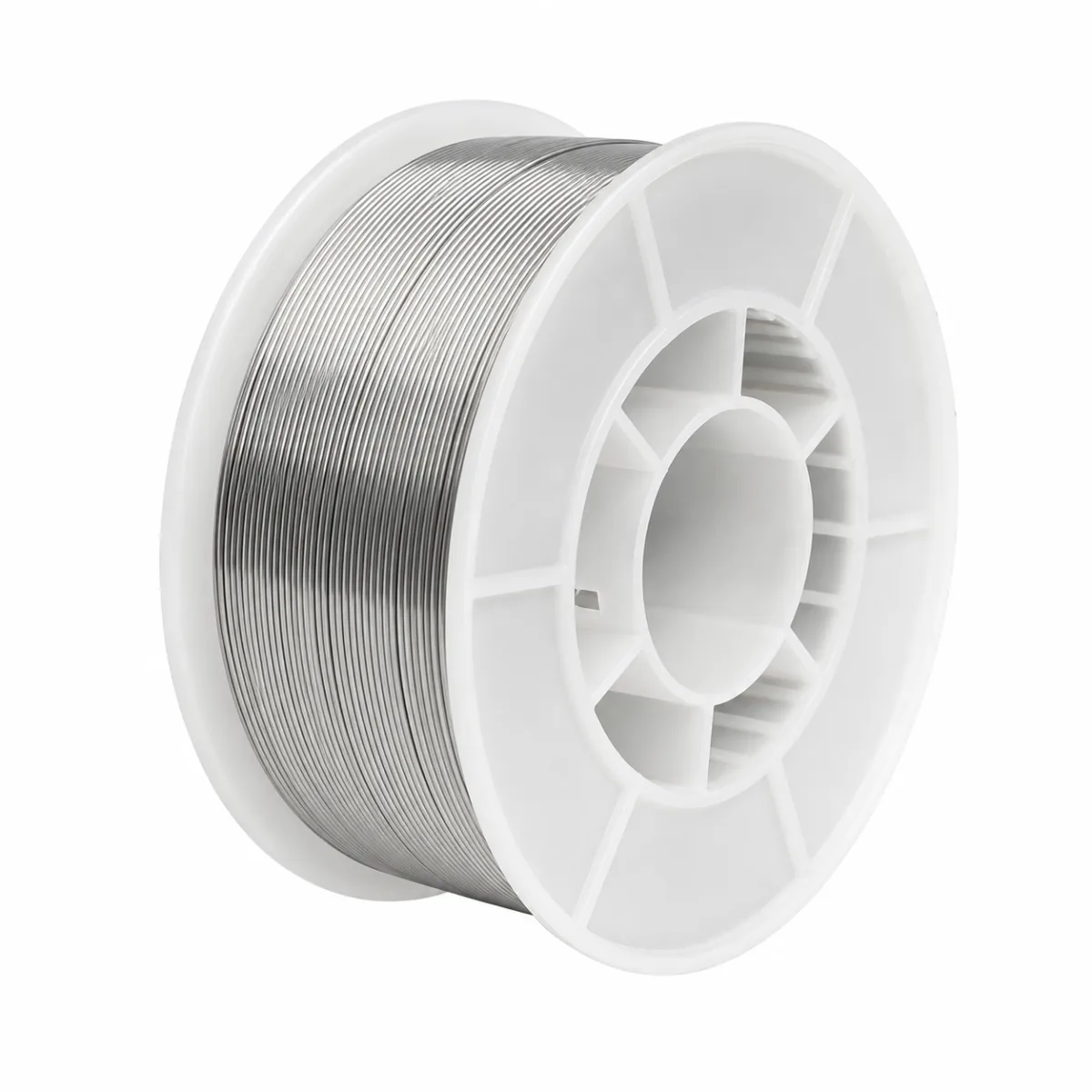
Titanium welding wire is a filler metal used to join titanium by gas tungsten arc welding (GTAW or TIG) and gas metal arc welding (GMAW or MIG). AWS A5.16/A5.16M classifies titanium and titanium-alloy electrodes and rods primarily by electrode chemical composition and also addresses general requirements, testing, packaging and application guidance. This guide explains common ERTi classifications, how filler selection relates to the base metal and qualified welding procedure, the supply forms to define in an RFQ, and the process controls that affect weld acceptance.
How to select an AWS A5.16 ERTi classification
Filler selection must follow the engineering design and the qualified welding procedure specification (WPS), supported by the applicable procedure qualification record (PQR). Matching the nominal alloy family is a starting point, not the complete acceptance rule.
| Filler classification | Nominal alloy family | Typical selection context, subject to WPS/PQR |
|---|---|---|
| ERTi-1 / ERTi-2 / ERTi-3 / ERTi-4 | Commercially pure titanium classifications | Commercially pure titanium base materials |
| ERTi-5 | Ti-6Al-4V | Grade 5 alloy applications |
| ERTi-7 | Ti-0.15Pd | Grade 7 corrosion-service applications |
| ERTi-9 | Ti-3Al-2.5V | Grade 9 alloy applications |
| ERTi-12 | Ti-0.3Mo-0.8Ni | Grade 12 corrosion-service applications |
| ERTi-23 | Ti-6Al-4V ELI | ELI applications when required by the design and welding procedure |
ERTi-2 is a commonly specified commercially pure titanium filler classification. Confirm it against the base material, service, joint design and WPS/PQR. A tensile minimum taken from a base-material product specification must not be presented as the AWS filler classification basis.
AWS A5.16 welding filler vs ASTM B863 general wire
Two different specifications are often confused on enquiries. AWS A5.16/A5.16M covers titanium welding electrodes and rods. ASTM B863 covers titanium and titanium-alloy wire for general applications. State the intended use and governing specification because the same nominal diameter does not make general wire an accepted welding filler.
| Specification | What it covers |
|---|---|
| AWS A5.16/A5.16M | Titanium welding electrodes and rods |
| ASTM B863 | Titanium and titanium-alloy wire for general applications |
What form and dimensions belong in the RFQ?
State whether the process needs straight cut rods or spooled wire, then provide the ERTi classification, diameter, cut length or spool requirement, quantity, surface and cleanliness requirements, packaging, and document scope. Beiyu confirms the quoted diameter, length, spool configuration and packing route for the selected classification before order release rather than treating one fixed range as universal.
Which welding controls affect titanium acceptance?
Titanium welding requires joint preparation, filler handling and inert-gas shielding that follow the qualified WPS. Keep the joint and filler free of contamination, protect the weld root where required, and maintain shielding over the weld and heat-affected zone for the duration stated by the procedure. Discoloration can indicate a shielding problem, but weld color alone is not a complete mechanical or code acceptance test. Apply the acceptance criteria in the governing WPS, fabrication code and project specification.
Common application contexts
ERTi-2 is commonly considered for commercially pure titanium fabrication such as tube, tube-to-tubesheet and process-equipment joints when the qualified procedure selects that classification. ERTi-5 serves Ti-6Al-4V alloy applications when the design and WPS require matching alloy filler. ERTi-7, ERTi-12 and ERTi-23 address their respective alloy families and service requirements, subject to engineering and procedure qualification.
| Classification | Application context the guide gives |
|---|---|
| ERTi-2 | Commonly considered for commercially pure titanium fabrication such as tube, tube-to-tubesheet and process equipment joints when the qualified procedure selects that classification |
| ERTi-5 | Serves Ti-6Al-4V alloy applications when the design and welding procedure require matching alloy filler |
| ERTi-7, ERTi-12 and ERTi-23 | Address their respective alloy families and service requirements, subject to engineering and procedure qualification |
What to put on a titanium welding wire RFQ
State the ERTi classification, base material, welding process, governing filler specification, diameter, form, cut length or spool requirement, quantity, surface and cleanliness requirements, packaging, and certificate or traceability scope. Required MTC, EN 10204 3.1 and heat or lot traceability fields must be stated in the RFQ and confirmed in the quotation and purchase order.
| Field to state on a welding wire RFQ | Detail |
|---|---|
| Classification | The ERTi classification |
| Base material and process | The base material and the welding process |
| Governing specification | The governing filler specification |
| Form and dimensions | Diameter, form, and cut length or spool requirement |
| Quantity | The order quantity |
| Surface and packaging | Surface and cleanliness requirements, and packaging |
| Certificate and traceability | Required mill test certificate, EN 10204 3.1 and heat or lot traceability fields, stated in the RFQ and confirmed in the quotation and purchase order |
Review TIG and MIG filler forms on the titanium welding wire and ERTi filler product page. For broader wire routes, browse the titanium wire category, compare alloys in the titanium grades comparison guide, and review tube options for welded assemblies on the titanium tube and pipe category. Send the base material, ERTi class, diameter, form, quantity and document requirements to [email protected] for quotation review.
Titanium wire: weight per metre and metres per kilogram
Filler wire is bought by weight and consumed by length, so the number a welding engineer actually needs is metres per kilogram. The table gives both directions across the full drawn range, from 0.1 mm fine wire through the diameters used in TIG and MIG work, in commercially pure and Ti-6Al-4V material.
| Diameter (mm) | Grade 2 / ERTi-2 | Grade 5 / ERTi-5 | ||
|---|---|---|---|---|
| kg/m | m/kg | kg/m | m/kg | |
| 0.1 | 0.000035 | 28,231 | 0.000035 | 28,741 |
| 0.15 | 0.00008 | 12,547 | 0.00008 | 12,774 |
| 0.2 | 0.00014 | 7,058 | 0.00014 | 7,185 |
| 0.3 | 0.00032 | 3,137 | 0.00031 | 3,193 |
| 0.4 | 0.00057 | 1,764 | 0.00056 | 1,796 |
| 0.5 | 0.00089 | 1,129 | 0.00087 | 1,150 |
| 0.6 | 0.0013 | 784 | 0.0013 | 798 |
| 0.8 | 0.0023 | 441 | 0.0022 | 449 |
| 0.9 | 0.0029 | 349 | 0.0028 | 355 |
| 1.0 | 0.0035 | 282 | 0.0035 | 287 |
| 1.2 | 0.0051 | 196 | 0.0050 | 200 |
| 1.6 | 0.0091 | 110 | 0.0089 | 112 |
| 2.0 | 0.0142 | 71 | 0.0139 | 72 |
| 2.4 | 0.0204 | 49 | 0.0200 | 50 |
| 3.0 | 0.0319 | 31 | 0.0313 | 32 |
| 3.2 | 0.0363 | 28 | 0.0356 | 28 |
| 4.0 | 0.0567 | 18 | 0.0557 | 18 |
| 5.0 | 0.0886 | 11 | 0.0870 | 11 |
| 6.0 | 0.1275 | 8 | 0.1253 | 8 |
Both columns come from the same cross-section: W (kg/m) = π × d² × ρ ÷ 4000, and metres per kilogram is its reciprocal. The densities are 4.51 g/cm³ for commercially pure titanium and 4.43 g/cm³ for Ti-6Al-4V.
The practical use is estimating a job rather than pricing one. A run of weld consumes a length of filler that depends on joint preparation, technique and deposition rate rather than on wire diameter alone, so these figures convert a length estimate into a purchase weight, not the other way round. Cut-length TIG rods are usually supplied in 1,000 mm lengths, which makes the arithmetic direct: at 1.6 mm in commercially pure titanium a kilogram is roughly 110 rods. At the fine end the numbers turn the other way round, and a kilogram of 0.1 mm wire runs to about 28 kilometres, which is why fine wire is bought by weight and planned by spool.
Spooled wire carries one more variable. Spool weight is nominal, and the usable length on a partly run spool is unknown without weighing it, so continuous processes are normally planned on spool count with a margin rather than on calculated metres. Diameters between the rows, and the nickel and zirconium filler grades, are covered by the titanium weight calculator.
Specification detail with sources
The filler document itself carries 2 designations worth quoting exactly: the 2013 edition is published as AWS A5.16/A5.16M:2013 (ISO 24034:2010 MOD), a modified adoption of the international filler standard, and ASME republishes the same text in Section II Part C as SFA-5.16. A code fabricator’s SFA-5.16 callout and a welding engineer’s AWS A5.16 callout therefore resolve to one classification set, which is why the RFQ should quote the designation and edition the WPS was qualified against.
Beiyu’s factory sheet pairs its drawn wire grades with 7 ERTi classifications, ERTi-1, ERTi-2, ERTi-4, ERTi-5, ERTi-7, ERTi-9 and ERTi-12, each released with heat chemistry checked at one of 2 designated laboratories. In the welding-wire RFQs Beiyu has reviewed over 15 years of titanium export work, the field most often missing is the base-metal grade written next to the ERTi class; adding that one line lets Beiyu cross-check the classification against the base material before quotation instead of after.