
Annealed titanium bar is the default for machining and for most medical and chemical specifications, because properties repeat heat to heat. Solution treated and aged bar raises strength, typically to around 1,100 MPa in Grade 5 against roughly 895 MPa annealed, at the cost of ductility and machinability.
Grade and standard tell a supplier what the titanium is. They don’t tell the shop how it will behave on the lathe or how strong the finished part will be: that’s set by the condition. Two bars of identical Ti-6Al-4V to the same ASTM B348 line can differ by 250 MPa in yield strength depending only on how they were heat-treated. Leaving “condition” off a purchase order is one of the most common ways a titanium order arrives technically correct but wrong for the job.
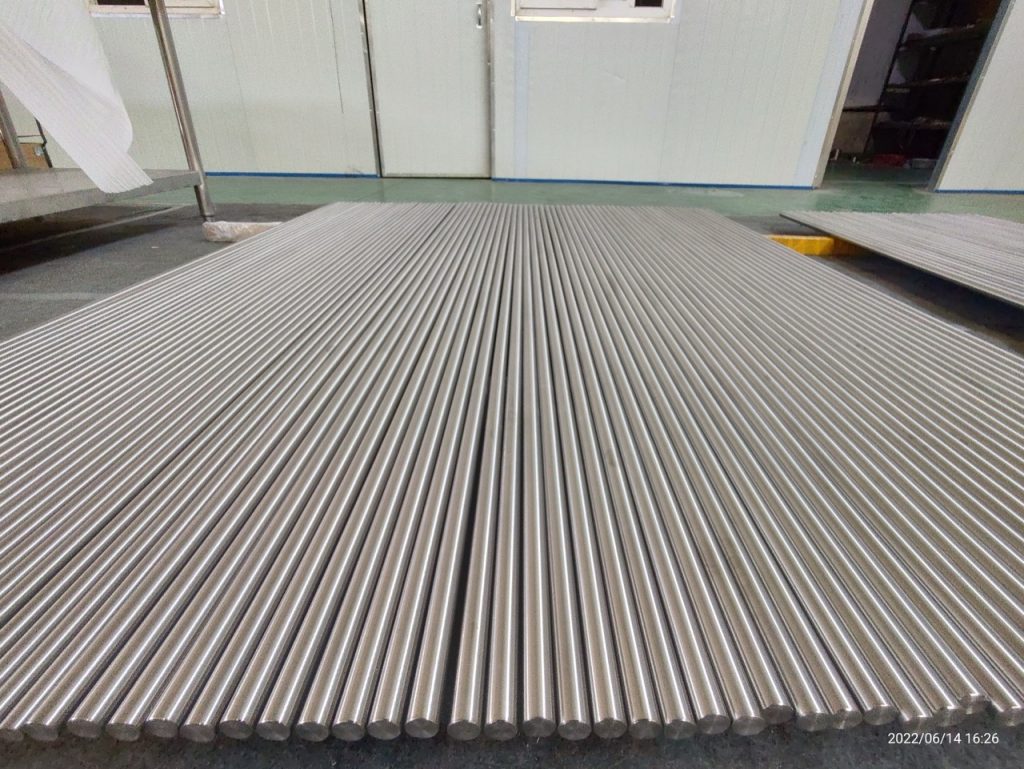
Heat-treat condition: annealed vs solution-treated-and-aged
For Ti-6Al-4V (Grade 5) the two conditions you’ll specify most are annealed and solution-treated-and-aged (STA).
| Property (typical Ti-6Al-4V) | Annealed | Solution-treated & aged (STA) |
|---|---|---|
| Yield strength | ~828 to 895 MPa (120 to 130 ksi) | ~1100 to 1170 MPa (160 to 170 ksi) |
| Ductility / toughness | Higher | Lower |
| Machinability | More predictable, gummier | Harder, more abrasive on tools |
| Weldability | Preferred | Possible, but ageing response in the weld changes |
| Section-size limit | Any size | Limited; thick sections don’t fully through-harden |
| Typical use | General structural, machined parts, welded assemblies | High-strength fittings, fasteners, small/medium sections |
Annealed is the default workhorse: more ductile, more forgiving to weld, and the condition you want for most machined and fabricated parts (see why in machining Ti-6Al-4V). STA buys roughly 30% more strength, but you pay for it in ductility, machinability and a real limit on section thickness, the alloy’s hardenability means a large-diameter bar won’t age uniformly to centre. Commercially pure grades (1 to 4) are single-phase and aren’t strengthened this way; they’re supplied annealed.
Surface and dimensional condition, the other half of the spec
“Condition” also covers how the bar’s surface and size were finished. This decides whether you can chuck it and cut, or have to clean and true it first.
| Supplied condition | What the guide states |
|---|---|
| As-forged / as-rolled | mill scale, an oxygen-enriched alpha case, loose tolerance and a machining allowance. Cheapest stock, most prep. |
| Pickled | scale and alpha case chemically removed; clean surface, ready to machine. |
| Turned / peeled | cleaned-up diameter, scale gone, better roundness. |
| Centreless ground / cold-finished | tight diameter tolerance and a smooth surface, for parts machined close to bar size or used as-is. Most expensive, least prep. |
What to actually put on the PO
| Field to state | What the guide states |
|---|---|
| Grade + standard | e.g. Ti-6Al-4V, ASTM B348 (or AMS 4928 for the aerospace bar spec). |
| Heat-treat condition | annealed or STA. Don’t leave it blank; “annealed” if you’re unsure. |
| Surface condition | pickled, turned or ground, and whether alpha case must be removed. |
| Diameter tolerance + straightness | tighter costs more; match it to the machining route: all-over machining or near-net. |
| Testing | mill test certificate with heat traceability, and ultrasonic inspection if your spec requires it. |
We supply Ti-6Al-4V (Grade 5) bar and AMS 4928 bar in annealed or STA condition, pickled, turned or ground to your tolerance, with the mill test certificate. For grade selection across the range, see the grades comparison guide and the ASTM B348 bar guide; then send condition, surface and tolerance with your Send an enquiry.
FAQ
If I don't specify a condition, what do I get?
Usually mill-annealed at a loose surface and tolerance; fine for general machining, but a poor fit if you needed STA strength or a ground bar. Always state the condition.
Can any Ti-6Al-4V bar be solution-treated and aged?
It can be aged, but large sections won’t through-harden uniformly because of limited hardenability, so the strength gain isn’t reliable in thick bar. STA is most effective in small and medium diameters.
Is annealed titanium weak?
No. Annealed Ti-6Al-4V still yields around 830 to 895 MPa, comparable to many high-strength steels at far lower weight. STA is simply a higher-strength, lower-ductility option when you need it.
Do commercially pure grades come in STA?
No. CP titanium (Grades 1 to 4) is single-phase alpha and isn’t age-hardenable; it’s supplied annealed. Strength there is set by grade (oxygen content), not heat treatment.
Specification detail with sources
Annealed Grade 5 bar to ASTM B348 must meet a minimum ultimate tensile strength of 895 MPa and a minimum 0.2% yield strength of 828 MPa (ASTM B348, mechanical requirements). These are floor values for the annealed condition; STA exists to move properties meaningfully above them.
| Requirement for annealed Grade 5 bar | Minimum per ASTM B348 |
|---|---|
| Ultimate tensile strength | 895 MPa |
| 0.2 percent yield strength | 828 MPa |
STA is a section size limited option: ASM Handbook, Volume 4 (Heat Treating of Titanium and Titanium Alloys) puts the practical through hardening limit of Ti-6Al-4V at about 25 mm (1 in.) of section thickness, so large diameter bar cannot develop full STA properties at the core regardless of furnace practice.
Send a technical RFQ
For titanium bar RFQs, include grade, ASTM or AMS standard, diameter, condition, surface finish, tolerance, quantity and required mill test certificate.
Reference sources
- ASTM B348 / B348M, Standard Specification for Titanium and Titanium Alloy Bars and Billets
- AMS 4928, Titanium Alloy Bars, Wire, Forgings and Rings, 6Al-4V, Annealed
- AMS 4967, Titanium Alloy Bars, Wire, Forgings and Rings, 6Al-4V, Solution Heat Treated and Aged
- ASM Handbook, Volume 4E, Heat Treating of Nonferrous Alloys
- ASTM E8 / E8M, Standard Test Methods for Tension Testing of Metallic Materials