
Titanium welding wire is selected by matching the ERTi filler classification to the base metal grade, and the single thing that decides weld quality is keeping oxygen, nitrogen and hydrogen out of the molten and cooling weld. Use ERTi-2 for commercially pure titanium, ERTi-5 for Ti-6Al-4V, ERTi-7 for Grade 7, and so on, all to AWS A5.16. Shield the weld pool, the root and the cooling weld with argon, and read the weld colour: bright silver is clean, straw and blue mean some contamination, grey and white powder mean a brittle, rejectable weld. Match the filler, control the gas, check the colour.
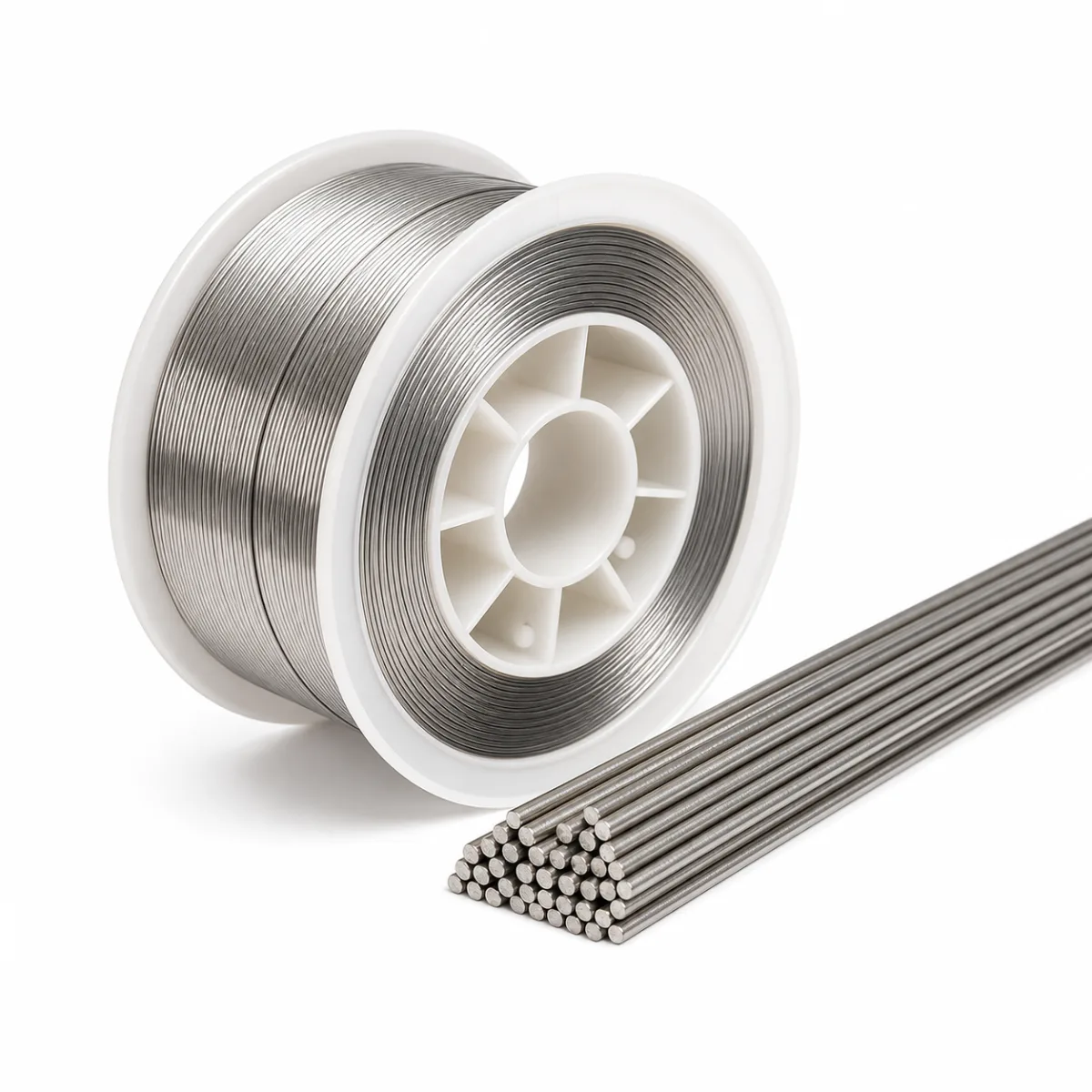
Beiyu Titanium supplies titanium welding wire and filler rod in ERTi grades to AWS A5.16 with EN 10204 3.1 mill test certificates.
A titanium weld that picks up gas looks acceptable but is brittle, and the failure shows up later as cracking in service. That is why titanium welding is judged on contamination control, not on bead appearance alone. This guide covers how to pick the filler, why contamination is the real problem, how to read the weld, and what to check when the wire arrives.
ERTi filler selection
Match the filler classification to the base metal. The AWS A5.16 ERTi classifications map to the common titanium grades:
| Base metal | Filler (AWS A5.16) | Notes |
|---|---|---|
| CP titanium Grade 1 | ERTi-1 | Lowest strength, highest purity |
| CP titanium Grade 2 | ERTi-2 | The common corrosion grade |
| CP titanium Grade 3 | ERTi-3 | Higher strength CP |
| Ti-6Al-4V Grade 5 | ERTi-5 | The structural alloy filler |
| Grade 7 (Ti-0.15Pd) | ERTi-7 | Palladium grade for reducing acids |
| Grade 9 (Ti-3Al-2.5V) | ERTi-9 | Mid-strength tube alloy |
| Grade 12 (Ti-0.3Mo-0.8Ni) | ERTi-12 | Hot-chloride crevice grade |
The general rule is to match the filler to the base metal grade. In some corrosion fabrications a CP filler such as ERTi-2 is used on a CP base for best corrosion behaviour, and for dissimilar joints the filler is chosen for the controlling requirement. State the base metal grade on the order so the matching filler is supplied.
Contamination is the main problem
Titanium is reactive at welding temperature. Above roughly 500 C it absorbs oxygen, nitrogen and hydrogen from air, and these interstitials dissolve into the weld and embrittle it. The weld can look sound and still fail, because the damage is in the chemistry, not the shape. Controlling contamination means:
| Point | What the guide states |
|---|---|
| Cleanliness | Degrease the joint and the filler, and remove any oxide, oil or moisture before welding. Handle filler with clean gloves. |
| Inert shielding, all the way through | Argon shields the molten pool, but the weld and heat-affected zone keep absorbing gas until they cool below about 500 C, so the trailing weld and the root also need shielding. |
| No air access while hot | Back-purge the root, use trailing shields or a chamber for critical work, and do not break the gas shield until the metal has cooled. |
Shielding and titanium weld colour
The colour of a finished titanium weld is a direct, no-instrument indicator of how clean the shielding was:
| Point | What the guide states |
|---|---|
| Bright silver or light straw | clean, properly shielded weld. |
| Dark straw to blue | some contamination; acceptable in some codes, marginal in critical work. |
| Grey, or a white powdery surface | heavy oxygen pickup, brittle, reject and re-weld with better shielding. |
Weld colour is one of the fastest ways to judge a titanium weld on the shop floor, and many specifications set a maximum acceptable colour. If welds are coming out blue or grey, the shielding coverage or gas purity is the first thing to fix.
Receiving check for titanium filler wire
When titanium welding wire arrives, check before it goes near a weld:
| Point | What the guide states |
|---|---|
| Certificate | The EN 10204 3.1 mill test certificate should state the ERTi classification, heat or lot number, chemistry and mechanical properties. |
| Classification match | Confirm the ERTi grade matches what the procedure calls for. |
| Surface condition | The wire should be clean and bright, with no oxide discolouration, oil or handling contamination. Contaminated filler puts gas straight into the weld. |
| Packaging | Titanium filler should be packaged to stay clean and dry; reject wire that arrived contaminated or with broken packaging. |
FAQ
Which titanium filler do I use for Grade 2?
Use ERTi-2 to AWS A5.16 for commercially pure Grade 2 base metal. Match the filler classification to the base metal grade.
Why does a titanium weld turn blue or grey?
The colour comes from oxygen and nitrogen pickup during welding and cooling. Blue means some contamination; grey or white powder means heavy contamination and a brittle weld. The cause is inadequate gas shielding of the weld, root or cooling metal.
What standard covers titanium welding wire?
AWS A5.16 classifies titanium and titanium-alloy welding electrodes and rods by ERTi number. The classification is stated on the mill test certificate.
Can titanium be welded to steel?
Titanium cannot be reliably fusion-welded directly to steel because brittle intermetallics form. Dissimilar joints use other methods such as explosion-bonded transition joints, not direct titanium filler welding.
How Beiyu Titanium supplies titanium welding wire
Beiyu Titanium supplies titanium welding wire and filler rod in ERTi-1, ERTi-2, ERTi-5, ERTi-7, ERTi-9 and ERTi-12 to AWS A5.16, available by order scope. We review the filler requirement against the base metal, classification, wire or rod form, dimensions, packaging and the qualified welding procedure. Review the available ERTi forms on the titanium welding wire product page; the titanium wire category covers the broader non-filler wire range. If EN 10204 3.1 documentation and heat or lot traceability are required, state the requested results and traceability fields in the RFQ.
What the wire order has to state
Filler wire and product wire are bought with the same word and inspected against different documents. A spool of welding filler is classified by a welding filler metal specification, while wire supplied as a mill product is classified by a product specification. Naming only the grade leaves that choice open, and the choice decides which table a receiving laboratory compares the certificate against.
| Line on the order | What it settles | Common consequence of omitting it |
|---|---|---|
| Which specification governs | Whether the item is filler metal or a wire mill product | The certificate reports to a table the buyer is not checking |
| Grade with its UNS number | The composition limits the results are judged against | Grade names alone leave alloy variants adjacent |
| Diameter with tolerance | The dimensional acceptance, read against the diameter band | A drawing class arrives without the band it is read against |
| Supply form | Spool, coil or straight cut lengths | Packaging and handling are set by the mill default |
| Surface and cleanliness | The delivered condition, stated apart from the metallurgical condition | Two fields are answered as one |
| Reports required | The reporting scope on the certificate | A compliant document still answers less than expected |
The last row is the one most often left to the mill. Wire has its own governing documents, but the pattern is not unique to wire: the bar and billet specification ASTM B348 lists the reports required and the disposition of rejected material among the items an order is expected to carry (ASTM B348, ordering information). Neither is supplied by naming a grade, on any product form.
Specification detail with sources
AWS A5.16 and ASTM B863 describe the same wire from 2 directions: the AWS document classifies filler metal by ERTi number, the seven pairings tabled above, while the ASTM document covers titanium wire in the same grade system as bar and plate, Grade 2 at a 345 MPa minimum tensile strength against 895 MPa for Grade 5. For dissimilar titanium joints the filler follows the controlling corrosion or strength requirement rather than either base metal by default, which is why both documents leave that decision to the procedure rather than to a table.
Beiyu Titanium reviews an incoming welding-wire order against the six fields this page’s receiving checklist mirrors, base metal grade, ERTi classification, wire or rod form, dimensions, packaging and the qualified welding procedure. Across 15 years of Beiyu’s titanium export work the commonest selection slip seen is a structural ERTi-5 ordered for a corrosion fabrication that a matching CP filler serves better, so a Beiyu quotation restates the base grade next to the classification, and Beiyu releases wire in 3 forms with an EN 10204 3.1 certificate carrying heat or lot traceability.