
When a retail fixture is described as titanium, it usually does not mean the part is made of titanium. In most display cases, counters and shopfitting hardware, the word points to a thin titanium-based coating on stainless steel, applied to get a gold, rose, champagne or black color that resists scratching. Solid titanium does turn up in fixtures, but only where its weight or its corrosion behavior earns back the higher material cost. This article separates the two, so a buyer or a fabricator can specify the right one and price it correctly.
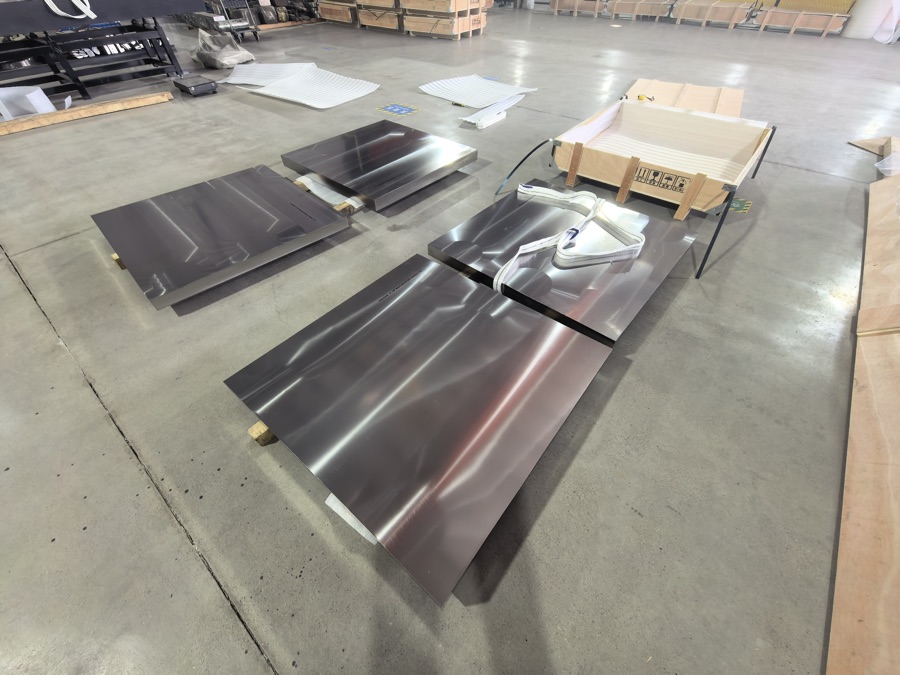
What a “titanium finish” usually is
The gold and dark tones sold as titanium are almost always PVD coatings. PVD, physical vapor deposition, bonds a hard ceramic layer a few microns thick onto stainless steel. The common chemistries are:
| Point |
|---|
| Titanium nitride (TiN): the original gold tone. |
| Titanium carbonitride (TiCN) and titanium aluminum nitride (TiAlN): bronze, grey and darker tones. |
| Zirconium nitride (ZrN): a paler, brass-like gold. |
Coating hardness sits around 2000 to 2500 HV, well above the stainless underneath, so it survives handling and cleaning on counters, frames and shelving brackets. The base metal is still stainless steel, which means the fixture’s strength, weight and price follow stainless, not titanium. Calling it titanium is shorthand for the look, not the material.
When fixtures use solid titanium
Solid titanium sheet or plate shows up in fixtures for reasons other than color:
| Point | What the guide states |
|---|---|
| Coastal and outdoor retail | Titanium does not pit or crevice-corrode in salt air and seawater spray, conditions where even 316 stainless needs upkeep. The reason is the passive oxide film that reforms instantly when scratched. |
| Weight | Titanium is about 40 percent lighter than steel for the same volume, which matters for large suspended panels, travelling show stands and pieces that staff move by hand. |
| Anodized color without a coating | Titanium can be anodized to blue, purple, gold and other interference colors by growing a controlled oxide film, with no dye and no separate layer to wear through. This is a different process from PVD and the color is part of the metal. |
| A material story | Some brands specify solid titanium for statement pieces where the metal itself is part of the message, and the cost is accepted as part of the design. |
For most indoor retail interiors none of these apply, and stainless with a PVD finish is the working choice. The solid-metal case is real but narrow.
PVD titanium finish against solid titanium
| PVD titanium finish on stainless | Solid titanium (Grade 1 / Grade 2) | |
|---|---|---|
| Color | Gold, rose, black, champagne by chemistry | Silver as rolled, or anodized interference colors |
| Corrosion | Good indoors; coating can wear at edges over years | Resists salt air and most chemicals, no coating to fail |
| Weight | Same as stainless | About 40 percent lighter than steel |
| Relative cost | Low to moderate | High; titanium sheet is roughly five to ten times the price of stainless |
| Repair | Re-coat the worn part | Refinish the surface; color sits in the oxide, not a film |
| Typical use | Indoor display hardware, frames, counters | Coastal, outdoor, weight-sensitive or luxury pieces |
How the fixture itself gets built
Material is one decision and the fixture is another. Custom retail fixtures, display cases and shopfitting are built to a brand’s drawings, with the finish, PVD or solid metal, chosen per piece. Shops that run this end to end, such as Elite Fixtures, coordinate the design and the factory production for retail display work, which is the stage where the substrate and the finish are specified together. Getting the material question settled before that stage keeps the quotation and the lead time stable.
If you do specify solid titanium
For the cases where solid titanium is the right call, a few points keep the order clean:
| Point | What the guide states |
|---|---|
| Grade | Grade 1 and Grade 2 commercially pure titanium cover most decorative and architectural sheet work. They form and anodize well and are the usual starting point. |
| Standard | ASTM B265 is the sheet and plate specification to state on the order. |
| Finish | Decide up front between as-rolled, polished, brushed or anodized, because anodizing color depends on the surface preparation underneath it. |
| Dimensions | Decorative panels are specified by thickness, width, length and flatness, the same inputs as any titanium sheet order. |
Beiyu supplies titanium sheet and plate in these grades to ASTM B265, with EN 10204 3.1 mill test certificates on request, for projects that call for solid titanium rather than a finish.
Common questions
Is titanium nitride the same as titanium? No. Titanium nitride is a ceramic coating that contains titanium. It is not solid titanium metal, and a fixture finished with it is stainless steel underneath.
Does a PVD gold finish wear off? The coating is hard and holds up for years of normal handling. High-wear edges can show wear over a long service life, and the part can be stripped and re-coated.
Can solid titanium be colored? Yes, by anodizing. Growing a controlled oxide film produces color by interference, so the color is in the surface of the metal rather than in a separate layer.
What the order has to state if the fixture is solid titanium
Once a fixture moves from a titanium coloured finish to solid titanium, it stops being a finish decision and becomes a material purchase, with the same fields any other mill product order carries. The most common omission is the surface, because on a display piece the appearance is the whole point and is still the field most often left to a default.
| Line on the order | What it settles |
|---|---|
| Grade with its UNS number | The composition limits the certificate reports against |
| Product form and specification | Whether sheet, tube or bar requirements apply |
| Dimensions with tolerance | Fit at assembly, read against the size band |
| Surface condition | The delivered finish, stated apart from the metallurgical condition |
| Marking | What is stamped or tagged on the piece, and what is not, which matters on a visible part |
| Packing | How the surface is protected in transit, since handling marks are the defect on a display item |
Marking, surface condition, packing and the disposition of rejected material all appear as expected order items in the bar and billet specification ASTM B348 (ASTM B348, ordering information). A fixture may be sheet or tube rather than bar, so that document is not the acceptance basis here. It is evidence that these four are treated as order fields rather than as courtesies. On a structural part the first three are routine. On a visible part they are the acceptance criteria, and they are the ones worth writing out in full.
Specification detail with sources
ASM density tables explain the weight line retail fixtures actually feel: titanium at 4.51 g/cm3 against 7.85 g/cm3 for carbon steel, the roughly 40 percent saving this page cites for suspended panels and hand-moved pieces. ASTM B265 is the flat-product specification that governs the solid-metal route, covering the Grade 1 (UNS R50250) and Grade 2 (UNS R50400) commercially pure sheet recommended above, while the 2000 to 2500 HV hardness this page quotes belongs to the PVD ceramic layer, not to titanium metal in either grade.
Beiyu Titanium supplies the solid-titanium side of this comparison as cold-rolled sheet from 0.5 to 3 mm thick in widths to 1500 mm, plus foil from 0.02 to 0.3 mm in widths to 600 mm for wrap and trim work, in Grade 1 and Grade 2. The cold-rolled bright and polished surfaces Beiyu’s mill lists are the starting condition anodised colour depends on, and every Beiyu delivery carries an EN 10204 3.1 mill certificate, which is also the 1-line check that separates a solid-titanium fixture from a coated-stainless one, since a PVD part has no titanium mill certificate behind it.