
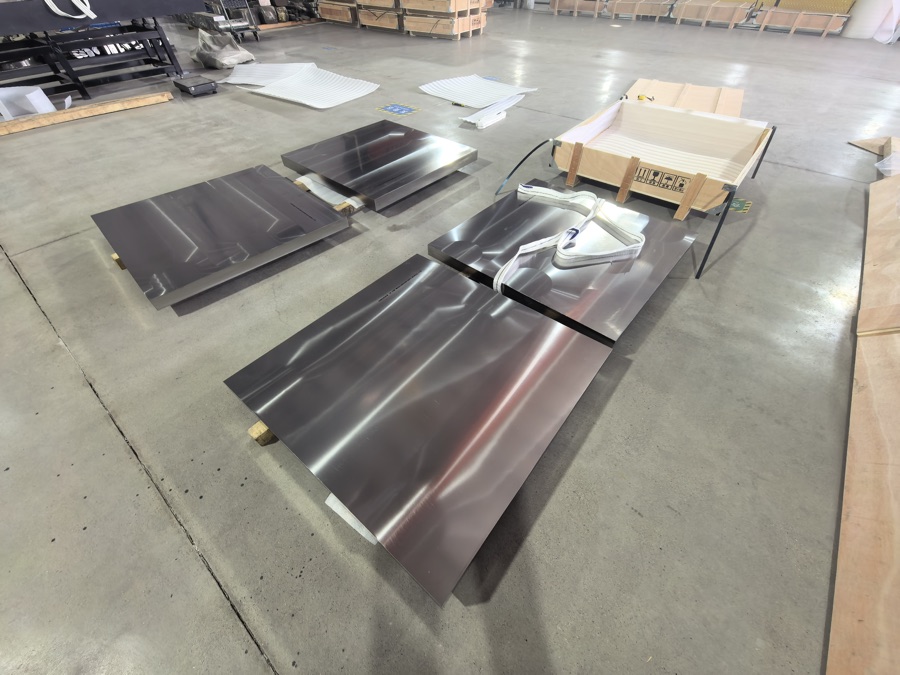
ASTM B265 is the standard specification for titanium and titanium alloy strip, sheet and plate. It defines grade chemistry, mechanical properties, thickness range and flat-product requirements. A useful ASTM B265 enquiry should state grade, thickness, width, length, tolerance, surface condition and certificate requirement.
What ASTM B265 covers
ASTM B265 applies to titanium strip, sheet and plate in commercially pure grades and titanium alloy grades. It is the flat-product standard used when buyers need Grade 2 titanium sheet, Grade 5 titanium plate, corrosion-resistant Grade 7 or Grade 12 plate, or Grade 23 ELI plate for medical-related components. For how those flat-product grades are chosen alongside tube for a given corrosion duty, see industrial titanium plate and tube.
- Product form: strip, sheet, plate or coil.
- Grade chemistry, including oxygen, nitrogen, carbon, hydrogen and iron limits.
- Mechanical properties such as tensile strength, yield strength and elongation.
- Thickness, width, length, surface and acceptance requirements.
Common ASTM B265 grades
| Grade | UNS | ASTM B265 min UTS / YS | Typical flat-product use | RFQ note |
|---|---|---|---|---|
| Grade 1 | R50250 | 240 / 138 MPa (35 / 20 ksi) | Deep-formed parts, linings, anodes | Confirm pickled, polished or protective-film surface |
| Grade 2 | R50400 | 345 / 275 MPa (50 / 40 ksi) | Heat exchanger sheet, chemical equipment, welded fabrication | Confirm surface condition and flatness |
| Grade 5 | R56400 | 895 / 828 MPa (130 / 120 ksi) | High-strength plate and machined blanks | State ASTM B265 or AMS 4911 for aerospace Ti-6Al-4V |
| Grade 7 | R52400 | 345 / 275 MPa (50 / 40 ksi) | Reducing-acid and crevice-corrosion service | State medium and temperature for grade review |
| Grade 12 | R53400 | 483 / 345 MPa (70 / 50 ksi) | Hot chloride and brine service | State medium and temperature for grade review |
| Grade 23 | R56407 (B265); R56401 (F136) | 828 / 759 MPa (120 / 110 ksi) | Medical-related or high-toughness plate | Confirm ASTM F136 if implant-related |
Values are ASTM B265 room-temperature minimums and are confirmed on the EN 10204 3.1 mill test certificate for each heat.
How to specify titanium sheet or plate
State ASTM B265, grade, thickness, width, length, tolerance, surface finish, edge condition and whether the material will be cut, formed, welded or machined. For ASME pressure equipment, the project may reference ASME SB-265. If that appears on the drawing, include it before quotation.
For strip or coil enquiries, review the SB-265 titanium coil and strip page and state grade, coil width, thickness, coil ID or OD, edge condition and required certificate scope.
Beiyu Titanium supplies ASTM B265 sheet and plate in Grade 2 (UNS R50400), Grade 5 (UNS R56400) and Grade 23 (UNS R56407). When EN 10204 3.1 documentation is required, state the requested chemistry, mechanical results and heat or lot traceability in the RFQ; Beiyu confirms the reporting scope in the quotation and purchase order.
| Field to state | Detail |
|---|---|
| Standard | ASTM B265. For ASME pressure equipment the project may reference ASME SB-265; if that appears on the drawing, include it before quotation |
| Grade | The grade the duty calls for |
| Dimensions | Thickness, width and length |
| Tolerance | The tolerance that applies |
| Surface and edge | Surface finish and edge condition |
| Downstream processing | Whether the material will be cut, formed, welded or machined |
| For strip or coil instead | Grade, coil width, thickness, coil inside or outside diameter, edge condition and required certificate scope |
Sheet vs plate: where is the cutoff?
In titanium flat product, “sheet” is the thinner gauge and “plate” the heavier gauge, with the cutoff commonly taken near 4.75 mm (0.1875 in) under ASTM B265. State thickness, width, length and surface condition so the correct flat-product route and certificate scope are quoted.
| Term | What the guide states |
|---|---|
| Sheet | The thinner gauge of titanium flat product |
| Plate | The heavier gauge |
| Where the cutoff sits | Commonly taken near 4.75 mm (0.1875 in) under ASTM B265 |
Inspection and packing details
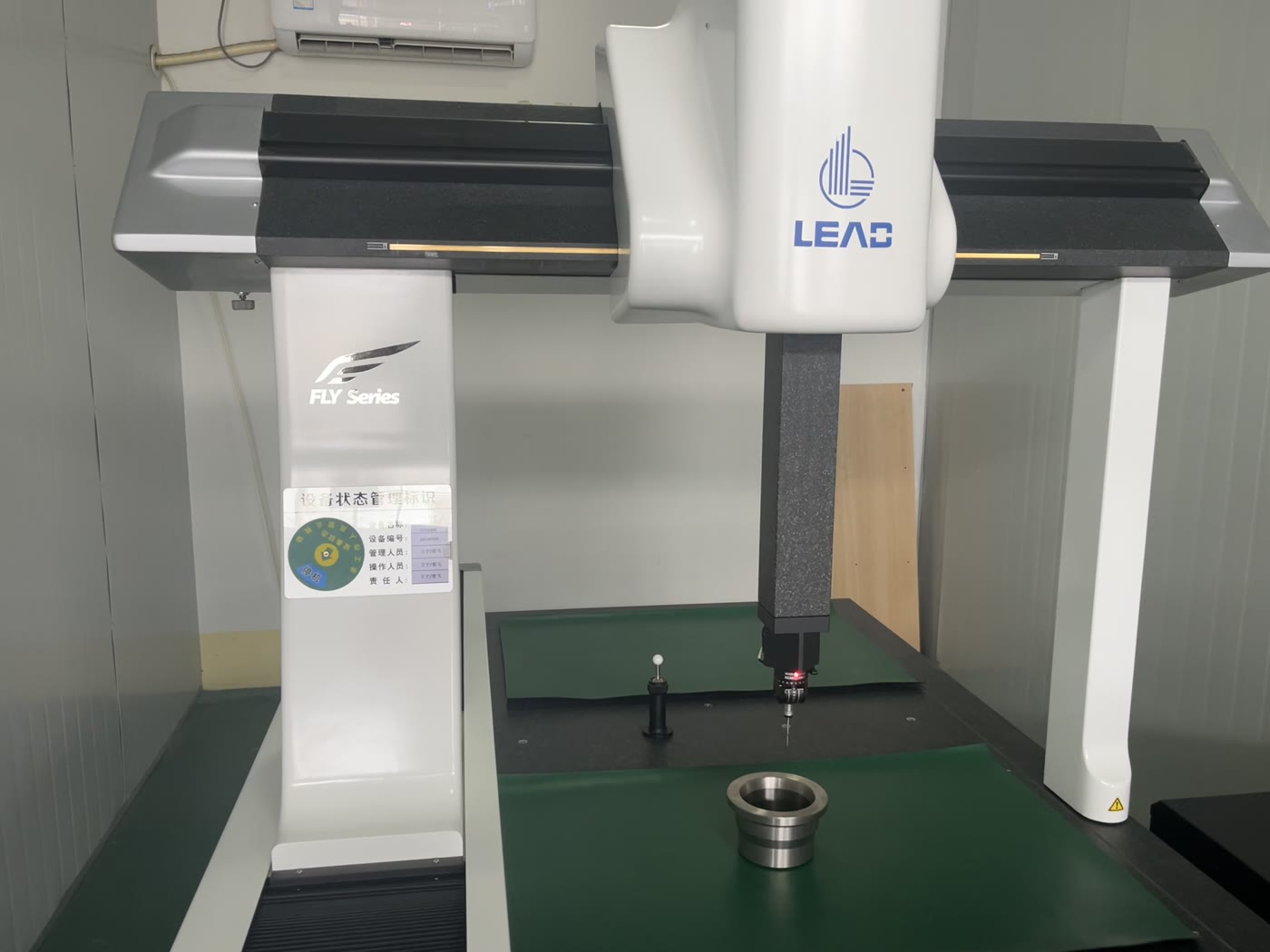
Receiving inspection normally checks thickness, flatness, surface scratches, edge condition, heat number and certificate data against the purchase order. Thin sheets and polished surfaces should have packing and surface protection defined before shipment.
| Inspection and packing point | What the guide states |
|---|---|
| Dimensions and surface | Thickness, flatness, surface scratches and edge condition, matched to the purchase order before packing |
| Identity and documents | Heat number and certificate data checked against the purchase order; EN 10204 3.1 documents should show grade, heat number, chemistry and mechanical properties |
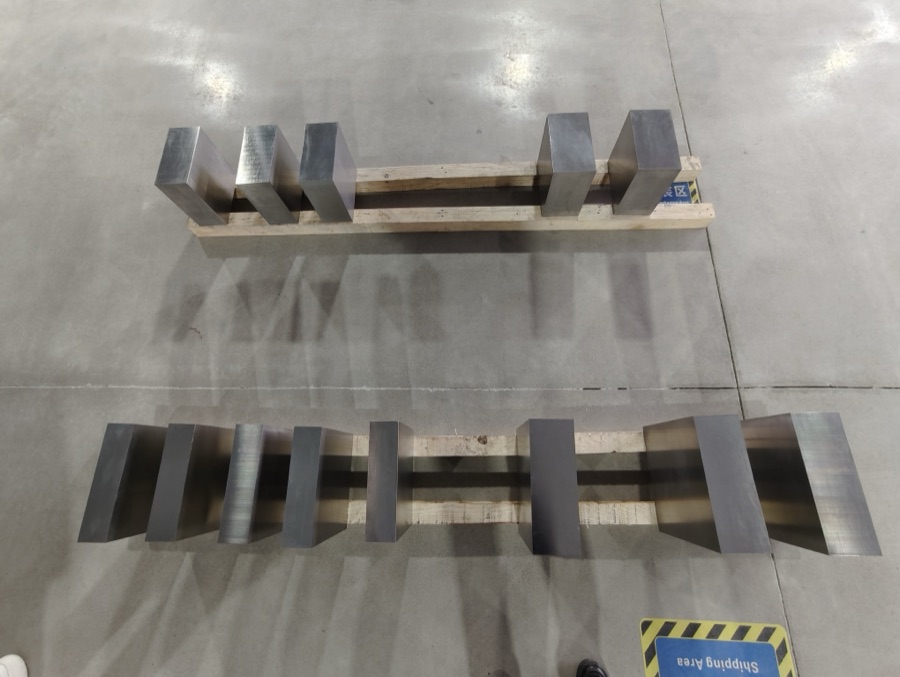
| Packing | Thin sheets and polished surfaces should have packing and surface protection defined before shipment |
FAQ
What is the difference between ASTM B265 and ASME SB-265?
ASME SB-265 is the ASME adoption of ASTM B265 for titanium strip, sheet and plate. It is often cited in pressure-equipment specifications.
Which grades does ASTM B265 cover?
It covers commercially pure Grades 1 to 4 and alloy grades including Grade 5, Grade 7, Grade 9, Grade 12 and Grade 23.
What documents are normally requested?
Buyers usually request a mill test certificate or EN 10204 3.1 certificate showing heat number, chemistry and mechanical properties.
Titanium sheet and plate weight per square metre, by thickness
Flat product is bought by weight and cut by area, so the conversion between the two decides both the price and how much material a nesting layout wastes. The table gives theoretical weight per square metre at common ordering thicknesses, and shows where the product name changes from sheet to plate.
| Thickness (mm) | Grade 2 (CP) | Grade 5 (Ti-6Al-4V) | Product called |
|---|---|---|---|
| 0.5 | 2.26 | 2.22 | Sheet |
| 0.8 | 3.61 | 3.54 | Sheet |
| 1.0 | 4.51 | 4.43 | Sheet |
| 1.2 | 5.41 | 5.32 | Sheet |
| 1.5 | 6.76 | 6.64 | Sheet |
| 2.0 | 9.02 | 8.86 | Sheet |
| 2.5 | 11.27 | 11.07 | Sheet |
| 3.0 | 13.53 | 13.29 | Sheet |
| 4.0 | 18.04 | 17.72 | Sheet |
| 5.0 | 22.55 | 22.15 | Plate |
| 6.0 | 27.06 | 26.58 | Plate |
| 8.0 | 36.08 | 35.44 | Plate |
| 10.0 | 45.10 | 44.30 | Plate |
| 12.0 | 54.12 | 53.16 | Plate |
| 15.0 | 67.65 | 66.45 | Plate |
| 20.0 | 90.20 | 88.60 | Plate |
| 25.0 | 112.75 | 110.75 | Plate |
| 30.0 | 135.30 | 132.90 | Plate |
The arithmetic is direct: W (kg/m²) = t × ρ, with thickness t in millimetres and density ρ in g/cm³. For a cut piece, multiply by length and width in metres. Densities used are 4.51 g/cm³ for Grade 2 and 4.43 g/cm³ for Grade 5.
The naming boundary in the last column follows the sheet-to-plate cutoff described earlier on this page, and it matters commercially: sheet and plate are produced by different routes with different surface and flatness expectations. An enquiry for “2 mm plate” is really an enquiry for sheet, and quoting it against plate practice produces the wrong price and the wrong surface. For a cut list rather than a per-square-metre figure, the titanium weight calculator takes length and width directly.
Sizes quoted. Flat product is produced in three bands. Foil runs from 0.02 mm to 0.3 mm thick in widths up to 600 mm. Thin plate and sheet run from 0.5 mm to 3 mm thick, up to 1,500 mm wide and 6,000 mm long. Heavy plate runs from 3 mm to 70 mm thick, up to 2,500 mm wide and 6,000 mm long. Surfaces are supplied cold-rolled bright, hot-rolled and pickled, ground or sandblasted, in R, M or Y condition, to ASTM B265 and ASME SB265, with ASTM F67, F136, ISO 5832-2, ISO 5832-3 and AMS 4911 where required.
What melting and inspection sit behind Beiyu sheet and plate
Material supplied by Beiyu is produced on a triple vacuum arc remelt route, meaning the manufacturing mill remelts the ingot three times under vacuum. A third remelt is bought for cleanliness rather than for compliance, which is the general reason the route exists: melt count is not what a chemistry table checks, so a double melted heat can satisfy the same composition limits. Because it is a route rather than a test result, the way to confirm it is heat by heat in the documentation supplied with the order rather than from a datasheet.
Plate is inspected for internal soundness and for surface condition. Ultrasonic examination is the check worth naming on the order, because plate destined for a pressure retaining weld carries the same discontinuity risk as any other forged and rolled product.
| Inspection | What it is there to catch |
|---|---|
| Ultrasonic flaw detection | Internal discontinuities: inclusions, porosity and laps carried forward from the billet or slab |
| Surface optical inspection | Grinding marks, scratches and handling damage on the finished surface |
Ultrasonic examination only becomes a meaningful pass or fail once the method, the coverage, the calibration reflector and the acceptance class are all named. Those four fields differ by product form, so they belong on the order rather than being inferred from the words “ultrasonic tested”: with every other condition equal, a scan calibrated against a larger reflector will pass material that a finer setting rejects, and both suppliers can print the same three words on the certificate. For this product form the method, coverage, reference reflector and acceptance criteria should be stated on the order. The settings documented for the precision ground bar route are specific to that route and should not be assumed to carry across.
Specification detail with sources
ASTM B265 accepts titanium sheet and strip on a bend test as well as tension, and the bend table is what separates the grades on a press brake. Grade 1 sheet below 1.8 mm (0.070 in) must form around a mandrel of 3 times its thickness and 4T from 1.8 mm up, Grade 2 is held to 4T and 5T at the same breakpoints, and Grade 5 is allowed 9T and 10T. The tension side ranks the grades the same way, with minimum elongation of 24 percent for Grade 1, 20 percent for Grade 2 and 10 percent for Grade 5, so a forming-led flat-product job argues itself down the grade ladder before strength enters the discussion.
Beiyu Titanium has the chemistry for each flat-product heat analysed at an external mill laboratory or the mill’s own in-house laboratory, 2 laboratory routes, and adds third-party inspection by agreement, so the heat number carried through marking, weighing and packing traces back to a named analysis rather than to the packing list alone. Beiyu also quotes flat product against 2 references this page does not list, ASME SB265 for pressure work and ISO 5832-2 for unalloyed implant sheet, which is what lets one rolled heat serve a pressure order and an implant order without a second melt.
Request ASTM B265 titanium sheet or plate
Send grade, thickness, size, tolerance, surface finish, quantity and certificate requirement. Beiyu reviews the sheet or plate requirement before quotation.
Standards and sources
Grades, conditions and properties are summarized from ASTM B265 (titanium and titanium alloy strip, sheet and plate). For ASME code work the equivalent is ASME SB-265, and the aerospace flat-product specification is SAE AMS 4911. Confirm the current revision and certificate package on the order, and the heat against its mill test certificate.