
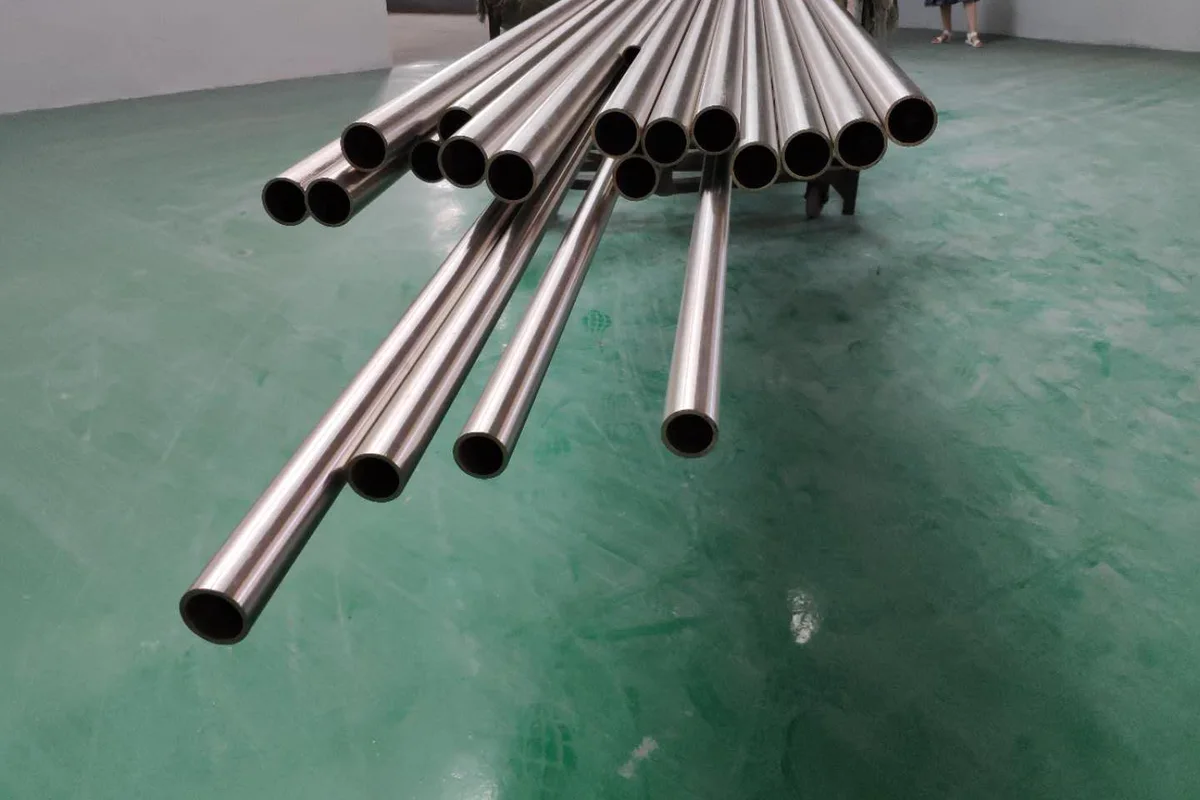
Seamless or welded is a specification decision, not a quality ranking
Buyers often treat welded tube as the lesser option. On an order line it is not a grade of quality, it is a different product standard with a different size envelope and a different acceptance basis. Choosing between them decides which standard the certificate has to be written against.
| Route | Product standard the order runs under |
|---|---|
| Seamless pipe | ASTM B861 |
| Welded pipe | ASTM B862 |
| Tube for condensers and heat exchangers | ASTM B338, which covers both seamless and welded |
The size envelope is where the decision usually gets made
The two routes do not reach the same sizes. In practice this is what settles the choice more often than any argument about the weld itself.
| Form | Range Beiyu reviews against |
|---|---|
| Capillary tube | 1 mm to 5 mm outside diameter, 0.1 mm to 2 mm wall |
| Seamless tube and pipe | 5 mm to 325 mm outside diameter, 0.5 mm to 12 mm wall, length to 12000 mm |
| Welded tube and pipe | 6.35 mm to 1219 mm outside diameter, 0.5 mm to 25.4 mm wall, length to 22000 mm |
The envelope is a production capability, not a stock statement, and not every combination of grade, size, condition and inspection exists across the whole range. The ordered combination is confirmed at quotation.
Where the two routes genuinely differ on an order
| Field | What changes between the routes |
|---|---|
| Large diameters | Only the welded route reaches the upper end of the envelope above |
| Long lengths | The welded route reaches longer lengths than the seamless route |
| Weld examination | Applies to the welded route and has to be specified with its acceptance basis |
| Governing standard | B861 and B862 are separate standards, so the certificate names one of them |
Tube and pipe are not the same order line either
The distinction is not a synonym problem. It changes which standard governs, and therefore what the acceptance requirements are.
| Ordered as | Standard it points to |
|---|---|
| Tube for condensers and heat exchangers | ASTM B338 |
| Pipe, seamless | ASTM B861 |
| Pipe, welded | ASTM B862 |
| Neither stated | The mill has to ask before it can quote, or it guesses |
Which grades are covered
Not every grade appears in every one of these standards. Naming a grade without naming the standard leaves the combination unverified.
| Grade | Covered by |
|---|---|
| Grade 2 commercially pure titanium (UNS R50400) | ASTM B338, ASTM B861, ASTM B862 |
| Grade 5 Ti-6Al-4V (UNS R56400) | ASTM B861, ASTM B862 |
What to state on the purchase order
Ordered as: ______ (tube or pipe)
Route: ______ (seamless or welded)
Governing standard: ______ (ASTM B338, B861 or B862)
Grade and UNS: ______
Outside diameter and wall: ______
Length: ______ (state random or cut, with tolerance)
Condition: ______ (R / M / Y, stated on the order)
Examination scope: ______ (state each examination with its acceptance standard and class)
Certificate: EN 10204 3.1 mill test certificate with heat number traceability, reporting scope by order
Name the route and the standard on the same line. Beiyu confirms the grade, size and standard combination against the ordered envelope before quoting.
Specification detail with sources
The route and the standard are two fields on one line. Tube for condensers and heat exchangers runs under ASTM B338, seamless pipe under ASTM B861 and welded pipe under ASTM B862, and the certificate names one of them. The starting chemistry is common ground: ASTM B348 sets Grade 2 at 0.25 percent oxygen maximum and 0.30 percent iron maximum, and Grade 9 Ti-3Al-2.5V at 0.15 percent oxygen maximum with 2.5 to 3.5 percent aluminium and 2.0 to 3.0 percent vanadium (ASTM B348, chemical requirements).
| Ordered as | Standard the certificate names |
|---|---|
| Tube for condensers and heat exchangers | ASTM B338 |
| Pipe, seamless | ASTM B861 |
| Pipe, welded | ASTM B862 |
Where a weld examination is required, name the method and its acceptance basis on the order rather than relying on the word welded. The analysis methods behind the certificate are referenced by the material standards themselves, including ASTM E1409 for oxygen and nitrogen by inert gas fusion, ASTM E1447 for hydrogen and ASTM E2371 for plasma atomic emission analysis (ASTM B348, referenced documents). Naming a method settles how a reported value was produced; it does not establish weld integrity, which is a separate examination with its own acceptance standard and class. In Beiyu’s supply practice the grade, size and standard combination is confirmed against the ordered envelope before quoting.
Send a technical RFQ
For titanium tube and pipe RFQs, include the route, the governing standard, grade and UNS, outside diameter and wall, length, condition, the examination scope with its acceptance standard and class, and the required mill test certificate.