
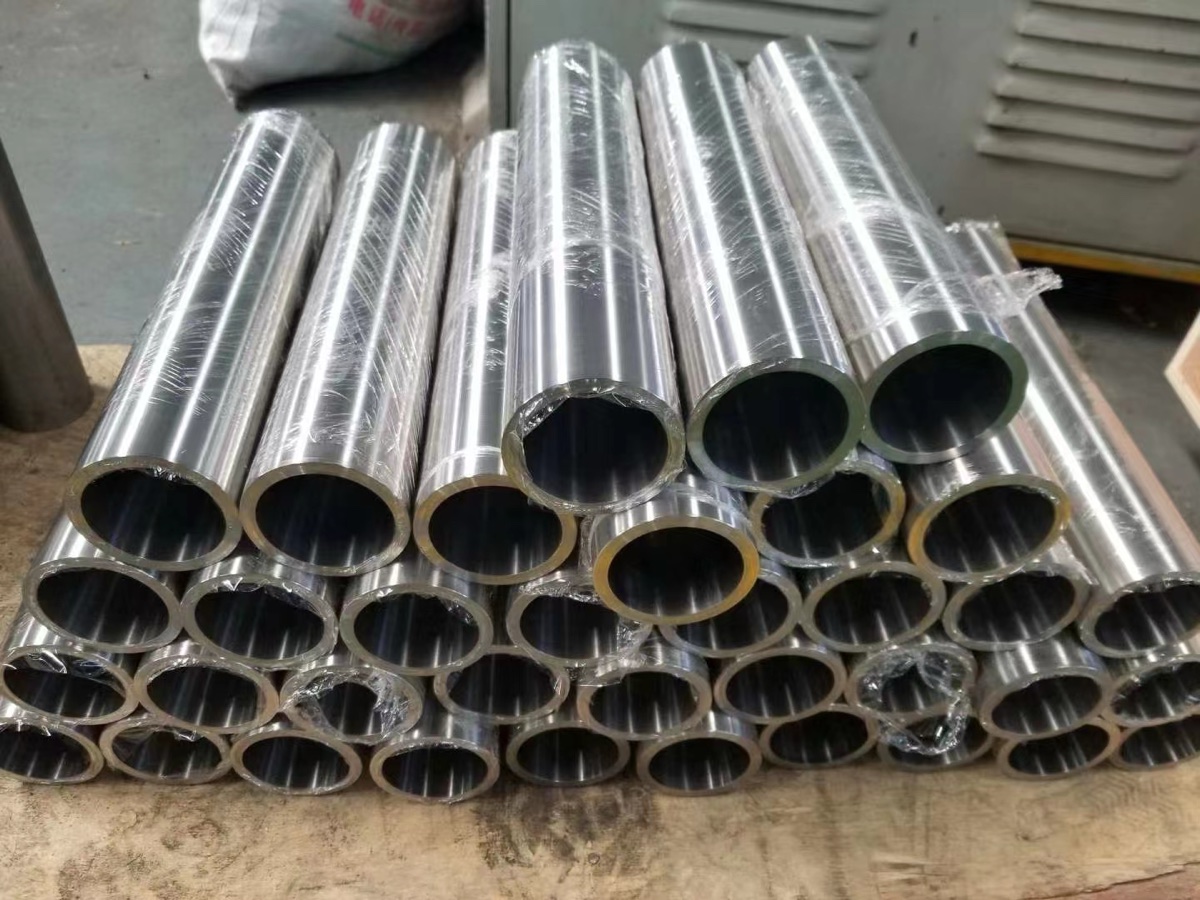
ASTM B338 is the standard specification for seamless and welded titanium and titanium alloy tubes used in condensers and heat exchangers. It is a tube standard, not a pipe standard. Titanium pipe is normally specified to ASTM B861 for seamless pipe or ASTM B862 for welded pipe.
What ASTM B338 covers
Beiyu Titanium supplies ASTM B338 seamless and welded titanium tube in Grades 2, 7, 9, and 12. For an ASTM B338 enquiry, identify seamless or welded construction, grade, outside diameter, wall, length, heat-treatment condition and the required hydrostatic, pneumatic, ultrasonic or electromagnetic examination route. ASTM B338 requires each tube to pass one of these examinations; the route is selectable, so state which one applies to the ordered construction rather than assuming a default. ASTM E426 covers electromagnetic (eddy-current) examination of both seamless and welded tubular products. Add any EN 10204 3.1 reporting and heat-traceability fields to the RFQ so the complete inspection scope can be confirmed in the quotation and purchase order. ASTM B338 defines titanium tube for heat-transfer service, including grade chemistry, mechanical properties, dimensions, tolerances and test requirements.
Common ASTM B338 grades
| Grade | UNS | Typical heat-exchanger use | RFQ note |
|---|---|---|---|
| Grade 2 | R50400 | Seawater condenser and general heat-exchanger tube | Default starting grade for many seawater applications |
| Grade 7 | R52400 | Aggressive chemical and brine service | The 0.15 to 0.25 wt% palladium addition shifts the open-circuit potential into the passive region in reducing acid and low-pH chloride environments, eliminating the active dissolution that occurs on unalloyed titanium under the same conditions. Choose Grade 7 over Grade 2 when the process fluid is a reducing acid (hydrochloric, dilute sulfuric) or when crevice geometry is unavoidable. |
| Grade 9 | R56320 | Higher-pressure or weight-sensitive tubing | Ti-3Al-2.5V, stronger than CP grades |
| Grade 12 | R53400 | Hot chloride-bearing process streams | Review for hot brine and crevice corrosion requirements |
ASTM minimums for reference, confirmed on EN 10204 3.1 mill test certificates per heat: Grade 2, R50400, 345 MPa UTS / 275 MPa YS (50 / 40 ksi); Grade 7, R52400, 345 MPa UTS / 275 MPa YS (50 / 40 ksi); Grade 9, R56320, 620 MPa UTS / 483 MPa YS (90 / 70 ksi); Grade 12, R53400, 483 MPa UTS / 345 MPa YS (70 / 50 ksi). Grade 9 carries the highest strength of the four, making it the preferred choice when tube wall thickness or diameter must be minimized under pressure.
How many grades does ASTM B338 cover?
The current edition of ASTM B338 lists 28 grades of seamless and welded titanium and titanium alloy tube for surface condensers, evaporators and heat exchangers. They span commercially pure titanium (Grades 1 to 3), the palladium-bearing corrosion grades such as Grade 7, Grade 11, Grade 16 and Grade 17, the Ti-3Al-2.5V alloy (Grade 9) and the Ti-0.3Mo-0.8Ni alloy (Grade 12), among others. Most orders are placed against a much shorter list: the four grades in the table above are the common condenser and heat-exchanger choices, and the grade is fixed by the service chemistry and temperature rather than by the standard itself.
What is titanium seamless tube, and how is it made?
Seamless titanium tube is made without a longitudinal weld. ASTM B338 defines seamless tube as tube made from hollow billet by cold reducing or cold drawing. The upstream hollow may be produced by piercing or boring, followed where applicable by hot extrusion. Cold pilgering, drawing or both then reduce it to size. Intermediate annealing may be used when further cold work requires restored ductility; B338 does not require vacuum annealing between every pass. Welded tube starts from strip that is rolled into a cylinder and seam welded, and the standard also recognises welded/cold-worked tube (WCS), where the welded tube is cold worked after welding. The standard covers seamless and welded titanium tube for surface condensers, evaporators and heat exchangers.
The route matters for three reasons on a real order. A project or code may name the route directly, in which case there is no choice to make. Where the route is open, welded and welded/cold worked tube is widely used for condenser and heat-exchanger bundles, and which route prices better depends on the size, quantity, tolerance and project requirements rather than following a general rule. Seamless is chosen when the specification forbids a weld seam, or when the ordered size and wall fall outside what the welded route can hold for that order. Whichever route is ordered, the inspection package changes with it, so the route has to be stated rather than left to the mill.
| Route | How the guide describes it |
|---|---|
| Seamless | Tube made from hollow billet by cold reducing or cold drawing. The upstream hollow may be produced by piercing or boring, followed where applicable by hot extrusion. Cold pilgering, drawing or both then reduce it to size |
| Welded | Strip rolled into a cylinder and seam welded |
| Welded and cold worked (WCS) | Welded tube that is cold worked after welding |
Tube or pipe: which standard applies, and how each is ordered
A common cause of re-quotation on titanium hollows is an enquiry that mixes tube and pipe conventions. Under ASTM B338, tube is ordered to a specified outside diameter and wall thickness, stated as minimum or average wall. Under ASTM B861 and B862, standard pipe sizes are ordered by NPS and schedule; NPS maps to a defined outside diameter and schedule maps to a nominal wall thickness. ASTM B862 also permits custom wall thicknesses outside its table for NPS 8 and larger. Naming a schedule on a tube specification, or an outside diameter on a pipe specification, leaves the mill guessing which dimensional table to work to.
| Form and route | ASTM | ASME | How it is ordered | Typical service |
|---|---|---|---|---|
| Seamless tube | B338 | SB-338 | Outside diameter and wall thickness | Condensers, evaporators, heat exchangers where a weld seam is not accepted |
| Welded and welded/cold worked (WCS) tube | B338 | SB-338 | Outside diameter and wall thickness | The volume route for condenser and heat-exchanger bundles |
| Seamless pipe | B861 | SB-861 | Nominal pipe size and schedule | Process line pipe and piping systems |
| Welded pipe | B862 | SB-862 | Nominal pipe size and schedule | Process line pipe where a welded route is accepted |
ASTM B338 also does not cover every grade. Its grade list runs to the commercially pure and corrosion-resistant alloy grades and does not include Grade 5, so a request for ASTM B338 Grade 5 tube cannot be certified as written. ASTM B861 and B862 list Grade 5 for seamless and welded pipe respectively. If Grade 5 tubing is required, another applicable specification or an approved design change is necessary; do not substitute pipe for tube, or change the grade, without design approval. The titanium tube grade selection guide works through that choice by service condition.
For an accurate quotation on either form, state the grade, the standard, the route, the dimensions in the convention that matches the standard, the length and tolerance, and the certificate and inspection package. Related product pages include Grade 2 titanium seamless tube, Grade 12 titanium tube, titanium heat exchanger coil, titanium coil tubing, titanium capillary tube, the welded titanium pipe option and the titanium tube and pipe category.
For the service case behind the common Grade 2 exchanger order, see how Grade 2 is used for chemical and heat-exchanger duty before fixing the final tube grade.
For the higher-strength option under this standard, see Grade 9 (Ti-3Al-2.5V) titanium tube, used where pressure ratings exceed what commercially pure tube allows.
What ASTM B338 requires: tolerances, testing and documents
Three permissible variations matter on most tube orders. Average wall thickness may vary by plus or minus 10 percent of the specified wall, for both seamless and welded tube; where minimum wall is ordered instead, the tolerance becomes all-plus at twice that value. Outside diameter tolerance is set by a table in the standard and depends on the ordered OD bracket; where the tube will be roller-expanded into a tubesheet, a tighter OD tolerance than the standard default is often agreed on the purchase order. Tube ordered cut to length may not be shorter than the specified length, with a plus tolerance of 1/8 inch (3.2 mm) on lengths up to 24 feet (7.3 m). State the OD, wall convention, length and any tighter-than-standard tolerance on the RFQ so the mill route is priced correctly.
| Dimension | Permissible variation stated in the guide |
|---|---|
| Average wall thickness | Plus or minus 10 percent of the specified wall, for both seamless and welded tube |
| Minimum wall ordered instead | The tolerance becomes all-plus at twice that value |
| Outside diameter | Set by a table in the standard and dependent on the ordered OD bracket. Where the tube will be roller-expanded into a tubesheet, a tighter OD tolerance than the standard default is often agreed on the purchase order |
| Cut length | May not be shorter than the specified length, with a plus tolerance of 1/8 inch (3.2 mm) on lengths up to 24 feet (7.3 m) |
What testing does ASTM B338 require on every tube?
ASTM B338 sets a nondestructive testing package for each tube rather than a single test. Welded tube is examined by eddy current to ASTM E426 and by ultrasonic examination, together with a hydrostatic or pneumatic test. Seamless tube likewise takes ultrasonic and eddy-current examination together with a hydrostatic or pneumatic test. In the hydrostatic test the tube must hold an internal pressure that produces a stress of 50 percent of the grade’s specified minimum yield strength in the tube wall, without leaks or bulges. Mechanical sample testing includes a flattening test, and for tube up to 3.5 inches (88.9 mm) OD with wall up to 0.134 inch (3.4 mm), a flare test with a 60 degree tool to the expansion set by the standard, with no cracking or rupture visible. Welded tube additionally takes a reverse flattening test on the weld. Third-party witness points and any testing beyond the standard are defined by the order, so state the inspection scope before production, not after it.
Inspection and documents
Depending on the order, ASTM B338 tube may require chemical and mechanical results, flattening or flare testing, hydrostatic or pneumatic testing, eddy-current examination for welded tube, dimension inspection and heat-number traceability. Confirm EN 10204 3.1 and third-party inspection before production.
FAQ
Which titanium grade is used for a seawater condenser?
Grade 2 titanium is the usual starting point for seawater condenser tube. Grade 7 or Grade 12 may be reviewed for hotter chloride, brine or crevice-prone conditions.
Is ASTM B338 a pipe standard?
No. ASTM B338 is a tube standard for condensers and heat exchangers. Titanium pipe is normally ASTM B861 for seamless pipe or ASTM B862 for welded pipe.
What should an ASTM B338 enquiry include?
Send grade, OD, wall thickness, length, tolerance, surface condition, seamless or welded route, quantity and certificate requirement.
Tube grade selection guide
Use the titanium tube grade selection guide when an ASTM B338, B861 or B862 inquiry needs grade comparison across Grade 2, Grade 7, Grade 9 and Grade 12 by service condition, strength requirement and tube construction.
Standards and sources
Grades, seamless and welded forms and test requirements are summarized from ASTM B338 (titanium tube for surface condensers and heat exchangers). Titanium pipe falls under ASTM B861 (seamless) and B862 (welded), and welding fittings under ASTM B363. Confirm the current revision, the test scope and the certificate package on the order.
For the supplier side of a B338 enquiry, the titanium supplier lists index collects company-page comparisons by tube type and grade.
On the design side, published erosion rates at seawater velocities up to 120 ft/sec and the crevice results by grade are in titanium in seawater: velocity and erosion limits.