
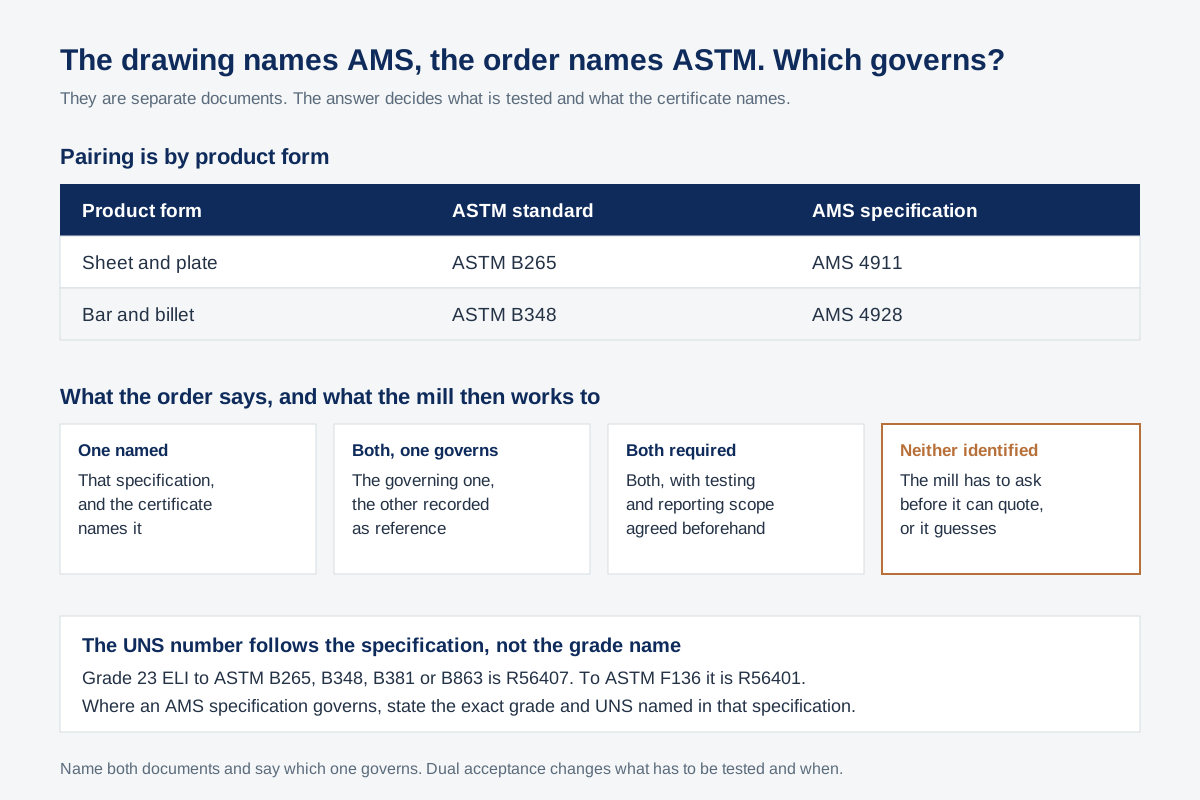
A drawing that names two specifications creates one question
Aerospace drawings often carry an AMS specification while the purchase order carries an ASTM standard. They are separate documents with separate requirements. The order has to say which one governs, or whether the material has to satisfy both, because that decides what is tested and what the certificate is written against.
| What the answer decides |
|---|
| Which requirements the material is accepted against |
| Which tests are run and reported |
| Which specification appears on the certificate |
Which specification pairs with which product form
The pairing is by product form. An AMS number written against the wrong form is one of the more common reasons a line has to go back for clarification before it can be priced.
| Product form | ASTM standard | AMS specification Beiyu supplies against |
|---|---|---|
| Sheet and plate | ASTM B265 | AMS 4911 |
| Bar and billet | ASTM B348 | AMS 4928 |
Dual certification is agreed before production, not after
Asking for a second specification once the material is finished is not a paperwork step. It can require testing that has to be scheduled while the material is still available in the right condition.
| Ordered as | What the mill works to |
|---|---|
| One specification named | That specification, and the certificate names it |
| Both named, one stated as governing | The governing specification, with the other recorded as reference |
| Both named, both required | Both, with the testing and reporting scope agreed before production |
| Both named, neither identified | The mill has to ask before it can quote, or it guesses |
The UNS number follows the specification, not the grade name
This is where certificates and drawings most often disagree. The same alloy carries a different UNS number depending on the specification the order was placed against, so the number has to be read off the named specification rather than from a general grade table.
| Grade 23 ELI ordered to | UNS |
|---|---|
| ASTM B265, B348, B381 or B863 | R56407 |
| ASTM F136 for surgical implants | R56401 |
| An AMS specification | State the exact grade and UNS named in that specification on the order |
What a mill needs before it can price a dual specification line
| Field | Why it is on the order |
|---|---|
| Which specification governs | Decides the acceptance basis for the whole line |
| Revision or edition of each | Requirements change between editions |
| Testing and reporting scope | Decides what has to be scheduled during production |
| Certificate wording required | Decides whether one or both specifications are named on the document |
What to state on the purchase order
Product form: ______ (sheet, plate, bar or billet)
ASTM standard: ______ (ASTM B265 or ASTM B348)
AMS specification: ______ (AMS 4911 or AMS 4928)
Which governs: ______ (name one, or state that both are required)
Edition or revision of each: ______
Grade and UNS: ______ (as named in the governing specification)
Testing and reporting scope: ______
Certificate: EN 10204 3.1 mill test certificate with heat number traceability, naming the specification the material was accepted against
Name both documents and say which one governs. Beiyu reviews the specification pair against the ordered product form and grade before quoting, since dual acceptance changes what has to be tested and when.
Specification detail with sources
When two specifications are named, the order has to say which governs, because each one carries its own ordering clause. ASTM B348 requires an order to include the grade number, product classification, chemistry, mechanical properties, marking, finish, packaging, the required reports and the disposition of rejected material (ASTM B348, ordering information). An AMS specification named on the drawing does not replace that list; it either governs in its place or sits alongside it as a second requirement set.
| Grade 23 ELI ordered to | UNS |
|---|---|
| ASTM B265, B348, B381 or B863 | R56407 |
| ASTM F136 for surgical implants | R56401 |
| An AMS specification | State the exact grade and UNS named in that specification |
The underlying chemistry limits are stated in the product standard: ASTM B348 sets Grade 23 ELI at 0.13 percent oxygen maximum and 0.0125 percent hydrogen maximum, against 0.20 percent oxygen maximum and 0.015 percent hydrogen maximum for standard Grade 5 (ASTM B348, chemical requirements). Testing follows the referenced methods, including ASTM E8 for tension testing and ASTM E1409 for oxygen and nitrogen (ASTM B348, referenced documents). Naming both documents and the methods still leaves one question open, and it is the one that has to be answered before quoting: which specification the material is accepted against.
Send a technical RFQ
For dual specification RFQs, state the product form, the ASTM standard, the AMS specification, which one governs or that both are required, the edition of each, grade and UNS as named in the governing specification, the testing and reporting scope and the certificate wording required.