
What separates a supplier you can price against from one you have to interview
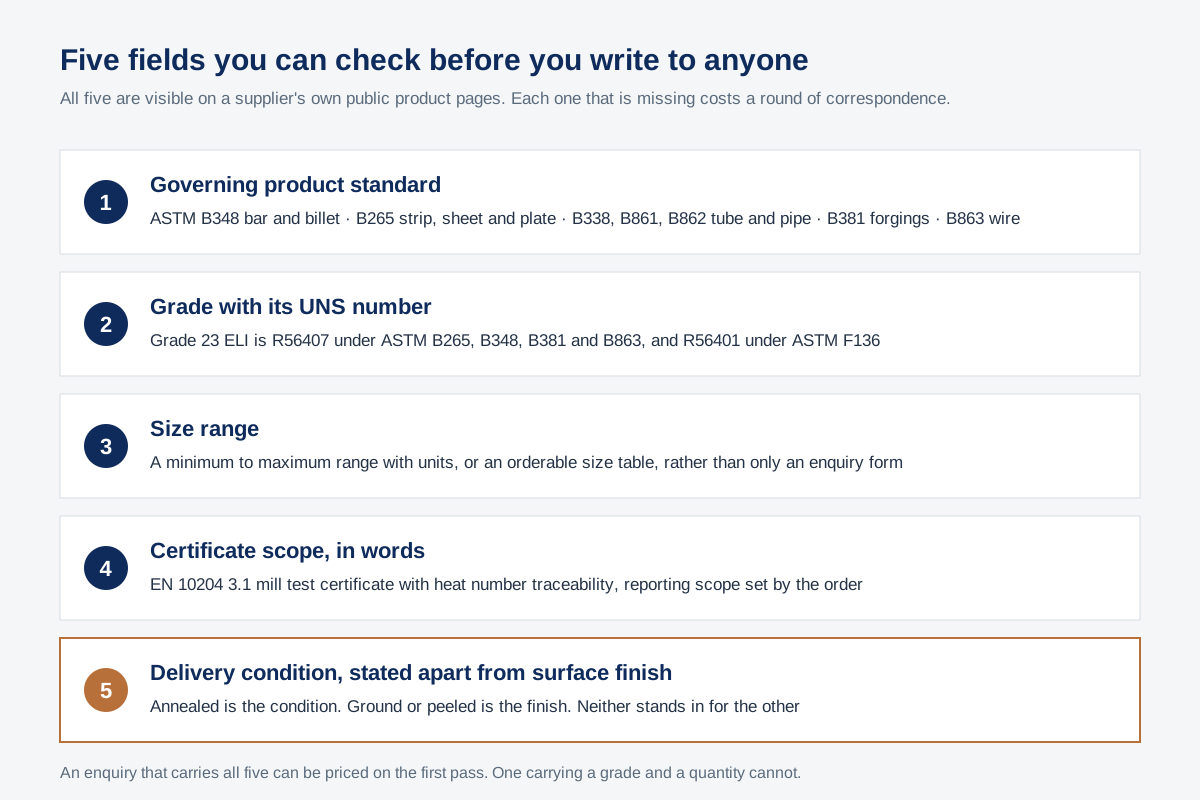
A supplier page that lists grades and invites an enquiry is enough to start a conversation and not enough to raise a purchase order. Five fields decide whether your enquiry can be quoted on the first pass, and all five can be checked from outside, on any supplier’s own public pages, before you write to anyone.
| Field | What it decides | What it costs when it is missing |
|---|---|---|
| Governing product standard | The acceptance basis, the tolerance table and the certificate wording | A quotation against a standard your drawing does not accept |
| Grade with its UNS number | Which specification chain the material is certified to | A certificate that cannot be reconciled with the drawing, found late |
| Size range | Whether the part is supplyable at all | A round of correspondence before anyone can say yes or no |
| Certificate scope | What arrives with the metal | Documents that answer less than incoming inspection needs |
| Delivery condition, stated apart from surface finish | The metallurgical state as distinct from the surface | Bar that meets the standard and still fails the first operation |
How to check each field on a supplier site in about five minutes
These are the checks in the order that eliminates suppliers fastest. Each one is answerable from a public product page, without contacting anybody.
| Check | What a usable answer looks like |
|---|---|
| Does a product page name a product standard | ASTM B348 for bar and billet, B265 for strip, sheet and plate, B338, B861 or B862 for tube and pipe, B381 for forgings, B863 for wire |
| Are grade and UNS given together | Both, and consistent with the standard the page names |
| Is a size range published | A range with units, or an orderable size table, rather than only an enquiry form |
| Is certificate scope described in words | EN 10204 3.1 mill test certificate with heat number traceability, reporting scope set by the order |
| Is delivery condition separate from finish | Annealed stated as the condition, ground or peeled stated as the finish, neither standing in for the other |
The two grade traps worth checking on any site, including this one
These two cause rejected certificates rather than slow quotations, and both are visible on a supplier page before anything is ordered.
| Grade 23 ELI ordered to | UNS |
|---|---|
| ASTM B265, B348, B381 or B863 | R56407 |
| ASTM F136 for surgical implants | R56401 |
A page showing only one of these two numbers for Grade 23 is showing a number that is right for one specification chain and wrong for the other. Ask which chain it belongs to before the order is placed rather than when the certificate arrives.
Grade 7 is the second trap. It is commonly written as Ti-0.15Pd, while ASTM B348 states the composition as unalloyed titanium plus 0.12 to 0.25 percent palladium. The shorthand is a legitimate commercial name, but an order or a certificate that treats 0.15 as a specification limit is quoting a figure the standard does not contain.
What a published size has to say before it is usable
Published sizes come in several forms and they are not equivalent. Read which one you are looking at before assuming your part is covered.
| What is published | What you can conclude from it |
|---|---|
| A minimum to maximum range with units | The envelope is stated; the ordered combination still needs confirming |
| A single maximum, such as up to a given diameter | The top end only; nothing about the small end or the length |
| An orderable size table with stock sizes | Those specific sizes, which may be narrower than the production envelope |
| Nothing, only a request for enquiry | Nothing yet; this is the round of correspondence the other forms avoid |
What Beiyu answers to the same five checks
A page that tells buyers what to check should answer the same checks itself rather than leave them implied.
| Check | Beiyu published position |
|---|---|
| Governing standards | ASTM B265, B338, B348, B363, B381, B861, B862, B863, AMS 4911 and AMS 4928, named per product form |
| Grade and UNS | Given together, with the Grade 23 rule above applied per specification chain |
| Size ranges | Round bar 1 mm to 500 mm; plate 3 mm to 70 mm thick and to 2500 mm wide; seamless tube 5 mm to 325 mm outside diameter; wire 0.8 mm to 6.0 mm straight, 0.8 mm to 12 mm in coil, 0.01 mm to 6.35 mm on spool |
| Certificate scope | EN 10204 3.1 mill test certificate with heat number traceability, reporting scope set by the order |
| Delivery condition | Stated separately from surface finish on every order line |
Those ranges are a production envelope reviewed against, not a stock statement, and not every combination of grade, size, condition and inspection exists across the whole range. The ordered combination is confirmed at quotation.
What to send so the first reply is a quotation
Product form: ______ (bar, plate, tube, forging, wire)
Governing standard: ______
Grade and UNS: ______ (as named in that standard)
Size: ______ (with the dimension each tolerance applies to)
Length and tolerance: ______
Delivery condition: ______
Surface finish: ______ (stated separately from the condition)
Examination scope: ______ (method, coverage, acceptance standard and class)
Certificate: EN 10204 3.1 mill test certificate with heat number traceability, reporting scope by order
An enquiry carrying these nine lines can be priced without a clarification round. One carrying a grade and a quantity cannot, whichever supplier receives it.
Specification detail with sources
The two grade traps above are not opinions. ASTM B348 states the Grade 7 composition as unalloyed titanium plus 0.12 to 0.25 percent palladium, and lists Grade 23 ELI under UNS R56407 (ASTM B348, scope). ASTM F136, the surgical implant specification for the same alloy, is the chain under which that grade carries R56401 instead. The standard also fixes what an order has to carry: grade number, product classification, chemistry, mechanical properties, marking, finish, packaging, the required reports and the disposition of rejected material (ASTM B348, ordering information).
| Field the standard fixes | Field the buyer has to state |
|---|---|
| Chemistry and mechanical minimums, by grade | Which grade and which specification chain |
| Dimensional tolerances, by its own tolerance tables | The ordered size each tolerance applies to |
| Default marking content and stamping position | Anything beyond that default |
| Certification content, covering all tests the specification requires | Examination scope and acceptance class |
Two defaults are worth reading before assuming they are adequate. ASTM B348 furnishes bars for machining machine straightened to its camber table, which allows 1/8 inch in any 5 feet for hot worked bar and 1/16 inch in any 5 feet for cold finished bar, and it permits material to be shipped with no protection in accordance with the manufacturer’s standard practice unless the order says otherwise (ASTM B348, camber and packaging). Naming the standard settles those defaults. It does not deliver anything tighter, and it does not protect a finished surface, which is why both belong on the order rather than in an assumption.
The method above is for checking one supplier’s site. If the question is which sites to check in the first place, the list of suppliers ranking for a titanium suppliers search records who appeared, on what date, and under what selection rule.
Send a technical RFQ
For titanium RFQs, include the product form, governing standard, grade and UNS, size with the dimension each tolerance applies to, length and tolerance, delivery condition, surface finish, examination scope and the required mill test certificate.