
Inconel 625, also sold as Alloy 625 and designated UNS N06625 and Werkstoff Nr. 2.4856, is a nickel-chromium-molybdenum alloy with niobium. It takes its strength from molybdenum and niobium dissolved in the nickel-chromium matrix, so Special Metals states that precipitation-hardening treatments are not required, unlike the precipitation-hardened Inconel 718. Special Metals cites its high strength, fabricability and outstanding corrosion resistance. On the corrosion side, high molybdenum gives resistance to pitting and crevice corrosion in chloride media, and niobium stabilises it against sensitisation during welding. The ASTM plate, bar and forging specifications furnish it in heat-treated grades, chiefly Grade 1 annealed and Grade 2 solution annealed, and a buyer orders it by specification and grade, for example ASTM B443 Grade 1 for plate, rather than by the alloy name alone.
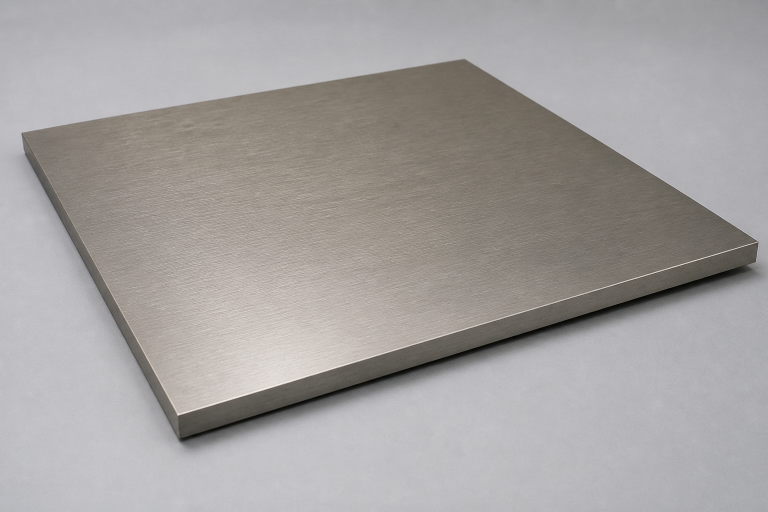
Inconel 625 at a glance
| Property | Value | Note |
|---|---|---|
| Names and numbers | UNS N06625, W.Nr. 2.4856 (EN NiCr22Mo9Nb), Alloy 625 | INCONEL is a trademark name; the generic names are Alloy 625 and UNS N06625 |
| Alloy type | Ni-Cr-Mo alloy with Nb, strengthened in solid solution | Face-centred cubic; Special Metals states precipitation hardening is not required |
| Density | 8.44 g/cm³ (0.305 lb/in³) | One producer gives 8.47 g/cm³ |
| Melting range | 1290 to 1350 °C (2350 to 2460 °F) | Other producers give 1288 to 1349 °C and 1288 to 1343 °C |
| ASTM conditions | Grade 1 annealed, Grade 2 solution annealed | Rod and bar to ASTM B446 add Grade 3, solution annealed and cold worked |
| Main specifications | ASTM B443, B446, B444, B704, B705, B564; AMS 5599, 5666, 5581 | Listed form by form further down the page |
Chemical composition
Listed here are the limits Special Metals publishes for the alloy (UNS N06625). ATI prints the same limits, without the cobalt line, under ASTM B443 and AMS 5599, with the ASME SB-443 equivalent, and three distributor data sheets give the same limits, two of them stating nickel as the balance rather than as a 58.0 % minimum. The full ASTM and AMS texts were not found in public sources (only ASTM scopes and SAE titles and abstracts were), so the specification and revision on the order decide acceptance.
| Element | Weight % |
|---|---|
| Nickel | 58.0 min |
| Chromium | 20.0 to 23.0 |
| Molybdenum | 8.0 to 10.0 |
| Niobium (plus tantalum) | 3.15 to 4.15 |
| Iron | 5.0 max |
| Cobalt | 1.0 max, where determined |
| Carbon | 0.10 max |
| Manganese | 0.50 max |
| Silicon | 0.50 max |
| Aluminium | 0.40 max |
| Titanium | 0.40 max |
| Sulfur | 0.015 max |
| Phosphorus | 0.015 max |
European orders can call for a different document. The German VdTÜV data sheet 499, as VDM restates it, is tighter on several elements: carbon 0.03 % max, niobium plus tantalum 3.2 to 3.8 %, silicon 0.4 % max, phosphorus and sulfur 0.01 % max each, chromium 21 to 23 % and nickel 58 to 71 %. VDM adds that DIN EN 10095 sets carbon at 0.03 to 0.10 % and copper at 0.50 % max. The two sets of limits are not interchangeable, so the certificate should name the document the order names.
Physical properties
Typical values for information only; Special Metals states that its physical data should not be used for specification purposes. Several room-temperature figures below come from one data set that three producers republish, so the separate VDM values are shown alongside.
| Property | Typical value |
|---|---|
| Density | 8.44 g/cm³ (0.305 lb/in³); VDM 8.47 g/cm³ |
| Melting range | 1290 to 1350 °C |
| Specific heat | 410 J/kg·°C at 21 °C (calculated); VDM 496 J/kg·K at 100 °C |
| Thermal conductivity | 9.8 W/m·°C at 21 °C; VDM 12.4 W/m·K at 100 °C |
| Mean thermal expansion | 12.8 µm/m·°C from 21 to 93 °C; VDM 12.51 × 10⁻⁶/K at 100 °C |
| Electrical resistivity near room temperature | 125 to 129 µΩ·cm, by source |
| Young’s modulus at room temperature | 205 to 209 GPa, by source |
| Magnetic permeability | 1.0006 at 200 oersted; VDM 1.003 max at 20 °C |
| Curie temperature | Below −196 °C (−320 °F) |
Grade 1, Grade 2 and Grade 3: what the conditions mean
For 625 the ASTM grade is the heat-treated condition. ASTM B443 (plate, sheet and strip), B446 (rod and bar) and B564 (forgings) define the grades in matching terms, and B446 adds a third.
| ASTM grade | ASTM scope wording | Producer heat treatment |
|---|---|---|
| Grade 1, annealed | Normally employed in service temperatures up to 1100 °F (593 °C) | Annealing at 1700 to 1900 °F (Special Metals), 1600 to 1900 °F (ATI), 950 to 1050 °C (VDM); one producer mill-anneals at 1925 ± 25 °F (1052 ± 14 °C) |
| Grade 2, solution annealed | Normally employed above 1100 °F (593 °C) when resistance to creep and rupture is required | Solution treatment at 2000 to 2200 °F, or 1093 to 1204 °C (Special Metals and ATI); 1080 to 1160 °C (VDM) |
| Grade 3, solution annealed and cold worked (rod and bar, ASTM B446 only) | Normally employed where higher strengths are needed | Solution anneal followed by cold work, as the grade name states |
The boundary between the two main grades is not drawn at the same temperature everywhere: ASTM uses 1100 °F (593 °C), VDM says Grade 2 is generally used above 600 °C, and Special Metals says either annealed or solution-treated material serves above 1200 °F, recommending the solution-treated condition where optimum creep or rupture resistance is needed. ASTM also notes that hot working or re-annealing may change properties significantly. Special Metals states that the cooling rate after heating has no significant effect on this alloy.
Mechanical properties
Few specification minimums for 625 turned up in public sources. The table shows the ones a producer restates, each with its source, and none should be read as a substitute for the ordered specification.
| Document, form and condition | Tensile strength, min | Yield strength, min | Elongation, min | Restated by |
|---|---|---|---|---|
| ASTM B443 (ASME SB-443) Grade 1 and AMS 5599: annealed plate, sheet and strip | 120 ksi (827 MPa) | 60 ksi (414 MPa) | 30 % | One producer (ATI); a distributor sheet gives the same ksi figures for bar up to 101.6 mm (4 in) without naming the specification |
| VdTÜV 499, strip and sheet up to 7 mm | 830 MPa | 400 MPa | 30 % | VDM |
| VdTÜV 499, sheet and plate up to 50 mm | 760 MPa | 380 MPa | 35 % | VDM |
| VdTÜV 499, forgings under 160 mm | 760 MPa | 380 MPa | 30 % | VDM |
| VdTÜV 499, forgings 160 mm and over | 730 MPa | 330 MPa | 35 % | VDM |
The typical values show the trade-off between the grades. Special Metals gives nominal room-temperature properties for annealed rod, bar and plate of 120 to 150 ksi (827 to 1034 MPa) tensile and 60 to 95 ksi (414 to 655 MPa) yield, against 105 to 130 ksi (724 to 896 MPa) and 42 to 60 ksi (290 to 414 MPa) solution treated; it describes these as composites for sizes up to 4 in, not for specification use. ATI’s typical figures point the same way: 136 ksi tensile and 63 ksi yield after annealing at 1920 °F, against 115.5 ksi and 49.5 ksi after a 2150 °F solution anneal. In both data sets the solution-treated condition has the lower typical room-temperature strength, and it is the condition ASTM assigns to creep and rupture service above 1100 °F. ATI gives annealed hardness as Rockwell B 88 to Rockwell C 25 depending on annealing temperature, rising to Rockwell C 36 to 42 after 30 to 60 % cold work.
Corrosion resistance
| Form of attack | What producers state |
|---|---|
| Pitting and crevice corrosion | The high molybdenum content makes the alloy very resistant to pitting and crevice corrosion, including in chloride-containing media |
| Chloride stress-corrosion cracking | The high nickel content gives freedom from chloride-ion stress-corrosion cracking; ATI reports no cracks after 1000 hours in a 42 % magnesium chloride test |
| Intergranular corrosion after welding | Niobium stabilises the alloy against sensitisation during welding; producers describe it as resistant to intergranular corrosion in the welded condition |
Its range is wide but not unlimited. Haynes writes that 625 resists aqueous corrosion well but generally not as effectively as modern HASTELLOY corrosion-resistant alloys, so a severe acid service is still a matter for the corrosion engineer and the medium, concentration and temperature on the drawing.
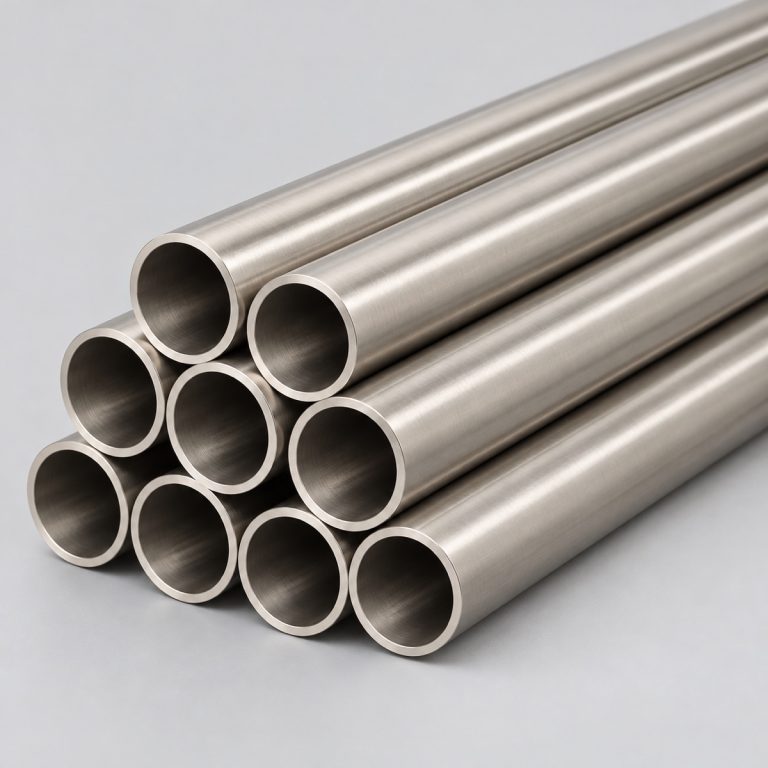
Specifications by product form
| Form | ASTM | SAE AMS |
|---|---|---|
| Plate, sheet and strip | B443 (Grades 1 and 2) | 5599 (annealed) and 5869 (solution heat treated), both up to 25.4 mm thick; 5879 (sheet, strip and foil up to 2.54 mm, consumable-electrode remelted, cold rolled and annealed; linked to 625 by its SAE title alone) |
| Rod and bar | B446 (Grades 1, 2 and 3) | 5666 (annealed bars, forgings, extrusions and flash-welded rings up to 254 mm, and stock of any size for them) |
| Forgings | B564 (Grades 1 and 2) | 5666 |
| Seamless pipe and tube | B444 (cold-worked seamless; general requirements B829) | 5581 (tubing only, seamless or welded, annealed) |
| Welded tube | B704 (boiler, heat-exchanger and condenser tubes, 3.18 to 127 mm OD, 0.38 to 12.70 mm wall; general requirements B751) | 5581 |
| Welded pipe | B705 (annealed; general requirements B775) | None listed |
| Wrought welding fittings | B366 (producers list it for 625; the public scope does not name the alloy) | None listed |
| Welding wire | None listed | 5837 |
No ASTM specification for Alloy 625 wire turned up in the sources used here; the wire specification found is AMS 5837, for welding wire. Producers list the alloy in NACE MR0175 / ISO 15156-3. For pressure equipment, Special Metals (2013) and Haynes (2020) both report ASME allowable stresses for Grade 1 up to 1200 °F (649 °C) and for Grade 2 up to 1600 °F (871 °C) in Section VIII, Division 1, and for Grade 1 up to 800 °F (427 °C) in Section III, Class 2 and 3; the edition in force for the project decides. For European pressure equipment, VDM states that its Grade 1 material is approved by TÜV for pressure vessels from −196 to 450 °C (−320 to 842 °F).
Where it is used, and its limits
| Industry | Typical parts named by producers |
|---|---|
| Chemical processing | Bubble caps, tubing, reaction vessels, distillation columns, heat exchangers, transfer piping and valves |
| Seawater and offshore | Seawater-exposed offshore equipment, seawater piping in shipbuilding, wire rope for mooring cables, sheathing for undersea communication cables |
| Oil and gas | Production pipe systems and riser linings; flaring systems in refineries and on offshore platforms (Grade 2) |
| Aerospace | Aircraft ducting, engine exhaust and thrust-reverser systems, bellows, turbine shroud rings, heat-exchanger tubing in environmental control systems |
| Power and nuclear | Power plant scrubbers, tubes in geothermal plants, reactor-core and control-rod components in water reactors |
The upper temperature is where the sources disagree most. Special Metals gives service temperatures from cryogenic to 1800 °F (982 °C) and ATI gives strength and toughness from cryogenic temperatures to 2000 °F (1093 °C), while Haynes gives strength up to about 1500 °F (816 °C) and oxidation resistance to 1800 °F. For long service Haynes is stricter: it advises restricting 625 to 1100 °F (593 °C), because long thermal exposure above that results in significant embrittlement from delta phase, and ATI says impact properties may be expected to fall with extended service between 1200 and 1600 °F. Special Metals describes the effect of such exposure as hardening: hot-rolled annealed bar held 2000 hours at 1200 °F rose from 140 to 176 ksi tensile while room-temperature elongation fell from 54 % to 30 %, which it attributes to a nickel-niobium phase that gradually transforms to orthorhombic Ni3Nb, and it reports no embrittling intermetallic phases such as sigma after exposure between 1000 and 1800 °F. The producers name the change differently; the Special Metals figures still show a large loss of room-temperature elongation. For long-term hot service, the grade, the expected exposure and any toughness requirement should be stated together on the order.
Fabrication has two points to watch. The alloy work-hardens faster than austenitic stainless steel, so complex forming may need intermediate anneals, and sulfur, phosphorus, lead and other low-melting metals can damage it during heat treatment, so lubricants, particularly sulfur-bearing ones, should be removed before it goes into the furnace.
Common questions
Is Inconel 625 magnetic? No, not in normal service. Its Curie temperature is below −196 °C, and producers give a magnetic permeability of 1.0006 at 200 oersted and a relative permeability of 1.003 maximum at 20 °C.
Can Inconel 625 be age hardened like Inconel 718? It is not meant to be. Its strength comes from solid solution, and Special Metals states that precipitation-hardening treatments are not required. One producer notes that a low-carbon version can be age hardened, but the ASTM grades are annealed, solution annealed, or solution annealed and cold worked. Long exposure at intermediate temperatures also hardens it somewhat, which is the effect described in the limits above. Where an aged, higher-strength nickel alloy is needed, Inconel 718 is the related grade.
Which grade should an order name? Grade 1 for corrosion service and for service up to about 1100 °F (593 °C), Grade 2 when creep and rupture strength above that temperature matter. A bar order needing higher strength can name Grade 3 under ASTM B446.
How is Inconel 625 welded? Producers cite its fabricability, including joining, and state that niobium stabilises it against sensitisation during welding, so it stays resistant to intergranular corrosion in the welded condition. One producer lists AWS A5.14 ERNiCrMo-3 bare filler and AMS 5837 wire, and A5.11 ENiCrMo-3 coated electrodes. The same producer does not recommend submerged-arc welding because of its high heat input and slow cooling, while another lists it among usable processes, so the welding procedure specification should settle the process.
Where titanium is also on the shortlist for a corrosive or hot application, the guide titanium or Inconel sets the two side by side.
Specification detail with sources
Taken from the 2013 Special Metals bulletin on INCONEL alloy 625: the designations UNS N06625 and W.Nr. 2.4856, the NACE MR-01-75 listing, the composition limits in the table with cobalt reported where determined, the statement that molybdenum and niobium stiffen the matrix so that precipitation hardening is not required, the density of 0.305 lb/in³ (8.44 g/cm³), the melting range of 2350 to 2460 °F (1290 to 1350 °C), the calculated specific heat of 410 J/kg·°C, the conductivity of 9.8 W/m·°C, the mean expansion of 12.8 µm/m·°C, the resistivity of 129 µΩ·cm, the modulus of 207.5 GPa annealed, the permeability of 1.0006 and the Curie temperature below −196 °C, the annealing range of 1700 to 1900 °F and solution treatment at 2000 to 2200 °F, the 1200 °F condition guidance and the note on cooling rate, the nominal properties for annealed and solution-treated rod, bar and plate, the 2000-hour exposure data at 1200 °F with the nickel-niobium phase behind them and the absence of sigma-type phases, the pitting, crevice, stress-corrosion and sensitisation statements, the ASME allowable-stress ranges, and the chemical-processing, seawater, aerospace and nuclear uses. The EN designation NiCr22Mo9Nb, the VdTÜV 499 composition and minimum properties, the DIN EN 10095 carbon and copper note, the density of 8.47 g/cm³, the specific heat of 496 J/kg·K, the conductivity of 12.4 W/m·K, the expansion of 12.51 × 10⁻⁶/K, the resistivity of 125 µΩ·cm and the modulus of 209 GPa, the relative permeability of 1.003, the Grade 1 and Grade 2 annealing temperatures and the 600 °C boundary, the TÜV pressure-vessel range for Grade 1, the oil-and-gas, offshore, shipbuilding, geothermal and flaring uses, the work-hardening comparison with stainless steel and the heat-treatment contamination caution are taken from VDM Metals data sheet 4118 (Revision 06, 2022). The 1925 ± 25 °F mill anneal, the melting range of 1288 to 1349 °C, the modulus of 208 GPa, strength to about 1500 °F and oxidation resistance to 1800 °F, the 1100 °F long-term limit and delta-phase embrittlement, the comparison with HASTELLOY alloys, the scrubber use, the ASME table, the filler-metal classifications and the submerged-arc caution are from the Haynes 625 alloy brochure (H-3073H, 2020). The ASTM B443 / AMS 5599 Grade 1 minimums, the annealing range of 1600 to 1900 °F, the 2150 °F and 1920 °F typical tensile values, the hardness ranges, the magnesium chloride test, the impact caution for 1200 to 1600 °F, service to 2000 °F, the melting range of 1288 to 1343 °C, the modulus of 205 GPa, the lubricant caution and the list of usable welding processes are from ATI’s 625 technical data sheets (2012 and 2013) and its 625 product page. The distributor composition limits are from the Rolled Alloys Alloy 625 data sheet (Bulletin 1015USe), the Smiths Metal Centres Alloy625 technical datasheet (2023) and the High Temp Metals Inconel 625 technical data, and the distributor bar figures are from the Smiths datasheet alone. The grade definitions and product forms of ASTM B443, B446, B444, B704, B705 and B564, and the scope of B366, come from the scope text ASTM publishes for each; the AMS forms and size limits come from the titles and abstracts SAE publishes for AMS 5599, 5869, 5879, 5666, 5581 and 5837. All of these are public alloy references and say nothing about which mill makes material for a Beiyu order. The name INCONEL is held as a trademark by the Special Metals Corporation group.
Ordering Inconel 625
A request for quotation should state the specification with its revision, the grade (Grade 1 annealed, Grade 2 solution annealed, or Grade 3 for cold-worked bar), the product form and size, and, for long hot service, the expected temperature and exposure. Beiyu Titanium quotes Inconel 625 plate to ASTM B443 (ASME SB-443) in the Grade 1 or Grade 2 condition, or to AMS 5599 where the buyer specifies it, including plate cut to size from a drawing or cutting list, and reviews enquiries for Alloy 625 seamless or welded nickel alloy pipe and tube against the buyer’s standard, the route depending on alloy, size and specification. Mill test certificate, EN 10204 3.1 documentation, heat number traceability, PMI and dimensional or third-party inspection are provided as the order requires. Include the drawing or a size list together with the grade and the documents needed, and Beiyu checks the request against them before quoting.