
Inconel 718, also called Alloy 718, UNS N07718 and Werkstoff Nr. 2.4668, is a precipitation-hardenable nickel-chromium-iron alloy with niobium and molybdenum. It is typically supplied in the solution-annealed condition, which is relatively soft, and gains its strength in an ageing heat treatment that precipitates gamma prime and gamma double-prime phases, which is why the same alloy appears in specifications in both conditions. Producer data put its useful range from cryogenic temperatures to about 1300 °F (704 °C), and its main markets are aircraft and land-based gas turbine parts, liquid-rocket components, fasteners and oil and gas equipment. A buyer orders it by specification and condition, for example ASTM B637 or AMS 5662 for bar, rather than by the name alone.
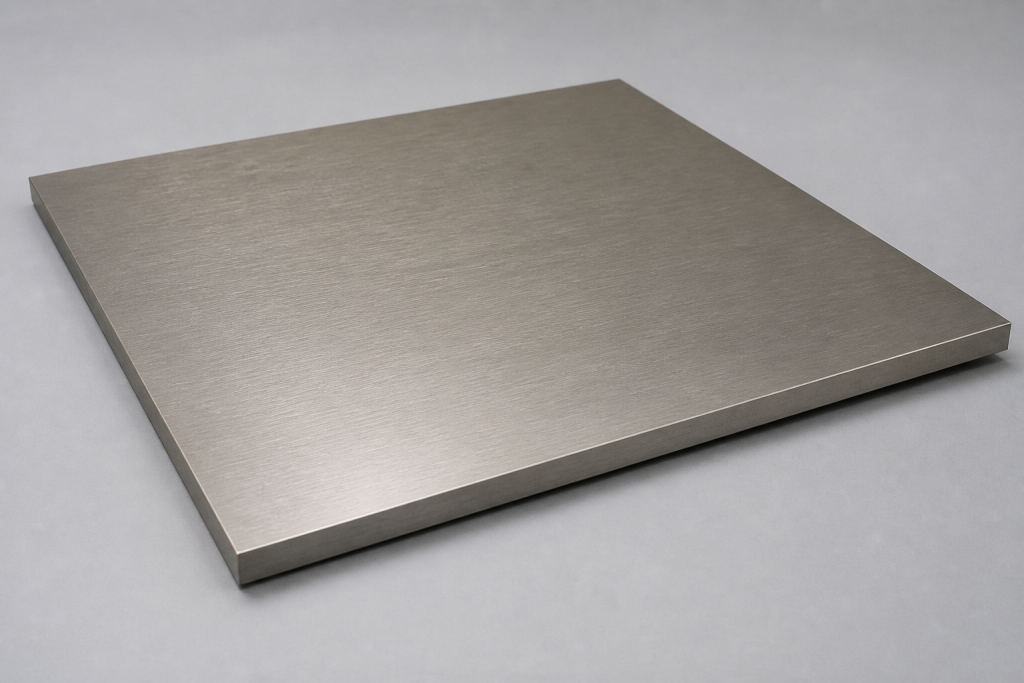
Inconel 718 at a glance
| Property | Value | Note |
|---|---|---|
| Designations | UNS N07718, W.Nr. 2.4668, Alloy 718 | INCONEL is a trademark of the Special Metals group |
| Alloy type | Precipitation-hardenable Ni-Cr-Fe alloy with Nb and Mo | Hardened by gamma prime and gamma double-prime |
| Density | 8.19 g/cm³ (0.296 lb/in³), annealed | Two other producer data sheets give 8.23 and 8.26 g/cm³ |
| Melting range | 1260 to 1336 °C (2300 to 2437 °F) | Other producers give 1257 to 1260 °C for the lower bound and 1335 to 1343 °C for the upper |
| Service temperature | About −253 °C (−423 °F) to 704 °C (1300 °F) | One producer limits it to below 650 °C (1200 °F) |
| Main specifications | ASTM B637, B670, B983, A1014; AMS 5662, 5663, 5596 | See the product-form table below |
Chemical composition
The limits below are those one producer publishes for UNS N07718 and states as conforming to the AMS specifications. A second producer data sheet and a 1972 NASA materials handbook give the same figure for each element, though they express the nickel and niobium limits slightly differently (see the note below the table). The ASTM and AMS documents themselves control any order, so the ordered specification and revision decide.
| Element | Weight % |
|---|---|
| Nickel (plus cobalt) | 50.00 to 55.00 |
| Chromium | 17.00 to 21.00 |
| Iron | Balance |
| Niobium (plus tantalum) | 4.75 to 5.50 |
| Molybdenum | 2.80 to 3.30 |
| Titanium | 0.65 to 1.15 |
| Aluminium | 0.20 to 0.80 |
| Cobalt | 1.00 max |
| Carbon | 0.08 max |
| Manganese | 0.35 max |
| Silicon | 0.35 max |
| Phosphorus | 0.015 max |
| Sulfur | 0.015 max |
| Boron | 0.006 max |
| Copper | 0.30 max |
One point to check on a certificate is how niobium is reported, because the data sheets express it in different ways: niobium plus tantalum 4.75 to 5.50 % (two producers), niobium 4.75 to 5.5 % with tantalum limited separately to 0.05 % (one producer), niobium plus tantalum 5.0 to 5.5 % (an older bar data sheet) and niobium alone 4.75 to 5.50 % (the NASA handbook). Check that the certificate reports it the way the ordered specification does.
Physical properties
These are typical values for information, not acceptance values; one producer states that its physical data are not suitable for specification purposes.
| Property | Typical value |
|---|---|
| Density, annealed | 8.19 g/cm³ (0.296 lb/in³) |
| Density, annealed and aged | 0.297 lb/in³ (8.22 g/cm³) |
| Melting range | 1260 to 1336 °C |
| Specific heat at room temperature | 435 to 460 J/kg·K, by source |
| Thermal conductivity near room temperature | 11.2 to 11.5 W/m·K, by source |
| Mean thermal expansion near room temperature | 12.8 to 14.1 µm/m·°C, by source |
| Electrical resistivity at room temperature | 118 to 127 µΩ·cm, by source and condition (121 aged) |
| Young’s modulus at room temperature | 200 to 204 GPa, by source |
| Curie temperature, annealed and aged | −112 °C (−170 °F) |
Heat treatment: the two standard routes
Inconel 718 is aged after a solution anneal, and producers describe two standard routes. The choice is written into the order, because the AMS specifications are split by solution temperature.
| Route | Solution anneal | Ageing | Used for |
|---|---|---|---|
| Lower solution temperature | 927 to 1010 °C (1700 to 1850 °F), rapid cool | 718 °C (1325 °F) for 8 hours, furnace cool to 621 °C (1150 °F), 18 hours ageing in total, air cool | Tensile and creep-rupture strength; the condition behind AMS 5596, 5662 and 5663 |
| Higher solution temperature | 1038 to 1066 °C (1900 to 1950 °F), rapid cool | 760 °C (1400 °F) for 10 hours, furnace cool to 649 °C (1200 °F), 20 hours ageing in total, air cool | Impact properties; the condition behind AMS 5664 and 5597; one producer notes a tendency to notch brittleness in stress rupture |
Material for oil-field service is a third condition: one producer makes it to NACE MR0175, which requires a maximum hardness of 40 HRC after solution annealing and ageing, typically by solution treatment at 1850 to 1900 °F (1010 to 1038 °C) and ageing at 1450 °F (788 °C) for six to eight hours. That condition has to be stated on the order.
Mechanical properties by specification
The full AMS texts are not public; the minimums below are as restated by producers for material solution annealed at 927 to 1010 °C and aged, tested at room temperature. Each row is given in at least two producer data sheets.
| Specification and form | Tensile strength, min | 0.2 % yield strength, min | Elongation, min | Other |
|---|---|---|---|---|
| AMS 5662 / 5663, bars, transverse | 180 ksi (1240 MPa) | 150 ksi (1030 MPa) | 6 % | Reduction of area 8 %; hardness 331 HB min; one producer restates this row for rod and bar up to 127 mm (5 in); the specifications cover product up to 254 mm (10 in) |
| AMS 5596, sheet and plate 0.25 to 25.4 mm thick | 180 ksi (1241 MPa) | 150 ksi (1034 MPa) | 12 % | Strip under 0.25 mm: the same strength minimums, no elongation given |
Before ageing the alloy is much softer: one producer gives about 20 to 25 HRC in the solution-treated condition, rising to about 36 to 44 HRC after ageing. That is why the condition on the certificate matters as much as the specification number.
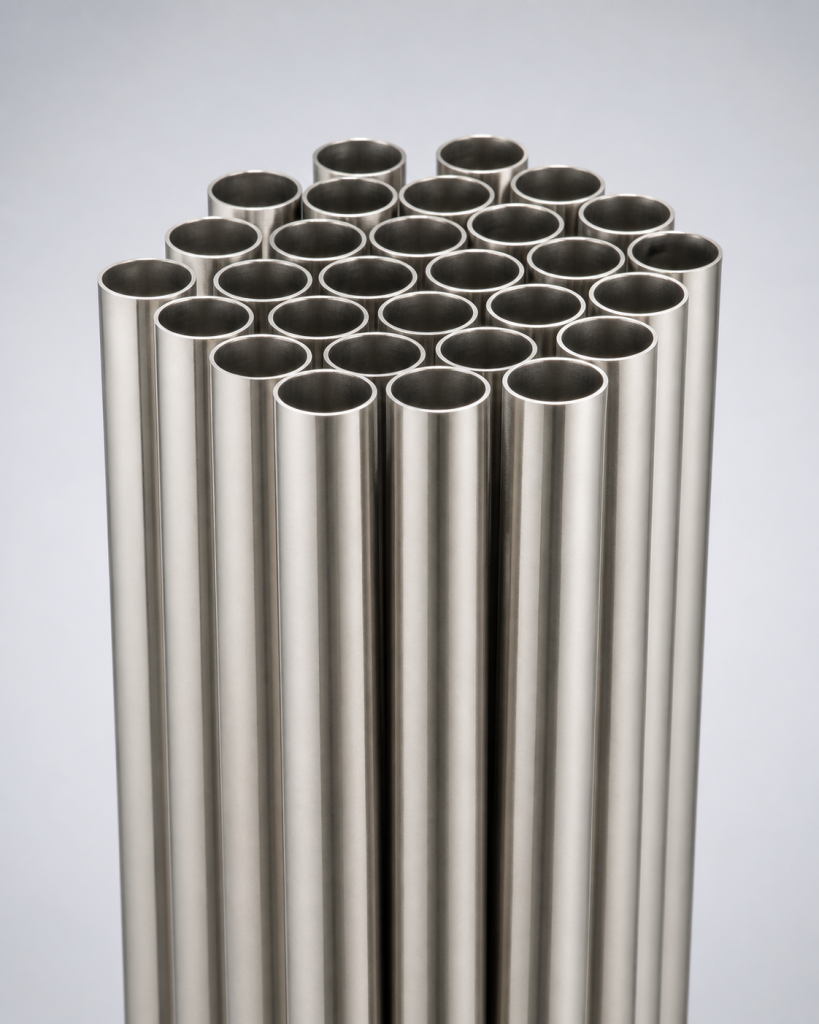
Specifications by product form
| Product form | ASTM | SAE AMS |
|---|---|---|
| Bar, rod, forgings and forging stock (rings: AMS) | B637 | 5662 (solution treated), 5663 (solution and precipitation treated), 5664 (1950 °F solution treated); all three also cover rings |
| Plate, sheet and strip | B670 (annealed condition) | 5596, 5597 |
| Seamless tube (ASTM B983 also covers pipe) | B983 | 5589, 5590 (seamless tubing) |
| Bolting material | A1014 | None listed |
| Round bar and wire, work strengthened | None listed | 5962 |
| Welding wire | None listed | 5832 (AWS A5.14 ERNiFeCr-2 filler) |
No ASTM or AMS specification for welded Inconel 718 tube or pipe turned up in the sources used for this page, so a welded tube requirement needs its own agreed specification.
Where it is used, and its limits
| Use | Typical parts |
|---|---|
| Aircraft and land-based gas turbines | Rings, casings, discs, mounting parts and formed sheet-metal parts |
| Liquid-rocket engines and cryogenic service | Injector plates, forged rings, thrust-chamber jackets, bellows, tubing, cryogenic tankage |
| Fasteners and springs | High-strength bolts and screws; springs up to about 593 °C (1100 °F) |
| Oil and gas | Listed in NACE MR0175; oil-field material is made to a 40 HRC maximum in the condition described above; one producer offers an oil-and-gas variant used in drilling equipment and pump shafts |
The upper temperature differs between sources: most producers give strength up to about 704 °C (1300 °F), one gives high strength to about 760 °C (1400 °F), and another limits use to below 650 °C (1200 °F). These are strength limits; producers give oxidation resistance to a higher temperature, about 980 to 1000 °C. Producers warn that heating fuels must be very low in sulfur and the material clean before it goes into the furnace, and that forging needs uniform final reductions to avoid a duplex grain structure; one producer adds that Laves phase forming in weld metal lowers strength and toughness unless it is dissolved by a 1900 to 1950 °F solution treatment. A 1972 NASA handbook did not recommend the alloy for gaseous-hydrogen tankage because of embrittlement.
Common questions
Is Inconel 718 magnetic? It is not ferromagnetic at room temperature. Its Curie temperature is −112 °C in the aged condition and below −196 °C in the annealed condition, and producers give a relative permeability of about 1.001 at room temperature.
What is the difference between AMS 5662 and AMS 5663? Both cover bars, forgings, rings and forging stock solution heat treated at 968 °C (1775 °F). AMS 5662 covers the solution-treated, precipitation-hardenable condition; AMS 5663 covers material that is solution and precipitation heat treated. One producer restates the hardness as below 277 HB for bar in the AMS 5662 condition and above 331 HB after ageing, so bar ordered to AMS 5662 arrives in the softer condition and reaches the aged properties only after ageing.
Can Inconel 718 be welded? Yes. Producers describe its resistance to post-weld and strain-age cracking as good, because it ages slowly, and give AWS A5.14 ERNiFeCr-2 or AMS 5832 matching filler; Laves phase in the weld metal is the point to control.
Is Inconel 718 the same as Alloy 718? Yes, as a material. INCONEL is a trademark; Alloy 718 and UNS N07718 are the generic names, and W.Nr. 2.4668 is the European material number.
How Inconel compares with titanium for corrosion and high-temperature service is covered in titanium or Inconel.
Specification detail with sources
The designations UNS N07718 and W.Nr. 2.4668, the operating range of −423 to 1300 °F, the composition limits shown in the table (stated to conform to AMS specifications), the density of 0.296 lb/in³ annealed, the melting range of 2300 to 2437 °F (1260 to 1336 °C), the specific heat of 435 J/kg·°C, the Curie temperatures, the exact temperatures and times of the two standard heat treatments, the notch-brittleness note, the AMS 5662/5663 and AMS 5596 minimums in ksi, the furnace-cleanliness and forging cautions, the NACE MR-01-75 listing and the 40 HRC oil-field condition, the permeability of 1.0011 aged, springs up to 1100 °F and the gas-turbine, rocket, cryogenic-tankage and fastener uses are from the Special Metals INCONEL alloy 718 bulletin (Publication SMC-045, 2007). Composition reported according to ASTM and SAE AMS with tantalum listed separately, the density of 8.26 g/cm³, the specific heat of 460 J/kg·K, the thermal conductivity of 11.5 W/m·K, the modulus of 204 GPa, the AMS 5662/5663 and AMS 5596 minimums in MPa with their size limits, the melting range of 1257 to 1342 °C, the expansion of 14.1 µm/m·K, the resistivity of 118 µΩ·cm, the permeability of 1.001 maximum, the hardness below 277 HB (AMS 5662) and above 331 HB (aged), oxidation resistance to about 1000 °C, the turbine disc and mounting-part uses and the oil-and-gas variant are from VDM Metals Material Data Sheet No. 4127 (2020). The density of 8.19 g/cm³, the aged density of 8.22 g/cm³, the resistivity of 121 µΩ·cm, the niobium plus tantalum range of 5.0 to 5.5 % in the bar data sheet, the hardness before and after ageing, the purpose of each heat-treatment route (impact properties at the higher solution temperature, tensile and creep-rupture properties at the lower), the melting range of 1260 to 1343 °C, the thermal conductivity of 11.2 W/m·K, the resistivity of 127 µΩ·cm annealed, the high-strength limit of about 1400 °F, the oxidation limit of about 1800 °F (982 °C) and the Laves-phase caution are from ATI technical data sheets for 718 (2011 and 2017). The 1200 °F limit, the melting range of 1260 to 1335 °C, the density of 8.23 g/cm³, the thermal conductivity of 11.4 W/m·°C, the expansion of 12.8 µm/m·°C and the AWS A5.14 ERNiFeCr-2 filler are from the Haynes 718 alloy brochure (H-3055D, 2020). The same element limits, the density of 8.19 g/cm³, the injector-plate, thrust-chamber-jacket, bellows and tubing uses in rocket engines and the gaseous-hydrogen caution are from NASA CR-123774, Materials Data Handbook: Inconel Alloy 718 (1972). The product forms covered by ASTM B637, B670, B983 and A1014 are from ASTM’s published scopes, and the AMS titles, solution temperatures and the 254 mm size limit of AMS 5662 and 5663 are from SAE’s published titles and abstracts for AMS 5662, 5663, 5664, 5596, 5597, 5589, 5590, 5962 and 5832. These documents are cited as public references for the alloy; they do not identify the mill producing material for any Beiyu order. INCONEL is a trademark of the Special Metals Corporation group of companies.
Ordering Inconel 718
An enquiry should name the specification and revision, the condition (solution annealed, or solution annealed and aged) and, if the parts will be aged after machining, which heat-treatment route applies. Beiyu Titanium quotes Inconel 718 bar as round, forged, turned or peeled bar and cut blanks to ASTM B637, AMS 5662, AMS 5663 or the buyer’s specification, with chemistry and mechanical reports by heat number and an EN 10204 3.1 certificate by order scope. Send the drawing or size list with the condition and documents required, and the enquiry is reviewed against them before quotation.