
Alloy 825, sold by Special Metals as INCOLOY alloy 825 and designated UNS N08825 and Werkstoff Nr. 2.4858 (EN NiCr21Mo), is a nickel-iron-chromium alloy to which molybdenum, copper and titanium are added. VDM describes it as a titanium-stabilised, fully austenitic alloy; ATI states that it is not hardenable by heat treatment; Special Metals states that cold work can strengthen it substantially, and ATI that cold deformation may raise its strength. Special Metals names sulfuric acid, phosphoric acid, sulfur-containing flue gases, sour gas and oil wells and sea water as the environments where it is particularly useful, and states that its nickel content is enough for resistance to chloride-ion stress-corrosion cracking. Buyers order it by product form and specification, for example ASTM B423 for seamless pipe and tube, B424 for plate, sheet and strip and B425 for bar.
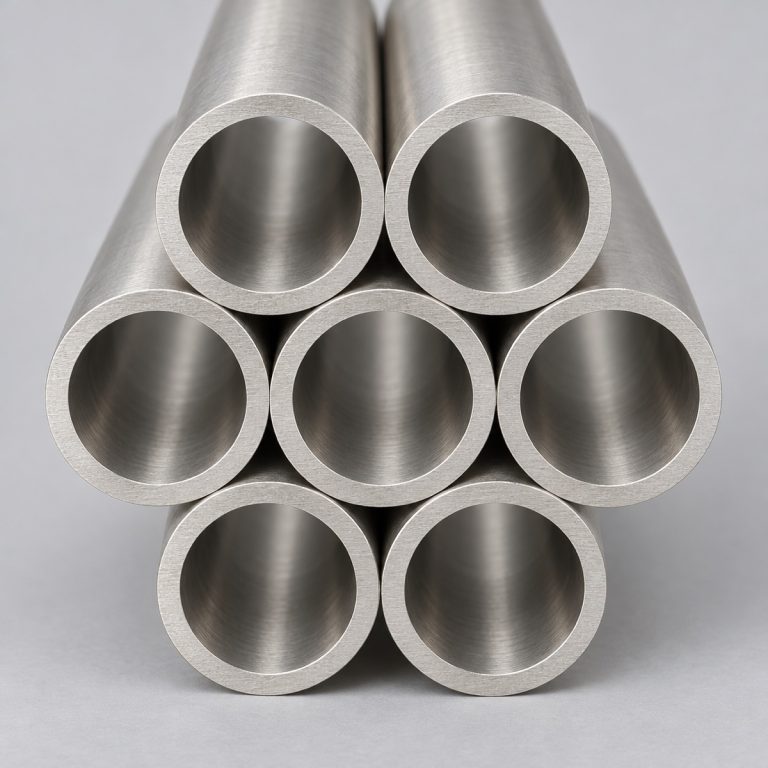
Alloy 825 summary
| Aspect | Value | Remark |
|---|---|---|
| Designations | UNS N08825, W.Nr. 2.4858 (EN NiCr21Mo), Alloy 825 | Also ISO NiFe30Cr21Mo3 and AFNOR NC21FeDU; the INCOLOY name is trademarked by Special Metals |
| Family | Ni-Fe-Cr with Mo, Cu and Ti; face-centred cubic | Not hardenable by heat treatment; strengthened by cold work |
| Density | 8.14 g/cm³ (0.294 lb/in³) | The same figure from Special Metals, VDM and ATI |
| Melting range | 1370 to 1400 °C (2500 to 2550 °F) | Special Metals and VDM |
| Temperature caution | About 540 °C: above it, Special Metals states, phase formation can significantly lower ductility and impact strength | Special Metals; ASME Section VIII, Division 1 use up to 538 °C (VDM, Alleima) |
| Main specifications | ASTM B423, B424, B425, B163, B704, B705, B564 | No SAE AMS specification appears in the producer lists |
Composition, weight percent
The table follows Special Metals, whose bulletin names no specification for these limits. ATI prints the same limits on the cards for plate, sheet and strip that list ASTM B424 and ASME SB-424, except that its plate and strip cards give iron as the balance instead of 22.0 % minimum. No public copy of the ASTM tables was found, so acceptance rests on whichever specification and revision the purchase order names.
| Element | Weight % |
|---|---|
| Nickel | 38.0 to 46.0 |
| Iron | 22.0 min |
| Chromium | 19.5 to 23.5 |
| Molybdenum | 2.5 to 3.5 |
| Copper | 1.5 to 3.0 |
| Titanium | 0.6 to 1.2 |
| Carbon | 0.05 max |
| Manganese | 1.0 max |
| Silicon | 0.5 max |
| Aluminium | 0.2 max |
| Sulfur | 0.03 max |
The German DIN 17744 limits that VDM publishes are a separate document and differ on several elements: carbon 0.025 % max, sulfur 0.015 % max, phosphorus 0.02 % max and cobalt 1 % max, with iron given as a range of 20 to 38 %. Material certified to DIN 17744 and material certified to ASTM limits should not be treated as interchangeable without checking each element against the order.
Physical properties
Typical values, for information. Three producers publish their own room-temperature data and agree closely, so the spread is narrow.
| Property | Typical value, by source |
|---|---|
| Density | 8.14 g/cm³ (Special Metals, VDM, ATI); Alleima rounds to 8.1 g/cm³ |
| Melting range | 1370 to 1400 °C |
| Specific heat near 20 °C | 440 J/kg·K (Special Metals, VDM, Alleima); ATI’s 500 J/kg·K is an average over 0 to 100 °C |
| Thermal conductivity near 20 °C | 10.8 W/m·K at 20 °C (VDM); 11.1 W/m·K at 21 to 25 °C (Special Metals, ATI) |
| Electrical resistivity near 20 °C | 112 µΩ·cm (VDM); 113 µΩ·cm (ATI; Special Metals 1.13 µΩ·m) |
| Mean thermal expansion to about 100 °C | 14.1 µm/m·°C from 27 to 100 °C (Special Metals); 13.9 from 21 to 93 °C (ATI); 14.2 from 30 to 100 °C (Alleima) |
| Young’s modulus at room temperature | 196 GPa on hot-rolled, annealed plate (Special Metals); 195 GPa (VDM, ATI typical) |
| Magnetic permeability | Special Metals 1.005 (200 oersted); VDM 1.005 maximum (20 °C) |
| Curie temperature | Under −196 °C (−320 °F), per Special Metals |
Annealing, stabilisation and cold work
Special Metals states that the titanium addition stabilises the alloy against sensitisation “with an appropriate heat treatment”. The producers’ guidance on that treatment is summarised below.
| Treatment or condition | What the producers state |
|---|---|
| Anneal during fabrication | Special Metals: subsequent anneals between 930 and 980 °C (1700 to 1800 °F), followed by rapid air cooling or water quenching, to maintain the properties |
| Stabilisation treatment | ATI: one hour or more between 870 and 955 °C (1600 to 1750 °F) for improved resistance to intergranular corrosion |
| Hot working | Special Metals: final hot working between 870 and 980 °C for optimum corrosion resistance; heavy sections may sensitise while cooling from the hot-working temperature, and a stabilising anneal restores resistance |
| Intermediate temperatures | ATI: best practice is to avoid long dwell times between 593 and 816 °C (1100 to 1500 °F) |
| Cold worked | The route to higher strength; Alleima supplies cold-worked, high-strength tube (Sanicro 41-110) for oil and gas production tubing and casing |
Mechanical properties
The minimums below are the ones producers restate, each with its basis. None of them replaces the ordered specification.
| Basis, form and condition | Tensile | 0.2 % yield | Elongation | Source |
|---|---|---|---|---|
| ATI card listing ASTM B424 and ASME SB-424: plate, sheet and strip | 85 ksi (586 MPa) min | 35 ksi (241 MPa) min | 30 % min | ATI |
| VdTÜV 432, room temperature: strip 0.5 to 6.4 mm, sheet and plate 5 to 100 mm | 585 MPa min | 240 MPa min | 30 % min | VDM |
| VdTÜV 432, room temperature: rod and bar up to 240 mm | 550 MPa min | 220 MPa min | 35 % min | VDM |
| Seamless tube, cold finished, at 20 °C (producer minimums; elongation on 2 in) | 586 MPa min | 241 MPa min | 30 % min, 90 HRB max | Alleima |
| Seamless tube, hot finished, at 20 °C (producer minimums; elongation on 2 in) | 517 MPa min | 172 MPa min | 30 % min, 90 HRB max | Alleima |
Typical room-temperature values from Special Metals show how much condition matters: annealed plate 662 MPa tensile and 338 MPa yield with 45 % elongation, annealed tubing 772 MPa and 441 MPa with 36 %, and cold-drawn tubing 1000 MPa and 889 MPa with only 15 %. For impact, Special Metals reports Charpy keyhole values of 107 to 113 J for plate at room temperature and 91 to 97 J at −196 °C, each an average of three tests.
Corrosion resistance and its limits
| Environment | What the producers report |
|---|---|
| Sulfuric and phosphoric acid | Among the environments where Special Metals calls it particularly useful; VDM lists sulfuric acid pickling plants and phosphoric acid production equipment |
| Chloride stress-corrosion cracking | Special Metals: nickel content sufficient for resistance. ATI: in the extremely severe boiling magnesium chloride test, a percentage of samples crack in long tests |
| Chloride pitting | ATI: chromium and molybdenum give a level of resistance, but not to the level of alloys such as ATI 625 |
| Intergranular corrosion | Titanium stabilises the alloy against sensitisation, with an appropriate heat treatment (Special Metals) |
| Sour oil and gas | Listed in NACE MR0175 (Special Metals). Alleima states that under ISO 15156 / NACE MR0175 it is acceptable cold worked and annealed with no environmental limits on H2S partial pressure or elemental sulfur, and reports NIDI tests supporting use up to 260 °C at H2S partial pressures up to 10000 psi without elemental sulfur. These are two different Alleima statements: a reading of the standard’s listing, and a tested envelope that excluded elemental sulfur |
| Hot nitric acid near its azeotrope | ATI recommends higher-chromium alloys for these most severely oxidising conditions |
| Sulfur at high temperature | Heat treatment in, or exposure to, high-sulfur environments at elevated temperature is detrimental (ATI); VDM warns that sulfur, phosphorus, lead and similar low-melting-point metals can cause damage when the alloy is heat treated |
The upper temperature limits come from different documents and serve different purposes. Special Metals warns that exposure above about 540 °C (1000 °F) can cause phase formation that significantly lowers ductility and impact strength, so the alloy is not normally used where creep-rupture properties are design factors. VDM gives good toughness up to about 550 °C, and pressure-vessel approval up to 450 °C under VdTÜV and 538 °C under ASME Section VIII, Division 1.
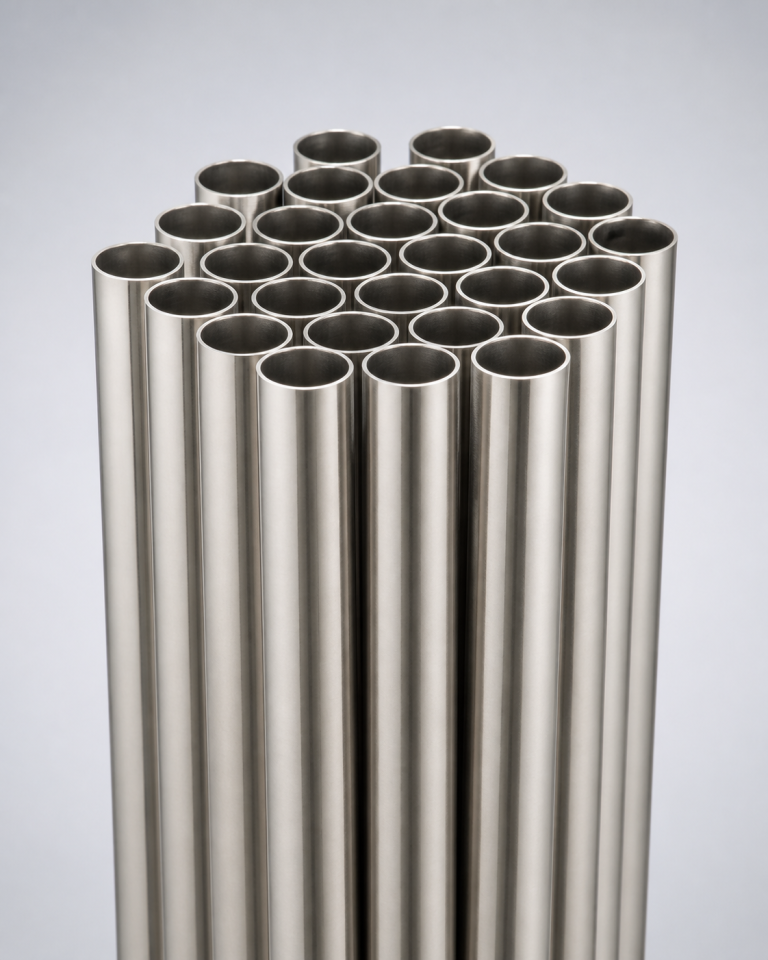
ASTM specifications for each form
| Form | ASTM specification |
|---|---|
| Seamless pipe and tube | B423, cold-worked or hot-finished (general requirements B829) |
| Seamless condenser and heat-exchanger tube | B163 (in the 825 lists of Special Metals, ATI and Alleima; ASTM’s scope page gives no alloy list) |
| Welded boiler, heat-exchanger and condenser tube | B704, outside diameter 3.18 to 127 mm and wall 0.38 to 12.70 mm (Special Metals also lists B751) |
| Welded pipe | B705, annealed (Special Metals also lists B775) |
| Plate, sheet and strip | B424 (Special Metals also lists B906) |
| Rod and bar | B425, hot-finished or cold-drawn rounds, squares, hexagons and rectangles |
| Forgings | B564 |
| Fittings | B366 (Special Metals includes it in its 825 list; the ASTM scope page lists no alloys) |
Two producers list ASTM B425 for wire as well, but the public B425 scope covers rounds, squares, hexagons and rectangles and does not mention wire, so a wire order should state its specification explicitly. Alleima states ASME approval under Section I, Section VIII Division 1 and Division 2, and Section III Division 1 Classes 1 and 3; the edition the project uses decides what applies.
Where Alloy 825 is used
| Industry | Equipment named by the producers |
|---|---|
| Chemical processing and acid production | Heating coils, vessels, boilers, baskets and chains in sulfuric acid pickling plants; heat exchangers, evaporators, washers and immersion pipes in phosphoric acid production |
| Oil and gas | Pipes, tubes and fittings in extraction, including heat exchangers and offshore piping; refinery heat exchangers with high hydrogen sulphide and chloride; cold-worked production tubing and casing |
| Pollution control | Named in Special Metals’ application list; sulfur-containing flue gases are among the environments it names separately |
| Nuclear | Fuel reprocessing and radioactive-waste handling; fuel element dissolvers that handle sulfuric and nitric acids and sodium hydroxide in the same equipment |
| Sea water and food | Sea-water service (Special Metals); food industry equipment (VDM) |
Buyer questions
Is Alloy 825 the same as Incoloy 825? Yes, as a material. INCOLOY is a Special Metals trademark; the generic name is Alloy 825 or UNS N08825, and other producers sell the same alloy as Nicrofer 4221 (VDM) and Sanicro 41 (Alleima).
Is Alloy 825 magnetic? Not at room temperature. Its Curie point is under −196 °C, and Special Metals and VDM both quote a permeability of 1.005.
Alloy 825, Inconel 625 or Inconel 600? Alloy 825 carries 38 to 46 % nickel with substantial iron, plus molybdenum and copper; Special Metals names sulfuric and phosphoric acid among its environments. Inconel 625 carries at least 58 % nickel and 8 to 10 % molybdenum, and ATI places its chloride pitting resistance above that of 825. Inconel 600 has no molybdenum in its limits and allows only 0.50 % copper.
Can Alloy 825 be used for high-temperature equipment? Only within limits. Special Metals states that it is not normally used where creep-rupture properties are design factors, because exposure above about 540 °C can significantly lower ductility and impact strength. For pressure parts, VDM cites approval to 450 °C under VdTÜV and 538 °C under ASME Section VIII, Division 1 (Alleima gives the same ASME figure), and VDM’s toughness statement runs to about 550 °C.
Specification detail with sources
Special Metals’ INCOLOY alloy 825 bulletin (Publication SMC-030, 2004) is the source for UNS N08825 and W.Nr. 2.4858, the alloy description, the composition limits in the table, the density of 0.294 lb/in³ (8.14 Mg/m³), the melting range of 2500 to 2550 °F (1370 to 1400 °C), the specific heat of 440 J/kg·°C, the conductivity of 11.1 W/m·°C, the resistivity of 1.13 µΩ·m, the mean expansion of 14.1 µm/m·°C, the modulus of 196 GPa, the permeability and Curie temperature, the typical tensile values and Charpy results, the cold-work, annealing, hot-working and stabilising-anneal statements, the 540 °C phase-formation warning, the chloride and titanium-stabilisation statements, the NACE MR0175 listing, the specification lists and the uses and environments. VDM Metals’ data sheet No. 4101 for VDM Alloy 825 (Revision 01, 2020) gives the EN, ISO and AFNOR designations, the titanium-stabilised austenitic description, the DIN 17744 composition, its density, melting range, specific heat of 440 J/kg·K, conductivity of 10.8 W/m·K, resistivity of 112 µΩ·cm, modulus of 195 GPa and relative permeability, the VdTÜV 432 minimums, the 550 °C toughness and the 450 °C and 538 °C pressure-vessel figures, the heat-treatment contamination caution, the wire listing under B425 and the pickling, phosphoric acid, oil and gas, nuclear dissolver and food uses. ATI’s 825 product page and technical data sheet (2013) give the plate, sheet and strip card with its minimums beside ASTM B424 and ASME SB-424, the density, the 500 J/kg·K specific heat, the 11.1 W/m·K conductivity, the 113 µΩ·cm resistivity, the 13.9 expansion, the typical 195 GPa modulus, the stabilisation treatment, the 593 to 816 °C dwell caution, the magnesium chloride, pitting, nitric acid and sulfur statements and the cold-work strengthening statement. Alleima’s Sanicro 41 seamless tube data sheet (2025) gives the seamless tube minimums, the 8.1 g/cm³ density, the 14.2 expansion, the ASME approvals and the 538 °C Section VIII limit, the ISO 15156 / NACE MR0175 statement and the NIDI sour-service tests, the cold-worked production tubing and the refinery heat-exchanger use. The forms covered by ASTM B423, B424, B425, B704, B705 and B564, and the scopes of B163 and B366, come from ASTM’s published scope pages. These are public alloy references only and none of them identifies the mill producing material for a Beiyu order. INCOLOY is a trademark name of the Special Metals Corporation group.
Ordering Alloy 825
An enquiry should give the product form and specification (for tube, whether it is seamless, welded or capillary), the size, the condition and, where intergranular corrosion matters, whether a stabilised condition is required. Beiyu Titanium quotes Alloy 825 tubing to the buyer’s grade, standard, size and inspection requirement: seamless tube in outside diameters of 5 to 325 mm with walls of 0.5 to 12 mm and lengths up to 12000 mm, welded tube in outside diameters of 6.35 to 1219 mm with walls of 0.5 to 25 mm in the same lengths, and capillary tube of 1 to 5 mm outside diameter with walls of 0.1 to 2 mm and lengths up to 6000 mm, against ASTM B163, B423, B704 or B705 as the order requires. Mill test certificates with chemical composition and mechanical properties, heat number traceability and, when requested before quotation, hydrostatic, eddy-current, PMI or third-party inspection are provided by order scope. The nickel alloy pipe and tube page also covers Alloy 825.
For standard grades and sizes the typical lead time is 15 to 30 days from order confirmation or deposit to ex-works dispatch, sea transit time not included; special chemistry or mechanical requirements call for an adjusted melt recipe, so their lead time depends on the requirements and is confirmed with the quotation.