
Alloy 20 is the material designated UNS N08020 and W.Nr. 2.4660 (DIN EN NiCr20CuMo; ISO FeNi35Cr20Cu4Mo2). The producer data sheets name it CarTech 20Cb-3 stainless (Carpenter Technology), INCOLOY alloy 020 (Special Metals, 2004 bulletin), VDM Alloy 20 (VDM) and ATI 20 (ATI). The producers do not file it under one family. Carpenter calls it an austenitic stainless steel and ATI a superaustenitic stainless steel. VDM describes a low-carbon, niobium-stabilised nickel-iron-chromium alloy with copper and molybdenum, and the titles of ASTM B473, B475 and B729 use nickel-iron-chromium-molybdenum-copper alloy. Sulfuric acid is the service every producer highlights: Special Metals reports excellent corrosion resistance in environments containing sulfuric acid and useful resistance where chlorides, nitric acid and phosphoric acid are present. One fact bears on how the alloy is ordered in 2026. ASTM now shows five of the B specifications written for N08020 (B463, B464, B468, B473 and B729) as withdrawn with no replacement, while producer data sheets, all of them older than the withdrawals, still list them.
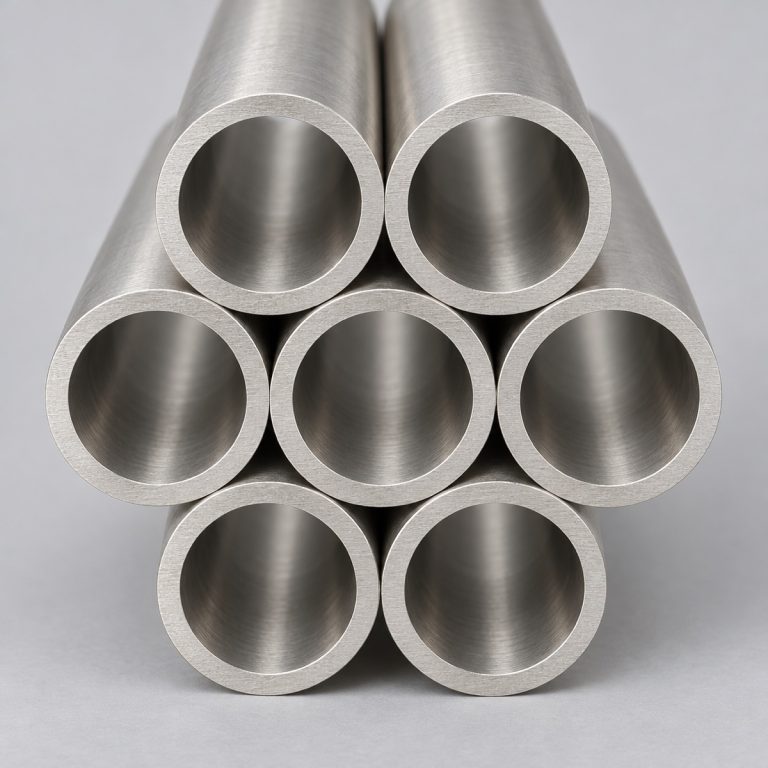
Alloy 20 in brief
| Item | Detail | Note |
|---|---|---|
| Designations | UNS N08020, W.Nr. 2.4660, DIN EN NiCr20CuMo, ISO FeNi35Cr20Cu4Mo2 | Names: CarTech 20Cb-3 (Carpenter), INCOLOY alloy 020 (Special Metals), VDM Alloy 20, ATI 20 |
| Alloy type | Niobium-stabilised austenitic alloy of nickel, iron and chromium with copper and molybdenum | Carpenter and ATI class it as stainless steel; VDM as a nickel-iron-chromium alloy |
| Strengthening | Cold work only | ATI and Carpenter: it cannot be hardened by heat treatment |
| Delivery condition | Annealed (ATI: all material it furnishes; VDM: plate and sheet); stabilized annealed in the withdrawn B463 | Special Metals says it is normally used annealed |
| Density | 8.08 g/cm³ (0.292 lb/in³) | Special Metals and ATI; VDM gives 8.1 g/cm³ |
| Melting range | 1,380 to 1,420 °C (2,520 to 2,600 °F) | VDM; the only producer figure we found. Rolled Alloys, a distributor, prints 2525 to 2630 °F |
| Main strength | Sulfuric acid service, including resistance to stress-corrosion cracking in boiling 20 to 40 % sulfuric acid | Special Metals; Carpenter for the cracking statement |
| Main limits | Cracks in boiling 42 % magnesium chloride and in the very severe 45 % magnesium chloride test; organic-acid resistance below that of high-molybdenum alloys | ATI test data and wording |
| ASTM status, 2026-11-06 | B463, B464, B468, B473 and B729 withdrawn with no replacement; B475 for weaving wire active | Set out in the next section |
Where the ASTM specifications stand in 2026
Every producer data sheet we found, dated 2002 to 2021, lists one of ASTM’s B specifications for each product form. The ASTM store pages read on 2026-11-06 show a different picture.
| Document and form | Status on the ASTM store page |
|---|---|
| B463, plate, sheet and strip | Withdrawn 2026, no replacement; last edition B463-21 |
| B464/B464M, welded pipe | Withdrawn 2025, no replacement; last edition B464/B464M-15(2020) |
| B468, welded tube | Withdrawn 2025, no replacement; last edition B468-10(2020) |
| B473, bar and wire other than for reforging | Withdrawn 2026, no replacement; last edition B473-24 |
| B729, seamless pipe and tube | Withdrawn 2026, no replacement; last edition B729-20 |
| B475, round weaving wire | Active (B475-24), and its scope still names N08020; its Note 1 refers welded uses needing stabilization to B473, now withdrawn |
| B462, flanges, forged fittings, valves and parts | Active (B462-26), but N08020 is no longer in the scope list; B462-25a still had it |
| B472, billets and bars for reforging | Active (B472-26), but N08020 is no longer in the scope list; B472-23 still had it |
| B366, wrought welding fittings | Active (B366/B366M-25); N08020 could not be confirmed from the public page; full standard not read |
| B474/B474M, electric fusion welded pipe | Active (B474/B474M-19(2023)); N08020 could not be confirmed from the public page (full standard not read), while the historical B474-03(2009) table had an Alloy 20 row |
The abstracts of B462-26 and B472-26 still mention N08020, and the general-requirement documents B751-21 and B829-24 still list B468 and B729 respectively, so the ASTM pages are not consistent with each other; we rely on the scope text, and the full documents were not read. ATI and Special Metals, and the distributor Rolled Alloys, list ASTM A240 for plate, but we could not confirm N08020 from the public A240 page, and the full standard was not read. The pages of all five withdrawn documents state that there is no replacement, plate included. A buyer who still writes B463 or B473 on an order is citing a withdrawn document, and the order should say which document and edition govern acceptance.
Chemical composition, wt %
The producers publish three composition tables. Special Metals’ limiting table and the limits ATI shows on its plate, sheet and strip cards agree line for line (ATI also prints a separate Cb line with the same limits), though ATI’s 2012 data sheet heads its table “typical… per ASTM B463”. Carpenter prints a narrower type analysis for its own 20Cb-3, and its data sheet notes that single figures are nominal except where noted. VDM’s table follows the German standard DIN 17744 for 2.4660. None of them is a current ASTM table, so the three are shown side by side rather than merged.
| Element | Special Metals (same on ATI’s cards) | Carpenter type analysis (nominal, for its 20Cb-3) | VDM, to DIN 17744 |
|---|---|---|---|
| Nickel | 32.0 to 38.0 | 32.50 to 35.00 | 32.0 to 38.0 |
| Chromium | 19.0 to 21.0 | 19.00 to 21.00 | 19.0 to 21.0 |
| Copper | 3.0 to 4.0 | 3.00 to 4.00 | 3.0 to 4.0 |
| Molybdenum | 2.0 to 3.0 | 2.00 to 3.00 | 2.0 to 3.0 |
| Niobium plus tantalum | 8 × C to 1.0 | 8 × C min, 1.00 max | 8 × C min, 1.0 max |
| Carbon | 0.07 max | 0.06 max | 0.07 max |
| Manganese | 2.0 max | 2.00 max | 2.0 max |
| Silicon | 1.0 max | 1.00 max | 1.0 max |
| Phosphorus | 0.045 max | 0.035 max | 0.025 max |
| Sulfur | 0.035 max | 0.035 max | 0.015 max |
| Cobalt | No limit listed | No limit listed | 1.5 max |
| Iron | Balance | Balance | Balance |
Balance (Fe): the remainder is determined within the grade’s composition limits under the standard specified for the order; any customer-specific chemistry requirements are confirmed in that order’s written quotation.
All three agree on chromium, copper, molybdenum, manganese, silicon and the niobium rule, and differ on nickel, carbon, phosphorus, sulfur and cobalt. All three tie niobium (plus tantalum) to the carbon content at a minimum of eight times. VDM explains that the balanced composition and optimum annealing temperature promote niobium carbides so that sensitisation does not impair corrosion resistance, and Carpenter states that the columbium minimizes carbide precipitation during welding. VDM notes that other specifications may differ slightly in some elements; the order should name the limit set it uses.
Physical properties
These are producer figures, described by VDM, ATI and Carpenter as typical. Where producers disagree, each value is shown with its source.
| Property | Special Metals | VDM | ATI |
|---|---|---|---|
| Density | 8.08 g/cm³ (0.292 lb/in³) | 8.1 g/cm³ | 8.08 g/cm³ on its data sheet, 8.09 on its product page |
| Melting range | Not given | 1,380 to 1,420 °C | Not given |
| Specific heat | 500 J/kg·°C | 456 J/kg·K at 20 °C | 0.50 kJ/kg·K from 0 to 100 °C |
| Thermal conductivity | 12.3 W/m·°C, temperature not stated | 11.5 W/m·K at 20 °C; 13.0 at 100 °C | 12.2 W/m·°C at 50 °C; 13.1 at 100 °C |
| Electrical resistivity | 1.08 µΩ·m | 107 µΩ·cm at 20 °C | 108 µΩ·cm |
| Thermal expansion | Mean 14.7 µm/m·°C, 25 to 100 °C | 15.0 ×10⁻⁶/K at 100 °C, reference temperature not stated | Mean 14.7 ×10⁻⁶/°C, 25 to 100 °C, on material annealed at 941 °C for 1 hour and water quenched |
| Modulus of elasticity | 193 GPa; shear modulus 76 GPa | 202 GPa at 20 °C | 193 GPa in tension |
| Magnetic permeability | Not given | 1.002 max at 20 °C | Not given |
Carpenter gives a Poisson’s ratio of 0.310 and a permeability of 1.0020 at 200 oersteds for both annealed material and material cold reduced by up to 80 %. Resistivity and expansion agree well across producers; the modulus does not: Special Metals and ATI give 193 GPa, VDM 202 GPa at 20 °C, and Carpenter prints both 29.0 ×10³ ksi at 75 °F and 28.0 ×10³ ksi in tension, so a stiffness calculation should name its source.
Annealing, hot working and welding
The producers anneal Alloy 20 in a band of roughly 920 to 1010 °C, but they set the window and the cooling differently. These are each producer’s practice, not specification limits.
| Producer | Anneal | Hot working |
|---|---|---|
| Carpenter | 941 to 1010 °C (1725 to 1850 °F) for 30 minutes per 25.4 mm of thickness, water quench; do not overheat | Heat uniformly and forge from 1149 to 1232 °C, not below 982 °C, then reheat to 941 to 1010 °C for at least 30 minutes per 25.4 mm of thickness and water quench for optimum stabilization |
| ATI | 927 to 1010 °C for half an hour per inch of thickness, water quench; do not overheat | Not given |
| Special Metals | 982 to 1010 °C for a time suited to the section, air cooled | 760 to 1175 °C |
| VDM | 920 to 960 °C, preferably about 950 °C; rapid cooling in water is required for optimum corrosion properties, and rapid air cooling may be used below about 3 mm | 1,150 to 900 °C, then rapid cooling in water or air, with heat treatment afterwards recommended |
Carpenter and ATI note that lower hardness for better formability may be obtained by annealing at up to 1149 °C, at a sacrifice of stabilization in Carpenter’s wording and with a possible sacrifice in ATI’s, and both producers accept the higher temperatures only if the part will not later be welded or heated above 538 °C. VDM adds that work hardening is faster than in austenitic stainless steels and that cold forming beyond 15 % needs a new stabilising anneal, that stress relief is carried out at about 540 °C, and that heating in contact with sulfur, phosphorus, lead or other low-melting metals, for example from marking paints or lubricants, may embrittle it.
Welding guidance diverges on filler metal. Carpenter suggests matching AWS E/ER320LR consumables, ATI names E320-15 and E320-16 matching electrodes for shielded metal arc welding; for gas tungsten and gas metal arc welding VDM recommends nickel-alloy fillers to AWS A5.14 ERNiCrMo-3 or ERNiCrMo-13 (with AWS A5.11 ENiCrMo-3 or ENiCrMo-13 electrodes for shielded metal arc welding, choosing coated electrodes with a low silicon content), and Special Metals lists INCONEL filler metals 625 and 622 and INCO-WELD filler metal 686CPT for the same two processes, with INCONEL welding electrodes 112 and 122 and INCO-WELD welding electrode 686CPT for shielded metal arc welding. ATI notes that the alloy, like many other fully austenitic alloys, is somewhat prone to weld hot cracking and microfissuring, and that cracking is particularly prevalent under high restraint and high heat input, and that welds made with matching filler are slightly less corrosion resistant than the base metal. Carpenter advises against oxyacetylene welding because of carbon pickup. Interpass limits differ: below 93 °C in ATI’s shielded metal arc guidance and no more than 120 °C for VDM. VDM states that neither pre- nor post-weld heat treatment is required. Carpenter states that assemblies have usually gone into service as welded, and that a post-weld stabilizing heat treatment should be considered for elevated-temperature service.
Mechanical properties
Two producers publish minimums for plate, and they agree: 550 MPa tensile, 240 MPa yield and 30 % elongation. ATI shows them, with a hardness limit of 95 HRB, on plate, sheet and strip cards that list ASTM B463, ASME SB-463 and ASTM A240, and B463 is now withdrawn. VDM’s Table 4 gives the same figures at 20 °C, with yield as Rp0.2, for stabilized-annealed plate up to 25 mm thick without naming a specification, together with minimums at higher temperatures.
| VDM minimums, stabilized-annealed plate up to 25 mm | 0.2 % yield | 1.0 % yield | Tensile |
|---|---|---|---|
| 20 °C | 240 MPa | 280 MPa | 550 MPa (elongation 30 %) |
| 100 °C | 210 MPa | 250 MPa | 520 MPa |
| 200 °C | 180 MPa | 220 MPa | 495 MPa |
| 300 °C | 160 MPa | 200 MPa | 470 MPa |
We found no publicly available minimums for bar, wire, pipe, tube, forgings or fittings in N08020 (the full ASTM documents were not read), so for those forms the document named on the order has to supply them. Typical values run above the plate minimums. Special Metals gives typical room-temperature values of 620 MPa tensile, 300 MPa yield (0.2 % offset) and 40 % elongation. ATI’s typical room-temperature ranges are 324 to 386 MPa yield (0.2 %), 620 to 661 MPa tensile, 35 to 40 % elongation in 50.8 mm and 84.5 to 86.5 HRB for sheet and strip. For plate they are 345 to 414 MPa, 586 to 655 MPa, 35 to 45 % and 200 to 220 HB, and ATI puts annealed hardness at 187 to 240 HB. Cold work raises strength steeply. In Special Metals’ room-temperature tensile tests on cold-worked material, with the 0 % row footnoted as stabilize-annealed, yield (0.2 % offset) goes from 306 MPa at 0 % reduction to 765 MPa at 20 % and 965 MPa at 60 %, tensile from 661 to 826 and 1029 MPa, and elongation falls from 38 % to 13 % and 5 %. Carpenter notes that 10 to 20 % cold work alone improves yield strength significantly.
Corrosion resistance and its limits
Carpenter reports superior resistance to stress-corrosion cracking in boiling 20 to 40 % sulfuric acid, and VDM lists excellent resistance to sulfuric, phosphoric and organic acids and to aqueous salt solutions, with good resistance to nitric acid. ATI attributes the alloy’s useful resistance to reducing acids to its nickel and copper. It rates its resistance to organic acids as good but not at the level of high-molybdenum alloys such as AL-6XN (UNS N08367), and its resistance to chloride pitting and crevice corrosion as comparable to Type 316. Carpenter cautions that rates measured in reagent-grade sulfuric acid are only a guide. Iron, copper and chromium ions, usually present in pickling and plating solutions, can lower the attack, and chloride ions can raise it, and rates on heat-transfer surfaces can be markedly higher than where metal and solution are at the same temperature, at atmospheric pressure.
| Test and conditions | Result | Source |
|---|---|---|
| Sulfuric acid, strip, 168 h: 70 % at 50 °C; 20 % at 85 °C; 20 % boiling (concentration basis not stated) | 0.051, 0.457 and 0.432 mm a year | Special Metals |
| Boiling 10 % sulfuric acid (by weight), five 48 h periods, unwelded | 0.3 mm a year, against 16.2 mm a year for Type 316 | ATI |
| Boiling 20 % and 40 % sulfuric acid (by weight), five 48 h periods | 0.2 mm a year unwelded and 0.3 mm a year with an autogenous GTAW weld, in both concentrations | ATI |
| 240 h in boiling 65 % nitric acid, and 120 h in the ferric sulfate-sulfuric acid test (a 50 % sulfuric acid solution containing ferric sulfate), annealed and annealed plus sensitized at 677 °C for one hour | Passes at 0.002 ipm maximum; elsewhere in the same data sheet Carpenter gives the ferric sulfate result as 0.002 inches per month maximum, about 0.6 mm a year | Carpenter |
| ASTM G28 Practice A | 0.27 mm a year unwelded, 0.24 welded, 0.49 sensitized | ATI |
| ASTM A262 Practice C, 65 % nitric acid | 0.24 mm a year unwelded, 0.21 welded, 0.46 sensitized; Practice E (copper-copper sulfate-sulfuric acid): none recorded, unwelded and welded; no sensitized result shown | ATI |
| Crevice test in 6 % ferric chloride at room temperature | Weight loss 0.15 g/cm² unwelded and welded, against 0.2 for Type 316 | ATI |
| Boiling 42 % magnesium chloride | Cracked after 200 h unwelded and 80 h with an autogenous GTAW weld | ATI |
| Boiling 33 % lithium chloride, 26 % sodium chloride and 50 % sodium hydroxide | No cracking after 1,000 h, unwelded and with an autogenous GTAW weld | ATI |
The cracking result is the limit a buyer should keep in mind. ATI states that the high nickel level gives significant resistance to chloride stress-corrosion cracking and that the alloy resists most less severe laboratory tests, but that it will crack in the very severe 45 % magnesium chloride test. Carpenter says only that 20Cb-3 showed improved resistance in boiling 42 % magnesium chloride and better chloride stress-corrosion cracking resistance than its earlier 20Cb grade; it gives no pass or fail. VDM lists very good resistance to chloride-ion induced stress-corrosion cracking without giving test data. VDM states that optimum corrosion resistance needs a clean, metallically bright surface, and Carpenter that surfaces must be free of scale, lubricants, foreign particles and coatings applied for drawing and heading, with cleaning or passivation considered after fabrication.
Specifications by product form
The table pairs each form with the documents producers list for it and the ASTM document’s status on 2026-11-06; the ASME SB adoptions were not checked.
| Product form | Document producers list | Status |
|---|---|---|
| Plate, sheet and strip | ASTM B463 / ASME SB-463; ASTM A240 (ATI, Special Metals), with ASME SA-240 in Special Metals’ list | B463 withdrawn; the ASME SB-463 adoption was not checked; N08020 not confirmed from the public A240 page; full standard not read |
| Bar and wire | ASTM B473 / ASME SB-473 | B473 withdrawn; the ASME SB-473 adoption was not checked |
| Seamless pipe and tube | ASTM B729 / ASME SB-729 | B729 withdrawn; the ASME SB-729 adoption was not checked |
| Welded pipe | ASTM B464 / ASME SB-464; ASTM B474 for electric fusion welded pipe | B464 withdrawn; the ASME SB-464 adoption was not checked; B474 active; N08020 not confirmed from the public page; full standard not read |
| Welded tube | ASTM B468 / ASME SB-468 | B468 withdrawn; the ASME SB-468 adoption was not checked |
| Flanges, forged fittings, valves and parts | ASTM B462 | Active; N08020 no longer in its scope |
| Billets and bars for reforging | ASTM B472 | Active; N08020 no longer in its scope |
| Wrought welding fittings | ASTM B366 / ASME SB-366 | Active; N08020 not confirmed from the public page; full standard not read |
| Round weaving wire | ASTM B475 | Active; names N08020 |
| European documents | DIN 17744 for composition; DIN 17750, 17752 and 17753 for plate and strip, rod and bar, and wire (VDM) | Producer lists |
Carpenter states that the alloy is included in ASME Section VIII Division 1, Section III Classes 2 and 3 and Section IX as P-No. 45, and in AWS A5.4 and A5.9 for its E320, E320LR, ER320 and ER320LR consumables. ATI’s 2012 data sheet also names Section VIII Division 2 and states that the ASTM and ASME specifications covering the alloy carry assigned maximum design stresses to 540 °C (1000 °F). These producer statements predate the ASTM withdrawals, so the project’s own code edition is the reference for what applies. Carpenter’s 2002 data sheet also lists the alloy in NACE MR0175 for sulfide stress cracking resistance, in the annealed or cold worked condition at up to Rockwell C 32; the current NACE edition was not checked.
Where Alloy 20 is used
| Industry | Producer’s examples |
|---|---|
| Sulfuric acid | Equipment for making sulfuric acid and for processes based on it (VDM); SO2 scrubbers where acid matters more than halides (Carpenter) |
| Chemical and allied industries | Synthetic rubber, high-octane gasoline, solvents, explosives, plastics, synthetic fibers, heavy and organic chemicals, pharmaceuticals and agrichemicals (Carpenter); synthetic polymers and amino acid extraction columns (VDM) |
| Process equipment | Mixing tanks, heat exchangers, process piping, pickling equipment, pumps, valves, fasteners and fittings (Special Metals); fans, agitators, distillation towers, bubble caps, pump shafts, valve stems and tie rods (Carpenter) |
| Product purity | Food and dye processing, where corrosion must not contaminate the product with metal ions (ATI); food-processing equipment, to protect against contamination (VDM) |
Special Metals adds that its aqueous-corrosion applications are essentially the same as those of INCOLOY alloy 825, and VDM puts its range of use at temperatures up to approximately 500 °C.
Common questions from buyers
Is Alloy 20 a nickel alloy or a stainless steel? The producers disagree. Carpenter and ATI call it a stainless steel, VDM a nickel-iron-chromium alloy, and the titles of ASTM B473, B475 and B729 a nickel-iron-chromium-molybdenum-copper alloy. The UNS number N08020 and the specification on the order identify the material whichever label is used.
Is it immune to chloride stress-corrosion cracking? No. ATI’s data show cracking in boiling 42 % magnesium chloride after 200 hours unwelded and 80 hours with an autogenous GTAW weld, and ATI states that the alloy cracks in the very severe 45 % magnesium chloride test while resisting most less severe laboratory stress-corrosion tests.
Can it be used as welded? Carpenter states that niobium minimizes carbide precipitation during welding and that assemblies have usually been placed in service as welded, and it suggests considering a post-weld stabilizing heat treatment for elevated-temperature service. ATI adds that welds with matching filler are slightly less corrosion resistant than the base metal.
What is its upper temperature? The figures are of different kinds. VDM states use up to approximately 500 °C, ATI’s 2012 data sheet cites ASME and ASTM design stresses to 540 °C, a statement that predates the ASTM withdrawals, and Carpenter gives a safe scaling temperature of 982 °C in continuous service. They describe different limits and should not be read as one figure.
Can an order still cite ASTM B463 or B473? Both are withdrawn with no replacement, B463 in 2026 at edition B463-21 and B473 in 2026 at B473-24. An order that cites them names a withdrawn document, so the order should state which document and edition apply.
Specification detail with sources
Carpenter Technology’s CarTech 20Cb-3 data sheet (edition 11/08/02) gives the UNS number, the stainless classification, the type analysis, the Poisson’s ratio and permeability, the boiling sulfuric acid cracking statement, the comparison with 20Cb, the contaminant and heat-transfer cautions, the nitric acid and ferric sulfate test results, the 941 to 1010 °C anneal and the 1149 °C formability note with its 538 °C condition. The same data sheet gives the forging range, the cold-work note, the welding advice, the ASME, AWS and NACE listings, the scaling temperature and the uses. Special Metals’ INCOLOY alloy 020 bulletin (Publication SMC-018, 2004) gives the limiting composition, its physical constants, the typical and cold-worked tensile values, the strip sulfuric acid rates, the anneal and hot-forming ranges, the welding products, its specification list, the comparison with alloy 825 and the uses. VDM Metals’ VDM Alloy 20 data sheet (April 2021) gives the DIN EN and ISO designations, the DIN 17744 composition, the melting range and its physical constants, the stabilized-annealed plate minimums, the anneal, hot-forming, cold-forming and stress-relief rules, the contamination caution, the filler metals and interpass limit, its corrosion characterisation, the 500 °C statement and the uses. ATI’s technical data sheet for ATI 20 (2012) and product page give the superaustenitic classification, the composition and plate minimums on the cards, the density, the physical constants, the typical tensile ranges and hardness, the anneal, the boiling sulfuric acid, G28, A262, ferric chloride and stress-corrosion test results, the weld cracking and weld-metal cautions, the ASME statements and the uses. Rolled Alloys’ Alloy 20 data sheet (Bulletin 1006USe, 2012), a distributor document, is cited for its A240 listing and its separately reported melting range. The withdrawal status of B463, B464, B468, B473 and B729, and the scopes of B475, B462, B472, B366, B474, B751, B829 and A240, come from the store pages ASTM publishes. These documents are references on the grade in general and do not identify who produces the material in any Beiyu order. INCOLOY, INCONEL and INCO-WELD are Special Metals Corporation group trademarks; CarTech and 20Cb-3 are trademarks of CRS Holdings Inc., a subsidiary of Carpenter Technology Corporation; ATI 20 and AL-6XN are ATI trademarks.
Sources, with the editions read on 2026-11-06:
- Carpenter, CarTech 20Cb-3 Stainless data sheet (edition date 11/08/02)
- Special Metals, INCOLOY alloy 020 (Publication SMC-018, 2004)
- VDM Metals, VDM Alloy 20 data sheet (April 2021)
- ATI 20 technical data sheet (Version 1, 4/16/2012) and the ATI 20 product page
- Rolled Alloys, Alloy 20 data sheet (distributor; URL path dated 2022/07)
- ASTM store pages: B463-21, B464/B464M-15(2020), B468-10(2020), B473-24, B729-20, B475-24, B462-26, B462-25a, B472-26, B472-23, B366/B366M-25, B474/B474M-19(2023), B474-03(2009), B751-21, B829-24 and A240/A240M-26. Only these public pages were read, not the full standards.
Ordering Alloy 20
An Alloy 20 RFQ should name the product form, the limit set or document that governs the chemistry and its edition, the size, the condition (stabilized annealed or annealed) and any corrosion testing to be carried out, for example to ASTM G28 or A262. Because B463, B464, B468, B473 and B729 are withdrawn, stating the document and edition explicitly reduces doubt at inspection.
Please state the form, size, tolerance and quantity you need; whether that combination can be supplied in Alloy 20 is confirmed in the written quotation. For pipe and tube, start from the nickel alloy pipe and tube page. Rings, discs and blocks are set out in the nickel alloy forgings guide, and other product forms are listed in the nickel and nickel-based alloys category. State in the RFQ which documents the order needs, such as a mill test certificate with chemical and mechanical results, a dimensional report, PMI or third-party inspection. If the order needs an EN 10204 3.1 certificate, name it in the RFQ with the other documents so its scope can be confirmed in the quotation.
Lead time and any chemistry or mechanical requirements beyond the governing document are confirmed in the written quotation for each order.