
Grade 5 titanium (Ti-6Al-4V) costs well above the commercially pure grades, and for a US or UK industrial buyer a large part of that price gap pays for more than the alloy: it pays for the certificate and traceability package that comes with it. A quote written to AMS reads differently from one written to ASTM, which reads differently again from a Chinese mill offer that names the alloy TC4. This guide sets out how the designations line up, why AMS 4928 and AMS 4911 are not interchangeable, what a Grade 5 mill test certificate should contain, and how to read a non-US or non-UK offer on the terms that matter for industrial procurement. It is written for industrial and commercial service; aerospace and defence qualification sit under separate approval regimes and are out of scope here.
Grade 5 has five names: Ti-6Al-4V, TC4, R56400, 3.7165 and the AMS numbers
The same alloy carries different labels in different markets, and the first job on any Grade 5 purchase is to confirm that two offers describe the same metal. Ti-6Al-4V is the alloy; the rest are the system labels that sit on top of it.
| System | Grade 5 designation | Notes |
|---|---|---|
| Common alloy name | Ti-6Al-4V | 6% aluminum, 4% vanadium, alpha-beta alloy |
| UNS (US / ASTM) | R56400 | Grade 5; the ELI variant Grade 23 is R56407 under the ASTM B-series and R56401 under ASTM F136 |
| Werkstoff (EN / DIN) | 3.7165 | The German material number for Ti-6Al-4V |
| China GB/T | TC4 | The Chinese national designation; TC4 ELI is the Grade 23 equivalent |
| ASTM product standard | B348 (bar), B381 (forgings), B265 (sheet / plate) | Names the form and its requirements |
| AMS material spec | 4928 (bar, forging, ring), 4911 (sheet, strip, plate) | Alloy plus condition, by product form |
The practical point for a buyer sourcing from a Chinese mill is simple: TC4 on a mill certificate is Ti-6Al-4V, the same alloy as Grade 5 and Werkstoff 3.7165. What decides equivalence is the chemistry and mechanical results on the certificate against the standard you name, not the label the mill happens to use in-house. Name the standard the certificate must cite on the RFQ, and incoming inspection then has one reference to check against.
Why AMS 4928 and AMS 4911 are not interchangeable
Buyers who work to AMS material specifications sometimes quote a single AMS number for a whole order and then get a certificate mismatch, because the AMS numbers split by product form, not just by alloy.
| AMS spec | Product form | Same alloy | Condition |
|---|---|---|---|
| AMS 4928 | Bar, wire, forgings, rings, drawn shapes | Ti-6Al-4V | Annealed |
| AMS 4911 | Sheet, strip, plate | Ti-6Al-4V | Annealed |
Both are annealed Ti-6Al-4V, but a bar order certified to AMS 4911 is written to the wrong form and will not match at inspection. For bar and forging, the reference is AMS 4928; for sheet and plate, AMS 4911. When a buyer names an AMS number, the mill should confirm it matches the form actually being supplied before the order is booked, and the certificate should cite the number for that form.
The EN 10204 certificate chain: 3.1 versus 3.2
For a high-strength grade the certificate matters more than for a commercially pure grade, because the mechanical and interstitial results are what confirm you received Grade 5 and not something short of it. EN 10204 describes who verified those results, and the type number is not a quality grade of the metal.
| EN 10204 type | Who certifies | What it means for you |
|---|---|---|
| 2.2 | The manufacturer, on non-specific inspection | A statement of compliance, not results tied to your batch. Rarely enough for Grade 5. |
| 3.1 | The manufacturer’s authorised inspection representative, independent of manufacturing | Specific-inspection results for the delivered product. State the required document type in the RFQ and confirm its reporting scope and timing in the quotation. |
| 3.2 | The manufacturer’s authorised inspection representative and either the purchaser’s authorised representative or the inspector designated by the applicable official regulations | Specific-inspection results with the additional validation required by the order. Define the responsible parties, witness points, reports and schedule before order release. |
EN 10204 3.1 is one inspection-document option for Grade 5 orders that require specific-inspection results. State the required type, product specification, traceability fields and test scope in the RFQ and purchase order. If 3.2 validation or third-party involvement is required, define the responsible parties, witness points, reports and schedule before order release. Beiyu confirms the agreed document and inspection scope in the quotation.
A Grade 5 mill test certificate to 3.1 should carry, at minimum, the heat number; the chemistry, covering oxygen, nitrogen, hydrogen, carbon and iron; and the tensile strength, yield strength and elongation for the delivered heat in the annealed condition. The interstitials are worth checking on a high-strength grade, because they are where Grade 5 and its extra-low-interstitial variant differ.
Grade 5 versus Grade 23: the interstitial difference
Grade 23 is Ti-6Al-4V ELI, where ELI means extra-low interstitial. It is UNS R56407 across the industrial ASTM B-series, covering B348 bar, B265 plate and sheet, B863 wire and B381 forgings as Grade F-23. Only the surgical implant specification ASTM F136 designates its Ti-6Al-4V ELI as UNS R56401, so the correct number for the ELI grade depends on which standard is ordered rather than on the product form. In China’s system it is TC4 ELI. The alloying is the same 6% aluminum and 4% vanadium as Grade 5; the difference is tighter limits on oxygen and iron, which raises fracture toughness and ductility at some cost to strength. Grade 5 is the general high-strength workhorse; Grade 23 is specified where damage tolerance and toughness are the priority. For sourcing, the point is that they are not interchangeable on paper even though they look alike: the certificate has to state which one, and the interstitial results on it are what tell them apart.
| Standard | UNS for Grade 23 |
|---|---|
| ASTM B348 bar | R56407 |
| ASTM B265 plate and sheet | R56407 |
| ASTM B863 wire | R56407 |
| ASTM B381 forgings | R56407 |
What US and UK buyers cite differently
The metal is the same across both markets; the paperwork convention is not.
| Designation or standard convention |
|---|
| US buyers usually write Grade 5 to ASTM, UNS R56400 and, where needed, AMS 4928 for bar and forging. |
| UK and European buyers more often reference Werkstoff 3.7165, EN product standards for the form and EN 10204 for the certificate type. |
| Neither system is more valid; the dispute-prevention step is naming the single standard the certificate must be written to. |
Reading a Chinese mill’s Grade 5 offer
For a US or UK buyer comparing a Chinese Grade 5 quote against local supply, hold everything except origin constant and check the certificate package, not just the headline price.
| Field to state | What the guide states |
|---|---|
| Confirm the alloy through the label | TC4 is Ti-6Al-4V; match it to your Grade 5 or 3.7165 before comparing anything else. |
| Match the standard and form | Confirm the offer cites the right form standard, so you are comparing like with like. |
| Match the certificate type | A 3.1 offer and a 3.2 offer are not the same commercial package; align the EN 10204 type before comparing price. |
| Check the interstitials and heat traceability | On a high-strength grade, the certificate should report the interstitials, especially oxygen, along with the iron content for the delivered heat. |
| Compare landed cost, not ex-works cost | Freight, duty, currency and any third-party inspection charge belong in the comparison. |
The most reliable comparison comes from putting the same specification to both sources: grade and standard, dimensions and tolerance in metric, quantity, surface condition and the certificate type. The background on what moves titanium prices explains why two Grade 5 quotes can still differ on more than origin. The full field list is in our titanium bar RFQ checklist.
Checking a Grade 5 certificate at receiving: a five-minute routine
A certificate check works best as a fixed routine rather than an expert judgement. Five lines catch most problems. One: the specification and its revision match the purchase order, including the product-form spec, such as Grade 5 titanium bar to B348 or AMS 4928, and plate to B265 or AMS 4911. Two: the heat number on the paper matches the marking on the metal. Three: the chemistry table is complete for the grade, including the interstitials oxygen, nitrogen, hydrogen and carbon with iron as a residual, not just the aluminum and vanadium. Four: the mechanical results meet the minimums for the actual section size, since AMS minimums step with diameter. Five: the certificate type is the one ordered, 3.1 or 3.2, with the right signatures. Anything that fails the routine is a query to the mill before the material moves into stock, not after.
Why Grade 5 certificates get rejected
The common rejection causes are paperwork failures, not material failures, and most are preventable at RFQ stage. Interstitial values missing from the chemistry table. A specification edition on the certificate that predates the one on the drawing. A single certificate covering mixed heats without per-heat results. Mechanical results quoted from the wrong size band. The condition stated on the paper, annealed against STA, not matching the order. A certificate to the industrial standard where the purchase order named an AMS or implant specification. Each of these traces back to an RFQ line that was vague or absent, which is why the specification section earlier in this guide matters more than any inspection at the receiving dock.
Keeping the certificate chain alive through subcontractors
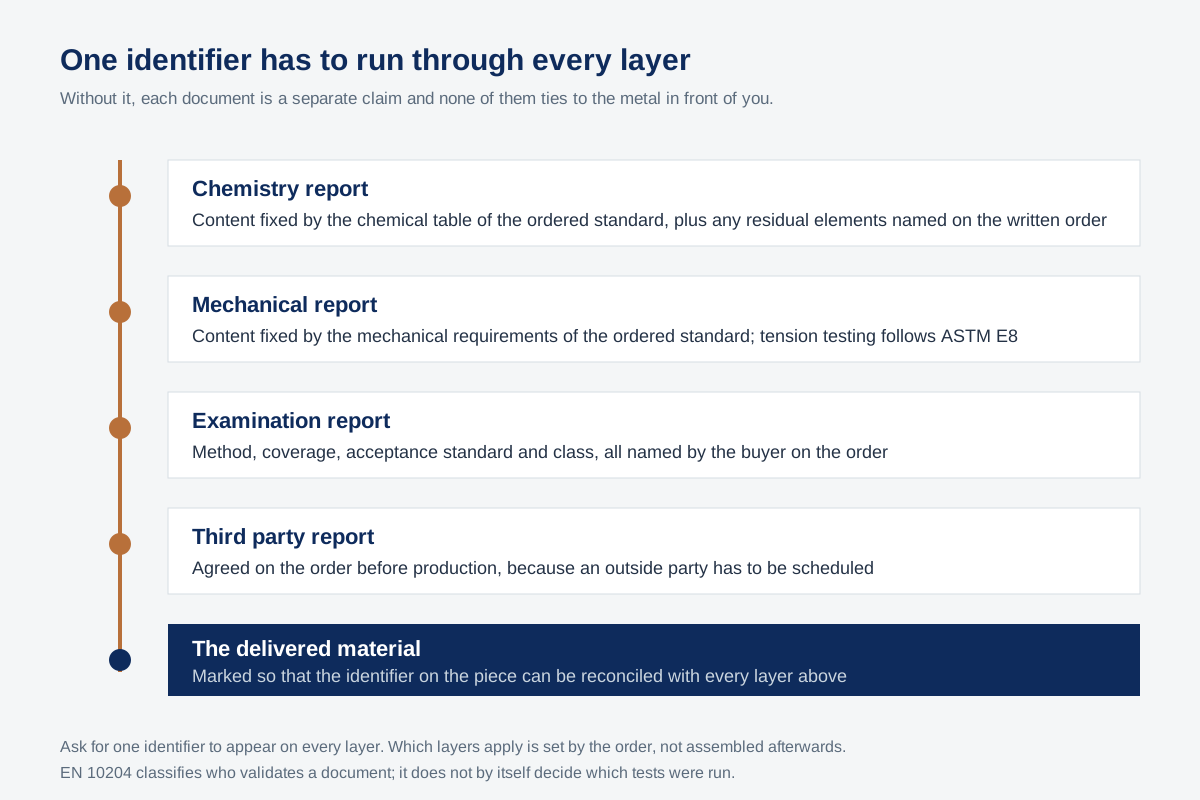
A Grade 5 certificate certifies a heat, and the chain breaks silently when material passes through cutting services, machine shops or treatment houses that return parts without identity. Three habits keep it intact: require heat-number transfer marking on every offcut and part batch; require subcontractor paperwork to reference the original heat and certificate; and file the mill certificate with the job, not in a general folder, so the link from finished part to melt survives an audit years later. For buyers reselling or assembling downstream, an intact chain is part of the product.
Procurement notes from the export desk
Two requests cost nothing at order time and a lot afterwards. Ask for the certificate draft or a specimen format before first shipment, so format arguments happen before the material sails. State the certificate language and any customer-form requirement up front; reissuing paperwork after delivery is slower than issuing it right the first time. Where a project sits between systems, dual certification, ASTM with AMS, or ASTM with ASME SB for code work, is routine when named at production and awkward to retrofit. It only works when the heat genuinely meets both specifications, since the AMS requirements are the tighter set. Beiyu supplies Grade 5 with EN 10204 3.1 mill test certificates and heat-number traceability by order scope, and reviews certificate format requirements at RFQ stage.
FAQ
What is the difference between AMS 4928 and AMS 4911?
Both are annealed Ti-6Al-4V, but they cover different product forms. AMS 4928 is for bar, wire, forgings, rings and drawn shapes; AMS 4911 is for sheet, strip and plate. A bar order should cite AMS 4928 and a plate order AMS 4911, because a certificate written to the wrong form will not match at incoming inspection.
Is TC4 titanium the same as Grade 5?
Yes. TC4 is the Chinese GB designation for Ti-6Al-4V, which is the same alloy as ASTM Grade 5, UNS R56400 and Werkstoff 3.7165. Equivalence is confirmed by the chemistry and mechanical results against the standard you specify.
What is the UNS and Werkstoff number for Grade 5 titanium?
Grade 5 Ti-6Al-4V is UNS R56400 and Werkstoff 3.7165. The extra-low-interstitial variant, Grade 23, is UNS R56407 throughout the ASTM B-series and UNS R56401 only when ordered to the implant specification ASTM F136.
Does a Chinese mill issue EN 10204 3.1 certificates for Grade 5?
A Chinese or other non-EU mill can issue a document stated as EN 10204 3.1 when its validation route and reported specific-inspection results meet the definition of that document type. Country alone does not determine the type. State the required document, results and traceability scope in the RFQ. If 3.2 is required, define the additional validation party, witness points, reports and schedule before production.
References
- SAE AMS 4928 and AMS 4911, Ti-6Al-4V specifications for bar, forging, sheet, strip and plate: sae.org/standards
- ASTM B348, B265 and B381, standard specifications for titanium mill products: astm.org
- EN 10204, Metallic products, types of inspection documents (CEN)
What the order has to state so the certificate comes out right
A certificate can be rejected without any mistake at the mill. It is often the predictable result of an order that left a field open, which the mill then filled with its own default. ASTM B348 sets out what an order is expected to carry (ASTM B348, ordering information), and each of those items decides something that later appears on the certificate.
| Item the order should carry | What it decides on the certificate |
|---|---|
| Grade | Which set of limits the results are judged against |
| Product classification | Whether bar or billet requirements apply |
| Chemical requirements | Which composition table the analysis is reported to |
| Mechanical requirements | Which strength and elongation minimums are quoted |
| Marking | What is stamped or tagged on the piece, and what is not |
| Surface condition | The finish as delivered, stated apart from the metallurgical condition |
| Packing | How the material is protected in transit |
| Reports required | Which reports are required beyond the results the specification already mandates on the certificate |
| Disposition of rejected material | What happens to rejected material before a problem becomes a dispute (ASTM B348, ordering information and rejection clauses) |
The last two are the easiest to leave blank and the hardest to do without. A certificate reports what the order asked for. Where the reporting scope was never stated, a document that is fully compliant can still answer less than incoming inspection expects.
Heat analysis and product analysis are not the same number
This is why a compliant Grade 5 certificate can turn into an argument. The composition limits for the grade are heat analysis limits, taken at the melt. A product analysis run later on the finished bar is allowed its own tolerance, and that tolerance exists to cover variation between laboratories rather than to widen the grade (ASTM B348, product analysis).
| Analysis | What it is | What it does not do |
|---|---|---|
| Heat analysis | The acceptance basis for the grade | Nothing further; the limits are the limits |
| Product analysis | A later check on the finished product, with its own tolerance under ASTM B348 | It does not loosen the heat analysis limits, and material outside those limits is not made acceptable by it |
When a receiving laboratory reports a figure marginally outside a limit, the question to settle first is which of the two analyses is being compared, and whether the rounding practice the standard names, ASTM E29, was applied before the comparison. Those are the first two checks to make before anyone re-tests anything.
What Beiyu states on a Grade 5 certificate
These are the fields Beiyu carries as a matter of course, so an enquiry can be written against them rather than around them.
| Field | Beiyu position |
|---|---|
| Certificate type | EN 10204 3.1 mill test certificate |
| Traceability | Heat number, carried through to the delivered pieces |
| Reporting scope | Set by the order, which is why the order should state it |
| Grade and UNS | Given together and consistent with the standard the order names |
| Delivery condition | Stated separately from surface finish |
A certificate is the part of the order that outlives the delivery. Write the reporting scope into the purchase order text, name the governing standard next to the grade, and the document that arrives can be checked in minutes instead of queried over a week.
Specification detail with sources
Certification requirements for Grade 5 titanium bar are anchored in numbered clauses rather than supplier custom. ASTM B348 caps oxygen for Grade 5 at 0.20 percent and hydrogen at 0.015 percent, the two interstitial columns a receiving check reads first. SAE AMS 4928 adds the aerospace acceptance floor, with room-temperature tensile minimums starting at 130 ksi (896 MPa) ultimate and 120 ksi (827 MPa) yield in the annealed condition before stepping down with section size. The inspection documents those orders cite are defined in EN 10204:2004, the edition current for titanium mill products.
Beiyu Titanium quotes Grade 5 titanium bar against ASTM B348, AMS 4928 and AMS-T-9047, with round bar available from 1 mm to 500 mm diameter, produced to ISO 9001:2015 and EN 9100:2018 quality-system requirements. Where a purchase order requires independent validation, Beiyu arranges third-party inspection by agreement, working with agencies including SGS, Bureau Veritas and TÜV SÜD, three of the inspection bodies active on titanium export orders, so the witness and report scope is fixed before production rather than negotiated afterwards.
Request a quote for Grade 5 titanium
To quote Grade 5 titanium for US or UK industrial service, Beiyu needs the grade by any designation you use, the form and its standard, dimensions and tolerance, quantity, surface condition and the certificate type. Send the drawing or specification and we review each line against mill capability before quoting, with EN 10204 3.1 documentation and heat-number traceability by order scope. Contact Beiyu Titanium for an RFQ.