
Hastelloy X is the nickel-chromium-iron-molybdenum alloy designated UNS N06002 and W.Nr. 2.4665 (DIN NiCr22Fe18Mo). Haynes International, which owns the HASTELLOY trademark, sells it as HASTELLOY X alloy; Special Metals markets it as INCONEL alloy HX, and VDM lists it as VDM Alloy X with the alternative name Nicrofer 4722 Co. Haynes credits the alloy with an exceptional combination of oxidation resistance, fabricability and high-temperature strength, and Special Metals calls it matrix-stiffened, with outstanding oxidation resistance and exceptional strength at up to 2200 °F (1200 °C). Gas turbine combustion zones and industrial furnaces are the uses every producer names; Haynes adds chemical process equipment, and Special Metals and VDM add nuclear engineering. An order names the form and its document: ASTM B435 for plate, sheet and strip, B572 for bar and rod, B622 for seamless pipe and tube, or the SAE AMS documents, such as AMS 5536 for sheet and plate and AMS 5754 for bar and forgings, where the buyer works to aerospace material specifications.
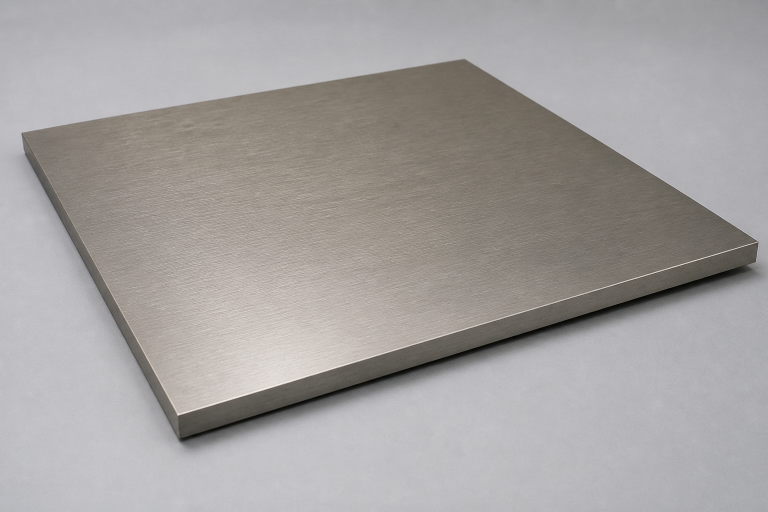
Hastelloy X in brief
| Item | Detail | Note |
|---|---|---|
| Designations | UNS N06002 (Haynes also prints W86002), W.Nr. 2.4665, DIN NiCr22Fe18Mo | VDM adds ISO NiCr21Fe18Mo9 and AFNOR NC22FeD; INCONEL alloy HX and VDM Alloy X are the other producers’ names |
| Alloy type | Nickel-chromium-iron-molybdenum, described as matrix-stiffened | Haynes and Special Metals wording; the titles of AMS 5536, 5754, 5587 and 5588 give the nominal 47.5Ni-22Cr-1.5Co-9.0Mo-0.60W-18.5Fe (AMS 5798 prints 18Fe) |
| Delivery condition | Solution heat-treated, unless the order states otherwise | Haynes for wrought forms; Special Metals says the alloy is normally supplied this way |
| Density | 8.22 g/cm³ (0.297 lb/in³) at 22 °C | Haynes; Special Metals prints 8.2 g/cm³ |
| Melting range | 1260 to 1355 °C (2300 to 2470 °F) | Haynes and Special Metals; a producer value, not a specified limit |
| Main strength | Oxidation resistance and strength at high temperature | Haynes recommends it for furnaces because it resists oxidizing, reducing and neutral atmospheres; Special Metals gives oxidation resistance up to 1200 °C |
| Main limits | No producer gives one maximum service temperature; long exposures at 649 to 760 °C reduce room-temperature elongation and impact energy | Haynes aged-property data from single heats |
| Product documents | ASTM B435, B572, B472, B622, B619, B626; SAE AMS 5536, 5754, 5587, 5588, 5798 | Listed by form below; the ASTM B564 forging scope does not include N06002 |
Chemical composition limits, wt %
Special Metals prints a limiting composition table for the alloy, and the one ASTM table that is public for N06002, Table 1 of the historical edition B619-10e1, carries the same values. VDM’s sheet for its powder variant and the 1967 AMS row reproduced in a NASA contractor report agree with both, so the four sources agree on every limit in the table below.
| Element | Special Metals, limiting composition | ASTM B619-10e1 Table 1 (historical edition) |
|---|---|---|
| Nickel | Balance | Remainder, by difference |
| Chromium | 20.5 to 23.0 | 20.5 to 23.0 |
| Iron | 17.0 to 20.0 | 17.0 to 20.0 |
| Molybdenum | 8.0 to 10.0 | 8.0 to 10.0 |
| Cobalt | 0.5 to 2.5 | 0.5 to 2.5 |
| Tungsten | 0.2 to 1.0 | 0.20 to 1.0 |
| Carbon | 0.05 to 0.15 | 0.05 to 0.15 |
| Manganese | 1.0 max | 1.0 max |
| Silicon | 1.0 max | 1.0 max |
| Phosphorus | 0.04 max | 0.04 max |
| Sulfur | 0.03 max | 0.03 max |
Carbon has a minimum as well as a maximum. Haynes publishes a nominal analysis rather than limits: nickel 47 as balance, chromium 22, iron 18, molybdenum 9, cobalt 1.5, tungsten 0.6 and carbon 0.1. Inside that nominal block it also lists boron at 0.008 max, niobium at 0.5 max, aluminum at 0.5 max and titanium at 0.15 max. None of the limit tables above sets a value for those four elements, and the current tables of ASTM B435, B572 and AMS 5536 are not shown publicly. A buyer who needs boron, aluminum, titanium or niobium controlled should check whether the edition of the specification named on the order sets a limit and, if it does not, write the limit into the order; that edition decides acceptance.
Physical properties
All of these are producer figures. Haynes presents its data as indicative test results rather than guaranteed limits, and Special Metals expects a variation of ±5 % in thermal expansion with compositional changes within the release specification, processing history and form. The two producers disagree on several room-temperature values, so each is shown with its source.
| Property | Haynes | Special Metals |
|---|---|---|
| Density | 8.22 g/cm³ (0.297 lb/in³) at 22 °C | 8.2 g/cm³ (0.297 lb/in³) |
| Melting range | 1260 to 1355 °C | 1260 to 1355 °C |
| Specific heat | 486 J/kg·°C at room temperature | 461 J/kg·°C at 20 °C |
| Thermal conductivity | 9.2 W/m·°C at 25 °C; 11.2 at 100 °C | 11.6 W/m·°C at 20 °C; 12.9 at 100 °C |
| Electrical resistivity | 114.83 µΩ·cm at 24 °C | 116 µΩ·cm at 20 °C |
| Mean thermal expansion | 13.9 ×10⁻⁶/°C from 26 to 100 °C; 15.0 from 26 to 500 °C | 13.3 ×10⁻⁶/°C from 20 to 100 °C |
| Dynamic modulus of elasticity | 205 GPa at room temperature | 205 GPa at 20 °C; torsional modulus 80 GPa |
| Poisson’s ratio | 0.32 at 22 °C | 0.320 at room temperature |
| Magnetic permeability | 1.002 at 200 oersteds, room temperature | Not given |
The widest gap is in thermal conductivity, where 9.2 and 11.6 W/m·°C differ by about a quarter, so a thermal calculation should state which producer’s figure it uses. Special Metals measured its conductivity and resistivity on five casts of 1 to 1.7 mm cold-rolled sheet heat-treated at 1175 °C and rapidly air cooled. A NASA contractor report of 1967 measured 8.296 g/cm³, the average of four determinations on one forging heat after a braze cycle, against the 8.23 it found in vendor literature, which is a reminder that a weight estimate depends on the density figure it starts from.
Heat treatment, hot working and welding
Both producers anneal at the same Fahrenheit temperature and print slightly different Celsius conversions. Neither figure is a specification limit; the document on the order and the fabricator’s procedure govern.
| Step | Haynes (brochure, 2022) | Special Metals (bulletin, 2005) |
|---|---|---|
| Solution heat treatment | Typically 2150 °F (1177 °C) and rapid cooling; bright-annealed products are cooled in hydrogen | 2150 °F (1175 °C), then rapid air cooling or water quenching |
| Hot working | Forging or other hot working once the whole piece has been held at 1177 °C long enough to reach temperature | Start at 1175 °C; no hot working below 980 °C |
| After forming | Anneal all hot- or cold-worked parts and cool them rapidly to restore the best balance of properties | Not given |
| Arc welding processes | Gas tungsten arc and gas metal arc with ERNiCrMo-2 filler to AWS A5.14; coated electrodes for shielded metal arc in non-ASME-code construction; submerged arc not recommended | Metal arc, gas tungsten arc, gas metal arc and submerged arc; welding is best done in the flat position because the alloy’s fluidity makes position welding difficult |
| Interpass temperature | Below 93 °C (200 °F) | Not given |
| Post-weld heat treatment | Not generally required | Not normally necessary; solution heat treatment after welding may be needed for the greatest corrosion resistance |
Haynes cautions that annealing below the solution temperature may precipitate secondary phases that may affect strength and ductility. It does not recommend submerged arc welding, because the process’s high heat input and slow cooling can increase weld restraint and promote cracking; Special Metals’ 2005 bulletin listed submerged arc among the usable processes, so the two producers conflict on this point and the dates of the two documents should be weighed. Two points from a 1968 NASA contractor report bear on fabrication. The report cites published data showing that large grains after annealing appear mainly in material previously cold-worked by 1 to 10 %, while material cold-worked by more than 10 % is relatively insensitive to the annealing variables. In the report’s own brazing tests, brazing at temperatures up to 2125 °F had little influence on properties, but brazing at 2150 and 2175 °F produced large grains and reduced ductility, and rapid cooldown after heating to 2175 °F was necessary for maximum ductility, which the report equates with preventing carbide precipitation. For machining, Special Metals recommends the annealed condition, carbide or high-speed steel tools and plenty of sulfur-free cutting fluid.
Mechanical properties
We found no current minimum tensile values for N06002 in any public source. The ASTM store pages for B435, B572, B619, B622 and B626 and the SAE pages for AMS 5536, 5754, 5587 and 5588 show scope only. A NASA contractor report of 1968 quotes the minimums of AMS 5536D, a superseded revision, as 45,000 psi yield, 100,000 psi tensile and 35 % elongation for sheet. AMS 5536 has since reached revision R (2024), so those figures are history, not acceptance values, and the edition on the order supplies the minimums. The values below are typical results published by the producers.
| Form and test temperature | 0.2 % yield | Tensile | Elongation |
|---|---|---|---|
| Plate, 21 °C (Haynes) | 340 MPa | 760 MPa | 48.9 % |
| Plate, 538 °C (Haynes) | 224 MPa | 604 MPa | 60.2 % |
| Plate, 649 °C (Haynes) | 212 MPa | 558 MPa | 63.5 % |
| Plate, 760 °C (Haynes) | 218 MPa | 421 MPa | 74.5 % |
| Plate, 871 °C (Haynes) | 189 MPa | 255 MPa | 98.1 % |
| Plate, 982 °C (Haynes) | 94 MPa | 138 MPa | 98.1 % |
| Sheet, 21 °C (Haynes) | 376 MPa | 783 MPa | 46.5 % |
| Sheet, 871 °C (Haynes) | 193 MPa | 251 MPa | 117.9 % |
| Sheet, room temperature, one representative heat (Special Metals) | 345 MPa | 793 MPa | 45.5 % |
In Haynes’ plate data, yield falls from 340 MPa at 21 °C to 224 MPa at 538 °C, runs at 212 to 218 MPa from 649 to 760 °C, and drops to 94 MPa at 982 °C, while elongation rises. Haynes gives room-temperature hardness after solution annealing at 2150 °F as 86 HRBW for sheet, 87 for plate and 88 for bar, and Special Metals reports Rb 90 on its single sheet heat. Mean Charpy V-notch energy is 140 J at room temperature for plate heat-treated at 1149 °C and water quenched (28 samples from several heats, Haynes). At minus 196 °C, Haynes’ average tensile strength for plate heat-treated at 1177 °C and rapidly cooled is 1036 MPa with 46 % elongation. For creep, Haynes’ data for solution heat-treated sheet put the stress for a minimum creep rate of 0.0001 % per hour at 50 MPa at 760 °C and 19 MPa at 871 °C, and the stress for 0.01 % per hour at 97 and 43 MPa respectively, based on more than 100 sheet tests. Cold reduction raises strength sharply: in room-temperature tests on 2.8 mm sheet, Haynes reports 565 MPa yield and 848 MPa tensile after 5 % reduction and 945 MPa and 1110 MPa after 30 %, from a limited number of tests. Haynes’ average all-weld-metal values at room temperature are 458 MPa yield, 680 MPa tensile and 28 % elongation in 1 inch.
Oxidation, hot corrosion and long exposure
Special Metals rates the alloy’s oxidation resistance as outstanding up to 2200 °F (1200 °C), and VDM states that the conventionally produced alloy usually shows excellent oxidation resistance up to 1,200 °C and can be used in neutral as well as reducing atmospheres, adding that it resists carburizing and nitriding atmospheres. Haynes reports furnace rolls still in good condition after 8,700 hours at 1177 °C and calls the alloy exceptionally resistant to stress-corrosion cracking in petrochemical applications. Every figure in the table comes with its own test conditions.
| Test and conditions | Result | Source |
|---|---|---|
| Static oxidation in flowing air, 1008 h, cooled to room temperature once a week, 980 °C | Metal loss 0.007 mm per side; metal loss plus continuous internal penetration 0.019 mm | Haynes |
| The same test at 1095 °C | 0.038 mm and 0.069 mm per side | Haynes |
| Hot corrosion in combustion products of No. 2 fuel oil (0.4 % sulfur) with 5 ppm sea salt, gas velocity 4 m/s, thermal shock once an hour, 900 °C | Total metal affected 0.08 mm per side after 200 h, 0.17 mm after 1000 h | Haynes |
| Carburizing gas of 2 % methane and 98 % hydrogen flowing at three furnace volumes per hour, 100 h at 980 °C | Average weight gain 7.7 mg/cm² on a representative heat | Special Metals |
| 0.125 in sheet aged 16,000 h at 649 °C, tested at room temperature | Elongation 15 %, against 57 % solution heat-treated (single heat) | Haynes |
| Plate aged 1,000 h at 649 °C, or 8,000 h at 760 °C, Charpy V-notch | 33 J and 11 J, against 129 J solution heat-treated (12.7 mm plate, average of four tests on a single heat) | Haynes |
Haynes describes the alloy as keeping good ductility after 16,000 hours at 650, 760 and 870 °C, and its own aged-property tables show how much ductility and impact energy remain after such exposures, so a design that relies on toughness after long service should read the aged figures rather than the solution-treated ones. A NASA Phoebus-2 materials report of 1967 cites earlier work in which exposures at 1050 °F raised hardness and lowered ductility, and attributes the hardening to precipitation, with M6C believed to be the main phase and others not ruled out. No source sets a single maximum service temperature; the oxidation statements above and the design code’s temperature limits are the published reference points.
Specifications by product form
| Product form | Document |
|---|---|
| Plate, sheet and strip | ASTM B435, whose scope names N06002 among the alloys it certifies; SAE AMS 5536 (Alloy X or HX), revision R of 2024 |
| Bar and rod | ASTM B572, which names N06002 |
| Billets and bars for reforging | ASTM B472 |
| Bars, forgings and rings | SAE AMS 5754 (Alloy X), whose scope covers bars, forgings and flash-welded rings; the ASTM B564 forging and B462 flange scopes do not list N06002 |
| Seamless pipe and tube | ASTM B622; SAE AMS 5587 for seamless tubing |
| Welded pipe | ASTM B619, which covers Class I and Class II pipe in Schedules 5S, 10S, 40S and 80S to ANSI B36.19, all solution annealed and descaled |
| Welded tube | ASTM B626, 3.2 to 88.9 mm outside diameter and 0.41 to 3.7 mm wall; SAE AMS 5588 for welded and drawn tubing |
| Wrought welding fittings | ASTM B366, in the Haynes and Special Metals lists (the public ASTM scope page names no alloys) |
| Welding consumables | AWS A5.14 ERNiCrMo-2 bare rod and wire, AWS A5.11 ENiCrMo-2 coated electrodes, SAE AMS 5798 welding wire |
Special Metals adds the general-requirement documents B751, B775 and B829, with ASME SB equivalents for each ASTM form, and the European documents BSI HR6 and HR204, DIN 17750 to 17754 and ISO 6207, 6208, 9723, 9724 and 9725. Haynes’ specification table lists DIN 17742 against No. 2.4665 NiCr22Fe18Mo, while Special Metals lists DIN 17744 as the composition standard for the same designation, so a European order should quote the number it means. Haynes’ current code table gives the alloy’s ASME Section VIII Division 1 limit as 899 °C (1650 °F) for plate, sheet, bar, fittings, pipe, tube and bolting. Under Division 2 it gives 482 °C for plate, sheet and rod, 899 °C for welded and seamless pipe and tube and 427 °C for bolting. For the forms in its footnotes, ASME B31.3, B16.5 and B16.34 allow it up to 816 °C, Section III Classes 1 to 3 at up to 427 °C, and Section XII at up to 343 °C. Both producers list the alloy under NACE MR0175, Haynes together with ISO 15156.
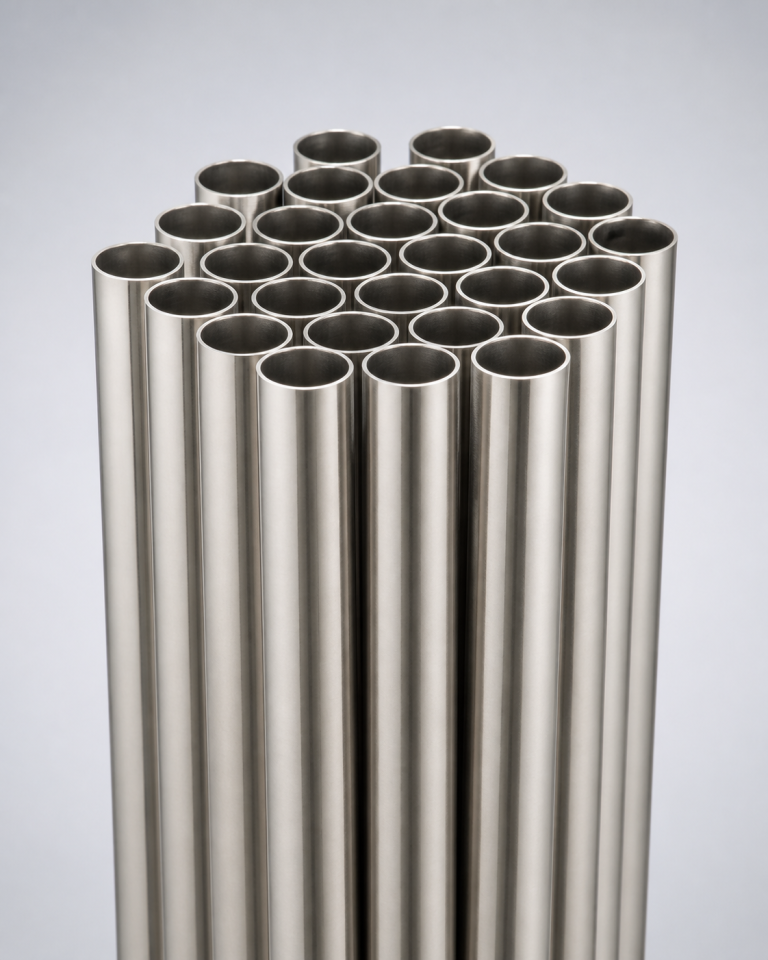
Where Hastelloy X is used
| Field | Parts named by a producer |
|---|---|
| Gas turbines | Transition ducts, combustor cans, spray bars, flame holders, afterburners, tailpipes and cabin heaters (Haynes); combustion chambers, afterburners and tail pipes in aircraft and land-based engines (Special Metals); combustion chambers, honeycombs and housings (VDM) |
| Industrial furnaces | Furnace rolls and parts for oxidizing, reducing and neutral atmospheres (Haynes); fans, roller hearths and support members (Special Metals); support rolls, grids, wire belts and radiant tubes (VDM) |
| Chemical and petrochemical processing | Retorts, muffles, catalyst support grids, furnace baffles, pyrolysis tubing and flash drier components (Haynes); pigtails in petrochemical furnaces (VDM) |
| Nuclear engineering | Named generally by Special Metals; high-temperature gas-cooled reactors (VDM) |
Common questions from buyers
Is INCONEL alloy HX the same material as Hastelloy X? Both carry UNS N06002 and W.Nr. 2.4665, and the Special Metals limit table matches the historical ASTM B619 row. The names belong to different producers, so an order written to the UNS number and the specification is clearer than one written to a trade name.
Can Hastelloy X forgings be ordered to ASTM B564? Not under its published scope: the B564-25 scope table does not list N06002. AMS 5754 covers bars, forgings and flash-welded rings, ASTM B472 covers billets and bars for reforging, and Special Metals also lists BSI HR6, ISO 9725 and DIN 17754 for forgings.
What is the highest temperature it can be used at? No producer states one limit. Special Metals gives oxidation resistance up to 1200 °C, and VDM says the conventionally produced alloy usually shows excellent oxidation resistance up to 1,200 °C, while the ASME limits in Haynes’ table run from 343 to 899 °C depending on the code and form, and the aged data show lower ductility after long exposure at 649 to 760 °C. The project’s code and design life decide the figure.
Can it be welded by submerged arc? Haynes’ 2022 brochure does not recommend it, because the process’s high heat input and slow cooling can increase weld restraint and promote cracking. Special Metals’ 2005 bulletin listed submerged arc among the usable processes. A fabricator who wants to use it should weigh the two statements and their dates.
Does it need heat treatment after welding? Haynes states that post-weld heat treatment is not generally required. Special Metals agrees that it is not normally necessary, but adds that a solution heat treatment after welding may be needed for the greatest corrosion resistance.
Specification detail with sources
The trademark owner’s HASTELLOY X alloy brochure from Haynes International (document H-3009F, 2022) and its current web data sheet supply the UNS and DIN designations, the solution-treated delivery and the 1177 °C anneal, the nominal composition with its boron, niobium, aluminum and titanium lines, the density of 8.22 g/cm³ and the other physical constants in its column, and the typical plate and sheet tensile data at room and elevated temperature. They also give the hardness by form, the Charpy and cryogenic results, the creep-rate and cold-reduction data, the weld-metal values, the oxidation and hot-corrosion tests and the aged-property tables. The welding guidance, the specification list, the ASME code table, the NACE listing and the uses come from the same two documents. Special Metals’ INCONEL alloy HX bulletin (Publication SMC-007, 2005) gives the W.Nr. 2.4665, the limiting composition, its own physical constants and single-heat sheet properties, the 1175 °C anneal and hot-working limit, its welding, post-weld and machining notes, the carburization result, the 1200 °C oxidation statement, the specification lists including the BSI, DIN and ISO documents, and the uses. VDM’s data sheet No. 2003 for VDM Powder X (Revision 03, 2020), based on VDM Alloy X, supplies the EN, ISO and AFNOR designations, a composition table, the 1,200 °C oxidation and atmosphere statements and its application list, and VDM’s product-range page gives the alternative name Nicrofer 4722 Co. The historical ASTM B619-10e1 table, the scope pages of ASTM B435, B572, B472, B622, B619, B626, B366, B564 and B462, and the SAE titles of AMS 5536, 5754, 5587, 5588 and 5798 are published by those bodies. NASA technical reports CR-89512 (1967) and CR-66910 (1968) supply the measured density, the 1967 AMS composition row, the AMS 5536D minimums, the cited 1050 °F exposure finding and the annealing and brazing results. These documents are published references for the alloy as a whole; not one of them tells you which mill supplies a given Beiyu order. The HASTELLOY trademark is owned by Haynes International, and INCONEL is a Special Metals Corporation group trademark.
Ordering Hastelloy X
A Hastelloy X RFQ should state the form, the governing document and its revision (an ASTM number, or an AMS number for aerospace work), the size, the condition, and any requirement beyond the specification, such as a boron or aluminum limit, a grain size, or a corrosion or oxidation test. ASTM B435 itself sets grain size requirements for annealed N06002 sheet and strip. The table shows the published nickel-family size ranges used as the starting point for Hastelloy X enquiries.
| Form | Published range |
|---|---|
| Round bar | Ø5.0 to 300 mm, lengths up to 6000 mm |
| Sheet | 0.8 to 3.0 mm thick, up to 1200 mm wide |
| Plate | 3.0 to 70 mm thick, up to 2500 mm wide |
| Seamless tube | 5 to 325 mm OD, wall 0.5 to 12 mm |
| Welded tube | Up to 1219 mm OD |
| Forged bar | Ø50 to 500 mm, up to 3000 mm long |
| Forged ring | 50 to 1000 mm OD, 10 to 500 mm ID, 20 to 300 mm high |
| Forged disc and block | Discs 50 to 1000 mm outside diameter and 20 to 500 mm thick; blocks 50 to 500 mm |
A range in this table is not a promise that every size exists in Hastelloy X; the combination of size and form is confirmed for each order at quotation. Tube enquiries are covered on the nickel alloy pipe and tube page, forged shapes in the nickel alloy forgings guide, and the remaining forms in the nickel and nickel-based alloys category. List the documents the order needs, for example a mill test certificate reporting chemistry and mechanical tests, a dimensional report, PMI, or inspection by a third party. If the order needs an EN 10204 3.1 certificate, state it in the RFQ so that the certificate scope can be confirmed in the quotation.
Lead time and any chemistry or mechanical requirements beyond the governing document are confirmed in the written quotation for each order.