
When you buy industrial titanium, what decides the order is not the word titanium but whether the grade, form, dimensions and corrosion duty match. This page covers the common grades for titanium plate and tube (Grade 2, 5, 7), metric specification fields, how to select a grade for seawater and chemical service, and the UNS/ASTM cross-reference and EN 10204 3.1 certificate that international procurement checks. It is written for engineering and purchasing, not consumer goods.
Common grades for titanium plate and tube
Industrial titanium is mostly commercially pure titanium and a few alloys, chosen by corrosion and strength need, not by picking the highest grade.
| Grade | UNS | Werkstoff | Characteristics and typical use |
|---|---|---|---|
| Grade 2 (CP) | R50400 | 3.7035 | Workhorse for general chemical, seawater and heat-exchanger service; good corrosion resistance, easy to weld and form |
| Grade 5 (Ti-6Al-4V) | R56400 | 3.7165 | High-strength structural parts; corrosion resistance is lower than CP, chosen for strength |
| Grade 7 (Ti-Pd) | R52400 | 3.7235 | CP titanium plus palladium; corrosion resistance in reducing acids (HCl, H2SO4) is much wider than Grade 2 |
The same grade of titanium carries different codes in different markets: UNS (R50400) and ASTM are common in international procurement, while the EN and DIN system uses a Werkstoff number (3.7035). Listing all of them lets a buyer searching by any code reach the page. The working standards are ASTM in practice: plate ASTM B265, tube ASTM B338, bar ASTM B348, and an order can also cite JIS H4600 series or CNS.
Selecting a grade for seawater and chemical service
Titanium’s corrosion resistance comes from a dense oxide film. In oxidizing and neutral media (seawater, wet chlorine, nitric acid), CP Grade 2 usually maintains a stable passive film and is the workhorse. In reducing acids (HCl, H2SO4), the film is harder to maintain, and Grade 7’s palladium widens the resistance window substantially. For hot brine and chloride crevice environments, Grade 12 is also an option. Choosing the wrong direction, such as using high-strength Grade 5 for a corrosion duty, only adds cost. The seawater and marine selection logic is in our titanium seawater corrosion resistance guide; the Grade 2 chemical and heat-exchanger case is in our Grade 2 chemical guide.
| Media | Grade the guide points to |
|---|---|
| Oxidising and neutral media such as seawater, wet chlorine and nitric acid | CP Grade 2 usually maintains a stable passive film and is the workhorse |
Metric specifications for RFQs
Taiwan and international buyers mostly search and quote by metric size. To let the mill judge manufacturability and tolerance, the RFQ should at least include these fields:
| Form | Metric fields to specify | Standard |
|---|---|---|
| Titanium plate | Thickness x width x length, tolerance and surface condition | ASTM B265 |
| Titanium tube | Outside diameter x wall thickness x length, tolerance, seamless or welded | ASTM B338 |
| Titanium bar | Diameter x length, tolerance and surface condition | ASTM B348 |
Material certificate: what to check on import
For imported industrial titanium, check the inspection document against the purchase order, ordered product standard and required document type. When EN 10204 3.1 is ordered, the document should report the specific-inspection results required for the delivered material and be validated by the manufacturer’s authorised inspection representative independent of the manufacturing department. On receipt, compare the reported chemistry with the ordered grade, confirm the mechanical results meet the ordered standard for that form and size, and match the traceability identifier on the document to the marking on the material. If 3.2 or other independent inspection is required, define the responsible parties, witness points, reports and schedule in the RFQ. The full field list for international RFQs is in our titanium bar RFQ checklist.
Frequently asked questions
What is the difference between titanium Grade 2 and Grade 5?
Grade 2 is commercially pure titanium, with good corrosion resistance and moderate strength, and is the workhorse for seawater and chemical service. Grade 5 (Ti-6Al-4V) adds aluminum and vanadium for high strength but lower corrosion resistance. Choose Grade 2 for corrosion duty, Grade 5 for structural strength.
Which titanium grade is used for seawater?
Seawater is an oxidizing, chloride-bearing environment where CP Grade 2 usually maintains a stable passive film, so it is the workhorse for seawater and marine service. Only when reducing acids or severe crevice corrosion are also present do you move up to Grade 7 (Ti-Pd) or another corrosion-upgrade grade.
What is the material certificate for imported titanium?
EN 10204 defines inspection-document types, not product requirements. A type 3.1 inspection certificate reports the specific-inspection results for the delivered products and is validated by the manufacturer’s authorised inspection representative independent of the manufacturing department; it does not replace ASTM B265, B338 or another product specification. State the required document type in the RFQ and purchase order, then verify that the certificate reports the results and traceability required for the ordered grade, form and size.
Two product forms, two sets of order fields
Plate and tube are often quoted together and accepted separately. The fields that decide acceptance are not the same, and an enquiry that treats them as one list leaves gaps on both sides.
| Field | On plate | On tube |
|---|---|---|
| Governing dimension | Thickness with its tolerance | Outside diameter and wall, stated together |
| Route | Rolled condition as delivered | Seamless or welded, which changes the specification |
| Surface | Stated apart from the delivery condition | Stated apart from the delivery condition |
| Examination | Scope and acceptance class on the order | Scope and acceptance class on the order |
What is common to both certificates
| Field | Beiyu position |
|---|---|
| Certificate type | EN 10204 3.1 mill test certificate |
| Traceability | Heat number, carried through to the delivered pieces |
| Reporting scope | Set by the order |
| Grade with its UNS number | Given together and consistent with the standard named |
Where one enquiry covers both forms, stating the governing dimension separately for each removes the most common cause of a re-quotation. Alloy tube runs as its own line item: Grade 9 titanium tube where strength governs, Grade 12 titanium tube where hot chloride crevice conditions do.
Specification detail with sources
Industrial titanium designations extend beyond the UNS and Werkstoff columns above into the Japanese system an Asian supply chain often quotes. JIS H4600 designates commercially pure titanium by minimum tensile strength, so its class 2 material is written TP 340, a 340 MPa floor sitting beside the 345 MPa of ASTM Grade 2, and the cross-reference matters for the same reason the Werkstoff table does: the certificate must cite the standard the drawing names, not a neighbouring one. For pipe rather than tube, the working ASTM documents are B861 for seamless and B862 for welded product, the companion numbers to the B338 tube line in the RFQ table above.
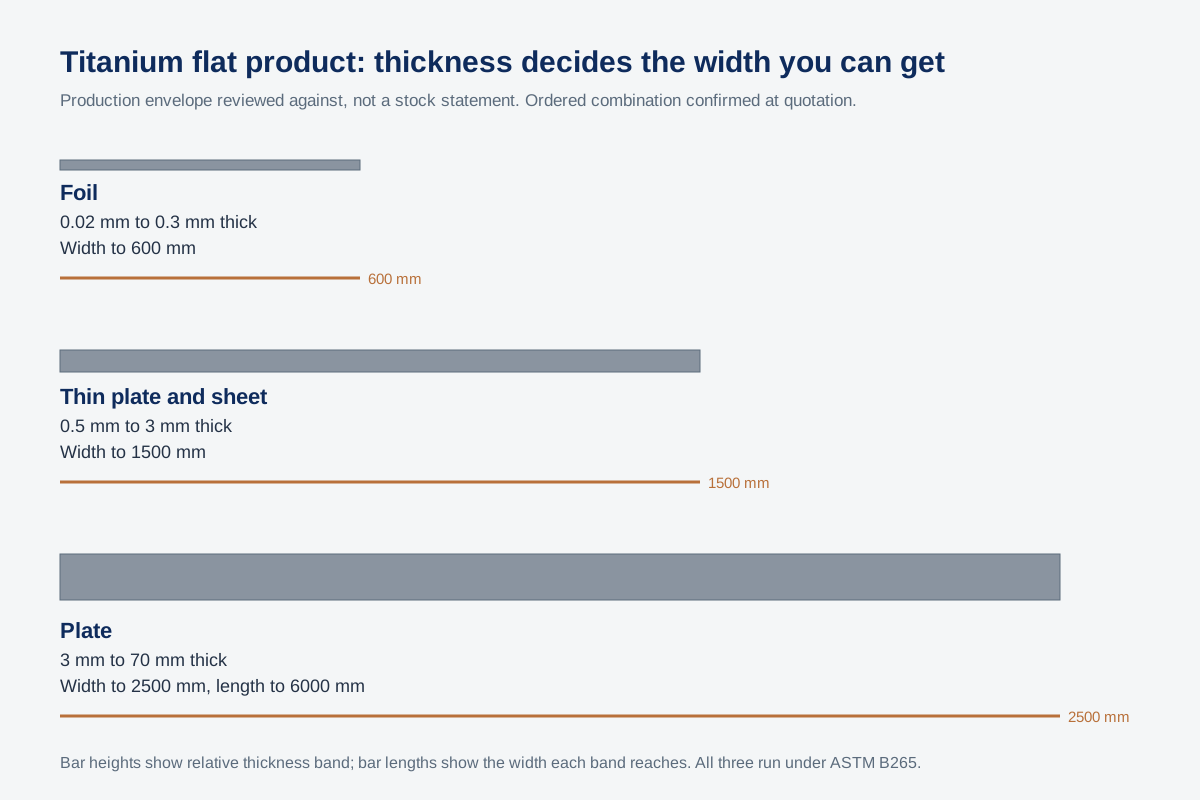
Beiyu Titanium’s plate program behind that RFQ table splits at 3 mm: plate from 0.5 to 3 mm thick runs to 1500 mm wide, plate from 3 to 70 mm runs to 2500 mm wide, both in lengths to 6000 mm, and the mill sheet carries 13 numbered ASTM grades for plate, including the palladium grades this page routes reducing-acid duty toward. On the tube side Beiyu also quotes capillary sections from 1 to 5 mm outside diameter with 0.1 to 2 mm walls, the instrument-scale end below exchanger sizes, so a metric enquiry written with the fields in the table above can be checked against these envelopes in one pass.
Request a quote for industrial titanium plate or tube
To quote industrial titanium plate or tube, Beiyu needs: grade (Grade 2/5/7, or the UNS/ASTM code), form and standard, metric dimensions (plate thickness / tube OD x wall / bar diameter and tolerance), quantity, service or medium, and the required inspection-document type. Review the titanium sheet and plate or titanium tube and pipe buying route, then state any EN 10204 3.1 or 3.2 document, test, validation and heat-traceability scope in the RFQ. Send the drawing or specification and we review each line against mill capability before quoting. Contact Beiyu Titanium for an RFQ.
| Field to state | Detail |
|---|---|
| Grade | Grade 2, 5 or 7, or the UNS or ASTM code |
| Form and standard | Both |
| Metric dimensions | Plate thickness, or the ordered tube dimensions |