
Caustic service is where commercially pure nickel earns its place over both stainless steel and titanium. Titanium is chosen for chlorides and oxidising conditions; hot concentrated caustic is the case that sends an enquiry to Nickel 200 and 201 instead. The part that catches buyers out is the paperwork: for one alloy, the specification number changes with the product form.
Why the alloy choice lands on commercially pure nickel
Nickel 200 and Nickel 201, UNS N02200 and N02201, are the unalloyed grades in the nickel family, and they are the ones normally taken into caustic evaporators, caustic handling pipework and electrochemical duty. Nickel 201 is the low-carbon version of the same metal, which is why the pair is usually quoted together and separated only when the service temperature makes the carbon level matter.
The boundary runs both ways. Titanium is the answer for seawater, wet chlorine and oxidising acids; commercially pure nickel is the answer for hot caustic, where titanium has no advantage. A parts list that mixes both duties should not be quoted on one material line.
The specification changes with the form, and that is the trap
For the same alloy, the supply range names a different ASTM specification on each product listing:
| Form | Nickel 200 and 201 |
|---|---|
| Bar | ASTM B160 |
| Sheet and plate | ASTM B162 |
| Seamless condenser and heat-exchanger tube | ASTM B163 |
An order that names the alloy and the size but not the form leaves the specification undetermined, and a certificate reporting against B160 does not satisfy a drawing calling for B162. Naming form and specification on the same line costs nothing and removes the ambiguity before it reaches a certificate.
The same pattern runs through the alloy families. Hastelloy carries B572, B574 and B335 on the bar listing, B575, B333, B435 and B619 on the sheet and plate listing, and B622, B619 and B626 on the tube listing. Monel carries B164 and B865 as bar and B163, B165 and B725 as tube. Inconel carries B166 and B446 as bar and B168, B443 and B670 as sheet and plate.
The supply envelope for the caustic-facing forms
These are the Beiyu Titanium supply ranges for the forms that normally go into caustic duty:
| Form | Supply range |
|---|---|
| Round bar | Ø5.0 to 300 mm, length to 6000 mm |
| Sheet | 0.8 to 3.0 mm thick, width to 1200 mm |
| Plate | 3.0 to 70 mm thick, width to 2500 mm |
| Seamless tube | Outside diameter 5 to 325 mm, wall 0.5 to 12 mm |
| Welded tube | Outside diameter 6.35 to 1219 mm |
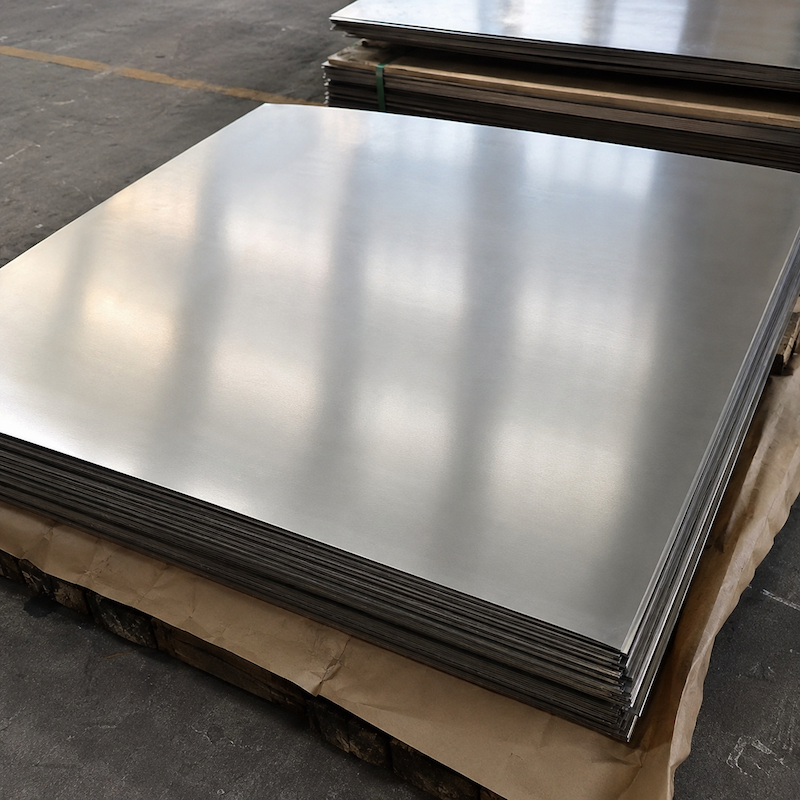
These are family-level ranges. They do not mean every alloy in the nickel family is available in every form at every size, and the ordered combination is confirmed at quotation. For caustic duty the two items most often quoted from this family are Nickel 200 and 201 tube and Nickel 201 plate.
Tube is where the two envelopes diverge most, and it is worth checking before a line list is priced. Seamless tube stops at outside diameter 325 mm, while welded tube reaches 1219 mm, so a large-bore caustic header is a welded item by envelope rather than by preference. The specification changes with it: B163 is the seamless condenser and heat-exchanger tube document and does not follow the part onto a large welded header, which is ordered against the welded pipe specification the drawing names. A line list that carries B163 against a 1219 mm header has the wrong document on it.
What a caustic-service enquiry has to state
The first three fields settle the specification. The fourth settles whether the alloy is right, and it is the one usually left blank.
| Field | Why it decides the quotation |
|---|---|
| Alloy with UNS number | N02200 or N02201; the carbon level is the difference |
| Product form | Sets which ASTM specification applies |
| Dimensions for that form | Bar, plate and tube have separate envelopes |
| Caustic concentration and temperature | Confirms the alloy rather than assuming it from the word caustic |
| Welded or seamless, for tube | Two different envelopes and two different listings |
| Inspection scope | Which examinations run, and what the certificate records |
One field on that list is not a dimension and is still worth filling in. Caustic duty covers a wide band, and the concentration and temperature together decide whether the part belongs on Nickel 200, on Nickel 201, or on an alloy from the Inconel or Hastelloy families instead. An enquiry that gives the service conditions can be checked against the alloy choice before it is priced; one that gives only the word caustic cannot.
Specification detail with sources
The figures on this page come from the Beiyu Titanium supply ranges, read per listing. Nickel round bar runs Ø5.0 to 300 mm with length to 6000 mm; sheet runs 0.8 to 3.0 mm thick in widths to 1200 mm and plate 3.0 to 70 mm thick in widths to 2500 mm; seamless tube runs outside diameter 5 to 325 mm with wall 0.5 to 12 mm, and welded tube reaches outside diameter 1219 mm.
The specification mapping is taken from the same document, where each product listing carries its own standards column keyed to the alloy family: Nickel 200 and 201 against ASTM B160 on the bar listing, B162 on the sheet and plate listing and B163 on the tube listing, with the Hastelloy, Monel and Inconel lists as quoted above. Those columns key to the alloy family, not to a size, so no specification here is narrowed to a particular diameter or wall. Certification is EN 10204 3.1 carrying the heat number.