
One heat can arrive as several batches
A heat is the melt. A batch is what was processed together afterwards. A single heat can be split across batches that were annealed, worked or finished separately, and the mechanical results are reported for each of them. Deciding which level you accept against is an order decision, not something to settle when the certificate arrives.
| Level | What it identifies |
|---|---|
| Heat | The melt the material came from |
| Batch | The material processed together after melting |
| Piece | The individual bar as marked and delivered |
Which properties belong to which level
This is the distinction that decides how many test reports you should expect.
| Property | Level it belongs to |
|---|---|
| Chemical composition | A property of the melt, reported per heat |
| Mechanical properties | Affected by processing, reported per batch |
| Dimensional and surface results | Per piece where the inspection runs at 100 percent |
Why the same heat can show different mechanical results
Batches from one heat share the chemistry but not necessarily the identical processing history. Reported values sit within the specification minimums, and they are not expected to be identical across batches.
| What varies between batches of one heat |
|---|
| The processing route the batch actually took |
| The delivery condition it was finished to |
| The section size at the point of testing |
The fields to name when you ask for per-batch results
Which fields appear on the certificate is set by the ordered specification and by what the order asks for. These are the ones buyers working to an implant or pressure specification normally name.
| Field to name on the order | What it records |
|---|---|
| Tensile strength | Measured value against the specification minimum |
| Yield strength | Measured value against the specification minimum |
| Elongation | Measured value against the specification minimum |
| Reduction of area | Measured value where the specification requires it |
| Hydrogen content | Measured value against the specification maximum |
| Microstructure | Assessed where the order requires it |
| Ultrasonic result | Result of the ordered examination |
How to write the acceptance level on the order
An order that says “test certificate required” does not say at which level acceptance is judged. These are the three ways it is normally written.
| Order states | What it commits the mill to |
|---|---|
| Per heat | One set of results covering everything from that melt |
| Per batch | Results for each processed lot within the heat |
| Per heat and per batch | Chemistry at heat level, mechanical results at batch level |
Lines to paste into your purchase order
Chemistry reporting level: ______ (state per heat, and whether ingot analysis is also required)
Mechanical reporting level: ______ (state per heat or per batch)
Fields to report: ______ (tensile, yield, elongation, reduction of area, hydrogen, microstructure)
Examination results to report: ______ (state each examination with its acceptance standard and class)
Traceability: heat and batch identification to appear on the certificate and on the material marking
Mixed lots: ______ (state whether material from more than one heat may be shipped against one line)
The last line is the one most often left out. State whether a single order line may be filled from more than one heat, because that decides how the certificates and the marking have to be organised before the material ships.
Specification detail with sources
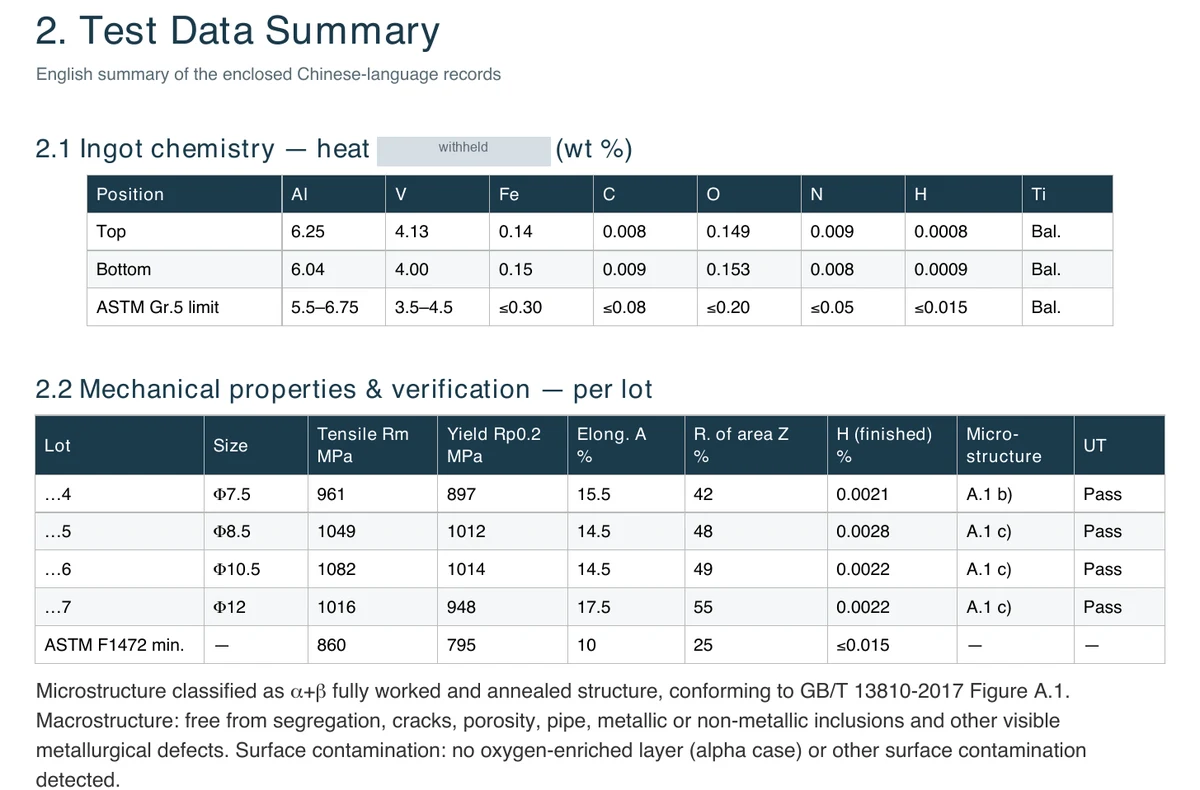
The product standard fixes what is sampled and reported, and it does so at the heat level first. ASTM B348 requires, at minimum, that the analysis of samples from the top and bottom of the ingot be completed and reported for all elements listed for the grade (ASTM B348, chemical requirements, table notes). It also requires hydrogen to be reported on the finished product while ingot hydrogen need not be, and states that product analysis tolerances do not broaden the heat analysis requirements but only cover variation between laboratories (ASTM B348, product analysis).
| Level | What ASTM B348 fixes at that level |
|---|---|
| Ingot, per heat | Top and bottom analysis completed and reported for the listed elements |
| Finished product | Hydrogen reported on the finished product |
| Product analysis | Tolerances cover interlaboratory variation, not a wider heat limit |
| Acceptance level | Stated by the buyer on the order |
What this looks like in practice is visible in Beiyu’s own production documentation. In one representative heat of Ti-6Al-4V, split across four processed lots, the reported tensile strength ran from 961 to 1082 MPa and reduction of area from 42 to 55 percent, with every lot above the implant specification minima of 860 MPa tensile and 795 MPa yield that the order was assessed against. Those are results for one heat and its lots, not a general specification, and they are reported per lot exactly because lots from one heat do not have to be identical. Tension testing follows ASTM E8 at a strain rate of 0.003 to 0.007 inch per inch per minute through the specified yield strength (ASTM B348, mechanical properties).
Send a technical RFQ
For titanium bar RFQs, state whether acceptance is judged per heat or per batch, whether one line may be filled from more than one heat, plus grade, standard, diameter, condition, examination scope and the required certificate package.