
A medical titanium bar enquiry fails in quieter ways than an industrial one. The quote comes back against the wrong specification, the certificate arrives without the interstitial results the auditor wants, or the heat traceability does not reach back to a single melt. This checklist walks through every line an implant-chain RFQ should carry, why each one exists, and the mistakes that cost buyers a requote or a rejected certificate. It is written for material sourcing of bar stock; device qualification and regulatory approval sit with the device maker and are out of scope here. For general industrial bar, use the titanium bar RFQ checklist instead; this page covers what the medical chain adds on top.
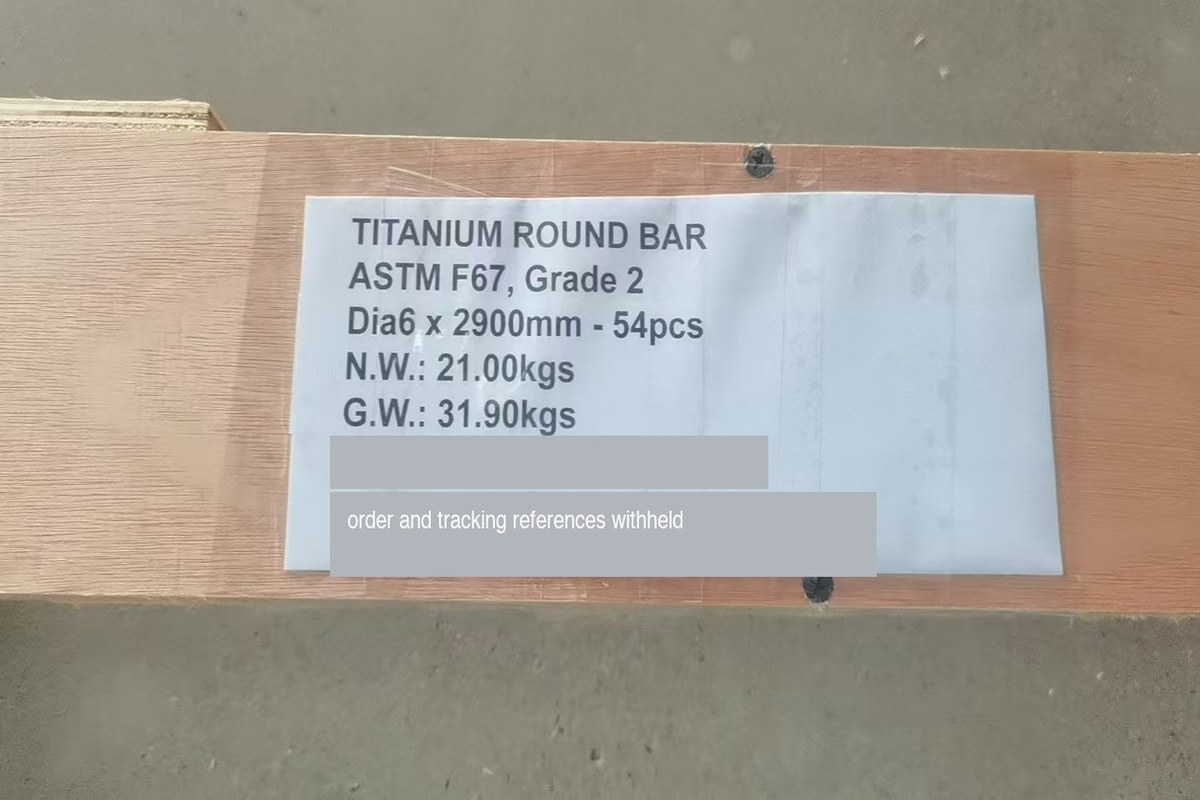
Why a medical bar RFQ is different
Three things separate an implant-chain order from an industrial one. First, the material specification changes: the drawing cites ASTM F67, F136 or F1472 rather than the industrial B348, and an industrial certificate does not satisfy an implant line item even when the chemistry matches. Second, the evidence burden rises: the certificate must report the full interstitial analysis and tie every bar to its melt, because those records feed the device maker’s audit trail. Third, the documentation scope is itself a purchase requirement: quality-system scope, certificate format and inspection add-ons have to be named at RFQ stage, not discovered at receiving inspection.
The checklist at a glance
| # | RFQ line | What to state |
|---|---|---|
| 1 | Specification and grade | ASTM F67 (Grade 1 to 4), F136 or F1472, with the UNS number |
| 2 | Form and size | Diameter, length, cut tolerance |
| 3 | Condition and surface | Annealed; peeled, ground or polished; Ra when it matters |
| 4 | Chemistry reporting | Full interstitial analysis per heat: O, N, H, C, plus Fe |
| 5 | Mechanical testing | Tensile, yield, elongation; grain size where the drawing cites it |
| 6 | Microstructure | Acceptance per the cited specification |
| 7 | Traceability | Heat number, lot logic, EN 10204 3.1 |
| 8 | NDT and inspection | UT, dimensional, PMI or third-party witness as required |
| 9 | Quality system and documents | ISO 13485 scope statement, certificate format, language |
| 10 | Packing and shipment | Contamination control, marking, destination documents |
The sections below take the lines one at a time.
1. Specification and grade: name the implant standard, not the industrial one
Write the specification and the UNS number on the same line. An auditor reads the certificate header before the chemistry table.
| Implant standard | What it covers | UNS on the certificate |
|---|---|---|
| ASTM F67 | Unalloyed titanium, Grades 1 to 4 | By grade |
| ASTM F136 | Ti-6Al-4V ELI | R56401 |
| ASTM F1472 | Standard-interstitial Ti-6Al-4V | R56400 |
| ASTM B348 Grade 23 | Industrial bar, not an implant specification | R56407 |
Grade 23 bar certified to industrial B348 is chemically the same metal as F136 stock, but it is not a drop-in substitute on a body-contact part. See the F136 vs F67 quick reference and the F1472 and F620 guide.
2. Form and size: diameter, length and what the machinist needs
| RFQ line | What to state | Why it matters |
|---|---|---|
| Diameter | Nominal plus the tolerance | Drives the Swiss machine setup on screws and pins |
| Length | Nominal plus the cut tolerance | Decides the cutting operation and the offcut |
| Quantity | By weight or by piece count | Bar is priced by weight, machined parts are counted in pieces |
| Straightness | Pull the value from the process engineer | Defaulting to the standard’s loosest class can fail the machine, not the standard |
| End use | Machining blank or forging input | Forging stock runs to different diameter logic, and the forging runs under ASTM F620 |
The forging route is covered in the implant forging guide.
3. Condition and surface finish
| RFQ line | What to state | Why it matters |
|---|---|---|
| Condition | Annealed is the normal supply condition for implant bar | Sets the mechanical properties the certificate will report |
| Surface | Peeled, ground or polished, on its own line | Medical buyers tend to specify ground or better for close-tolerance bar |
| Roughness | An Ra value, not the word polished | Polished is a workshop word; Ra is an acceptance number |
Surface defects that survive to the finished implant are a rejection risk the device maker carries, not the mill.
4. Chemistry reporting: the interstitials are the point
On a high-value implant grade the chemistry table on the certificate matters more than the nominal grade name. Ask for the full analysis per heat.
| Element to require | Why it is on the list | Note |
|---|---|---|
| Oxygen | The single most watched number: it separates F136 ELI from standard Ti-6Al-4V | ELI sits around 0.13 percent against about 0.20 percent for the standard grade |
| Nitrogen | Interstitial, controlled alongside oxygen | Report per heat |
| Hydrogen | Interstitial, drives embrittlement risk | Report per heat |
| Carbon | Interstitial | Report per heat |
| Iron | Residual rather than an addition | Report per heat |
The oxygen difference is what buys the higher fracture toughness and ductility the ELI grade is chosen for. A certificate that reports only the alloying elements and skips the interstitials is not enough for an implant-chain file. The metallurgy behind those limits is covered in the grain size and hydrogen control guide.
5. Mechanical testing scope
| Test to require | When | Why it belongs on the RFQ |
|---|---|---|
| Tensile strength, yield strength, elongation | Always | Baseline for the delivered heat |
| Grain size | Where the drawing cites a requirement | So the mill tests and reports it, instead of it becoming a downstream problem |
| Reduction of area | Worth requesting for forging stock | It appears in the bar standards |
| Test condition | Always, normally annealed | So the reported numbers match the delivery condition |
6. Microstructure: the line most RFQs forget
The implant specifications carry microstructure acceptance requirements, not just chemistry and tensile numbers. This is the line that separates an RFQ written by a buyer from one written with the metallurgist in the room.
| What to write | What it does |
|---|---|
| Microstructure acceptance per the cited specification applies | Invokes the requirement before the order rather than after |
| The mill confirms it in the documentation package | Puts the evidence in the file the auditor will read |
For Ti-6Al-4V ELI bar the concern is a fine, well-dispersed alpha-beta structure without the coarse or continuous alpha features that degrade fatigue performance. You do not need to write the metallurgy into the RFQ. What matters is that the requirement is invoked before the order, because microstructure cannot be inspected into a bar after the fact.
7. Traceability: one heat, one paper trail when the file requires it
| Traceability requirement | How to state it | What breaks without it |
|---|---|---|
| Heat rule | One heat per lot, or write explicitly that mixed-heat supply is allowed | It will not be inferred, and the supplier may quote the cheaper route |
| Material marking | Heat number marked on the material itself | Bars cannot be identified without opening and cross-checking |
| Document set | Heat number repeated on certificate, packing list and shipping marks | The paper trail breaks at the first transfer |
| Certificate type | EN 10204 3.1 | Validated by the manufacturer’s authorised inspection representative, independent of the manufacturing department |
Define these results, the material marking, the lot or heat traceability, the packing-document references and any one-heat-per-lot rule as a single purchase requirement rather than as separate wishes.
8. NDT and added inspection
| Inspection | What to state, not just the abbreviation | Cost effect |
|---|---|---|
| Ultrasonic testing | The acceptance standard and the coverage, not the bare letters UT | The usual add-on for implant bar |
| Dimensional inspection report | Which dimensions, and to what tolerance | Adds cost |
| PMI | Where in the process it is performed | Adds cost |
| Third-party witness inspection | Which operations are witnessed | Adds cost and sometimes lead time |
A useful discipline: for every inspection line, write down who will read the resulting report. If no one will, the line is cost without a customer.
9. Quality system and the documents pack
| RFQ line | What to state | When |
|---|---|---|
| Quality system scope | Whether the order must be supplied under an ISO 13485 scope | At RFQ stage, not at audit |
| Certificate type and format | Which certificate, and in what format | With the RFQ |
| Language | The language the documents must be issued in | With the RFQ |
| Certificate layout | Whether chemistry and mechanicals must appear on one certificate | With the RFQ |
| Customer-specific forms | Your own supplier questionnaires | Sent with the RFQ, not after the quote |
Sending the questionnaires up front is the single best way to keep the quoted price and lead time honest.
10. Packing, marking and contamination control
Titanium’s corrosion resistance does not remove the packing question. Implant-chain buyers care about contamination control, separation from other alloys, and moisture.
| Packing requirement | What to state |
|---|---|
| Separation | Separate packing by heat, and separation from other alloys |
| Marking | Marking that survives transit |
| Cleanliness | Any cleanliness or wrapping requirement the receiving site imposes |
| Moisture | Wrapping or desiccant requirement, if the receiving site has one |
Bars should arrive identifiable to their heat without opening every bundle.
Common mistakes that cost a requote
- Citing B348 when the file needs F136 or F67. The industrial standard is not an implant standard; the certificate header decides.
- Treating Grade 23 and F136 as the same callout. Grade 23 names the ELI alloy in the industrial system; F136 is the implant specification for it. The metal can be identical and the paperwork still wrong.
- Using the wrong UNS number for the chain. The medical chain keeps the material specification’s UNS, so F136 bar and its F620 forging stay R56401; the industrial forging chain under ASTM B381 assigns its own numbers, where the Grade F-23 forging is R56407. Match the number to the chain the drawing uses.
- Leaving surface as “polished” with no Ra, then rejecting bar that meets the specification but not the unstated expectation.
- Ordering without the interstitial reporting line, and discovering at audit that the certificate cannot demonstrate ELI limits.
- Adding every inspection option by default. Unread reports add cost and days without adding assurance.
Practical notes from the export desk
Two habits shorten the distance between enquiry and clean delivery. First, send the drawing note verbatim: the exact specification revision and any customer-spec overlay, rather than a paraphrase, because quoting against a paraphrase is how revision mismatches get built into an order. Second, ask the mill to confirm each RFQ line explicitly in the quotation, so the order documents inherit the full requirement set. Beiyu reviews each medical-chain line against mill capability before quoting, and where a customer specification adds tighter requirements, the order is made and certified to that specification. The wider picture of how implant-grade titanium is specified and bought is in the titanium for medical implants guide.
FAQ
What documents should come with medical titanium bar?
An EN 10204 3.1 mill test certificate reporting the delivered heat’s chemistry with full interstitial analysis and its mechanical results, tied to a heat number that is marked on the material and repeated on the packing documents. State at RFQ stage if the order must run under an ISO 13485 quality-system scope, and name any added inspection reports the project file requires.
Is ASTM B348 Grade 23 bar acceptable for an implant part?
Not as a substitute for an F136 line item. B348 is an industrial standard; F136 is the surgical-implant specification for the same ELI alloy, with implant-scope requirements an industrial certificate does not address. The certificate must cite the standard the drawing calls for.
Why do medical buyers ask for single-heat traceability?
Because the device maker’s audit trail runs from the finished implant back to the melt. Where the file requires one heat per lot, that requirement must be written into the RFQ and then repeated on the certificate, packing documents and material marking; otherwise the supplier may quote a compliant multi-heat lot against the standard but not against the project file.
What is the difference between F136 and F1472 for bar?
Both are surgical-implant specifications for wrought Ti-6Al-4V. F136 covers the ELI version, UNS R56401, with tighter interstitial limits and higher fracture toughness; F1472 covers the standard-interstitial version, UNS R56400. Which one applies is the device maker’s call; the mill certifies to the one on the order.
References
- ASTM F67, Standard Specification for Unalloyed Titanium for Surgical Implant Applications: astm.org/f0067
- ASTM F136, Standard Specification for Wrought Ti-6Al-4V ELI Alloy for Surgical Implant Applications: astm.org/f0136
- ASTM F1472, Standard Specification for Wrought Ti-6Al-4V Alloy for Surgical Implant Applications: astm.org/f1472
- EN 10204, Metallic products, types of inspection documents
- ISO 13485, Medical devices, quality management systems: iso.org/standard/59752
Specification detail with sources
ASTM F136 fixes the alloy window as well as the interstitials: aluminum must sit between 5.5 and 6.5% and vanadium between 3.5 and 4.5%, an aluminum band tighter than the 6.75% ceiling the industrial Ti-6Al-4V standards allow. ASTM F67 assigns one UNS number per grade, R50250, R50400, R50550 and R50700 for Grades 1 through 4, so a commercially pure implant line can carry both the grade and its UNS on the same row.
Beiyu’s centerless ground medical bar holds ±0.0127 mm (±0.0005 in) on diameter with a surface finish of Ra 0.8 µm or better, supplied annealed, figures Beiyu has already published for its implant-chain work. On the specification line, Beiyu quotes medical and implant-chain bar against the four medical references on its factory sheet, ASTM F67, ASTM F136, ISO 5832-2 and ISO 5832-3, with each heat’s chemistry checked at one of 2 designated laboratories before release.
Request a quote for medical-chain titanium bar
Send the specification and grade with the UNS number, diameter and length with tolerances, condition and surface with Ra where it matters, chemistry and mechanical reporting scope, traceability and certificate requirements, inspection add-ons, quality-system scope and destination. For commercially pure implant bar, review ASTM F67 titanium bar; for Ti-6Al-4V ELI, review Grade 23 ASTM F136 bar. Beiyu reviews each RFQ line against mill capability and confirms the available document scope before quotation. Contact Beiyu Titanium for an RFQ.