
Most titanium fact lists mix two different things: trivia about the element, and numbers an engineer is going to put on a drawing. The second kind is worth getting right, because several of the figures that circulate are quoted to more precision than the sources actually support, and a few of the properties most often listed are not verified by the specifications titanium is bought against.
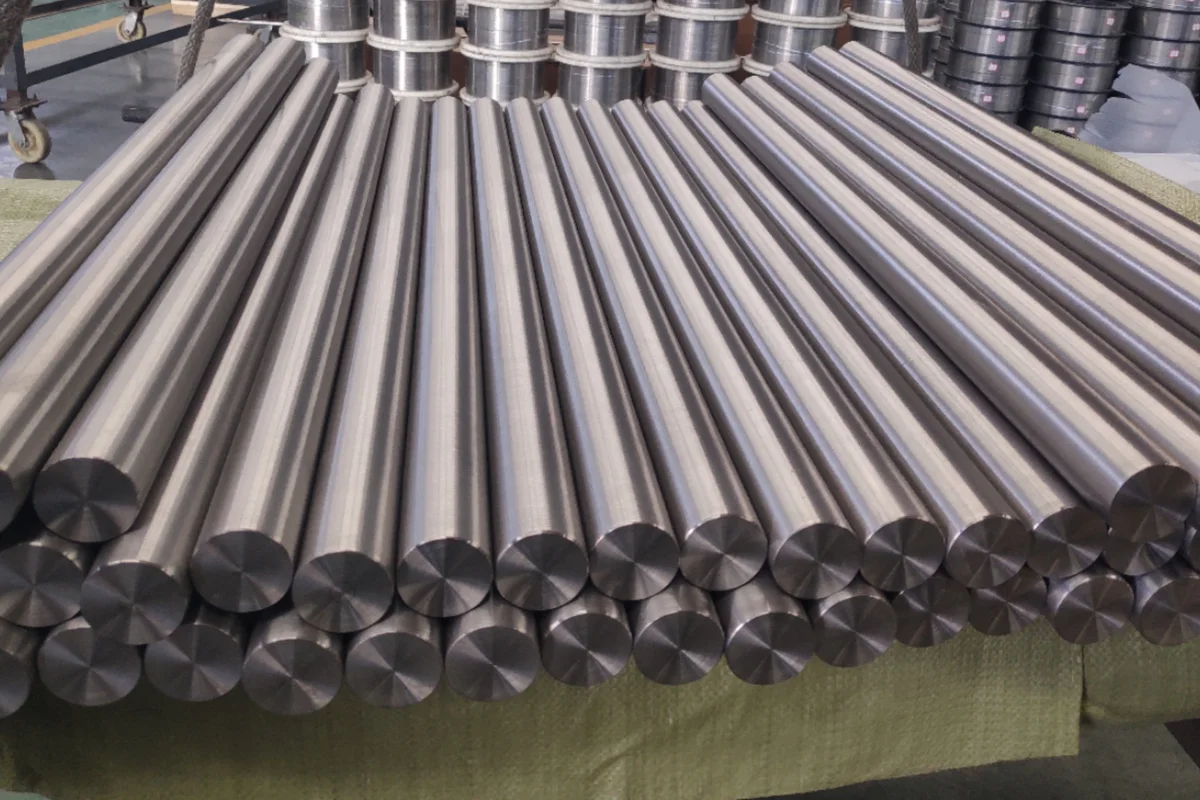
The numbers, with the spread the sources actually show
These are the values Beiyu Titanium publishes for Grade 2, an unalloyed grade. Where sources disagree, the disagreement is shown rather than averaged away.
| Property | Metric | Imperial |
|---|---|---|
| Density | 4.51 g/cm³ | 0.163 lb/in³ |
| Melting point | About 1660 °C; sources give 1649 to 1671 °C | About 3020 °F; 3000 to 3040 °F |
| Modulus of elasticity | 105 GPa | 15.2 × 10⁶ psi |
| Poisson’s ratio | 0.32 | 0.32 |
| Thermal conductivity at 20 °C | 20 to 22 W/m·K | 11.6 to 12.7 BTU/hr·ft·°F |
| Specific heat capacity | 520 J/kg·K | 0.124 BTU/lb·°F |
| Coefficient of thermal expansion | 8.6 × 10⁻⁶ /K (0 to 100 °C) | 4.8 µin/in·°F (68 to 212 °F) |
| Electrical resistivity | 0.48 to 0.53 µΩ·m | 19 to 21 µΩ·in |
Two of those entries deserve a caution rather than a tidy number. The 20 to 22 W/m·K in the table is the figure at 20 °C; across sources and temperature bases the published spread widens to roughly 16 to 22 W/m·K, and electrical resistivity behaves the same way, so sizing should use the figure the design code supports. The melting point is likewise quoted differently by different references, which is why it is given here as a range rather than a single value. A single number is not more accurate than a range; it has only hidden where the uncertainty sits.
Electrical resistivity is where that spread is widest and where the grade matters most, because Grade 5 is roughly three times more resistive than Grade 2. The figures grade by grade, and the disagreement between published sources set side by side rather than averaged, are in is titanium conductive.
Which of these a mill certificate actually confirms
This is the part that separates a fact worth citing from a fact worth acting on. ASTM B265 and ASTM B348, the specifications most titanium sheet, plate and bar is ordered against, set chemical composition, mechanical properties and dimensional tolerances. They do not carry the physical properties in the table above.
| Kind of figure | A routine reporting item under B265 or B348? | What that means for a drawing |
|---|---|---|
| Chemistry and tensile properties | Yes, required and reported | Can be specified and can be rejected against |
| Density, melting point, thermal and electrical values | No | Design data; an acceptance limit needs a separate agreement on the order |
| Hardness | No. The Grade 2 data sheet lists typical published values near 150 HB and separately 160 to 200 HV | Needs an agreed additional test if it is a requirement |
| Magnetic permeability | No | See is titanium magnetic for the figures and the clause |
The practical consequence is that a specification which repeats a handbook density or a nominal melting point as though the standard verified it is relying on something those specifications do not report. Such a limit is not impossible to order against, but it has to be agreed separately, with the method and the reporting requirement written onto the purchase order. Otherwise the number belongs in the calculation rather than in the acceptance clause.
Three facts that change what a buyer does
| Fact | Why it matters on an order |
|---|---|
| Grade 2 titanium has a density of 4.51 g/cm³ | Weight per metre is a calculation, not a catalogue value; it follows from the section and this density |
| Titanium does not form rust, because rust is iron oxide | It carries a passive titanium dioxide film instead. Corrosion resistance is generally associated with that film, and in some media the film can lose stability, so not rusting is not the same as not corroding |
| Unalloyed titanium is not one material | Grade 1, 2, 3 and 4 are all unalloyed and carry different chemistry limits, with oxygen and other interstitials among the elements that separate them. Naming “CP titanium” without the grade, the product form and the governing standard leaves the applicable chemical and mechanical requirements unfixed |
For the grade-by-grade figures behind these, see the Grade 2 and Grade 5 data sheets, which carry the chemistry limits, mechanical minimums and the standards each is supplied against.
Specification detail with sources
The physical property values quoted above are the ones carried on the Beiyu Titanium Grade 2 data sheet, including the melting point of about 1660 °C (sources give 1649 to 1671 °C) and the thermal conductivity spread of roughly 16 to 22 W/m·K noted there. The statement that these properties are absent from ASTM B265 and ASTM B348 reflects the scope of those specifications, which cover chemical composition, mechanical properties and dimensional tolerances; density, melting point, hardness and magnetic permeability are not among the reported items, which is why a limit on any of them is agreed between purchaser and supplier and stated on the order rather than assumed from the standard.
Ordering against the numbers rather than the trivia
Beiyu Titanium supplies titanium bar, plate, sheet, tube and forgings in Grade 1, 2, 5, 7, 9, 12 and 23 against ASTM and AMS specifications, with an EN 10204 3.1 mill test certificate by order scope. Send the grade, the governing specification, dimensions with tolerance, the delivery and surface condition and the inspection scope. Where a physical property has to be held to a limit, state the limit, the test method and the reporting requirement on the order so they can be agreed at quotation.