
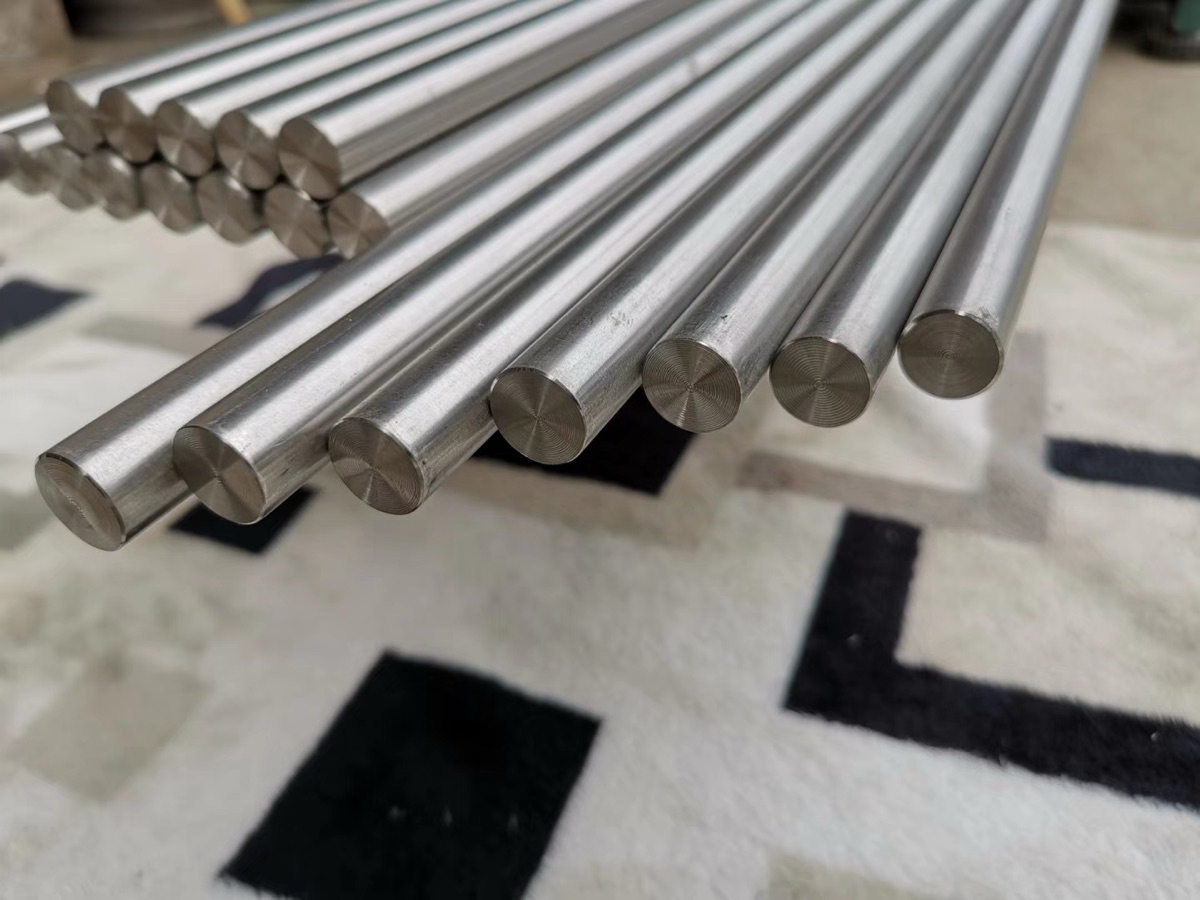
Grade 5 titanium is Ti-6Al-4V, UNS R56400: an alpha-beta alloy of 5.50 to 6.75 % aluminum and 3.50 to 4.50 % vanadium, balance titanium. Minimum tensile strength is 895 MPa against 345 MPa for commercially pure Grade 2, at a density of 4.43 g/cm3. It is the grade specified when commercially pure titanium is not strong enough.
Grade 5 titanium chemical composition
Limits below are the ASTM B348 (bar and billet) and ASTM B265 (plate, sheet and strip) requirements. Aluminum stabilizes the alpha phase and vanadium the beta phase, which is what makes the alloy heat treatable; the interstitials are capped because each raises strength and cuts ductility.
| Element | Min, wt % | Max, wt % | Function or reason for the limit |
|---|---|---|---|
| Aluminum (Al) | 5.50 | 6.75 | Alpha stabilizer |
| Vanadium (V) | 3.50 | 4.50 | Beta stabilizer, gives heat treatability |
| Iron (Fe) | – | 0.40 | Beta stabilizer, controlled residual |
| Oxygen (O) | – | 0.20 | Capped for ductility and toughness |
| Carbon (C) | – | 0.08 | Interstitial |
| Nitrogen (N) | – | 0.05 | Strongest interstitial hardener |
| Hydrogen (H) | – | 0.015 | 150 ppm; controls hydride embrittlement |
| Residuals, each | – | 0.10 | From sponge and revert |
| Residuals, total | – | 0.40 | Sum of the above |
| Titanium (Ti) | Balance | ||
Where AMS 4928 is tighter than ASTM
This catches people out on aerospace-derived drawings. AMS 4928 (bar, billet and forgings) holds hydrogen to 0.0125 % and iron to 0.30 %, against the ASTM limits of 0.015 % and 0.40 %. Material that passes ASTM B348 can therefore fail an AMS 4928 check on chemistry alone, so AMS 4928 titanium bar must be melted to the AMS limits, not corrected later. Some orders also invoke a 0.005 % max yttrium limit, which is not a universal ASTM B348 requirement and has to appear on the order to reach the certificate.
Grade 5 titanium mechanical properties
Tensile and yield minimums are identical across ASTM B348 Grade 5, B265 Grade 5 and B381 Grade F-5 in the annealed condition. They are acceptance thresholds, not design values. The elongation and reduction of area requirements are not identical: B348 and B381 measure elongation in 4D and add a 25 percent reduction of area minimum, while B265 measures elongation in 2 in. (50 mm) and sets no reduction of area requirement at all. Ordering B265 plate and then testing it against a reduction of area figure is a common way to reject conforming material.
| Property, annealed | ASTM minimum (metric) | ASTM minimum (imperial) | Typical mill bar |
|---|---|---|---|
| Tensile strength, ultimate | 895 MPa | 130 ksi | 950 to 1070 MPa (138 to 155 ksi) |
| Yield strength, 0.2 % offset | 828 MPa | 120 ksi | 880 to 1015 MPa (128 to 147 ksi) |
| Elongation (4D under B348 and B381; 2 in. under B265) | 10 % | 10 % | 15 to 20 % |
| Reduction of area (B348 and B381 only; not required by B265) | 25 % | 25 % | 38 to 51 % |
| Hardness | not specified | 30 to 36 HRC (about 330 HV) | |
| Charpy V-notch impact | not specified | 17 to 24 J | |
| Fracture toughness, KIc | not specified | about 75 to 107 MPa-m^0.5, condition dependent | |
Sheet and plate minimums change with thickness
Thin gauge is stronger and less ductile than heavy plate from the same heat, so a single sheet number misleads. Published AMS 4911 minimums for annealed sheet and plate run as follows; check the current AMS revision before use.
| Thickness | Tensile strength, min | Yield strength, min | Elongation in 2 in, min |
|---|---|---|---|
| Over 0.025 to 0.063 in | 134 ksi (924 MPa) | 126 ksi (869 MPa) | 8 % |
| Over 0.063 to 0.1874 in | 134 ksi (924 MPa) | 126 ksi (869 MPa) | 10 % |
| Over 0.1874 to 4.000 in | 130 ksi (895 MPa) | 120 ksi (828 MPa) | 10 % |
Requirements also shift with test orientation, bar diameter and design-authority conditions. Detail by form sits in our ASTM B348 bar and billet guide and ASTM B265 sheet and plate guide.
Solution treated and aged
Typical STA bar values from mill data sheets are 1034 to 1186 MPa (150 to 172 ksi) tensile, 945 to 1076 MPa (137 to 156 ksi) yield, 15 to 17 % elongation and 41 to 46 % reduction of area, with hardness rising to roughly 35 to 39 HRC. Hardness for every grade, and why it is not a B348 requirement, is on titanium hardness by grade. These are mill values, not specification minimums, and hold only in sections that quench fast enough.
Grade 5 titanium physical properties
Physical properties are alloy constants and do not change with the standard bought to. Where sources disagree, both figures are shown.
| Property | Value (metric) | Value (imperial) | Note |
|---|---|---|---|
| Density | 4.43 g/cm3 | 0.160 lb/in3 | Mill sheets quote 4.42 to 4.47 |
| Melting range | 1604 to 1660 C | 2920 to 3020 F | Solidus to liquidus; some mills quote 1538 C |
| Beta transus | about 995 C | about 1825 F | Tolerance +/- 14 C. ASM sheets list 980 C; confirm per heat before beta processing |
| Modulus of elasticity, tension | 113.8 GPa | 16,500 ksi | Band 105 to 120 GPa |
| Shear modulus | 44 GPa | 6,380 ksi | Band 40 to 45 GPa |
| Poisson’s ratio | 0.342 | 0.342 | Published band 0.31 to 0.37 |
| Thermal conductivity, 20 C | 6.7 to 7.1 W/m-K | 46.5 to 49.2 Btu-in/h-ft2-F | Low; drives cutting heat into the tool |
| Specific heat capacity | 526 to 570 J/kg-K | 0.126 Btu/lb-F | Some sources give up to 570 J/kg-K |
| Coefficient of thermal expansion, 20 to 100 C | 8.6 µm/m-K | 4.78 µin/in-F | About 9.2 µm/m-K over 20 to 315 C |
| Electrical resistivity | about 1.7 µΩ-m | 170 µΩ-cm | Roughly 100 times that of copper |
| Hardness, annealed | 30 to 36 HRC | About 330 HV, 334 HB | |
| Hardness, solution treated and aged | 35 to 39 HRC | Mill figure | |
| Magnetic permeability | 1.00005 at 1.6 kA/m | Does not respond to a magnet | |
Standards and product forms
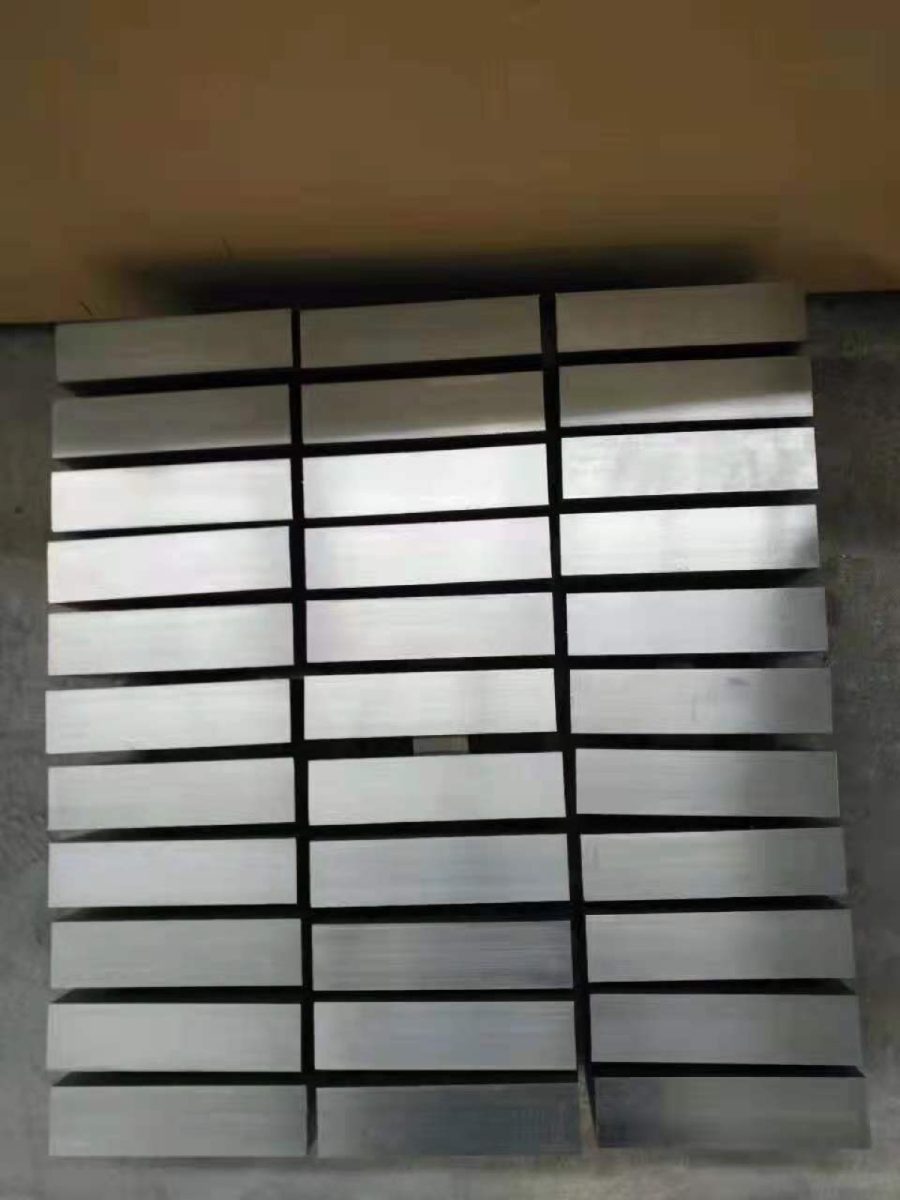
Grade 5 is bought to a different ASTM number for each product form. Quoting the wrong one is the most common ordering error on this alloy: a mill cannot certify against a standard that does not cover the form.
| Product form | ASTM specification | ASME equivalent | AMS specification |
|---|---|---|---|
| Bar and billet | B348 Grade 5 | SB-348 | AMS 4928 (annealed), 4965 (solution treated and aged), 4967 (annealed, heat treatable) |
| Plate, sheet and strip | B265 Grade 5 | SB-265 | AMS 4911 (annealed) |
| Forgings | B381 Grade F-5 | – | AMS 4928 (forgings and forging stock) |
| Wire | B863 Grade 5 | – | AMS 4928 (wire) |
| Seamless pipe | B861 Grade 5 | SB-861 | – |
| Welded pipe | B862 Grade 5 | – | – |
ASTM B381 requires the forging stock itself to conform to ASTM B348, so a forging order carries the bar standard behind it. And ASTM B338 does not cover Grade 5: B338 is the condenser and heat exchanger tube specification, and its grade list covers the commercially pure and corrosion-resistant alloy grades, not Grade 5. Requests for “ASTM B338 Grade 5 tube” cannot be certified as written. Where the design accepts pipe rather than condenser tube, the routes are ASTM B861 for seamless pipe and ASTM B862 for welded pipe; where the design genuinely requires B338 heat exchanger tube, the grade has to change, because no Grade 5 route exists under that specification.
On European drawings, Grade 5 appears as material number 3.7165 (TiAl6V4), and aerospace WL sheets carry 3.7164 for the same alloy. Both map to UNS R56400.

Grade 5 vs Grade 23 and Grade 2
Three grades cover most industrial titanium buying, trading strength against ductility and formability.
| Grade 2 (CP titanium) | Grade 5 (Ti-6Al-4V) | Grade 23 (Ti-6Al-4V ELI) | |
|---|---|---|---|
| UNS number to ASTM B348 / B265 | R50400 | R56400 | R56407 |
| Tensile strength, min | 345 MPa (50 ksi) | 895 MPa (130 ksi) | 828 MPa (120 ksi) |
| Yield strength, min | 275 MPa (40 ksi) | 828 MPa (120 ksi) | 759 MPa (110 ksi) |
| Elongation, min | 20 % | 10 % | 10 % |
| Oxygen, max | 0.25 % | 0.20 % | 0.13 % |
| Iron, max | 0.30 % | 0.40 % | 0.25 % |
| Chosen for | Forming, welding, corrosion service | Strength and heat treatability | Fracture toughness, cryogenic and implant work |
Grade 23 is the same nominal alloy with the interstitials pulled down, buying fracture toughness and low-temperature ductility at the cost of about 67 MPa of minimum tensile strength. One designation trap: Grade 23 is UNS R56407 when ordered to ASTM B348, B265, B381 or B863. UNS R56401 belongs to ASTM F136, the surgical implant specification, and the two are not interchangeable on a certificate. Full detail is in Grade 5 vs Grade 23 titanium, and the strength-versus-formability call against commercially pure material is covered in Grade 2 vs Grade 5 titanium.
Heat treatment: annealed vs solution treated and aged
Most Grade 5 ships annealed, at roughly 690 to 790 C (1275 to 1450 F) for half an hour to two hours, then air or furnace cooled. Stress relief runs lower, 540 to 650 C (1000 to 1200 F), used after machining or welding to remove residual stress without changing tensile properties.
For higher strength it is solution treated at 913 to 954 C (1675 to 1750 F), water quenched, then aged at 524 to 552 C (975 to 1025 F) for three to eight hours and air cooled. Where fracture toughness matters more than tensile strength, a beta anneal near 1065 C (1950 F) with aging at 620 to 705 C (1150 to 1300 F) is used instead.
The limit is hardenability. Grade 5 does not through-harden in heavy section: sections much beyond about 25 mm (1 in) will not develop full STA properties, and any delay between furnace and quench tank costs strength. Specify the condition on the order rather than assuming a heavy bar can be aged to a thin-section property table. Two process cautions also carry through from the mills: hydrogen picked up during acid pickling or improper heat treatment forms brittle hydrides, which is why the 0.015 % cap exists, and oxygen, nitrogen and carbon pickup during hot work leaves a hard, brittle surface layer that has to be removed.
Applications
Mill data sheets put Ti-6Al-4V at more than half of all titanium consumed. Recurring uses across mill data sheets include:
- Aero-engine compressor blades, discs and rings, and airframe structural parts
- Fasteners and critical forgings where strength per unit weight decides the design
- Offshore and marine hardware in seawater service
- Pressure vessels and chemical process equipment outside reducing-acid duty
- Medical and dental devices, with implants taken to the ELI grade and implant standards rather than Grade 5
- Motorsport components, sporting goods and hand tools
Corrosion is where Grade 5 gets misapplied. A stable titanium dioxide film forms the moment the surface meets air or water, giving a nil corrosion rate in room-temperature seawater. That film breaks down in hydrofluoric acid, and the alloy is attacked by hydrochloric, sulfuric and phosphoric acids at working concentrations. Grade 5 is susceptible to chloride stress corrosion cracking and should not be used with red fuming nitric acid. Continuous service is held to roughly 350 to 400 C (660 to 750 F). Low thermal conductivity also sends cutting heat into the tool rather than the chip, so machining needs slow speeds, heavy feeds, rigid setups and flood coolant.
How to specify Grade 5 titanium on an order
A complete Grade 5 line item removes a round of clarification and lets the certificate be written correctly first time. Include:
- Grade and designation: Grade 5, Ti-6Al-4V, UNS R56400. Add 3.7165 if the drawing is European.
- Standard and revision: ASTM B348, B265, B381, B863, B861 or B862 by form, or the AMS number.
- Product form: round bar, square bar, billet, plate, sheet, strip, forging, wire, pipe.
- Dimensions and tolerance: diameter or thickness, width, length, and the tolerance class or plus/minus values.
- Condition: annealed, stress relieved, or solution treated and aged. If STA, state the section size so hardenability can be checked.
- Surface: as forged or black, pickled, peeled, turned, centerless ground or polished, with a roughness figure if functional.
- Testing and certificate: EN 10204 3.1 mill test certificate, heat number traceability, tensile test orientation and sampling location, plus ultrasonic class if needed.
- Marking and packing: heat number marking method and export packing requirement.
Beiyu Titanium supplies Grade 5 in bar, billet, plate, sheet, forging and wire form to ASTM and AMS specifications, with EN 10204 3.1 mill test certificates and heat number traceability. Send a drawing or specification line and we will confirm in writing which standard, condition, tolerance and surface can be met. Bar dimensions and ordering detail are on the Ti-6Al-4V Grade 5 titanium bar page.
Is Grade 5 titanium the same as Ti-6Al-4V?
Yes. Grade 5 is the ASTM grade designation, Ti-6Al-4V the alloy shorthand, and both describe UNS R56400. The same material is written Ti64, TA6V on French drawings, TC4 in Chinese practice and 3.7165 in German material numbers. What matters is the standard it was certified to and the condition it shipped in, not the name.
Is Grade 5 titanium magnetic?
No. Grade 5 contains no ferromagnetic phase, and its magnetic permeability is 1.00005 at 1.6 kA/m, essentially that of free space, so it will not stick to a magnet. That makes it usable near sensitive instrumentation and in magnetic resonance environments that exclude steel.
Does Grade 5 titanium rust?
No. Rust is iron oxide and needs iron as the base metal. Grade 5 forms a thin titanium dioxide film that re-forms instantly if scratched in air or water, and the corrosion rate in room-temperature seawater is nil. The limits are chemical, not atmospheric: hydrofluoric acid strips the film, reducing acids attack the metal, and chlorides can drive stress corrosion cracking in a loaded part.
How strong is Grade 5 titanium compared to steel?
Grade 5 has a minimum tensile strength of 895 MPa at 4.43 g/cm3. Structural and medium-carbon steels sit lower in strength at about 7.85 g/cm3, so Grade 5 has roughly 56 percent of the density of steel. Whether it wins on strength per unit weight depends entirely on which steel grade it is compared against. Against hardened alloy steels reaching 1500 MPa it loses on absolute strength, winning only where mass, corrosion resistance or non-magnetic behavior drives the design. Aging narrows that gap without closing it.
Specification detail with sources
Grade 5 (Ti-6Al-4V, UNS R56400) is specified with 5.50 to 6.75% aluminum and 3.50 to 4.50% vanadium, per ASTM B265, Table 1. Annealed material must reach 895 MPa (130 ksi) minimum tensile strength and 828 MPa minimum yield strength, per ASTM B265, Table 2.
Density is 4.43 g/cm³ (ASM Handbook, Vol. 2), slightly below the 4.51 g/cm³ of unalloyed titanium, so the alloy carries roughly 2.6 times the minimum tensile strength of Grade 2 (345 MPa, ASTM B265, Table 2) at marginally lower weight. Bar and billet are supplied to ASTM B348, and aerospace bar in the annealed condition to AMS 4928.