
Titanium hardness depends on the grade. The unalloyed grades sit on the Rockwell B scale, from 70 HRB for Grade 1 to 100 HRB for Grade 4, while the alloys Grade 9, Grade 5 and Grade 23 move to the Rockwell C scale, with Grade 5 at a nominal 33 HRC in the RMI Titanium Company Titanium Alloy Guide. Those are typical values, not limits: neither ASTM B265 nor ASTM B348 sets a hardness requirement, so a hardness figure only becomes a checked value when the order asks for it.
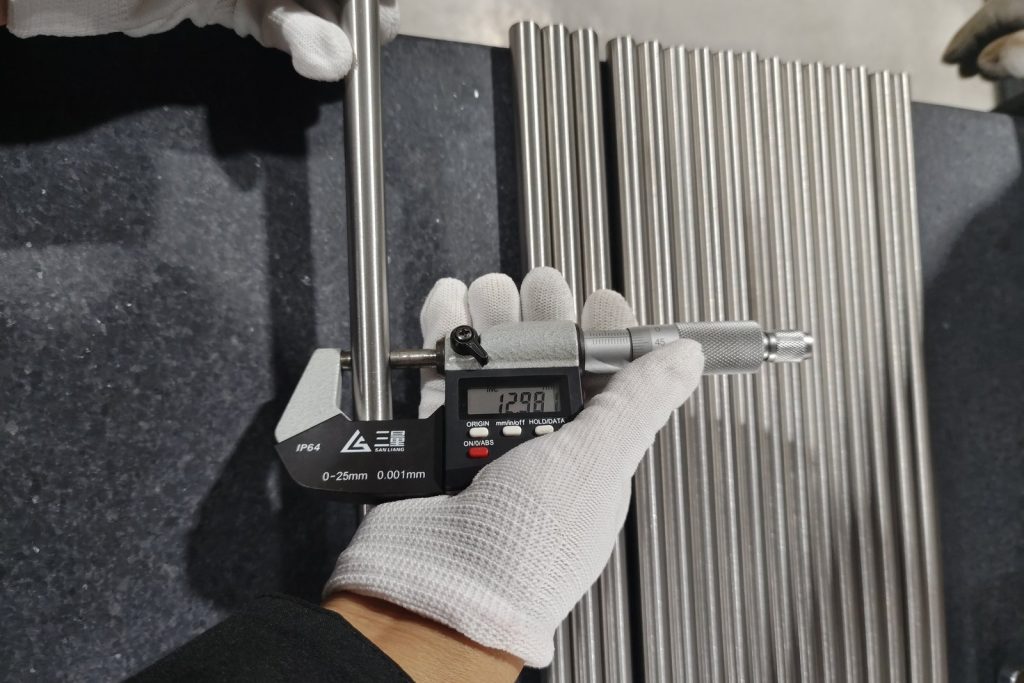
Titanium hardness by grade
The nominal values below come from the per-grade data sheets of a single publication, the RMI Titanium Alloy Guide (January 2000), so every row sits on the same basis. Where a Beiyu Titanium data sheet gives its own typical figure for the same grade, it is shown in the last column rather than merged, because they are typical values from two publications, and for Grade 2 on different scales.
| Grade | UNS | RMI nominal hardness | Beiyu data sheet typical value |
|---|---|---|---|
| Grade 1 | R50250 | 70 HRB | Not published |
| Grade 2 | R50400 | 82 HRB | Near 150 HB, or 160 to 200 HV |
| Grade 3 | R50550 | 90 HRB | Not published |
| Grade 4 | R50700 | 100 HRB | Not published |
| Grade 7 | R52400 | 82 HRB | Not published |
| Grade 12 | R53400 | 88 HRB | Not published |
| Grade 9 | R56320 | 25 HRC | Not published |
| Grade 23 | R56407 | 32 HRC | Not published |
| Grade 5 | R56400 | 33 HRC | 30 to 36 HRC annealed, about 330 HV or 334 HB; roughly 35 to 39 HRC solution treated and aged |
The UNS numbers are given for cross-reference; ASTM B348 itself identifies material by grade number only. Grade 23 is listed as R56407, and R56401 is the number ASTM F136 gives the implant form of the same alloy. The Grade 5 row is where the two sources can be read against each other on one scale: RMI’s nominal 33 HRC falls inside the 30 to 36 HRC annealed range on the Grade 5 data sheet.
Hardness and oxygen limit across the unalloyed grades
The four unalloyed grades are not four purities of one metal in the loose sense. They are separated by their limits on oxygen, nitrogen and iron, and the RMI figures for hardness rise in the same order as the oxygen limit.
| Grade | Oxygen, max (wt %) | Nitrogen, max (wt %) | Iron, max (wt %) | RMI nominal hardness |
|---|---|---|---|---|
| Grade 1 | 0.18 | 0.03 | 0.20 | 70 HRB |
| Grade 2 | 0.25 | 0.03 | 0.30 | 82 HRB |
| Grade 3 | 0.35 | 0.05 | 0.30 | 90 HRB |
| Grade 4 | 0.40 | 0.05 | 0.50 | 100 HRB |
For a buyer, the practical reading is that choosing between Grade 1 and Grade 4 is also choosing between the softest and the hardest of the unalloyed family.
Reading HRB, HRC, HB and HV side by side
A figure on the Rockwell B scale and one on the Rockwell C, Brinell or Vickers scale are not the same number in different units. In the RMI guide the unalloyed grades, Grade 7 and Grade 12 are quoted on Rockwell B, and the alloys Grade 9, Grade 5 and Grade 23 on Rockwell C, which is where the table above changes scale. Converting between scales needs a conversion basis agreed for the material; a limit on a drawing should therefore name the scale it is written on, and the test should be run on that scale.
| Scale | Where it appears in the per-grade sources used here |
|---|---|
| HRB (Rockwell B) | Unalloyed grades and Grade 7 and Grade 12 in the RMI guide |
| HRC (Rockwell C) | Grade 5, Grade 9 and Grade 23 in the RMI guide; Grade 5 on the Beiyu data sheet |
| HB (Brinell) | Beiyu data sheets for Grade 2 and Grade 5 |
| HV (Vickers) | Beiyu data sheets for Grade 2 and Grade 5 |
Mohs hardness, the scratch scale used for minerals, does not appear for any grade in either source.
Does condition change titanium hardness?
It does for the heat-treatable alloys. The Grade 5 data sheet gives 30 to 36 HRC in the annealed condition and roughly 35 to 39 HRC after solution treatment and ageing, so the same alloy can arrive in two different hardness bands depending on the condition written on the order. The RMI Grade 5 value is a nominal figure without a condition range. For the unalloyed grades, annealed is the normal supply condition and the table values are the ones to expect.
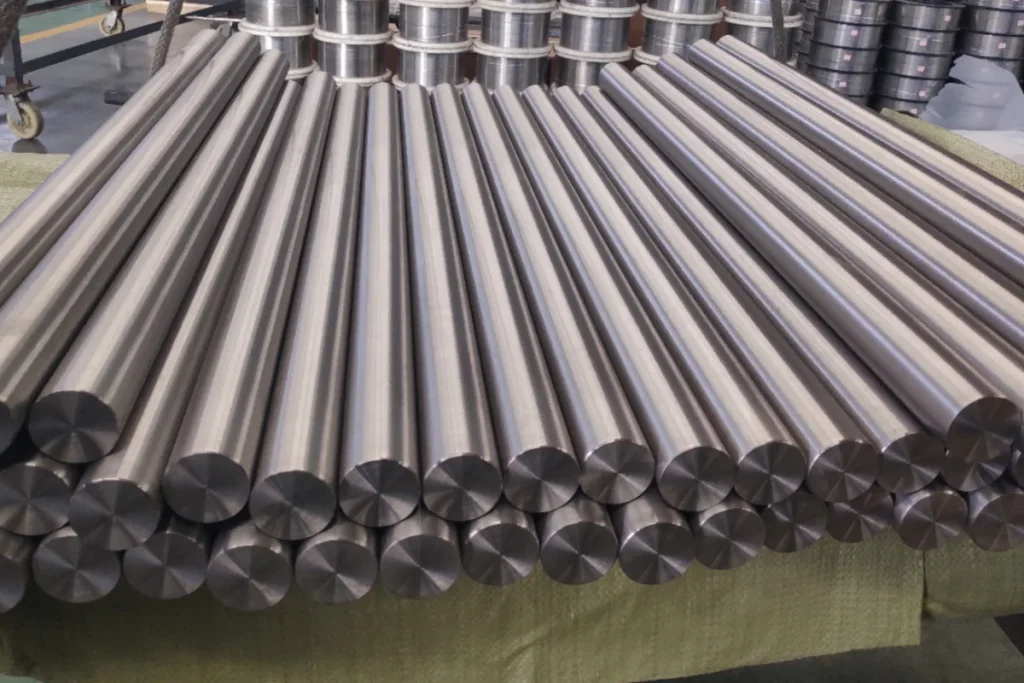
Putting a hardness limit on a titanium order
Because ASTM B265 and B348 carry no hardness column, a certificate issued to those specifications alone is not required to report hardness, and material cannot be rejected on hardness against them. The certificate side of this is set out in titanium vs stainless steel. When the part does need a hardness limit, the order has to carry it as an additional requirement.
| Line on the order | What to state |
|---|---|
| Grade and condition | For example Grade 5, annealed, or Grade 5, solution treated and aged |
| Scale | The scale the drawing uses (HRB, HRC, HB or HV), stated explicitly |
| Limit | Minimum, maximum or range on that scale |
| Test method and reporting | The test method, and that the result is reported on the certificate |
For bar, the titanium bar RFQ checklist sets out the other lines the enquiry needs, and material is supplied as Grade 2 titanium bar or Ti-6Al-4V plate among other forms.
Common questions
What is the hardest titanium grade? In the RMI figures for the grades above, Grade 5 at a nominal 33 HRC, with Grade 23 at 32 HRC; among the unalloyed grades, Grade 4 at 100 HRB.
Is titanium harder than steel? It depends on the steel; the comparison, including why wear is a surface question rather than a bulk hardness number, is on titanium vs stainless steel.
What is the hardness of Grade 2 titanium? A nominal 82 HRB in the RMI guide; the Grade 2 data sheet gives typical values near 150 HB, or 160 to 200 HV.
Is titanium magnetic? The answer, with permeability figures by grade, is on is titanium magnetic.
Is titanium heavy? Density by grade and weight per metre by bar size are on is titanium heavy.
Does hardness appear on a titanium mill certificate? ASTM B265 and B348 do not require it, so it appears only when the order adds it, as in the order section above.
Specification detail with sources
The nominal hardness values are from the RMI Titanium Company Titanium Alloy Guide (January 2000), which gives one nominal figure per grade on its data sheets: 70 HRB for Grade 1, 82 HRB for Grade 2, 90 HRB for Grade 3, 100 HRB for Grade 4, 82 HRB for Grade 7, 88 HRB for Grade 12, 25 HRC for Grade 9, 32 HRC for Grade 23 and 33 HRC for Grade 5. The oxygen, nitrogen and iron maximums in the unalloyed-grade table are from the same guide’s chemical composition lines for those grades. The Beiyu figures are the typical values carried on the Beiyu Titanium Grade 2 and Grade 5 data sheets, and they are shown next to RMI’s rather than reconciled because they are typical values from two publications, and for Grade 2 on different scales. None of these is a specification limit: ASTM B265 and ASTM B348 set chemical, mechanical and dimensional requirements and contain no hardness requirement, so hardness is verified only when the purchase order adds it.
What to put on the enquiry
State the grade, the condition and, if the drawing has one, the hardness limit with its scale; with those, a hardness test is quoted with the material rather than raised at inspection. Beiyu Titanium supplies titanium in Grade 1, 2, 5, 7, 9, 12 and 23 as bar, plate, sheet, tube and forgings to ASTM and AMS specifications, with an EN 10204 3.1 mill test certificate by order scope.