
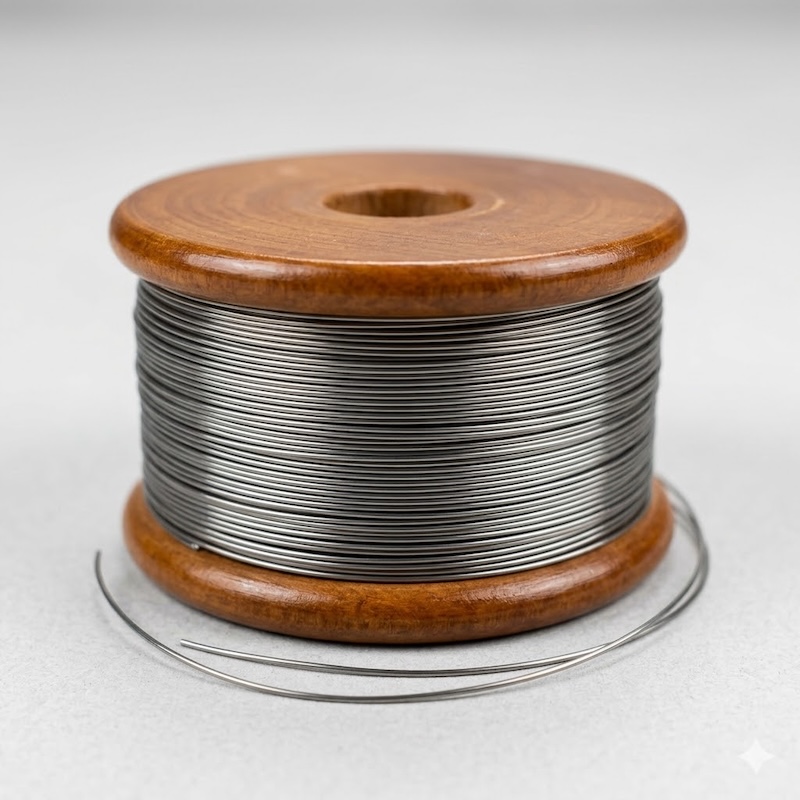
Ultra-fine titanium wire is a drawing and handling purchase. Below ordinary wire sizes, diameter distribution, surface defects, temper, tensile/elongation balance, continuous length, spool geometry and payoff tension can decide whether weaving, winding or precision forming runs at all. Five company-owned sources met the rule and exposed different minimum-size and application routes.
How the five company sources were selected
We froze the query ultra fine thin titanium wire supplier manufacturer small diameter on 1 September 2026. Eligible sources were company-owned fine-wire pages that exposed a titanium grade/material, sub-millimetre size, production/capability, surface, spool, tolerance, inspection or application field. Beiyu, geographies excluded by site policy, marketplaces, directories, third-party lists, finished mesh-only pages and Nitinol-only pages were removed. The discovery order is not a fineness or quality ranking.
A public page can identify a likely supply route. It cannot prove allocated stock, a current program approval, final schedule, lot compliance or suitability of material/equipment not yet produced or assigned. Those points remain dated quotation fields.
Company pages that met the rule
| Company source | Page role | Visible fields | RFQ check |
|---|---|---|---|
| Kobelco Wire | Ultra-thin wire technology page | Grade 1 at 50 μm, laboratory 20 μm class, high-purity options and sintered-mesh route | Separate production supply from laboratory capability; define purity, size, length and conversion |
| Bokang Titanium | Thin titanium-wire page | Fine-drawing, material/certification context, spooling/handling and inspection fields | Return actual grade, MOQ, distribution, temper, surface, continuous length and spool record |
| TopTi | Precision wire manufacturer page | Fine-drawing route down to a stated 0.1 mm, temper, traceability and custom-spool/packing fields | Reconfirm production minimum, grade, temper, continuous length, tolerance and spool |
| Chenyuan Metal Materials | Titanium-alloy wire page | 0.06 to 6 mm page range, grades, coil/spool/straight forms, surfaces and 3.1 option | Reconcile overlapping range statements in one diameter/tolerance/condition line |
| Chenxin Titanium | Ultra-fine wire product page | 0.1 to 1.0 mm listed sizes, custom packing route and multiple application examples | Use supply fields only; exclude unsourced medical/performance percentages |
A page’s smallest number may describe a laboratory result, a different alloy or a capability outside normal production. It is not comparable with a stocked or repeat-production range. The RFQ should distinguish nominal diameter, permitted variation, orderable range, sample quantity and minimum production lot, then ask how many continuous lengths and spool changes the shipment will contain.
Control the wire and the spool together
| Decision | Choices visible in the source set | Required written return |
|---|---|---|
| Material identity | CP Grade 1/2, Ti-6Al-4V or another alloy; purity where process-critical | Governing specification, heat chemistry, condition and application restriction |
| Diameter | Nominal size, tolerance, ovality and distribution along/within spools | Measurement method, sampling frequency, capability and lot results |
| Mechanical state | Annealed or cold-worked temper; tensile, elongation, ductility and springback | Ordered ranges and test direction/gauge appropriate to the fine wire |
| Surface/cleanliness | Bright/pickled/polished condition, scratches, oxide, lubricant and particles | Defect limits, cleaning route, inspection magnification and residue criteria |
| Package/payoff | Spool material/dimensions, traverse, tension, continuous length, welds and ends | Winding drawing, maximum breaks/joints, net mass and protected packaging |
Do not write “0.05 mm titanium wire” and leave the supplier to choose temper, surface and package. A size can pass a spot micrometre check and still fail in production because local scratches, inconsistent anneal, ovality, kinks or crossed turns cause breaks. State whether joining within a spool is prohibited and how a permitted joint must be marked. For high-purity or semiconductor-related use, define the purity and contamination schedule rather than borrowing a marketing label. For medical research or implant manufacturing, the governing regulatory/material specification and validated downstream process must be provided by the buyer; a general commercial wire page does not establish implant approval.
A page conflict is a verification prompt, not a finding that a company cannot supply the item. Preserve the observed difference, request a clean technical return and make the purchase order control final identity, geometry, responsibility and acceptance.
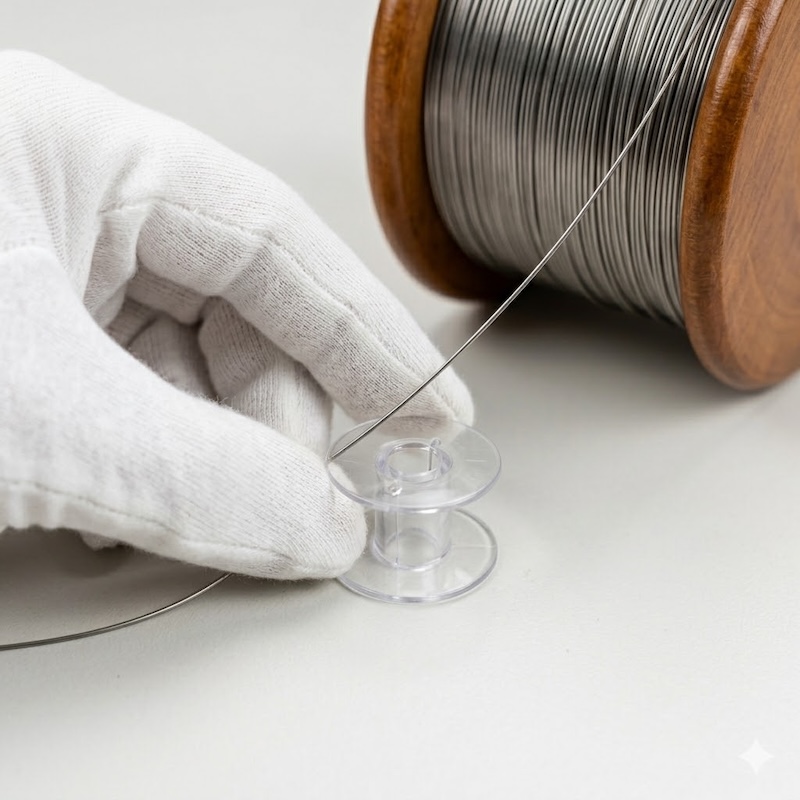
Send one controlled RFQ
| RFQ line | Buyer input | Supplier return |
|---|---|---|
| Identity | Grade/alloy, governing standard, purity and intended process | Offered material, heat/source and application exceptions |
| Dimension | Nominal diameter, tolerance, ovality, distribution and sample plan | Capability statement and lot measurement results |
| Condition | Temper, tensile/elongation or ductility, straightness/springback as relevant | Process condition and measured mechanical return |
| Surface | Finish, cleanliness, scratch/oxide/lubricant and inspection requirements | Cleaning/inspection route, criteria and records |
| Spool/packing | Spool drawing, traverse/payoff, continuous length, joints, labels and moisture protection | Winding/length report, net mass, joint map and packaging plan |
| Commercial | Sample and production quantity, repeatability, required date and destination | MOQ, current schedule, validity, exclusions and change control |
Remove any source that cannot return the exact material, deliverable, finished geometry and acceptance evidence. Compare price, schedule and terms only after technical lines, responsibility boundary and document scope are aligned.
Where Beiyu fits
Beiyu is outside the five-company set. Its thin titanium-wire route asks for grade/alloy and standard, nominal diameter/tolerance/ovality, condition and mechanical range, surface/cleanliness, continuous length, spool geometry/payoff, joint policy, inspection, heat/lot documents, sample/production quantity, packaging and destination. Welding filler remains a separate AWS A5.16 route.
The fields in this section describe only Beiyu’s published enquiry route. They do not score the companies above and do not transfer to another company’s catalogue.
Related Beiyu pages
- Thin titanium wire
- Titanium wire supplier pages compared
- Titanium wire grades and forms
- How to compare titanium quotations
Published by Beiyu Titanium. Beiyu is outside the five-company set. The sequence is a dated discovery snapshot after the stated exclusions, not a rating or endorsement.
Related supplier lists and supply ranges
- titanium wire supply range
- ERTi-7 Titanium Welding Wire Suppliers
- Grade 23 Titanium Wire Suppliers
- Titanium Welding Wire Suppliers
- Titanium Wire Suppliers
- all supplier lists by product family
Specification detail with sources
Beiyu Titanium publishes this list and is not part of the comparison above. For readers who want the publisher’s own figures on the same basis they would ask of any supplier on this page, the material is specified to ASTM B863, and each order carries an EN 10204 type 3.1 certificate with heat and pour numbers by order scope.
Beiyu supplies straight wire 0.8 to 6.0 mm diameter, coil wire 0.8 to 12 mm, and spooled wire 0.01 to 6.35 mm.
These are Beiyu published supply figures and inspection parameters, not limits taken from the standard; limit values belong to ASTM B863 and are confirmed against the exact edition named on the purchase order. Certification is stated as a production capability, and no stock position, delivery time or price is implied by any figure on this page.