
When a part has to survive temperatures that melt steel and nickel alloys, the choice usually comes down to two refractory metals: molybdenum and tungsten. Both keep their strength where ordinary metals soften, but they are not interchangeable. The right pick depends on how hot, how heavy, and how much machining the job allows.
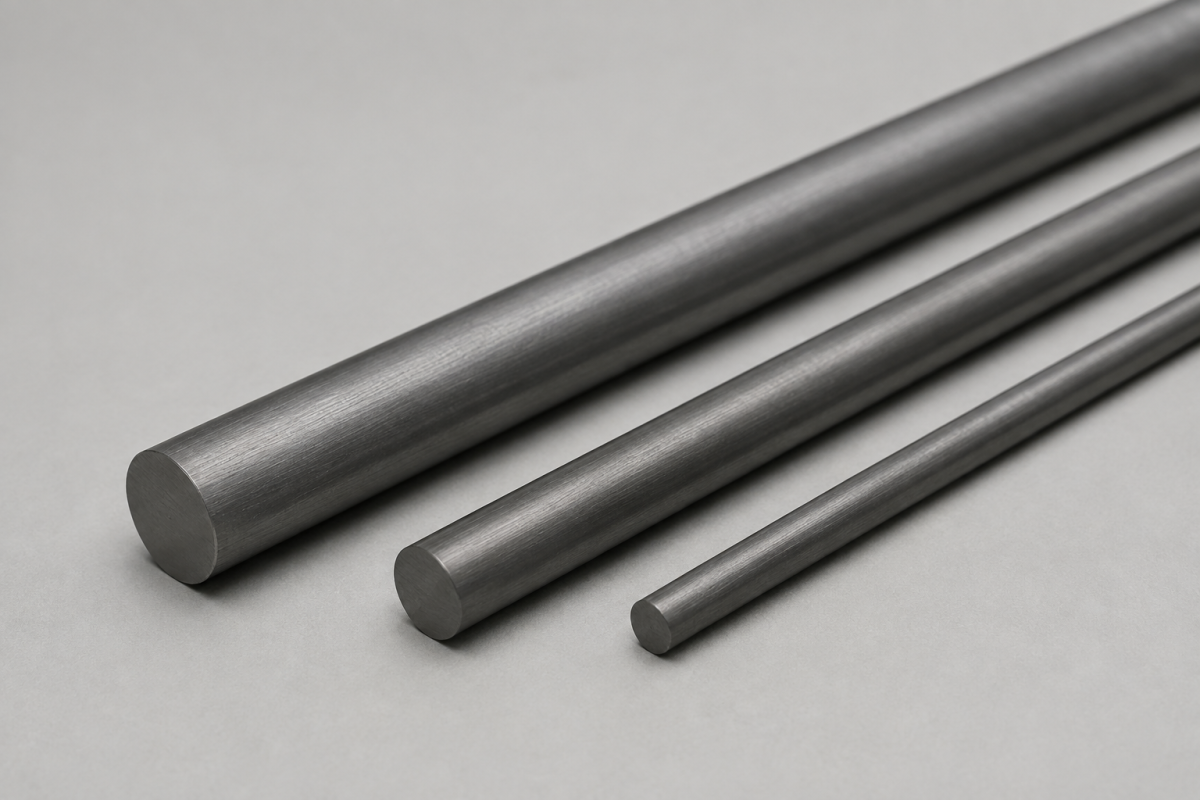
Side by side
| Property | Molybdenum (Mo) | Tungsten (W) |
|---|---|---|
| Melting point | 2,610 °C | 3,410 °C (highest of all metals) |
| Density | 10.22 g/cm³ | 19.25 g/cm³ (~2× Mo) |
| Machinability | Good (turns, mills, drills) | Poor: brittle; use grinding or EDM |
| Relative cost & weight | Lower, lighter | Higher, much heavier |
| Common standard | ASTM B387 (bar/rod) | By drawing / ASTM B777 |
Tungsten owns the extremes, the highest melting point and a density near gold’s. Molybdenum gives up some of that ceiling but is far easier to live with: lighter, lower cost, and genuinely machinable.
Choose molybdenum when…
| When molybdenum fits |
|---|
| You need to machine the part. Pure tungsten is brittle and shaped mainly by grinding and EDM; molybdenum (and TZM) can be turned, milled and drilled like a tough metal. |
| The duty is high-temperature structure, not the absolute extreme. Vacuum-furnace hot zones, supports, fasteners, heating elements and electrodes are classic molybdenum territory. |
| Weight and cost matter. At about half tungsten’s density and lower cost, molybdenum is the default for most furnace hardware. |
For stronger, more creep-resistant high-temperature parts, the TZM alloy (Mo-0.5Ti-0.08Zr) keeps strength to higher temperatures than pure molybdenum. See our molybdenum bar and rod (pure Mo / TZM, ASTM B387).
Choose tungsten when…
| When tungsten fits | What the guide states |
|---|---|
| The temperature is at the very top | Nothing metallic beats tungsten’s 3,410 °C melting point. |
| You need density | Radiation shielding, collimators, balance weights and counterweights exploit tungsten’s 19.25 g/cm³. For these, machinable tungsten heavy alloy (W-Ni-Fe) is usually specified instead of pure W. |
| Electrodes and contacts | Tungsten’s high melting point and electron emission suit electrodes and electrical contacts. |
See our tungsten bar and rod (pure W to the buyer’s material specification or drawing, heavy alloy to ASTM B777).
Both metals oxidise rapidly in air at high temperature, molybdenum above ~600 °C, tungsten somewhat higher, and molybdenum’s oxide is volatile. So high-temperature service for either is in vacuum, hydrogen or inert atmosphere, or with a protective coating. If your hot part runs in open air, neither bare refractory metal is the answer without protection.
| Metal | What the guide states |
|---|---|
| Molybdenum | Oxidises rapidly in air above about 600 C, and its oxide is volatile |
| Tungsten | Oxidises rapidly in air at somewhat higher temperature |
Quick selection rule
Default to molybdenum (or TZM) for machinable, lighter, lower-cost high-temperature parts. Move to tungsten only when you need the absolute melting point or the density, and where you can accept grinding/EDM fabrication (or switch to tungsten heavy alloy for machinable density parts).
FAQ
Is TZM worth it over pure molybdenum?
If the part is loaded near molybdenum’s temperature limit, yes; TZM resists recrystallisation and creep to higher temperatures. For lower-temperature or simple parts, pure Mo is more ductile and cheaper.
Why use tungsten heavy alloy instead of pure tungsten?
Pure tungsten is brittle and hard to machine. Tungsten heavy alloy (90 to 97% W in a ductile Ni-Fe/Ni-Cu matrix) keeps most of the density but machines like a metal; ideal for counterweights and shielding.
Can molybdenum or tungsten be used in air furnaces?
Not bare; both oxidise. Use them in vacuum or inert/reducing atmospheres, or specify an oxidation-protective coating.
Do you supply both with certificates?
Yes, on request. Molybdenum bar and rod are certified to ASTM B387; tungsten is certified to the route ordered: the buyer’s drawing for pure W bar and rod, ASTM B777 for heavy alloy, ASTM B760 for plate, sheet and foil. Send an enquiry with grade, size and condition.
What the order has to state once the metal is chosen
Molybdenum and tungsten are bought as small quantities of expensive stock, usually against a single drawing. The selection argument settles the metal and leaves every field that decides acceptance still open, and refractory enquiries stall in the same four places.
| Order field | What it settles | Consequence of leaving it open |
|---|---|---|
| Metal or alloy with its UNS number | Which composition table applies, since both metals are supplied unalloyed and alloyed | An alloyed grade is quoted against an unalloyed expectation |
| Governing specification | The acceptance basis and the certificate wording for the form being bought | The certificate reports to a table the buyer is not checking |
| Manufacturing route | Whether the item is sintered and worked or produced another way, which shows in the delivered properties | Two suppliers quote two different products at two different prices |
| Product form with dimensions and tolerance | Bar, rod, sheet or wire requirements, read with the size band | A drawing class arrives without the band it is read against |
| Delivery and surface condition | Two separate fields, since a ground surface is not a delivery condition | The finish is set by the supplier default |
| Reports required | The reporting scope on the certificate | A compliant document answers less than incoming inspection expects |
The pattern is not specific to refractory metals. The bar and billet specification ASTM B348 lists surface condition, marking, packing, the reports required and the disposition of rejected material among the items a titanium order is expected to carry (ASTM B348, ordering information), and the same fields go unanswered on a molybdenum or tungsten enquiry for the same reason: they belong to the order, not to the metal.
Specification detail with sources
ASM melting-point data frame the refractory choice: molybdenum melts at 2610 degrees C and tungsten at 3410 degrees C; the densities this site uses for them are 10.22 and 19.25 g/cm3, and the ASTM titles split by product as well as by metal: B387 is titled for molybdenum bar, rod and wire, B760 for tungsten plate, sheet and foil, B777 for tungsten-base high-density metal, and pure tungsten bar and rod go to the buyer’s material specification. The oxidation limit is part of the same published record, with molybdenum’s oxide volatilising in air from roughly 600 degrees C, which is why both metals are vacuum or protective-atmosphere materials rather than open-air ones.
| Property | Molybdenum | Tungsten |
|---|---|---|
| Density | 10.22 g/cm3 | 19.25 g/cm3 |
Beiyu Titanium’s mill production is titanium and nickel alloy, and Beiyu’s first-party numbers here mark where that range ends: for elevated-temperature titanium duty Beiyu supplies Ti-6242 and Ti-6246 alloy bar from 1 to 500 mm diameter. Above titanium’s ceiling but below the refractory threshold, Beiyu supplies Inconel 600 and 601 tube to ASTM B167, seamless from 5 to 325 mm OD in 0.5 to 12 mm walls and lengths to 12000 mm, and in Beiyu’s export practice the first selection question is atmosphere, because a part running hot in open air points to a nickel alloy long before it points to a bare refractory metal.
Send a technical RFQ
For molybdenum or tungsten RFQs, include material form, grade or purity, dimensions, tolerance, surface condition, quantity and the operating temperature range.