
The same titanium is sold under different names in different markets. An ASTM drawing says Grade 2 or UNS R50400; a German one says Werkstoff 3.7035; a French one says T40; a Japanese one says JIS Class 2. They are the same commercially pure metal. This guide maps the grade designations across the major systems, explains where they are genuinely equivalent and where only the naming differs, and shows which standard to put on a purchase order so incoming inspection has one reference to check.
What this is: a lookup for titanium grade designations. Type a grade number, a UNS number, a German Werkstoffnummer or an ASTM or ASME standard, and the matching grade is shown with its chemistry limits, mechanical minimums and the standard that governs each product form. Values are ASTM B-series specification limits unless a row says otherwise.
Chemistry and mechanical values are maximum or minimum specification limits, not typical mill results. Confirm the ordered revision and the acceptance values against the standard named on your purchase order.
How to use this cross-reference on a purchase order
Three things decide whether a mill certificate will be accepted at goods inward, and all three belong on the order: the grade designation, the governing standard for that product form, and the certificate type. A grade number on its own is not enough, because the same grade carries different acceptance requirements from one standard to the next. ASTM B265 flat product caps the yield strength of the commercially pure grades where ASTM B348 bar does not, and ASTM B348 requires a reduction of area that ASTM B265 never asks for.
Why Grade 23 has two UNS numbers
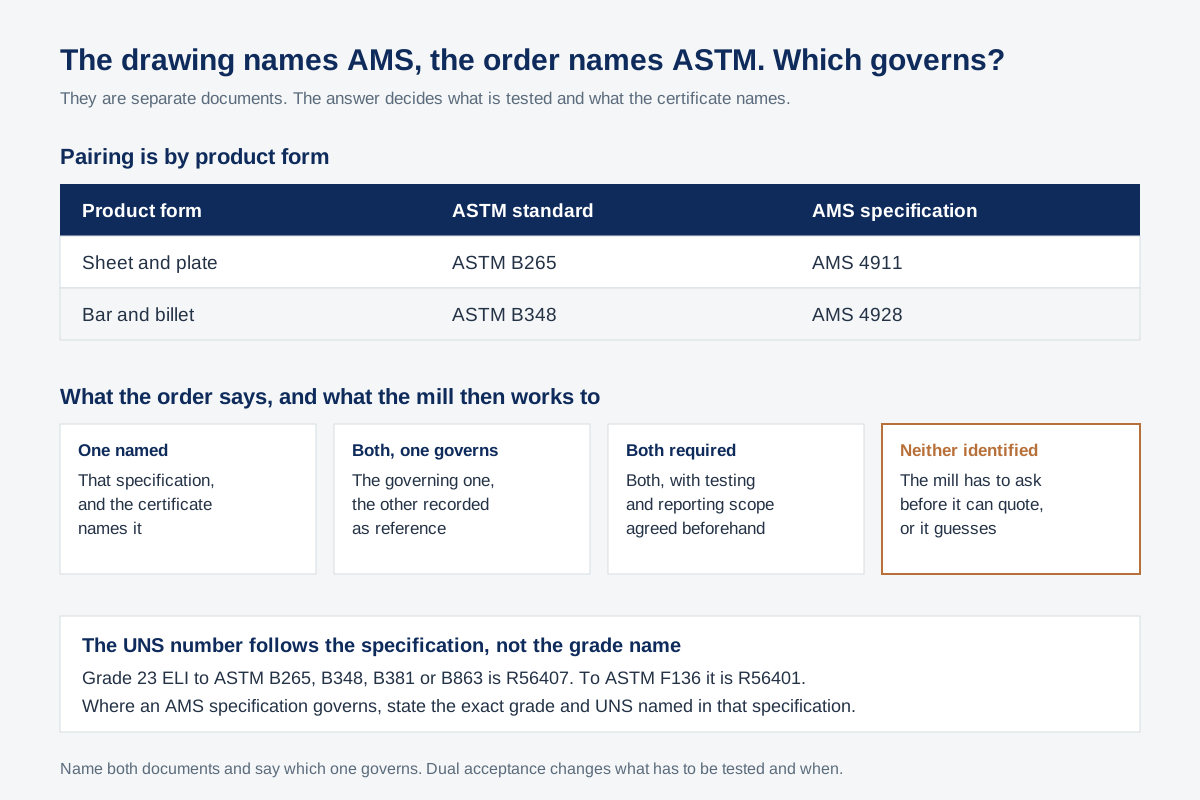
Grade 23 is the case that catches buyers out most often. The industrial ASTM B-series specifications, B265 for plate and sheet, B348 for bar and billet, B863 for wire and B381 for forgings, all designate Grade 23 as UNS R56407. The surgical implant specification ASTM F136 designates its wrought Ti-6Al-4V ELI as UNS R56401. Both numbers are correct, for different standards. Several widely cited data sheets print R56401 for Grade 23 regardless of standard, which is how the wrong number reaches a drawing and then a certificate. Cite the standard and the grade together and the mill certificate will report the number the drawing expects.
| Specification | UNS designation it gives Grade 23 |
|---|---|
| ASTM B265, plate and sheet | R56407 |
| ASTM B348, bar and billet | R56407 |
| ASTM B863, wire | R56407 |
| ASTM B381, forgings (Grade F-23) | R56407 |
| ASTM F136, surgical implant | R56401 |
ASTM and ASME designations
Once a part falls under a pressure code, the purchase order usually calls the ASME SB number rather than the ASTM B number. The two documents carry the same technical content: SB-265, SB-338, SB-348, SB-363, SB-367, SB-381, SB-861 and SB-862 are the Section II Part B versions of the matching ASTM specifications. ASTM B863 wire has no SB counterpart, so a wire requirement inside a code package is normally handled by naming the ASTM specification directly.
| ASTM specification | ASME Section II Part B version |
|---|---|
| ASTM B265 | SB-265 |
| ASTM B338 | SB-338 |
| ASTM B348 | SB-348 |
| ASTM B363 | SB-363 |
| ASTM B367 | SB-367 |
| ASTM B381 | SB-381 |
| ASTM B861 | SB-861 |
| ASTM B862 | SB-862 |
| ASTM B863, wire | No SB counterpart |
Why the same titanium has several different names
Each region built its own materials standard, so one grade carries several codes at once. ASTM uses a grade number, Grade 1 to 23, plus a UNS number. Germany and the EN system use a Werkstoff number in the 3.7xxx series. France uses NF designations such as T40 or TA6V. Japan uses JIS class numbers. A buyer who knows the cross-references stops rejecting or double-sourcing material that is actually the same metal, and can search or specify in whichever system a drawing uses.
Titanium grade cross-reference table
The table maps the common titanium grades across systems. Blank cells are left blank on purpose where a single verified designation does not exist or is not standardized, rather than guessed.
| ASTM grade | UNS | Werkstoff (EN/DIN) | French NF | JIS | Alloy |
|---|---|---|---|---|---|
| Grade 1 (CP) | R50250 | 3.7025 | T35 | Class 1 | Unalloyed Ti |
| Grade 2 (CP) | R50400 | 3.7035 | T40 | Class 2 | Unalloyed Ti |
| Grade 3 (CP) | R50550 | 3.7055 | Class 3 | Unalloyed Ti | |
| Grade 5 | R56400 | 3.7165 | TA6V | Ti-6Al-4V | |
| Grade 7 | R52400 | 3.7235 | Ti + 0.12 to 0.25% Pd | ||
| Grade 9 | R56320 | 3.7195 | Ti-3Al-2.5V | ||
| Grade 12 | R53400 | 3.7105 | Ti-0.3Mo-0.8Ni | ||
| Grade 23 (ELI) | R56407 (B-series); R56401 (F136) | 3.7165 | Ti-6Al-4V ELI |
CP Grades 1 to 3 line up one-to-one with JIS Class 1 to 3. German buyers most often search the Werkstoff number directly, while French buyers often search the NF designation such as T40 for Grade 2 and TA6V for Grade 5. The European market side of this is covered in our European titanium sourcing guide.
Are ASTM and EN/DIN titanium standards equivalent?
For the commercially pure and Ti-Pd grades, the chemistry and mechanical limits across ASTM and the EN/DIN system are close enough that one mill can certify a heat to both, so in material terms they are equivalent. The practical difference is not the metal, it is which standard the certificate cites. A certificate written to ASTM B348 and one written to a DIN bar standard can describe the same bar; incoming inspection needs to know which one to check against. The rule for a buyer is to name on the purchase order the single standard the certificate must reference, so there is one document to verify rather than an argument about equivalence.
Which product-form standard applies
Grade is only half of a specification; the form standard is the other half, and it differs by product form and by region.
| Form | ASTM | EN/DIN | JIS |
|---|---|---|---|
| Bar and billet | B348 | DIN 17862 | H4650 |
| Sheet, strip and plate | B265 | DIN 17860 | H4600 |
| Seamless and welded tube | B338 | DIN 17861 (seamless) / DIN 17866 (welded) | H4630 / H4635 |
A common trap is citing DIN 17850, which is titanium’s chemical-composition standard, as if it were the bar product standard; the bar delivery standard is DIN 17862. For aerospace-specification bar the reference is different again, which is why our AMS 4928 titanium bar guide treats that specification separately from ASTM B348.
The certificate the buyer specifies: EN 10204 3.1 or 3.2
Cross-referencing the grade and form still leaves the certificate type, which is a separate decision under EN 10204. A 3.1 certificate is issued by the manufacturer’s authorised inspection representative, independent of the production department, reports the actual results for the delivered heat tied to the heat number, ships with the goods and adds no lead time. A 3.2 certificate adds an independent third party or the buyer’s agent and a short lead time for the inspection. EN 10204 is defined by who issues the document, not by the mill’s country, so a non-EU mill issues valid 3.1 certificates. Specify the certificate type on the purchase order alongside the grade and form.
How to put the right standard on your PO
A clean titanium purchase order names four things so there is no ambiguity across systems: the grade in whichever designation the drawing uses, ASTM grade, UNS, Werkstoff or NF, the product-form standard for that form, the certificate type under EN 10204, and the dimensions and tolerance in the drawing’s units. Naming the grade in one system and asking the certificate to cite another is where disputes start. The full field list is in our titanium bar RFQ checklist. Beiyu supplies titanium mill products certified to the standard named on the order, with EN 10204 3.1 documentation and heat-number traceability, and reports the grade in the designation the buyer specifies.
FAQ
What is the EN or German equivalent of ASTM Grade 2 titanium?
ASTM Grade 2 commercially pure titanium, UNS R50400, is Werkstoff 3.7035 in the EN and DIN system, T40 in the French NF system, and JIS Class 2 in Japan. They are the same metal; the difference is which standard the certificate cites.
What is Werkstoff 3.7035?
Werkstoff 3.7035 is the German and EN material number for commercially pure Grade 2 titanium, equivalent to ASTM Grade 2 and UNS R50400. Grade 5, Ti-6Al-4V, is Werkstoff 3.7165, and Grade 7, Ti-Pd, is 3.7235.
Are DIN and ASTM titanium standards the same?
For commercially pure and Ti-Pd grades the chemistry and mechanical limits are close and a mill can certify to both, so they are equivalent as materials. The practical difference is which standard the certificate references, so state the one you want on the purchase order.
What titanium standard covers bar, and is DIN 17850 correct for bar?
Bar and billet are ASTM B348 or DIN 17862. DIN 17850 is titanium’s chemical-composition standard, not a bar product standard, so do not cite it as the bar delivery standard.
Request a quote with the standard you need
To quote titanium mill products, Beiyu needs the grade in your designation, ASTM grade, UNS, Werkstoff or NF, the product form and its standard, the EN 10204 certificate type, 3.1 or 3.2, and the dimensions and tolerance. Send the drawing or spec and we confirm the cross-reference and review each line against mill capability before quoting, with the certificate written to the standard on your order and heat-number traceability. Contact Beiyu Titanium for an RFQ.
Where bar stops and billet begins, and why the order changes with it
Cross-reference tables map names to names. They do not tell you that the same alloy, in the same standard, is classified differently once the section gets large enough. ASTM B348 draws that line by cross-sectional area rather than by what the item is called, and the classification decides which requirements are applied to it.
| Classification | How ASTM B348 separates them | What it means on the order |
|---|---|---|
| Bar | Cross-sectional area of 16 square inches (10,323 square millimetres) or less (ASTM B348, bar definition) | Ordered as bar, with bar tolerances and bar acceptance |
| Billet | Cross-sectional area above 16 square inches (10,323 square millimetres), with width under five times the thickness (ASTM B348, billet definition) | Ordered as billet, typically as forging or re-rolling stock |
| Rectangular bar | Width up to 10 inches (254 millimetres) and thickness above 0.1875 inches (4.8 millimetres) | Outside those bounds the item falls outside the bar definition of ASTM B348, whatever the enquiry calls it |
Two consequences follow, and both show up as rejected paperwork rather than as rejected metal. An item ordered as bar but sitting above the area threshold will be certified against a different classification than the drawing assumed. An item ordered as billet when it is within the bar range invites tolerances that were never intended for a machining input.
The classification is checkable before the enquiry is sent
Unlike most acceptance questions, this one needs no laboratory. It is arithmetic on the section the drawing already carries.
| Section | Area | Classification under ASTM B348 |
|---|---|---|
| Round, 100 mm diameter | About 7,850 square millimetres | Within the bar range |
| Round, 120 mm diameter | About 11,310 square millimetres | Above the bar threshold |
| Square, 100 by 100 mm | 10,000 square millimetres | Within the bar range |
| Square, 110 by 110 mm | 12,100 square millimetres | Above the bar threshold |
The threshold sits close to a 114.6 millimetre round and a 101.6 millimetre square, so enquiries in the 100 to 130 millimetre range straddle the threshold and the classification is worth checking before the enquiry is sent. Beiyu Titanium reviews the section against the classification before quoting, so state the finished section and the governing standard together and the question is settled at enquiry rather than at receiving.
Specification detail with sources
GB/T 3620.1, the Chinese titanium designation standard, is the column missing from most cross-reference tables, and it is the system Chinese works paperwork actually uses. Its nearest counterparts run TA1 to ASTM Grade 1, TA2 to Grade 2, TA3 to Grade 3, TA4 to Grade 4, TC4 to Grade 5 Ti-6Al-4V, TA9 to the palladium-bearing Grade 7 and TA10 to the Ti-0.3Mo-0.8Ni Grade 12. These are nearest counterparts rather than certified equivalents, because the chemistry windows differ in detail between the two systems, and the product standards split by form the way ASTM’s do: GB/T 2965 covers bar while GB/T 3621 covers sheet and plate.
| GB/T 3620.1 designation | Nearest ASTM counterpart |
|---|---|
| TA1 | Grade 1 |
| TA2 | Grade 2 |
| TA3 | Grade 3 |
| TA4 | Grade 4 |
| TC4 | Grade 5 Ti-6Al-4V |
| TA9 | Grade 7, palladium bearing |
| TA10 | Grade 12, Ti-0.3Mo-0.8Ni |
Beiyu Titanium works both columns of that table daily: production heats are identified as TA2 or TC4 in Chinese mill paperwork under GB/T 3620.1, and Beiyu confirms the ASTM or ASME designation with its UNS number in the quotation so the certificate is written to the standard named on the purchase order. That GB column is the one this table does not carry, and it is the designation a Chinese heat actually starts life under, which is why Beiyu states both on the quotation rather than only the ASTM grade.