
Titanium is a metallic element, symbol Ti and atomic number 22 on the periodic table published by Los Alamos National Laboratory. As an engineering metal it combines three properties: it is light, at 4.51 g/cm³ for the unalloyed grades, it is strong, with Grade 5 specified at a minimum tensile strength of 895 MPa in the annealed condition under ASTM B348, and it resists corrosion in seawater and many chemicals because of a passive oxide film that re-forms on its own. What industry buys is not “titanium” in general but a numbered ASTM grade, either commercially pure titanium or an alloy such as Ti-6Al-4V.
Titanium at a glance
The figures below are the ones this site uses, each taken from a page that sets out its sources and the spread between them.
| Property | Value | Where the detail is |
|---|---|---|
| Element | Ti, atomic number 22 | Los Alamos National Laboratory periodic table |
| Density | 4.51 g/cm³ for Grades 1, 2, 7 and 12; 4.43 g/cm³ for Grades 5 and 23 | Is titanium heavy? |
| Melting point | About 1668 °C unalloyed (ASM Handbook data); about 1650 to 1700 °C by grade (RMI) | Titanium melting point by grade |
| Electrical conductivity | Grade 2 conducts at about 3 per cent of annealed copper | Is titanium conductive? |
| Magnetism | Paramagnetic; a household magnet does not stick to it | Is titanium magnetic? |
| Corrosion | Protected by a passive titanium dioxide film; Grade 2 is the usual choice for seawater | Does titanium rust or corrode? |
Pure titanium and titanium alloys
Titanium is sold in two families. Commercially pure titanium, Grades 1 to 4, is unalloyed: the grades differ in how much oxygen and iron they allow, and strength rises from Grade 1 to Grade 4 as those limits rise. Titanium alloys add other elements on purpose. Grade 5, the most widely used alloy, is titanium with about 6 per cent aluminium and 4 per cent vanadium, which is why it is also called Ti-6Al-4V.
| Grade | Family | What makes it different | Minimum tensile strength (ASTM B348, annealed) |
|---|---|---|---|
| Grade 1 | Commercially pure | Lowest oxygen, easiest to form | 240 MPa |
| Grade 2 | Commercially pure | The general-purpose grade for corrosion service and welding | 345 MPa |
| Grade 3 | Commercially pure | Extra strength over Grade 2 for pressure parts, still unalloyed | 450 MPa |
| Grade 4 | Commercially pure | The strongest unalloyed grade | 550 MPa |
| Grade 5 | Alloy, Ti-6Al-4V | Aluminium and vanadium for high strength | 895 MPa |
| Grade 7 | Corrosion-resistant | Grade 2 chemistry plus palladium for reducing acids | 345 MPa |
| Grade 9 | Alloy, Ti-3Al-2.5V | Stronger than Grade 2 but still cold-formable, mostly as tube | 620 MPa |
| Grade 12 | Corrosion-resistant alloy | Molybdenum and nickel for hot chloride brine | 483 MPa |
| Grade 23 | Alloy, Ti-6Al-4V ELI | Extra-low interstitials for fracture-critical and implant use | 828 MPa |
More grades, with UNS and Werkstoffnummer cross-references, chemistry limits and density, are in the titanium grades chart.
Why titanium resists corrosion
A titanium surface is covered by a passive film of titanium dioxide. In oxidising and neutral chloride conditions, such as seawater, the film re-forms as fast as it is damaged, which is why unalloyed Grade 2 handles seawater indefinitely. That is usually why titanium replaces 304 and 316 stainless steel in hot, salty service, where stainless can pit and crack. The film has limits: in reducing acids such as hydrochloric and dilute sulfuric acid the film cannot repair itself and unalloyed titanium corrodes, and the answer there is a palladium grade such as Grade 7 rather than Grade 2. The molybdenum-nickel Grade 12 is chosen for hot chloride brine, not for reducing acids. Hydrofluoric acid attacks titanium badly and must be avoided.
How titanium becomes bar, plate and tube
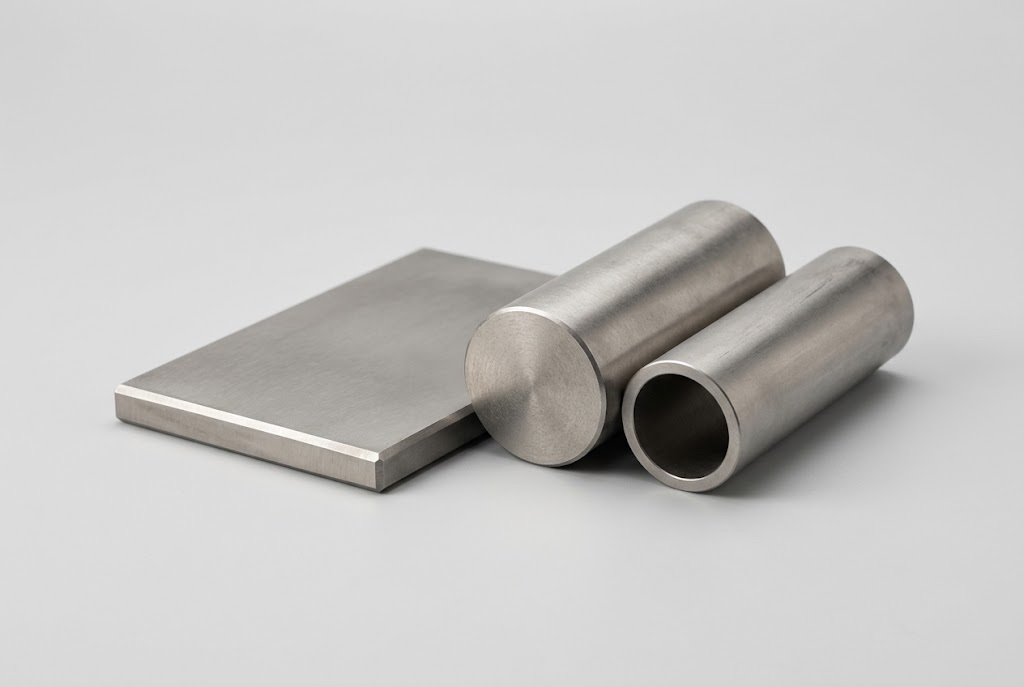
Titanium starts as sponge, the raw feedstock. The sponge is blended to the target grade, pressed into electrodes and vacuum melted into an ingot; melting in air is avoided because hot titanium absorbs oxygen, nitrogen and hydrogen, and those interstitial elements embrittle it. Material for demanding service is often melted more than once. The ingot fixes the grade and the heat number that later appears on the mill test certificate. Hot working then turns the ingot into the form a buyer orders; the route is set out step by step in how titanium mill products are made.
| Working route | Mill forms it produces |
|---|---|
| Forging | Forged bar, rings, discs and blocks |
| Hot and cold rolling | Plate, sheet, strip and foil |
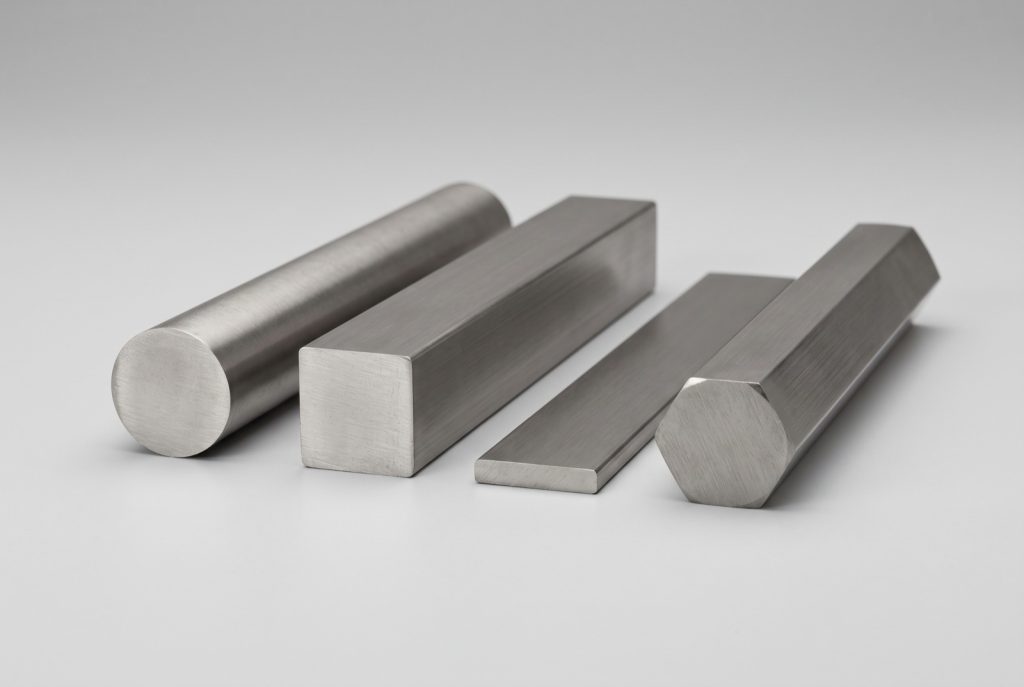
| Bar rolling and finishing | Round, square, flat and hexagonal bar |
| Extrusion and cold rolling, or forming and welding strip | Seamless tube and pipe, or welded tube |
Where titanium is used
| Use | Why titanium | Grade usually specified |
|---|---|---|
| Seawater heat exchangers and process piping | Resists pitting and crevice corrosion in chlorides | Grade 2 |
| Chemical equipment exposed to reducing acids or crevices under gaskets | Palladium keeps the oxide film passive | Grade 7 |
| Hot brine, geothermal and desalination duty | Better crevice resistance at high temperature | Grade 12 |
| Load-bearing machined parts, shafts and fasteners | High strength for its weight | Grade 5 |
| Hydraulic lines and aerospace ducting | Strength with enough ductility to cold draw tube | Grade 9 |
| Surgical implants and fracture-critical parts | Tighter limits on oxygen and other interstitials | Grade 23 |
| Anode substrates and linings | The most formable grade | Grade 1 |
Common questions
Is titanium a metal? Yes. It is a metallic element, Ti, atomic number 22.
Is titanium an alloy? Not necessarily. Commercially pure titanium, Grades 1 to 4, is unalloyed; Grade 5 is a titanium alloy with aluminium and vanadium.
Does titanium rust? No. Rust is an oxide of iron, and titanium contains no iron phase that could form it; what covers it is a passive titanium dioxide film. Not rusting does not mean it can never corrode: the environments that do attack the film are set out in does titanium rust or corrode?.
Is titanium stronger than steel? It depends on which grade of each is meant. Grade 5 titanium, with an 895 MPa tensile minimum, clears annealed 316 stainless at roughly 515 MPa while weighing a little over half as much; unalloyed Grade 2, at 345 MPa, is below 316 on raw tensile but far lighter. On strength for weight titanium leads; where raw strength alone matters, high-strength stainless and duplex grades stay in the running. The property-by-property comparison with 304 and 316 stainless is on titanium vs stainless steel.
Does titanium melt easily? No. Unalloyed titanium melts at about 1668 °C, well above aluminium at 660 °C.
Specification detail with sources
The element data, symbol Ti and atomic number 22, are from the Los Alamos National Laboratory periodic table. Densities of 4.51 g/cm³ for Grades 1, 2, 7 and 12 and 4.43 g/cm³ for Grades 5 and 23 are the nominal values used across this site, and density is not a tested value on a mill certificate. The tensile minimums are the annealed values required by ASTM B348 for bar and billet, which ASTM B265 matches for strip, sheet and plate in these grades. The 1668 °C melting point for unalloyed titanium is ASM Handbook data, the approximate 1650 to 1700 °C range by grade is from the RMI Titanium Company Titanium Alloy Guide (January 2000), and pure aluminium’s 660 °C is quoted from ASM Handbook Volume 2. The 3 per cent conductivity figure for Grade 2 is calculated from the room-temperature resistivity of 56 microhm-centimetres given in the same RMI guide, against the International Annealed Copper Standard.
Buying titanium
An enquiry names the grade, the product form, the standard and the size. Beiyu Titanium supplies Grade 1, 2, 3, 4, 5, 7, 9, 12 and 23 as bar, plate, sheet, tube, wire and forgings in the forms each grade’s standard covers (ASTM B338 tube, for example, does not list Grades 4, 5 or 23), including ASTM B348 for bar, ASTM B265 for plate and sheet, ASTM B338 for tube and ASTM B381 for forgings, with round bar from 1 to 500 mm diameter, and an EN 10204 3.1 mill test certificate by order scope.