
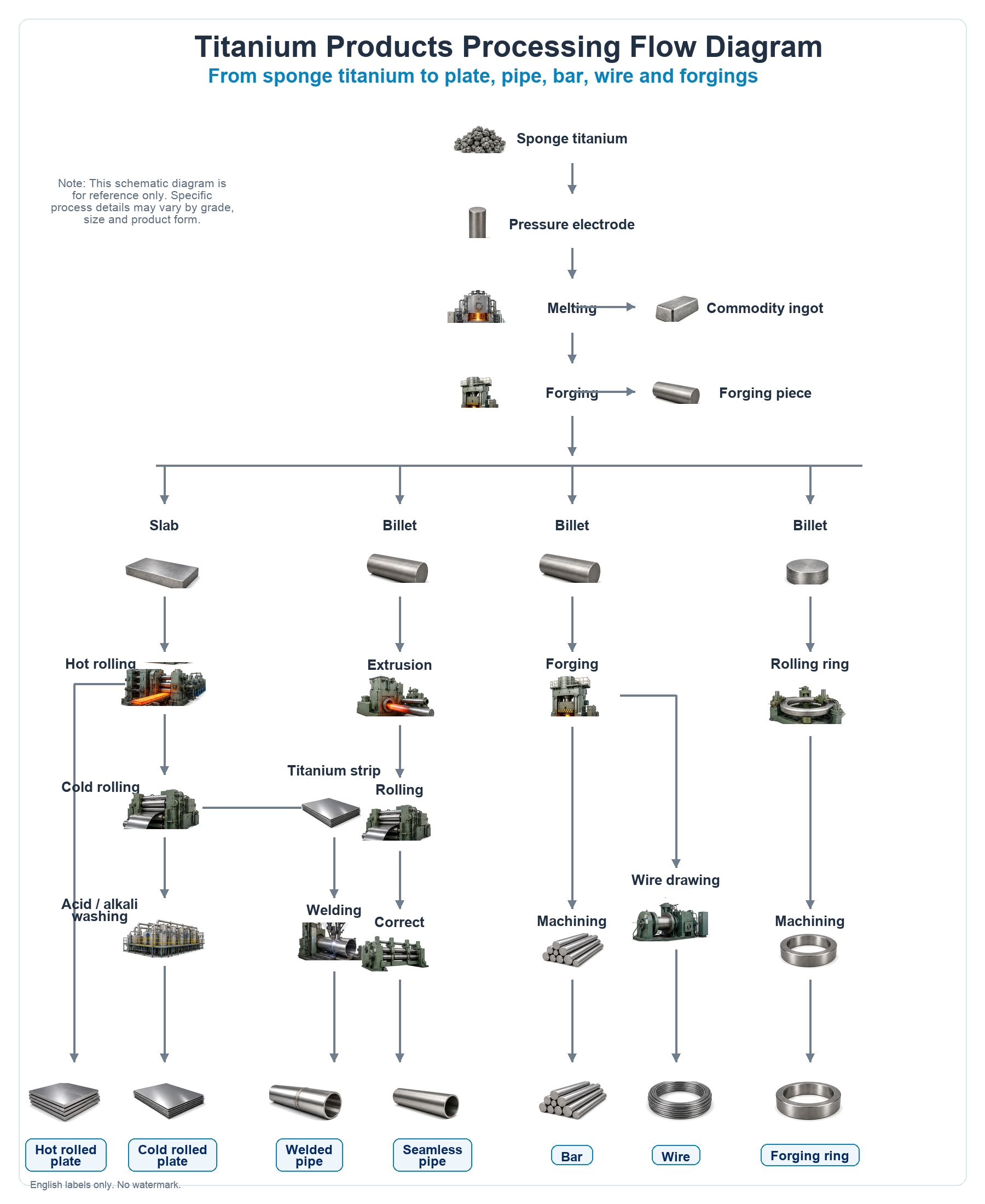
Every titanium bar, plate, tube and forging starts as titanium sponge and passes through the same broad route: melt the sponge into an ingot, work the ingot into a mill form by forging or rolling, then finish it to a grade, size and surface. Knowing that route tells a buyer why a given form carries the standards, condition and tolerances it does, and what to confirm on the order.
From sponge to ingot: melting
Titanium sponge is the raw feedstock. It is blended to the target grade, compacted into electrodes, and melted under vacuum into a solid ingot. Vacuum melting matters because hot titanium absorbs oxygen, nitrogen and hydrogen from air, and those interstitials embrittle the metal; melting under vacuum keeps the chemistry controlled. High-integrity material is often melted more than once for a uniform composition. The ingot is the point where the grade and the heat are fixed, which is why the heat number on the mill test certificate traces back to one melt. For how that chemistry is reported, see reading a titanium ingot test report.
From ingot to mill form: forging, rolling, extrusion and drawing
The ingot is broken down by hot working into the form the buyer needs. The working method is what separates the product families.
| Process | Mill form produced | Typical use |
|---|---|---|
| Forging | forged bar, ring, disc, block | near-net shapes, high-integrity parts |
| Hot and cold rolling | plate, sheet, strip, foil | flat products for fabrication |
| Rolling and finishing of bar stock | round, square, flat and hexagonal bar | machined parts and fasteners |
| Extrusion and cold rolling | seamless tube and pipe | heat exchangers, process piping |
| Forming and welding of strip | welded tube and pipe | larger-diameter and longer lengths |
| Wire drawing | straight, coil and spool wire | welding filler, fasteners, springs |
This is why a seamless tube and a welded tube can be the same grade but follow different standards and size ranges: the route to each is different. The same applies to a forged bar and a rolled bar. Beiyu supplies the finished forms from this route as titanium bar, sheet and plate, tube and pipe, forgings and wire.
Finishing: the steps that set the final specification
A mill form is not finished until its surface, dimensions and condition are set. These steps are where a lot of the order detail lives.
| Process step | What the guide states |
|---|---|
| Descaling and pickling | acid or alkali treatment removes mill scale and the oxygen-enriched surface layer. That layer is the brittle alpha case; leaving it on causes cracking in service, which is why pickled or machined surfaces are specified for critical work. Background: alpha case on titanium. |
| Straightening and cutting | bringing bar and tube to the straightness and length tolerance on the order. |
| Surface finishing | polished, ground, sandblasted or bright, chosen by how the part is used or machined. |
| Heat treatment | annealing for ductility, or solution treating and ageing for higher strength in alloy grades. |
| Inspection and documentation | chemistry, mechanical properties and dimensional checks recorded in the agreed release documents, with EN 10204 3.1 documentation and heat traceability when specified and agreed. |
Why the route matters when you order
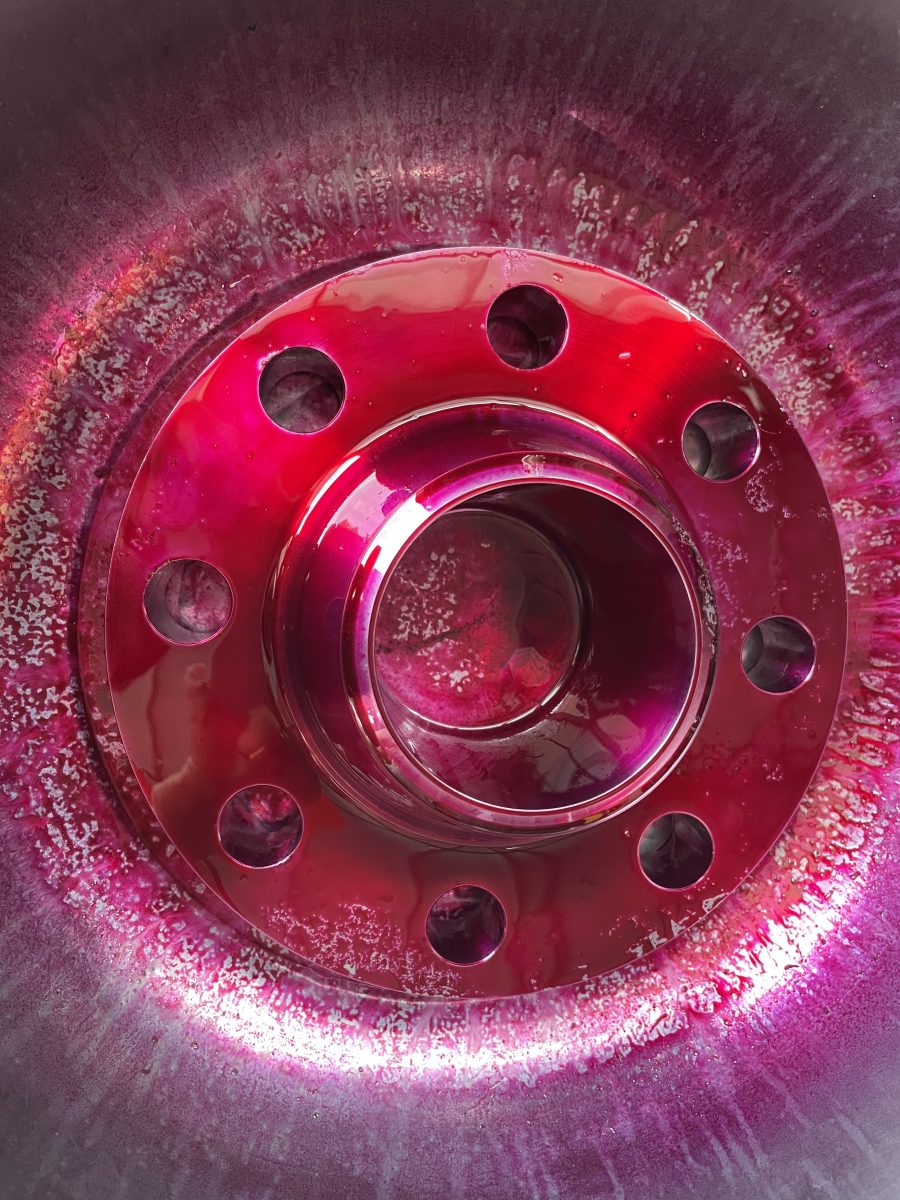
Each form maps to its own standard because each is made a different way: bar and billet to ASTM B348, sheet and plate to ASTM B265, tube and pipe to ASTM B338, B861 and B862, forgings to ASTM B381, and wire to AWS A5.16 and ASTM B863. State the form, grade, size, condition and standard on the request so the order is routed to the right product and certified to it. For the grades themselves see the titanium grades comparison guide, and for the standards see the titanium standards guide. Review titanium processing services for the work to include in your order, then send your requirement and document needs for quotation.
FAQ
How is titanium melted?
Titanium sponge is compacted into electrodes and melted under vacuum into an ingot, often more than once for a uniform composition. Vacuum melting keeps oxygen, nitrogen and hydrogen out of the metal.
What is the difference between seamless and welded titanium tube?
Seamless tube is made by extrusion and cold rolling with no weld seam; welded tube is formed and welded from strip, which allows larger diameters and longer lengths. Same grade, different route, different standards and size ranges.
Why are titanium products pickled?
Hot working leaves mill scale and an oxygen-enriched alpha case on the surface. Pickling removes both, leaving a clean surface that will not crack or contaminate machining.
Is a forged bar better than a rolled bar?
They are made differently for different needs. Forging is used for near-net shapes and high-integrity parts; rolled bar is the efficient route for straight stock that will be machined. The grade and certificate requirement do not change; the form does.
What documents come with material from this route?
The release package follows the quotation and order. EN 10204 3.1 documentation with the required chemistry and mechanical results and heat-number traceability is included when specified and agreed.
Which route each mill form takes from the same ingot
Every titanium mill form in this catalogue starts at the same two steps: titanium sponge is compacted into a consumable electrode, and the electrode is melted into an ingot. What separates a plate from a seamless pipe is everything that happens afterwards. The table below is the working version of that split.
| Mill form | Route from the ingot |
|---|---|
| Hot rolled plate | Ingot to forged slab, then hot rolling, then acid and alkali pickling |
| Cold rolled plate and sheet | Ingot to slab, hot rolling, cold rolling, then acid and alkali pickling |
| Strip and coil | Ingot to slab, hot rolling, then cold rolling to strip |
| Welded pipe | Strip, then forming and welding |
| Seamless pipe | Ingot to billet, extrusion, rolling, then straightening |
| Bar and rod | Ingot to billet, forging, then machining and finishing |
| Wire | Ingot to billet or wire feedstock, then drawing |
| Forged ring | Ingot to billet, ring rolling, then machining |
Two branch points on that table decide most of what a buyer sees on the certificate. The first is slab against billet: on these normal routes slab feeds the flat products and billet feeds the round, extruded, drawn and ring rolled forms, and the split happens early. The second is strip against billet for tube, which is the difference between a welded pipe and a seamless one. Process details vary between mills and between orders, so treat the routes as the normal path rather than a fixed sequence.
The melt step, and why the count is worth asking about
Material supplied by Beiyu is produced on a triple vacuum arc remelt route, meaning the manufacturing mill remelts the ingot three times under vacuum. A third remelt is bought for cleanliness rather than for compliance, which is the general reason the route exists: melt count is not what a chemistry table checks, so a double melted heat can satisfy the same composition limits. Because it is a route rather than a test result, the way to confirm it is heat by heat in the documentation supplied with the order rather than from a datasheet.
Interstitials deserve a separate note, because they do not all behave the same way downstream. Oxygen and nitrogen are set in the melt: rolling, forging and annealing change strength and structure, but none of them lower an oxygen or nitrogen result, which is why the melt chemistry determines which grade limits a heat can satisfy. Oxygen can still be added later at the surface, as the oxygen enriched layer that forms when titanium is held hot in air without protection. Hydrogen is the exception in the other direction, since it can be reduced by vacuum annealing. So melt chemistry is the upstream control, and the downstream steps still need their own control and verification rather than being treated as neutral.
Where inspection sits inside the route, not after it
A process description usually ends at the finished form. What decides whether that form is accepted is where inspection happens along the way, and at what coverage, because a check on a blank and a check after final machining do not cover the same material.
| Check | Coverage on the precision ground bar route | What it settles |
|---|---|---|
| Ultrasonic flaw detection | 100 percent of the lot | Internal discontinuities against the acceptance class named on the order |
| Eddy current | 100 percent of the lot | Surface and near surface discontinuities |
| Optical surface inspection | 100 percent of the lot | Visible surface condition along the full length |
| Infrared laser diameter measurement | 100 percent of the lot | Diameter through the length, not a spot check at the ends |
| Straightness | 100 percent of the lot | Bow against the published value over a stated gauge length |
Five checks at full coverage is a different statement from five checks performed on samples, which is why the coverage column exists. These are the checks carried on the quoted precision route, reviewed against as a production capability rather than offered as a stock statement.
Why the stage matters as much as the check
| Stage | What an examination at this point can show |
|---|---|
| On the worked blank | Discontinuities present before any material is removed |
| After finishing | The condition of the material that will actually be delivered |
| Named on the order | Which of the two the buyer is paying for, and against which acceptance class |
An order that names the examination but not the stage leaves the most expensive ambiguity in the route unresolved.
Specification detail with sources
Physical constants explain why titanium production is built around vacuum melting. ASM Handbook data put the melting point of unalloyed titanium at 1668 °C and its density at 4.51 g/cm³, about 57 percent of the 7.85 g/cm³ of carbon steel, and at melt temperature the metal reacts with air and with conventional refractories, which is why production melting runs under vacuum in a water-cooled copper crucible, typically for 2 or 3 remelt cycles on alloy grades.
Beiyu Titanium supplies both extremes of what this route can reach: cold rolled foil down to 0.02 mm thick and up to 600 mm wide at one end, and welded titanium pipe in lengths up to 22000 mm at the other, with capillary tube from 1 to 5 mm outside diameter at 0.1 to 2 mm wall between them. The spool wire in the table above starts at 0.01 mm diameter from Beiyu’s cold drawing route, and the filler pairing follows AWS A5.16, Grade 2 supplied as ERTi-2 and Grade 5 as ERTi-5, so the welding consumable can be ordered against the same standards sheet as the parent metal.
The finished output of that route, and the sizes one purchase order can cover, is laid out in titanium round bar across the 1 to 500 mm range.