
Tungsten’s density is about 19.3 g/cm3, the value reference tables give at room temperature. The figure worked out from tungsten’s crystal lattice is 19.265 g/cm3 at 25 °C, while the reference value behind the weight estimates on this site is 19.25 g/cm3, which is 19250 kg/m3 or about 0.695 lb/in3. That puts tungsten level with gold, about 1.7 times as dense as lead and a little over four times as dense as titanium. Tungsten heavy alloy is lighter than pure tungsten, at roughly 16.9 to 18.9 g/cm3 depending on its tungsten content, and cemented tungsten carbide is lighter again.
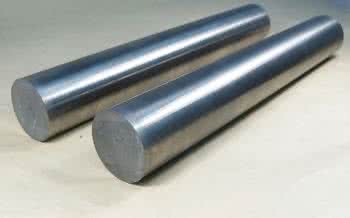
Tungsten density in common units
| Unit | Value at 19.25 g/cm3 (calculated) |
|---|---|
| g/cm3 | 19.25 |
| kg/m3 | 19250 |
| lb/in3 | 0.695 |
| lb/ft3 | about 1202 |
Handbook tables round the value to 19.3 g/cm3, which is about 0.697 lb/in3. The gap between 19.25 and 19.3 is 0.05 g/cm3, about 0.3 % (calculated), so either figure is fine for a weight estimate as long as the drawing or quotation says which one was used.
How tungsten compares with other metals
The values below come from one reference table, so they are consistent with each other; the table itself notes that some values are nominal.
| Metal | Density (g/cm3) | Ratio, tungsten at 19.25 ÷ table value |
|---|---|---|
| Gold | 19.32 | practically the same |
| Tungsten | 19.30 | reference row (ratios use 19.25, see note below) |
| Tantalum | 16.65 | about 1.16 times as dense |
| Lead | 11.35 | about 1.7 times as dense |
| Molybdenum | 10.22 | about 1.9 times as dense |
| Copper | 8.96 | about 2.1 times as dense |
| Iron | 7.874 | about 2.4 times as dense |
| Titanium | 4.54 | about 4.2 times as dense |
For its own weight estimates this site uses 10.22 g/cm3 for molybdenum, 16.69 g/cm3 for tantalum and 4.51 g/cm3 for titanium, so the ratios move slightly with the figure chosen.
Why tungsten is so dense
Two things combine. Each tungsten atom is heavy, with an atomic weight of 183.84, and the atoms pack into a body-centred cubic lattice with two atoms in a unit cell 3.1648 Å on each side. Dividing the mass of those two atoms by the volume of the cell gives the 19.265 g/cm3 lattice value. A sintered part can come in below the lattice value if it retains porosity; ASTM B311’s density method is written for PM materials with less than two percent porosity. Where density matters, it is measured on the part rather than taken from a table.
Tungsten heavy alloy density by class
Heavy alloy is the machinable route and sits below pure tungsten in density; the density rises with tungsten content, which ASTM B777 states in its scope. The cancelled military specification MIL-T-21014D listed these ranges by class:
| Class | Nominal tungsten (wt %) | Density (g/cm3) |
|---|---|---|
| 1 | 90 | 16.85 to 17.25 |
| 2 | 92.5 | 17.15 to 17.85 |
| 3 | 95 | 17.75 to 18.35 |
| 4 | 97 | 18.25 to 18.85 |
The specification measured density by water displacement to ASTM B311. It was later cancelled, its successor was in turn superseded by ASTM B777, and ASTM B777 is the document a current order would normally cite for class and density. So read the table as the historical class pattern, and take the acceptance range from the edition of ASTM B777 named on the order.
Tungsten carbide density
Tungsten carbide itself is about 15.6 g/cm3. Cemented carbide mixes it with a cobalt binder, so its density falls as the cobalt content rises:
| Material | Composition (wt %) | Density (g/cm3) |
|---|---|---|
| Tungsten carbide | WC | 15.6 |
| Straight WC-Co, K01 group (example) | 97 WC, 3 Co | 15.2 |
| Straight WC-Co, K20 group (example) | 94 WC, 6 Co | 14.8 |
| Straight WC-Co, K30 group (example) | 91 WC, 9 Co | 14.4 |
| Straight WC-Co, K40 group (example) | 89 WC, 11 Co | 14.1 |
The K codes are application groups; the compositions and densities shown are one published compilation’s examples, not a definition of each grade. ASTM B311 covers the water displacement method used to measure the density of cemented carbides.
Using density for a weight estimate
Weight is volume times density. A tungsten rod 20 mm in diameter and 1000 mm long has a volume of 314.16 cm3, so at 19.25 g/cm3 it weighs about 6.05 kg (calculated). The same rod in titanium at 4.51 g/cm3 weighs about 1.42 kg. The metal weight calculator uses 19.25 g/cm3 for tungsten, so its results match the figures on this page.
Common follow-up questions
Is tungsten denser than gold? They are practically the same. The reference table gives 19.32 g/cm3 for gold and 19.30 g/cm3 for tungsten, a difference of 0.02 g/cm3, about 0.1 % (calculated).
Is tungsten heavier than lead? Yes, by volume. At 19.25 g/cm3 against 11.35 g/cm3, a tungsten part weighs about 1.7 times as much as a lead part of the same size.
Does a material certificate report density? Only if the order or the specification asks for it. For heavy alloy, the cancelled MIL-T-21014D tied density to class, and ASTM B777 ties density to tungsten content, so state the ASTM B777 class and ask for the density test on the order.
For what tungsten’s density is used for, such as counterweights and radiation shielding, see what tungsten is used for.
Specification detail with sources
NIST’s table of elemental densities lists tungsten at 19.30 g/cm3, gold at 19.32, tantalum at 16.65, lead at 11.35, molybdenum at 10.22, copper at 8.96, iron at 7.874 and titanium at 4.54, with the note that some values are nominal (NIST, X-Ray Mass Attenuation Coefficients, Table 1). The National Bureau of Standards gives tungsten as body-centred cubic with a unit cell of 3.1648 Å at 25 °C and a lattice-derived density of 19.265 g/cm3 at 25 °C (NBS Circular 539, Vol. 1, 1953, §2.12), and the standard atomic weight of tungsten is 183.84 (CIAAW). MIL-T-21014D listed heavy alloy densities of 16.85-17.25, 17.15-17.85, 17.75-18.35 and 18.25-18.85 g/cm3 for Classes 1 to 4 and required water displacement testing to ASTM B311 (MIL-T-21014D, Table I and §4.2.3.2); the specification was cancelled, and its successor was superseded by ASTM B777. ASTM B777 states that density increases with tungsten content (ASTM B777, scope). Tungsten carbide has a density of 15.6 g/cm3 (IARC Monographs, Vol. 86, §1.1.3), and the four straight WC-Co grades in the NTP compilation run from 15.2 g/cm3 (3 % Co) to 14.1 g/cm3 (11 % Co) (NTP Report on Carcinogens background document on cobalt-tungsten carbide, Table 1-1). ASTM B311 covers density determination for cemented carbides by water displacement (ASTM B311, scope).
Ordering tungsten by weight or density
When a part is sized for its mass, put the target weight or density on the drawing as well as the dimensions, and say which density the weight was calculated with. For pure tungsten, tungsten bar and rod is reviewed from 1.6 mm to 70 mm diameter against the buyer’s material specification. For heavy alloy, name the ASTM B777 class. The Beiyu Titanium tungsten range covers pure tungsten in W1 and W2 and the W-Ni-Fe, W-Mo, W-Cu and W-La compositions; send the drawing with the enquiry and it is reviewed before we quote.