
Monel 400 is the nickel-copper alloy designated UNS N04400 and Werkstoff Nr. 2.4360 and 2.4361 (EN NiCu30Fe). Special Metals, which owns the MONEL trademark, describes MONEL alloy 400 as a solid-solution alloy that can be hardened only by cold working; VDM sells it as VDM Alloy 400 (Nicorros) and ATI as ATI 400. Special Metals calls its resistance to hydrofluoric acid exceptional in all concentrations up to the boiling point, and names marine work and chemical processing as the fields where it is especially widely used. Its Curie temperature lies close to room temperature, so some heats are magnetic at room temperature and others are not. Orders name a product form and its specification: ASTM B164 covers rod, bar and wire, B127 plate, sheet and strip, B165 seamless pipe and tube, and B564 forgings.
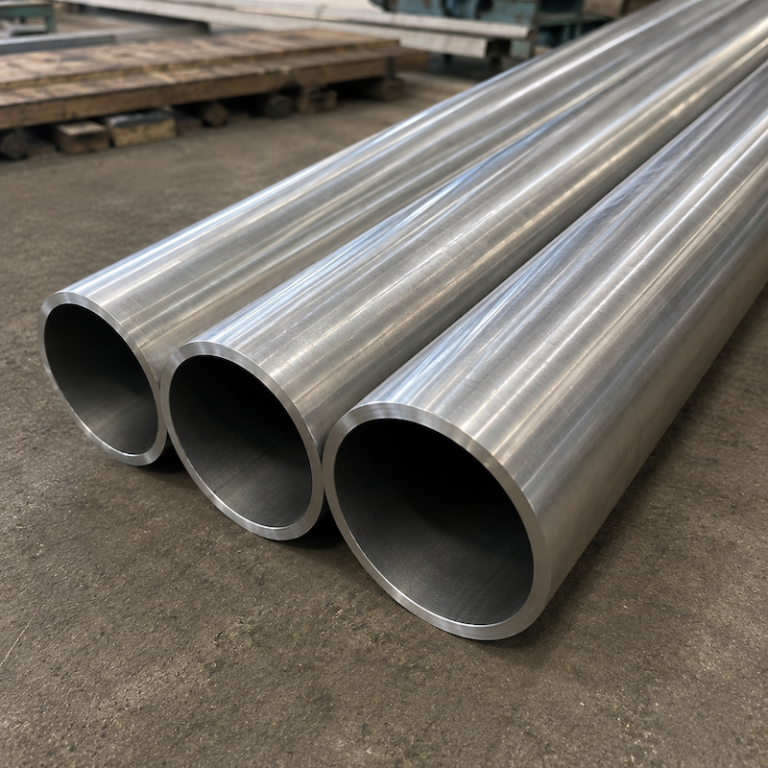
Monel 400 in brief
| Topic | Data | Comment |
|---|---|---|
| Designations | UNS N04400, W.Nr. 2.4360 and 2.4361, EN NiCu30Fe | VDM also lists ISO NiCu30, AFNOR NU 30 and BS NA 13; MONEL is a Special Metals trademark |
| Alloy type | Single-phase nickel-copper solid solution, face-centred cubic | Hardened only by cold working (Special Metals) |
| Density | 8.80 g/cm³ (0.318 lb/in³) | Special Metals; VDM 8.82, ATI and Alleima 8.83 |
| Melting range | 1300 to 1350 °C | Special Metals and VDM |
| Curie temperature | 21 to 49 °C (Special Metals); 20 to 50 °C (VDM) | Around room temperature, so magnetism varies by heat |
| Main corrosion strengths | Hydrofluoric acid, flowing seawater, alkalis; resistance to chloride stress-corrosion cracking | Special Metals, VDM and ATI |
| Main limits | Highly oxidizing acids such as nitric; stagnant seawater; mercury and moist aerated HF vapour | ATI, Special Metals and VDM |
| Product specifications | ASTM B164, B127, B165, B163, B725, B730, B564; SAE AMS 4544, 4574, 4675, 4730, 4731 | Set out by form further down |
Composition by producer, wt %
Special Metals and ATI print the same limits for every element they share, though they state nickel differently. VDM gives a different set and names no standard for it, so the three are kept in separate columns.
| Element | Special Metals Table 1 | ATI cards naming ASTM B127 | VDM data sheet Table 2 |
|---|---|---|---|
| Nickel | 63.0 min (nickel plus cobalt) | 63.0 to 70.0 (cobalt 1.0 max listed separately) | 63 min |
| Copper | 28.0 to 34.0 | 28.0 to 34.0 | 28 to 34 |
| Iron | 2.5 max | 2.5 max | 1 to 2.5 |
| Manganese | 2.0 max | 2.0 max | 2 max |
| Carbon | 0.3 max | 0.3 max | 0.15 max |
| Silicon | 0.5 max | 0.5 max | 0.5 max |
| Sulfur | 0.024 max | 0.024 max | No limit given |
| Aluminium | No limit given | No limit given | 0.5 max |
ATI’s typical heat runs at about 32.0 copper, 1.0 iron and 0.10 carbon, with nickel and cobalt as the balance, and Alleima gives copper as a nominal 30. ATI adds that material furnished to the US federal specification QQ-N-281 typically has lead, tin and zinc below 0.003 % each. Alleima’s tube data sheet calls it a copper-nickel alloy, while every other source calls it nickel-copper. ASTM’s public page for B127 names nickel, copper, iron, manganese, carbon, silicon and sulfur as the controlled elements without printing the values; the order should cite the edition against which the material is to be accepted.
Physical properties
Special Metals, VDM and ATI label these figures typical or informational, and none of them is a specified limit.
| Property | Figure and source |
|---|---|
| Density | 8.80 g/cm³ (0.318 lb/in³), Special Metals; 8.82 at 20 °C, VDM; 8.83, ATI and Alleima; 8.84 on ATI’s plate cards |
| Melting range | 1300 to 1350 °C (2370 to 2460 °F), Special Metals; the same range in °C from VDM |
| Curie temperature | 21 to 49 °C (70 to 120 °F), Special Metals; 20 to 50 °C, VDM |
| Specific heat | 427 J/kg·°C at 21 °C, Special Metals; 452 J/kg·K at 20 °C, VDM; 430 J/kg·K at room temperature, ATI |
| Thermal conductivity | 22.0 W/m·°C at 21 °C, Special Metals; 23.0 W/m·K at 20 °C, VDM; 21.8, Alleima |
| Electrical resistivity | 0.511 µΩ·m at 21 °C (annealed), Special Metals; 51.3 µΩ·cm at 20 °C, VDM; 51.0 µΩ·cm, ATI |
| Mean thermal expansion | 14.2 µm/m·°C over 21 to 100 °C (annealed), Special Metals; 13.9 over 21 to 93 °C, ATI; VDM 13.8 ×10⁻⁶/K at 100 °C |
| Modulus of elasticity | 26.0 ×10³ ksi in tension, Special Metals; 182 GPa at 20 °C, VDM; 180 GPa, ATI; Alleima 173 GPa |
| Poisson’s ratio | 0.32, Special Metals |
For comparison, the nickel melting point page lists melting ranges for pure nickel and the other nickel grades.
Magnetic or not: the Curie point
Special Metals points out that the Curie temperature of alloy 400 lies within the ambient range and moves with small differences in composition, so across normal production some heats are magnetic at room temperature and others are not. ATI says the same of its material: in the annealed condition it is often moderately to faintly magnetic at room temperature, and it is non-magnetic above the Curie temperature. Where a part must be non-magnetic, Special Metals advises considering other MONEL alloys, so a buyer who needs a non-magnetic part should say so in the enquiry rather than rely on alloy 400 by default.
Mechanical properties by condition
ATI notes that the alloy is low in strength when annealed and that tempers are used to raise it. The public minimums below are tied to the documents each producer names.
| Document, form and condition | 0.2 % yield, min | Tensile | Elongation, min |
|---|---|---|---|
| ATI plate, sheet and strip cards (ASTM B127, ASME SB-127, AMS 4544, QQ-N-281), annealed | 28 ksi (195 MPa) | 70 to 85 ksi (485 to 585 MPa) | 35 % |
| ATI bar and billet cards (incl. ASTM B164, AMS 4675), condition not stated | 25 ksi (172 MPa) | 70 ksi (482 MPa) min | 35 %; 70 HRB max |
| VDM sheet, plate, rod and bar to ASTM, ASME and QQ-N, annealed | 195 MPa | 480 MPa min | 35 % |
| VDM sheet, plate, rod and bar to ASTM and ASME, stress-relieved | 275 to 415 MPa | 550 to 600 MPa | 20 % |
| Alleima seamless tube, annealed, at 20 °C (product standards B163 and B165) | 195 MPa | 480 MPa min | 40 % |
The published minimums differ by form: ATI’s bar and billet card gives 25 ksi (condition not stated) and its annealed plate, sheet and strip card 28 ksi, while VDM’s single annealed row gives 195 MPa for both sheet and plate and rod and bar, so the order should name the document and condition that apply to its form. Typical tensile values sit above these minimums. Special Metals’ nominal range for annealed rod and bar is 517 to 620 MPa tensile and 172 to 345 MPa yield, which it describes as composites across sizes and unsuitable for specification. ATI’s typical annealed plate, sheet and strip runs at 240 MPa yield, 520 MPa tensile and 45 % elongation, while heavily cold-rolled sheet and strip reaches 650 MPa yield and 760 MPa tensile with 5 % elongation. Special Metals lists spring-temper wire from 0.032 to 0.250 in. at 1000 to 1241 MPa tensile. Toughness holds at low temperature: Special Metals states that the alloy shows no ductile-to-brittle transition even when cooled to the temperature of liquid hydrogen, and its annealed material rises from 78.65 ksi tensile at 70 °F to 115.25 ksi at minus 297 °F with elongation of about 50 % at both. ATI reports Charpy V-notch values ranging from 135 to 325 J at room temperature across the conditions in its table.
Corrosion resistance and its limits
Special Metals calls alloy 400 perhaps the most resistant of all commonly used engineering alloys to hydrofluoric acid, and VDM counts it among the few materials that can be used in contact with fluorine, hydrofluoric acid and hydrogen fluoride. VDM also reports very high resistance to alkaline media and calls it the long-standing standard material for salt production. In water, Special Metals reports very low corrosion rates in flowing seawater and resistance to stress-corrosion cracking and pitting in most fresh and industrial waters. ATI rates it more resistant than commercially pure nickel (UNS N02200) under reducing conditions and more resistant than refined copper alloys under oxidizing ones. It adds that the alloy is used in reducing acids such as sulfuric and hydrochloric, especially when air and oxidizing species are absent, and that it is exceptionally resistant to chloride stress-corrosion cracking.
| Condition | What the producer states | Source |
|---|---|---|
| Highly oxidizing acids such as nitric or nitrous | Not useful; high-chromium stainless steels should be considered | ATI |
| Oxidizing conditions in general | Without chromium, corrosion rates can rise significantly | VDM |
| Stagnant seawater | Crevice and pitting corrosion have been induced | Special Metals |
| Mercury, or moist aerated HF vapour | Stress cracks can appear; stress-relief annealing is necessary | VDM |
| Hot, concentrated caustic under high stress | Caustic stress-corrosion cracking has occurred | ATI |
| Sulfur | Attacked in sulfur-bearing gases above about 371 °C (700 °F) and by molten sulfur above about 260 °C (500 °F) | ATI |
| Oxidizing atmospheres | Useful up to and including 1000 °F; higher temperatures may be used in a reducing environment | Special Metals |
For the environments that can crack nickel-copper alloys, both producers recommend a stress relief: Special Metals gives 1000 to 1200 °F for one hour followed by slow cooling, and VDM about 550 to 650 °C, naming mercury and its compounds and fluorosilicic acid among those environments. The nickel alloys for caustic service guide explains why caustic duty usually goes to Nickel 200 and 201 and lists the standards Beiyu’s listings carry for the Nickel 200 and 201, Hastelloy, Monel and Inconel families.
Monel 400 or K-500
Special Metals describes MONEL alloy K-500 (UNS N05500) as the nickel-copper base with aluminium and titanium added and heated under controlled conditions so that submicroscopic Ni₃(Ti,Al) particles precipitate. The result keeps the corrosion resistance of alloy 400 and adds greater strength and hardness. Special Metals rates the corrosion resistance of the two as substantially equivalent, except that age-hardened K-500 has a greater tendency to stress-corrosion cracking in some environments. Alloy 400 itself can be hardened only by cold work, while K-500 gains its strength from age hardening. Special Metals also notes a free-machining version of alloy 400, MONEL alloy R-405.
Specifications by product form
| Product form | Specification |
|---|---|
| Rod, bar and wire | ASTM B164, hot- or cold-worked rod and bar and cold-worked wire (the scope covers N04400 and N04405) |
| Plate, sheet and strip | ASTM B127; SAE AMS 4544 |
| Seamless pipe and tube | ASTM B165 for cold-worked seamless pipe and tube; the scope says hot-worked material is available with properties and tolerances agreed between manufacturer and purchaser; B829 carries the general requirements; SAE AMS 4574 for seamless tubing |
| Condenser and heat-exchanger tube | ASTM B163 (in the producers’ lists; the public ASTM scope names nickel and nickel alloys “as shown in Table 1” without listing UNS numbers) |
| Welded pipe | ASTM B725 (general requirements B775) |
| Welded tube | ASTM B730 (general requirements B751) |
| Forgings | ASTM B564; SAE AMS 4675 covers bars of 2.35 to 100.00 mm in diameter or distance between parallel sides, and forgings |
| Welding fittings | ASTM B366 (in Special Metals’ list) |
| Wire | SAE AMS 4730; AMS 4731 for wire and ribbon |
The SAE titles of AMS 4730 and AMS 4731 name alloy 400; those of AMS 4544, 4574 and 4675 describe a 67Ni-30Cu or 67Ni-31Cu alloy, and the link to alloy 400 comes from the producers’ lists. Special Metals still lists AMS 7233 for rivets, but SAE shows it cancelled in 1991. For welding, Special Metals names filler metal to AWS A5.14 ERNiCu-7 and electrodes to AWS A5.11 ENiCu-7. Special Metals states that alloy 400 is an approved material of construction under the ASME Boiler and Pressure Vessel Code, with allowable stresses contained in Section II, Part D, Tables 1B and 2B for Section VIII Division 1 construction up to 900 °F and for Section III and Section VIII Division 2 construction up to 800 °F, while VDM states approval up to 480 °C under ASME and from minus 10 to 425 °C under VdTÜV Material Sheet 263. Special Metals records a NACE MR0175 listing for oil and gas service, and ATI’s plate, sheet and strip cards name QQ-N-281 Class A.
Where Monel 400 is used
| Field | Use named by a producer (grouped by field on this page) |
|---|---|
| Marine | Pump and propeller shafts, marine fixtures and fasteners (Special Metals); impellers and pump shafts, splash-zone lining on offshore platforms (VDM) |
| Chemical processing | Valves and pumps, chemical processing equipment, process vessels and piping (Special Metals); sulfuric and hydrofluoric acid alkylation (VDM) |
| Power and water | Boiler feedwater heaters and other heat exchangers, deaerating heaters (Special Metals); feedwater and steam generator tubes, brine heaters in saltworks (VDM) |
| Oil and gas | Crude petroleum stills (Special Metals); sour-gas resistant components for oil and gas production (VDM) |
| Tubing in chemical, nuclear and oil and gas plants | Heat exchangers, pumps and valves, reboiler tubes and control lines (Alleima) |
| Other | Springs, electrical and electronic components, gasoline and fresh water tanks (Special Metals) |
Buyer questions
Is Monel 400 magnetic? It can be. Its Curie temperature sits around room temperature, so some heats are magnetic at room temperature and others are not, according to Special Metals and ATI. State a non-magnetic requirement in the enquiry if the part needs one.
Can Monel 400 be heat treated for strength? No. Special Metals states that it can be hardened only by cold working, and ATI uses tempers to raise its strength. Age hardening is what distinguishes K-500.
Is it suitable for seawater? In flowing seawater Special Metals reports very low corrosion rates; in stagnant seawater it reports crevice and pitting corrosion. Designs that hold seawater still should take that into account.
Which specification applies to Monel 400 pipe? ASTM B165 for seamless pipe and tube, B725 for welded pipe and B730 for welded tube; producers list B163 for condenser and heat-exchanger tubes.
When does it need stress relieving? VDM recommends a stress relief for cold-worked material used in media that can crack nickel-copper alloys, such as mercury and its compounds or fluorosilicic acid, and calls it necessary in the presence of mercury or moist, aerated HF vapour. Special Metals strongly recommends a stress relief as a precaution against stress-corrosion cracking in certain environments.
Specification detail with sources
Special Metals’ MONEL alloy 400 bulletin (Publication SMC-053, 2005) is the source for UNS N04400 and W.Nr. 2.4360 and 2.4361, the solid-solution and cold-work statements, the composition limits, the density of 8.80 g/cm³, the melting range of 1300 to 1350 °C, the Curie temperature of 21 to 49 °C and the heat-to-heat magnetism note, its thermal and electrical constants with the modulus and Poisson’s ratio, the nominal tensile ranges, the spring-temper wire range, the low-temperature tensile values and the ductile-to-brittle statement, the hydrofluoric acid, seawater and fresh-water statements, the 1000 °F oxidizing-atmosphere limit, the stress-relief advice, the R-405 note, the specification lists, the welding consumables, the ASME approval statement, the NACE listing and the uses. Special Metals’ MONEL alloy K-500 bulletin (SMC-062, 2004) gives the K-500 description and the corrosion comparison. VDM Metals’ data sheet No. 4110 for VDM Alloy 400 (Revision 01, 2020) gives the EN, ISO, AFNOR and BS designations, its composition table, density, Curie range and thermal, electrical and elastic constants, the annealed and stress-relieved minimums, the fluorine, alkali and salt-production statements, the oxidizing-conditions, mercury and HF-vapour cautions, the 550 to 650 °C stress relief, the ASME and VdTÜV limits and the application list. ATI’s 400 data sheet of 2014, together with its product page, supplies the plate, sheet and strip and the bar and billet minimums with the documents named on each card, the typical composition and the QQ-N-281 note, their density, specific heat, resistivity, expansion and modulus, the typical tensile and Charpy values, the magnetism, reducing-acid, chloride, nitric acid, caustic and sulfur statements and the QQ-N-281 Class A link. Alleima’s Alloy 400 seamless tube data sheet (2025) gives the tube minimums, the nominal copper, its density, conductivity and modulus, its product standards and its uses. The forms covered by ASTM B164, B127, B165, B725, B730 and B564, the general-requirement lists of B829, B751 and B775, the scopes of B163 and B366 and the SAE AMS 4544, 4574, 4675, 4730, 4731 and 7233 titles come from the standards bodies’ public pages. Each is a public reference on the alloy, and none identifies the producing mill behind any Beiyu order. MONEL is a Special Metals Corporation trademark.
Ordering Monel 400
A Monel 400 RFQ should state the product form, the specification and its edition, the size, the condition or temper (annealed, stress-relieved or cold worked), and any non-magnetic or stress-relief requirement. Beiyu Titanium quotes alloy 400 inside the size ranges it publishes for the nickel family as a whole, listed in the table below; Monel 400 and K-500 are both among the alloys named for the forged shapes. Not every size exists in every alloy, so the exact combination is settled at quotation. Monel 400 appears among the RFQ grades on the nickel alloy pipe and tube product page; the nickel alloy forgings guide details the forged shapes, while the nickel and nickel-based alloys category gathers the other product listings. Beiyu’s own product listings carry the Monel family against ASTM B164 and B865 for bar and B163, B165 and B725 for tube, as the caustic service guide records; of those, the alloy 400 documents the producers above name are B164 for bar, B163 for condenser and heat-exchanger tube, B165 for seamless pipe and tube and B725 for welded pipe, so an alloy 400 order should cite the one that fits its form. Name the documents the order needs in the RFQ: mill test certificate, chemistry and mechanical results, PMI or third-party inspection; forged material carries an EN 10204 3.1 certificate with the heat number, according to the forgings guide.
| Form | Size range quoted for the nickel family |
|---|---|
| Round bar | Ø5.0 to 300 mm, lengths to 6000 mm |
| Sheet | Thickness 0.8 to 3.0 mm, width up to 1200 mm |
| Plate | Thickness 3.0 to 70 mm, width up to 2500 mm |
| Seamless tube | 5 to 325 mm OD with 0.5 to 12 mm walls |
| Welded tube | Up to 1219 mm OD |
| Forged round bar | Ø50 to 500 mm, lengths to 3000 mm |
| Forged ring | 50 to 1000 mm OD, 10 to 500 mm ID, 20 to 300 mm high |
| Forged disc | 50 to 1000 mm across, 20 to 500 mm thick |
| Forged block | 50 to 500 mm |
For standard grades and sizes the typical lead time is 15 to 30 days from order confirmation or deposit to ex-works dispatch, sea transit time not included; special chemistry or mechanical requirements call for an adjusted melt recipe, so their lead time depends on the requirements and is confirmed with the quotation.