
ASTM F136 gets most of the attention in medical titanium, but implant drawings regularly cite two adjacent specifications that buyers have far less material to read about: ASTM F1472, which covers standard-interstitial Ti-6Al-4V for surgical implants, and ASTM F620, which covers forgings made from implant-grade titanium stock. This guide sets out what each one covers, how F1472 differs from F136, and the detail that trips up purchase orders: the UNS number on a forging follows the specification chain it is made under. It is written for material sourcing; device qualification and regulatory approval sit with the device maker and are out of scope here.
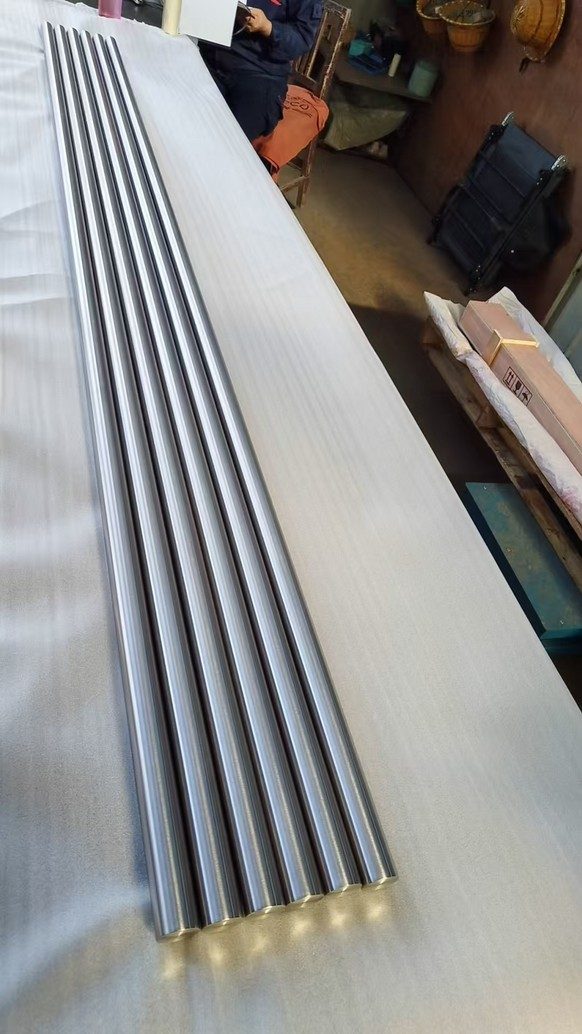
What ASTM F1472 covers
ASTM F1472 is the surgical-implant specification for wrought Ti-6Al-4V at standard interstitial limits, UNS R56400, the same alloy and UNS number used for industrial Grade 5. The implant distinction is in the scope and acceptance requirements, not in a new alloy name: F1472 covers strip, sheet, plate, bar, forging bar and wire, produced by multiple melting, with implant-scope microstructure requirements that a general ASTM B348 Grade 5 certificate does not address.
| Specification | Alloy | UNS | Interstitial level | Scope |
|---|---|---|---|---|
| ASTM B348 Grade 5 | Ti-6Al-4V | R56400 | Standard | Industrial bar and billet |
| ASTM F1472 | Ti-6Al-4V | R56400 | Standard | Surgical implants, wrought forms |
| ASTM F136 | Ti-6Al-4V ELI | R56401 | Extra low | Surgical implants, wrought forms |
The practical reading is simple: F1472 and B348 share chemistry and UNS, but not scope; F1472 and F136 share implant scope, but not the interstitial ceiling or UNS. If the drawing calls for F1472, the certificate must cite F1472 rather than a general Grade 5 standard. For the buyer-side quick comparison between the alloy implant grades, see Beiyu’s F136 vs F67 quick reference.
F1472 versus F136: standard interstitial versus ELI
Both standards cover wrought Ti-6Al-4V for surgical implants. F136 is the ELI version, UNS R56401, with tighter caps on oxygen and the other interstitial elements, which trades a little peak strength for higher fracture toughness, ductility and damage tolerance. F1472 keeps the standard Grade 5 interstitial limits and the higher strength ceiling that goes with them. Which one belongs on a device is a design and regulatory decision made by the device manufacturer; the supplier’s job is to certify the metal to the standard named on the order. The deeper ELI supply detail is in our ASTM F136 ELI bar guide.
| Standard | What the guide states |
|---|---|
| ASTM F136 | The ELI version, UNS R56401, with tighter caps on oxygen and the other interstitial elements, which trades a little peak strength for higher fracture toughness, ductility and damage tolerance |
| ASTM F1472 | Keeps the standard Grade 5 interstitial limits and the higher strength ceiling that goes with them |
What ASTM F620 covers, and why the UNS number depends on the source spec
ASTM F620 is the specification for titanium alloy forgings for surgical implants in the alpha-beta condition. It does not define a new alloy. Instead, it covers forgings made from implant material that already conforms to one of the medical wrought specifications: F136 Ti-6Al-4V ELI (UNS R56401), F1472 Ti-6Al-4V (UNS R56400), F1295 Ti-6Al-7Nb (UNS R56700) or F2066 Ti-15Mo (UNS R58150). The forging is produced by hammering, pressing, extruding or upsetting the bar or wire, then annealed after hot forging and tested against the F620 requirement set.
The point that confuses orders is that an F620 forging keeps the UNS number of its source material specification. A forging made under F620 from F136 stock remains UNS R56401; a forging made under F620 from F1472 stock remains R56400. That is different from ASTM B381, where the industrial Grade F-23 forging uses UNS R56407. The numbers are not in conflict; they belong to different specification chains, and the certificate has to match the chain the drawing calls for. For the product-side forging route, see our hip implant titanium forgings page.
| Source material specification | UNS the F620 forging keeps |
|---|---|
| ASTM F136 Ti-6Al-4V ELI | R56401 |
| ASTM F1472 Ti-6Al-4V | R56400 |
| ASTM F1295 Ti-6Al-7Nb | R56700 |
| ASTM F2066 Ti-15Mo | R58150 |
What to put on an F1472 or F620 enquiry
The certificate and traceability carry as much weight as the metal on an implant-chain order. A clean RFQ should state the specification and grade, the source material specification for forgings, the form and dimensions with tolerances, the condition and surface, and any test or microstructure requirement that sits beyond the base standard. If the order must be sourced from a mill operating under a medical quality-system route, say so on the RFQ so the documentation chain is aligned before the quote is issued.
| Field on an F1472 or F620 enquiry | Detail |
|---|---|
| Specification and grade | ASTM F1472 Ti-6Al-4V (UNS R56400), or ASTM F620 with the source material specification stated. |
| Form and size | bar, plate, wire or forging stock to drawing, with tolerances stated. |
| Condition and surface | annealed; descaled, ground, machined, peeled or polished as required. |
| Test scope | chemistry including interstitials, tensile properties, and for forgings hardness, elongation and reduction of area when the drawing requires them. |
| Traceability | heat number tied to one melt, with EN 10204 3.1 documentation. |
Beiyu supplies implant-chain titanium bar, plate, wire and forging stock against the specification cited on the order, with EN 10204 3.1 mill test certificates and heat-number traceability by order scope. The generic field list is in our titanium bar RFQ checklist, and the wider picture of how implant-grade titanium is specified and bought is in the titanium for medical implants guide.
FAQ
Is ASTM F1472 the same as Grade 5 titanium?
Chemically yes: F1472 covers Ti-6Al-4V at standard interstitial limits under UNS R56400, the same UNS number as industrial Grade 5. The difference is scope. F1472 is a surgical-implant specification with implant microstructure and inspection requirements that an industrial B348 Grade 5 certificate does not address.
What is the difference between ASTM F1472 and F136?
Both cover wrought Ti-6Al-4V for surgical implants. F136 is the ELI version, UNS R56401, with tighter interstitial limits for fracture toughness and damage tolerance. F1472 is the standard-interstitial version, UNS R56400, with the higher strength ceiling associated with Grade 5 chemistry.
What UNS number does an ASTM F620 forging have?
The UNS number of its source material specification. F620 forgings made from F136 stock keep R56401; forgings made from F1472 stock keep R56400. This differs from ASTM B381, where the industrial Grade F-23 forging uses R56407.
Can the same Ti-6Al-4V ELI forging be R56401 in one order and R56407 in another?
Two forgings of the same nominal ELI chemistry can carry different UNS numbers because the numbers belong to different standards chains: the medical chain F620 over F136 keeps R56401, while the industrial chain ASTM B381 Grade F-23 uses R56407. Match the certificate to the drawing’s specification chain.
How much margin one documented heat left against the F1472 minima
F1472 sets minima. A buyer specifying it wants to know what production material actually delivers against them, and whether several diameters produced from the same heat behave consistently. The figures below come from one documented triple melted heat that was processed into four bar lots and annealed at 750 °C for one hour with air cooling. Each lot was tested separately by an independent titanium testing laboratory.
| Lot from the same heat | Diameter | Rm MPa | Rp0.2 MPa | Elongation A % | Reduction of area Z % | Hydrogen % |
|---|---|---|---|---|---|---|
| Lot A | Φ7.5 mm | 961 | 897 | 15.5 | 42 | 0.0021 |
| Lot B | Φ8.5 mm | 1049 | 1012 | 14.5 | 48 | 0.0028 |
| Lot C | Φ10.5 mm | 1082 | 1014 | 14.5 | 49 | 0.0022 |
| Lot D | Φ12 mm | 1016 | 948 | 17.5 | 55 | 0.0022 |
| ASTM F1472 reference limits | reference limits applied in the reports | 860 | 795 | 10 | 25 | ≤0.015 |
Two features of that table are worth an engineer’s attention. The first is the spread: tensile strength ran from 961 to 1082 MPa across four diameters taken from one heat. Four results do not establish why, so treat the range as the observed variation across diameters rather than as an explained effect. The second is that strength and ductility do not move together across the four lots, which is a useful reminder when reading any multi diameter certificate: the highest tensile result and the highest elongation came from different lots.
Hydrogen across the four lots sat between 0.0021 and 0.0028 percent against a 0.015 percent ceiling, so the material used under a fifth of the allowance. Ingot chemistry was analysed at both the top and the bottom of the ingot, which is worth naming on an enquiry because a single sampling point tells a buyer less about a large ingot than two do.
Read these as results from documented production material, not as typical values and not as a level every heat will repeat. They show what the route produced on the material that was tested. Ask at enquiry which supporting records are available for the material being quoted, since the document scope and any redaction are agreed case by case rather than published here.
What is examined on implant grade bar, and at what coverage
On implant material the question is rarely whether a check was performed. It is whether it was performed on the whole lot or on a sample, and against which acceptance class. Coverage is therefore stated as a column rather than as an adjective.
| Check | Coverage | What it settles |
|---|---|---|
| Ultrasonic flaw detection | 100 percent of the lot | Internal discontinuities against the acceptance class named on the order |
| Eddy current | 100 percent of the lot | Surface and near surface discontinuities |
| Optical surface inspection | 100 percent of the lot | Visible surface condition along the full length |
| Infrared laser diameter measurement | 100 percent of the lot | Diameter through the length, not a spot check at the ends |
| Straightness | 100 percent of the lot | Bow against the published value over a stated gauge length |
These are the checks carried on the quoted precision route, reviewed against as a production capability rather than offered as a stock statement. Where an order needs a tighter acceptance class or an additional examination, that belongs in the purchase order text and is reviewed before the enquiry is priced.
The document fields an implant material enquiry should fix in advance
| Field | Beiyu position |
|---|---|
| Certificate type | EN 10204 3.1 mill test certificate |
| Traceability | Heat number, carried through to the delivered pieces |
| Reporting scope | Set by the order, which is why the order should state it |
| Melting route | Triple vacuum melted for medical grades, stated on the order |
| Delivery condition | Stated separately from surface finish |
A certificate reports what the order asked for. Where the reporting scope was never stated, a fully compliant document can still answer less than incoming inspection expects.
Specification detail with sources
Mechanical and interstitial numbers are where ASTM F1472 and ASTM F136 separate on paper. ASTM F1472 keeps the standard Grade 5 interstitial ceilings and requires annealed wrought product to reach 930 MPa ultimate tensile strength and 860 MPa yield, while ASTM F136 caps oxygen at 0.13 percent and sets the annealed minimums for standard bar sections at 860 MPa ultimate and 795 MPa yield, trading roughly 70 MPa of strength for fracture toughness. Those two requirement sets, not the shared alloy name, are what an F620 forging inherits from its source specification.
Beiyu Titanium quotes the forged end of this chain against ASTM F136 and ISO 5832-3, with hot forged discs from 50 to 2000 mm outside diameter at 20 to 500 mm thickness and forged blocks from 50 to 600 mm, supplied with a turned surface in the as-forged or annealed condition. On an F620 enquiry, Beiyu practice is to ask which of the four source specifications the drawing follows before quoting, because the disc or block is certified against that document’s limits and the answer changes the test scope on the certificate.
Request a quote for implant-chain titanium
To quote titanium against ASTM F1472 or F620, Beiyu needs the specification and grade with the UNS number, the source material specification for forgings, the form and dimensions with tolerances, condition and surface, quantity, the test or microstructure scope, and the certificate type. Send the drawing or specification and we review each line against mill capability before quoting, with EN 10204 3.1 documentation and heat-number traceability by order scope. Contact Beiyu Titanium for an RFQ.