
F67 is unalloyed titanium; F136 is Ti-6Al-4V ELI. Choose F67 where corrosion resistance and formability lead, F136 where strength governs, at roughly 860 MPa minimum tensile against 240 to 550 MPa for the F67 grades. Both are implant specifications with tighter interstitial limits than the industrial standards.
ASTM F136 and ASTM F67 are the two material standards that cover most titanium going into surgical implants, and the fastest way to choose between them is side by side. This page is the quick reference: the chemistry limits, the mechanical minimums and the decision rules, tables first. For the full picture of how implant-grade titanium is specified, certified and bought, see our guide to titanium for medical implants. For form-specific supply detail on each standard, the ASTM F67 bar guide and the ASTM F136 ELI bar guide go deeper.
What does ASTM F67 cover?
ASTM F67 is the standard specification for unalloyed titanium used to make surgical implants. It sets the chemical, mechanical and metallurgical requirements for four commercially pure grades, supplied as strip, sheet, plate, bar, billet, forgings and wire: Grade 1 (UNS R50250), Grade 2 (UNS R50400), Grade 3 (UNS R50550) and Grade 4 (UNS R50700). The grades differ mainly in their oxygen and iron limits. Across Grades 1 to 4, the specification combines progressively higher strength requirements with lower minimum elongation. The full chemistry and mechanical limits for all four grades are in the ASTM F67 table further down this page. F67 covers unalloyed titanium only. ASTM F136 specifies wrought annealed Ti-6Al-4V ELI (UNS R56401) for surgical implant manufacture, and the two standards are compared below.
The two implant material standards
F67 and F136 cover different metals for different jobs. F67 unalloyed titanium is the corrosion-driven, more ductile choice; F136 Ti-6Al-4V ELI is the load-bearing, high-strength choice used for most structural implants.
| Standard | Material | UNS | Why it is used for implants |
|---|---|---|---|
| ASTM F67 | Unalloyed titanium, Grades 1 to 4 (CP) | R50250 / R50400 / R50550 / R50700 | Single-phase, highly corrosion resistant and biocompatible; used where strength demand is lower |
| ASTM F136 | Wrought Ti-6Al-4V ELI (extra low interstitial) | R56401 | High strength to weight with the toughness and fatigue life a load-bearing implant needs |
| ASTM F1472 | Wrought Ti-6Al-4V (standard interstitial) | R56400 | Standard-interstitial implant alloy where ELI toughness is not required |
The point of an implant standard is consistency from heat to heat. Ordering the same alloy to F136 instead of a general industrial line tells the mill which interstitial limits, test frequency and certification the order has to meet, so the metal behaves the same way in every batch.
What ELI changes, in one paragraph
ELI (extra low interstitial) means tighter caps on oxygen, nitrogen, carbon, hydrogen and iron than standard Ti-6Al-4V, trading a little peak strength for higher fracture toughness, better ductility and greater damage tolerance, which is why F136 ELI is the default for load-bearing implants. The full metallurgy, including how grain size and hydrogen are controlled at the mill, is covered in the grain size and hydrogen control guide.
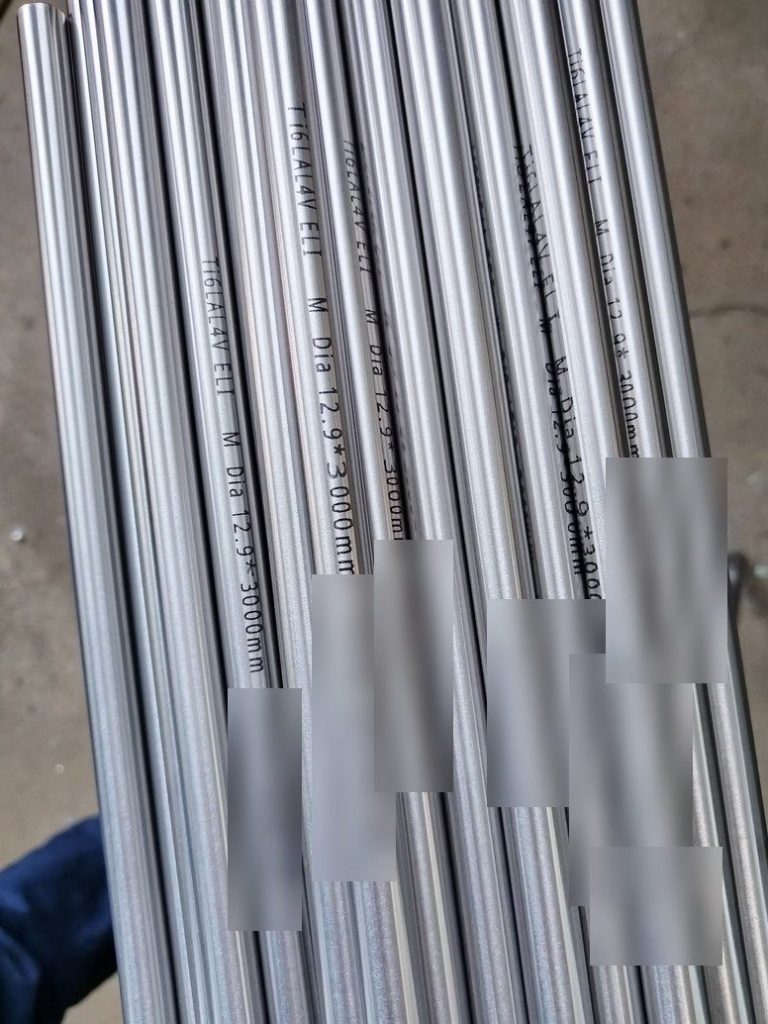
Grade 23 and F136: same alloy, different UNS and standard scope
Grade 23 and ASTM F136 both cover wrought Ti-6Al-4V ELI, but the UNS number follows the standard the order runs under: R56407 for Grade 23 under the ASTM B series, R56401 under ASTM F136. What differs is the scope of the standard the order runs under, and for implants that difference is decisive. Grade 23 is the wrought ELI alloy ordered under the industrial standards ASTM B348 (bar and billet) and ASTM B265 (sheet and plate); those are commercial and engineering specifications and are not certified for human-body contact. ASTM F136 is the surgical-implant specification for that same ELI alloy, with the implant-specific requirements an auditor expects. So Grade 23 to B348 is not a drop-in substitute for F136 on a body-contact part: for an implant the material certificate has to be written to F136 (or to F67 or F1295 where those apply). State which standard the certificate must reference on the order.
| Point | Grade 23 ordered to ASTM B348 or B265 | ASTM F136 |
|---|---|---|
| Alloy | Wrought Ti-6Al-4V ELI | The same wrought Ti-6Al-4V ELI metal |
| UNS on the certificate | R56407 | R56401 |
| Type of standard | Commercial and engineering specification | Surgical implant specification, with the implant-specific requirements an auditor expects |
| Surgical implant use | Does not establish conformance for surgical implant applications | Covers Ti-6Al-4V ELI for surgical implant applications; cite ASTM F136 on the mill test certificate |
| Use on a body-contact part | Not a drop-in substitute for F136 | Cite it on the order, or ASTM F67 or F1295 where those apply |
Forms and what to put on a medical-grade titanium RFQ
Implant-grade titanium is supplied as stock for downstream machining and forging, not as a finished device. Common forms are bar, plate, wire and forging stock. Material is supplied to the limits of the standard cited on the order; where a customer specifies tighter or different requirements, the order is made and certified to that customer specification. The certificate and traceability carry as much weight as the metal:
- Standard and grade: ASTM F136 Ti-6Al-4V ELI, ASTM F67 Grade 2 or 4 CP titanium, or Grade 23 to B348 / B265, with the UNS number
- Form and size: bar (diameter and length), plate (thickness, width, length), wire (diameter and spool), or forging stock to a drawing, with the diameter or thickness tolerance stated
- Condition and surface: annealed; peeled, ground or polished as required
- Mechanical properties: tensile, yield and elongation reported on the certificate
- Chemical composition: full interstitial analysis, including oxygen, reported on the certificate
- Traceability: heat number tied to one melt, mill test certificate to EN 10204 3.1
- Quality system: state if the order must be supplied under an ISO 13485 quality system scope
The generic field list, with tolerances and document scope, is in the titanium bar RFQ checklist.
| Field to state | What to give |
|---|---|
| Standard and grade | ASTM F136 Ti-6Al-4V ELI, ASTM F67 Grade 2 or 4 CP titanium, or Grade 23 to B348 / B265, with the UNS number |
| Form and size | Bar (diameter and length), plate (thickness, width, length), wire (diameter and spool), or forging stock to a drawing, with the diameter or thickness tolerance stated |
| Condition and surface | Annealed; peeled, ground or polished as required |
| Mechanical properties | Tensile, yield and elongation reported on the certificate |
| Chemical composition | Full interstitial analysis, including oxygen, reported on the certificate |
| Traceability | Heat number tied to one melt, mill test certificate to EN 10204 3.1 |
| Quality system | State if the order must be supplied under an ISO 13485 quality system scope |
ASTM F136 chemical composition (Ti-6Al-4V ELI, Grade 23, UNS R56401)
ASTM F136 specifies wrought Ti-6Al-4V ELI for surgical implants. It is the same alloy as ASTM B348 Grade 23, with tighter limits on the interstitial elements that define ELI (extra low interstitial). The UNS number follows the standard on the order: material certified to ASTM F136 is UNS R56401, while Grade 23 certified to the ASTM B series (B348, B265) is UNS R56407. The specified composition is:
| Element | Specified limit (wt%) |
|---|---|
| Aluminium (Al) | 5.5 – 6.5 |
| Vanadium (V) | 3.5 – 4.5 |
| Iron (Fe) | 0.25 max |
| Oxygen (O) | 0.13 max |
| Carbon (C) | 0.08 max |
| Nitrogen (N) | 0.03 max |
| Hydrogen (H) | 0.0125 max |
| Other elements, each | 0.10 max |
| Other elements, total | 0.40 max |
| Titanium (Ti) | Balance |
The lower oxygen, nitrogen and iron caps are what separate Grade 23 ELI from standard Grade 5. Lower interstitials raise ductility, fracture toughness and fatigue life, which is why this grade is specified for load-bearing implants rather than standard Grade 5.
Does medical-grade titanium contain nickel?
No. Neither Ti-6Al-4V ELI (ASTM F136) nor commercially pure titanium (ASTM F67) uses nickel as an alloying element. Nickel is not in the specified chemistry of either standard; it can only appear as a trace residual counted within the “other elements” limit. This is one reason orthopedic, dental and body jewelry buyers specify F136 or F67 for nickel-sensitive patients, instead of nickel-bearing stainless steels or nickel-titanium (Nitinol). When nickel content has to be documented, it is covered by the residual-element limits on the mill certificate.
ASTM F136 mechanical properties (minimum, annealed)
| Property | Minimum (metric) | Minimum (imperial) |
|---|---|---|
| Ultimate tensile strength | 860 MPa | 125 ksi |
| Yield strength (0.2% offset) | 795 MPa | 115 ksi |
| Elongation | 10% | 10% |
| Reduction of area | 25% | 25% |
Grade 23 ELI gives up a little strength against standard Grade 5 in exchange for better ductility and fatigue performance, which matters for cyclically loaded implants.
ASTM F67 commercially pure titanium (Grades 1 to 4)
ASTM F67 covers unalloyed (commercially pure) titanium for surgical implants. Oxygen is the main lever between grades: as oxygen rises, tensile and yield strength rise while ductility falls. CP titanium is chosen where maximum corrosion resistance and ductility matter more than high strength, for example dental components, mesh and low-load or non-load implants.
| Grade | UNS | N max | C max | H max | Fe max | O max | UTS min | Yield min | Elong min |
|---|---|---|---|---|---|---|---|---|---|
| Grade 1 | R50250 | 0.03 | 0.08 | 0.015 | 0.20 | 0.18 | 240 MPa | 138 MPa | 24% |
| Grade 2 | R50400 | 0.03 | 0.08 | 0.015 | 0.30 | 0.25 | 345 MPa | 275 MPa | 20% |
| Grade 3 | R50550 | 0.05 | 0.08 | 0.015 | 0.30 | 0.35 | 450 MPa | 380 MPa | 18% |
| Grade 4 | R50700 | 0.05 | 0.08 | 0.015 | 0.50 | 0.40 | 550 MPa | 483 MPa | 15% |
Values in the chemistry columns are maximum wt% limits. For billet, the ASTM F67 hydrogen limit can be lower, so confirm the ordered product form and current standard edition on the purchase order and mill certificate.
ASTM F136 vs ASTM F67: which medical titanium standard do you need?
F67 is commercially pure titanium (Grades 1 to 4): lower strength, highest corrosion resistance and ductility, used for dental work, mesh and low-load implants. F136 is Ti-6Al-4V ELI (Grade 23): high strength with good fatigue resistance, used for load-bearing implants such as hip and knee stems, bone screws and plates. F136 is the same alloy as B348 Grade 23 but qualified specifically for surgical implant use. Beiyu supplies bar, plate, sheet, wire and forging stock to both standards, with EN 10204 3.1 mill test certificates and heat-number traceability by order scope.
| When it applies | Standard | Material |
|---|---|---|
| Dental components, mesh, and low-load or non-load implants | ASTM F67 | Unalloyed titanium, Grades 1 to 4 |
| Load-bearing implants such as hip and knee stems, bone screws and plates | ASTM F136 | Wrought Ti-6Al-4V ELI |
| Implant parts where ELI toughness is not required | ASTM F1472 | Wrought Ti-6Al-4V, standard interstitial |
FAQ
Is Grade 23 the same as ASTM F136?
It is the same alloy, but the UNS number follows the standard: R56401 under ASTM F136, R56407 under the ASTM B series. Grade 23 is that Ti-6Al-4V ELI alloy ordered under the industrial standards ASTM B348 and B265, which are not certified for body contact; ASTM F136 is the surgical-implant specification for the same alloy. For an implant the certificate must be written to F136 (or F67 or F1295 where applicable), not to Grade 23 industrial. Specify which standard the certificate must cite.
Why use ELI titanium instead of standard Grade 5?
ELI holds oxygen and the other interstitials to lower limits, which raises fracture toughness, ductility and fatigue life. For implants loaded over millions of cycles, that matters more than the small loss in peak strength.
When is F67 commercially pure titanium used instead of F136?
Where corrosion resistance and ductility matter more than high strength. F67 CP titanium is single-phase and more formable, used for parts that do not carry high structural load.
Does buying medical-grade titanium bar mean I am buying a finished implant?
No. F136 and F67 are material standards for stock such as bar, plate, wire and forging stock. The implant itself is machined, forged, finished, cleaned, sterilized and cleared as a device downstream. The material certificate is one input to that chain.
What documentation should come with implant-grade titanium?
A mill test certificate to EN 10204 3.1 with full chemistry including oxygen, mechanical properties, and a heat number traceable to a single melt. State if the order must be supplied under an ISO 13485 quality system scope.
Can material be supplied to a tighter spec than the standard?
Yes. Material is supplied to the limits of the standard cited on the order by default. Where a customer specifies tighter or different limits, for example a narrower oxygen range or an additional test, the order is made and certified to that customer specification. State the controlling requirement on the purchase order.
Related guides and tools
For a stock-form and machining-route comparison, review titanium square bar for medical-device components.
- Grade 5 vs Grade 23 (Ti-6Al-4V vs ELI)
- Titanium grade for seawater and marine service
- Titanium grade for chemical processing
- Titanium grade selector tool
What is checked on the precision ground bar route, and how it is reported
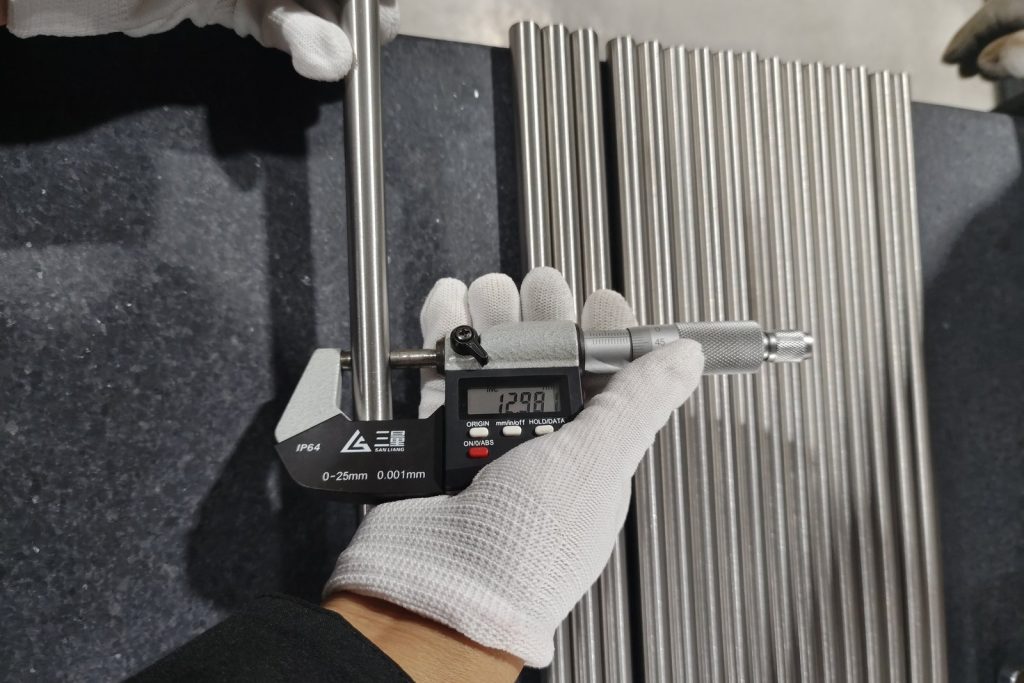
An implant-grade order is decided on documents as much as on metal. The list below is what Beiyu inspects on the precision ground bar route and what the paperwork carries, stated as fields a buyer can check on receipt rather than as adjectives. Each line is either done on the whole lot or it is not claimed.
| Check | Coverage | What it settles |
|---|---|---|
| Ultrasonic flaw detection | 100 percent of the lot | Internal discontinuities against the acceptance class named on the order |
| Eddy current | 100 percent of the lot | Surface and near surface discontinuities |
| Optical surface inspection | 100 percent of the lot | Visible surface condition along the full length |
| Infrared laser diameter measurement | 100 percent of the lot | Diameter through the length, not a spot check at the ends |
| Straightness | 100 percent of the lot | Bow against the published value, measured over a stated gauge length |
Five checks at full coverage is a different statement from five checks performed on samples, and it is the reason the coverage column exists. Where an order needs a tighter acceptance class or an additional examination, that belongs in the purchase order text and is reviewed before the enquiry is priced.
The ultrasonic setting behind the acceptance class
A coverage figure says every bar in the lot was scanned. It does not say how sensitive the scan was, and on an implant order those are separate questions: two certificates can both read “ultrasonic flaw detection” while the scans behind them were calibrated to different thresholds. With every other condition held equal, a scan set against a larger reference reflector passes material that a finer setting rejects. The six lines below are the documented setting Beiyu runs on the precision centreless ground bar route, published so that the sensitivity behind the class name can be audited rather than assumed.
| Line | Beiyu precision ground bar route |
|---|---|
| Method | Water immersion, focused longitudinal wave |
| Coverage | 100 percent of the circumference |
| Calibration reflector | Φ1.2 mm radial flat bottom hole, set to 80 percent screen height |
| Probe frequency | 10 MHz |
| Acceptance class | A1 |
| Acceptance specification | AMS-STD-2154 or GB/T 5193, whichever the order calls for |
Three limits bound what that table claims. The reflector fixes the threshold the scan is set against; it does not describe anything the material contains. A class letter has meaning only inside the specification that defines it, so an implant order carries the class and the acceptance specification together rather than converting one document’s label into another’s. And the setting belongs to the precision centreless ground bar route, which runs Ø3.175 mm to 25.4 mm, that is 0.125 in to 1.000 in, so it is not a statement about every diameter Beiyu supplies.
The published values a medical bar enquiry can be checked against
These are the values Beiyu works to on the precision centreless ground bar route. They are a production capability the order is reviewed against, not a stock statement, and the ordered combination is confirmed at quotation.
| Field | Published value | Tightened to |
|---|---|---|
| Diameter tolerance | ±0.0127 mm (±0.0005 in) | ±0.0076 mm on request |
| Straightness | 0.5 mm per metre | 0.3 mm per metre at diameters up to and including 25 mm, and to the drawing beyond that |
| Melting route | Triple vacuum melted for medical grades | Stated on the order |
| Certificate | EN 10204 3.1 mill test certificate with heat number traceability | Reporting scope set by the order |
Specification detail with sources
The dividing line between the two implant standards is interstitial control: ASTM F136 holds oxygen to 0.13 wt% max in Ti-6Al-4V ELI, while ASTM F67 allows up to 0.40 wt% oxygen in its strongest unalloyed grade. Oxygen is the main lever both standards use to trade ductility against strength.
Both materials stay light relative to surgical stainless steel: unalloyed titanium has a density of about 4.51 g/cm³ and Ti-6Al-4V about 4.43 g/cm³ (ASM Handbook, Volume 2, Properties and Selection: Nonferrous Alloys and Special-Purpose Materials), roughly 57 percent of the density of steel.
Supplier-side comparisons for implant-grade material are collected in the titanium supplier lists index.
Reference sources
- ASTM F67, Standard Specification for Unalloyed Titanium, for Surgical Implant Applications
- ASTM F136, Standard Specification for Wrought Ti-6Al-4V ELI Alloy for Surgical Implant Applications
- ISO 5832-2 and ISO 5832-3, Implants for surgery, Metallic materials
- ASTM F1472, Standard Specification for Wrought Titanium-6Aluminum-4Vanadium Alloy for Surgical Implant Applications
- EN 10204, Metallic Products, Types of Inspection Documents