
Most titanium buyers never look past the first page of a mill certificate. They check that it says “Grade 5,” scan for a stamp, and file it. That habit is how off-spec or poorly traced material slips into a build. A titanium ingot certificate carries more signal than a single grade line, if you know which numbers to read and what a good lab actually measures.
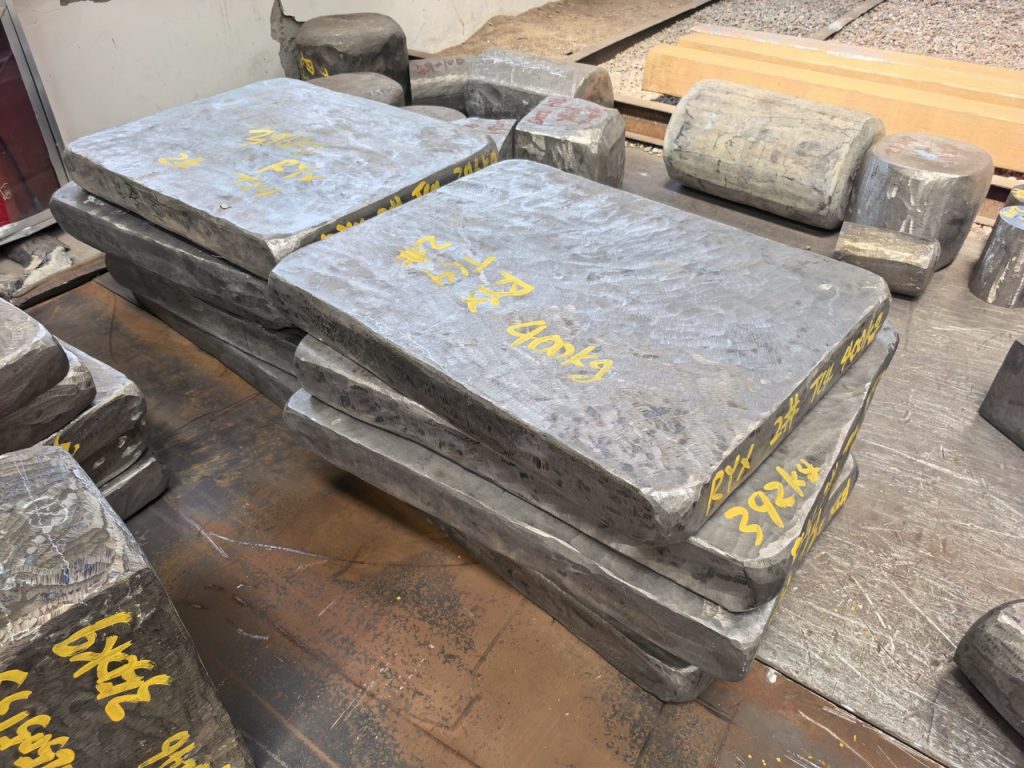
Below is a worked example using a real ingot lot we recently melted and had tested: lot (lot number withheld), designation TC4 (Ti-6Al-4V, equivalent to Grade 5), Φ600 mm, tested at an accredited independent laboratory. We’ll read it the way a receiving inspector should.
The chemistry table is reported top and bottom: that’s the point
The first thing worth noticing isn’t a value, it’s the column layout. A serious ingot report gives two analyses: one from the top of the ingot and one from the bottom. Here are the real numbers from that lot:
| Element (wt %) | Top (上) | Bottom (下) | ASTM B348 Gr 5 limit | Verdict |
|---|---|---|---|---|
| Aluminium (Al) | 6.53 | 6.35 | 5.5 to 6.75 | In range |
| Vanadium (V) | 3.87 | 3.77 | 3.5 to 4.5 | In range |
| Iron (Fe) | 0.18 | 0.19 | ≤ 0.40 | Well under |
| Oxygen (O) | 0.186 | 0.181 | ≤ 0.20 | Under, controlled |
| Carbon (C) | <0.004 | 0.004 | ≤ 0.08 | Well under |
| Nitrogen (N) | 0.007 | 0.007 | ≤ 0.05 | Well under |
| Hydrogen (H) | <0.0006 | <0.0006 | ≤ 0.015 | Well under |
Why two ends? Titanium alloys are usually double or triple Vacuum Arc Remelted (VAR). As the ingot solidifies, alloying elements don’t freeze perfectly evenly; heavier and lighter constituents can concentrate at different heights, a phenomenon called segregation. Aluminium tends to vary more than vanadium because it is volatile under vacuum. If the top and bottom disagree by a lot, the middle of that ingot is a gamble.
On this lot the Al spread is 6.53 → 6.35 (Δ0.18) and V is 3.87 → 3.77 (Δ0.10). Those are small, tight deltas, both comfortably inside the Grade 5 window. That is what compositional homogeneity looks like on paper. It’s also why aerospace specs and the FAA’s own guidance require bar to be traceable back to a specific ingot and at least to the top or bottom half it was cropped from, so the chemistry on the cert actually corresponds to the metal in your hand.
The interstitials matter more than Al and V
Aluminium and vanadium define the alloy. The four light elements, oxygen, nitrogen, carbon, hydrogen, the “interstitials”, define whether it will behave. They sit in the spaces of the titanium lattice and each tenth of a percent moves the mechanical properties hard.
| Element lever |
|---|
| Oxygen (0.186 / 0.181%) is the strongest lever. Oxygen raises strength but cuts ductility and fracture toughness. At 0.18% this lot is a normal, healthy Grade 5, but note it would fail Grade 23 (Ti-6Al-4V ELI), which caps oxygen at 0.13%. Same alloy, different interstitial budget. Our grade-selection guide covers when that distinction changes which grade you should order. |
| Hydrogen (<0.0006%, i.e. <6 ppm) is the one to respect. Hydrogen drives delayed cracking (hydrogen embrittlement) in titanium. The Grade 5 ceiling is 150 ppm; this ingot is below 6 ppm, which is what good vacuum practice and clean sponge buy you. |
| Nitrogen (0.007%) and carbon (<0.004%) are both an order of magnitude under their limits. High nitrogen in particular forms hard, brittle inclusions, so low is good. |
What a receiving inspector should actually check
| Certificate check |
|---|
| Does the lot number on the cert match the marking on the metal? The lot number should be physically on the ingot or bar, not just on paper. No match, no acceptance. |
| Are both top and bottom inside the spec you ordered: not just one end, and not just “Grade 5” generically. |
| Is the test lab independent and accredited? This report carries CNAS accreditation and the test methods are named per element (YS/T 1262-2018 for the metallics; GB/T 4698 series for O, N, H, C). A cert with no method references is a cert you can’t audit. |
| Do the interstitials suit your application, not just the alloy? If you need ELI toughness, an oxygen of 0.18% is a quiet rejection even though it passes Grade 5. |
From ingot to your order
Everything downstream inherits this chemistry. The same heat becomes Ti-6Al-4V bar, Grade 5 plate and forging stock, and the mill test certificate that ships with your order should trace back to the ingot analysis shown here. When extra-low-interstitial toughness is required, that’s a different starting ingot. See Ti-6Al-4V ELI (Grade 23) bar.
For the certificate package itself, including the difference between EN 10204 2.1, 2.2, 3.1 and 3.2 documents, see how to verify titanium quality with a mill test certificate.
FAQ
Is TC4 the same as Grade 5?
TC4 is the Chinese (GB) designation for Ti-6Al-4V; ASTM Grade 5 and AMS 4928 cover the same nominal 6% Al, 4% V chemistry. The composition limits line up, which is why a TC4 ingot can be certified against ASTM B348 Grade 5.
Why is oxygen reported to three decimals when Al is only two?
Because at 0.18% oxygen, a swing of 0.02% measurably changes yield strength and toughness, while a 0.02% change in 6.4% aluminium does not. The reporting precision follows the sensitivity.
What does a top/bottom difference tell me?
It quantifies ingot segregation. Small deltas (like the 0.10 to 0.18% here) indicate a homogeneous melt. Large deltas mean the chemistry you get depends on where your bar was cut from, a traceability and consistency risk.
What the certificate for the finished bar must then show, line by line with the test method behind each number, is covered in who supplies ASTM B348 titanium bar with EN 10204 3.1 certificates.
Can I get the ingot certificate for my heat?
Yes. Material can be supplied with the mill test certificate and EN 10204 3.1 documentation, with heat-number traceability from the certificate to the marked material. Send a technical enquiry with your grade, standard and documentation requirements.
What one real ingot report looks like from top to bottom
Position matters because an ingot does not solidify uniformly, and the sampling column on a report is there to show it. In an independent laboratory analysis of one Beiyu Ti-6Al-4V ingot, judged to GB/T 3620.1-2016 and run by ASTM E2371-21a for the alloying metals with the GB/T 4698 series for the interstitials, the same ingot read differently at each of the three sampling positions.
| Element, w/percent | Top | Middle | Bottom | Spread |
|---|---|---|---|---|
| Aluminium | 6.34 | 6.29 | 6.15 | 0.19 |
| Vanadium | 4.22 | 4.31 | 4.23 | 0.09 |
| Iron | 0.100 | 0.110 | 0.117 | 0.017 |
| Oxygen | 0.092 | 0.095 | 0.117 | 0.025 |
Every value sits inside the ASTM B348 Grade 5 window of 5.50 to 6.75 percent aluminium, 3.50 to 4.50 percent vanadium, 0.40 percent iron maximum and 0.20 percent oxygen maximum, so this ingot passes on all three positions. The reading to take from it is that aluminium moved 0.19 percent and oxygen 0.025 percent across one ingot, which is why a report quoting a single figure without its sampling position tells you less than it appears to. Beiyu supplies this analysis with the heat number on the certificate so a buyer can tie the position back to the material actually shipped.
Specification detail with sources
Test methods are what make a titanium ingot certificate auditable, and each element family on the report has its own ASTM number. ASTM E539 covers analysis of titanium alloys by X-ray fluorescence spectrometry, the routine route for metallic elements such as aluminum, vanadium and iron; ASTM E1409 covers oxygen and nitrogen by inert gas fusion; and ASTM E1941 covers carbon in reactive metals by combustion analysis. A report that names its methods, whether these ASTM procedures or their GB/T counterparts, can be repeated by a second laboratory, which is the working definition of an auditable certificate.
Beiyu Titanium runs the same melt-to-marked-product chain on its own ingot orders: chemistry is verified through an external or in-house mill laboratory under the mill quality flow, and the heat number fixed at the ingot follows the material into hot forged bar from 50 to 500 mm diameter in lengths up to 3000 mm under ASTM B381 and ASME SB381. Read against the report above, that is the practical use of a top and bottom analysis: Beiyu can trace the bar on a purchase order back to its melt through that heat number, because the number travels with the metal from ingot to dispatch.
Send a technical RFQ
For titanium ingot or billet traceability RFQs, include grade, product form, heat-number requirement, dimensions, quantity and required test report format.