
Two titanium bars can both be stamped “Grade 5,” both pass ASTM B348, and still not be chemically identical. That isn’t a defect: it’s how melted alloys work. Understanding the spread between heats is the difference between a buyer who specifies properly and one who is surprised when a second order machines or welds a little differently.
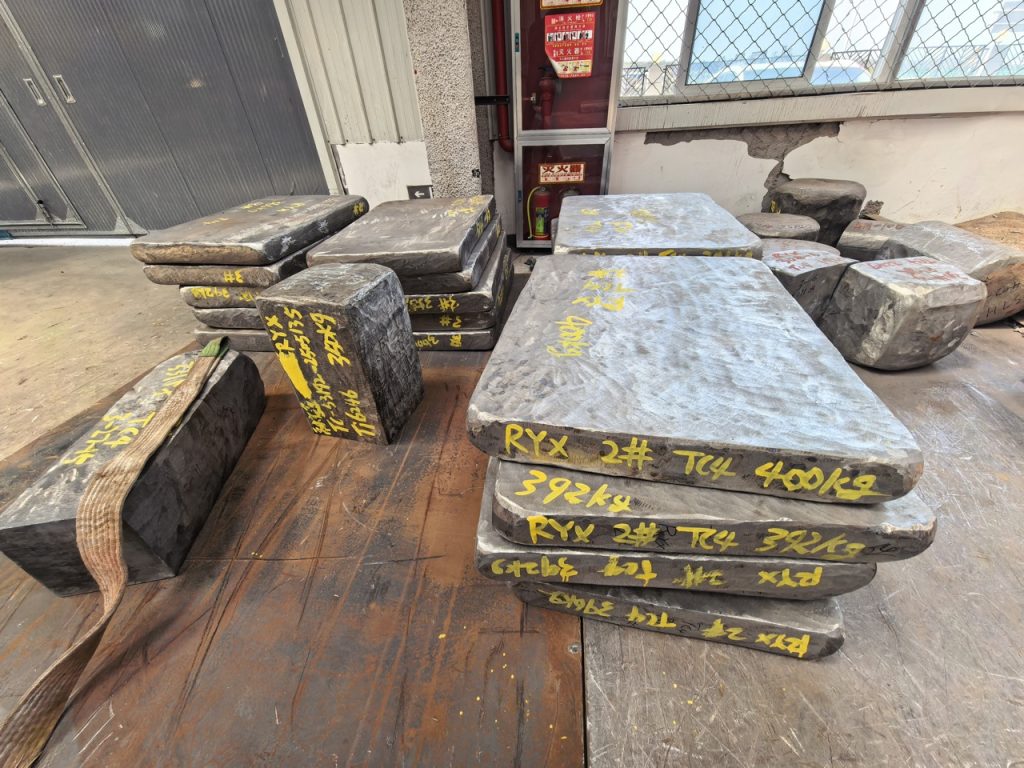
Here are two real Ti-6Al-4V (TC4) ingot heats we melted, both Φ600 mm, both third-party tested at an accredited independent laboratory on the same day:
| Element (wt %) | Heat A | Heat B | ASTM B348 Gr 5 limit |
|---|---|---|---|
| Aluminium (Al) | 6.35 to 6.53 | 6.15 to 6.18 | 5.5 to 6.75 |
| Vanadium (V) | 3.77 to 3.87 | 4.03 to 4.06 | 3.5 to 4.5 |
| Iron (Fe) | 0.18 to 0.19 | 0.18 to 0.19 | ≤ 0.40 |
| Oxygen (O) | 0.181 to 0.186 | 0.171 to 0.172 | ≤ 0.20 |
| Nitrogen (N) | 0.007 | 0.007 to 0.008 | ≤ 0.05 |
Both are unambiguously Grade 5. But look at the real differences: heat 52554 runs near the top of the aluminium band (6.5%) and lower on vanadium (3.8%); heat 52556 is the opposite: leaner aluminium (6.2%) and richer vanadium (4.0%). Oxygen differs by 0.014% between them. None of this is wrong; it’s the normal scatter of two separate melts.
Why heats differ in the first place
Titanium alloy is made by blending titanium sponge with master alloy and pressing electrodes, which are then melted, usually two or three times, by Vacuum Arc Remelting. Several things move the final number a little each time:
| Point | What the guide states |
|---|---|
| Aluminium is volatile under vacuum | Some aluminium evaporates during melting, so the charge is set high expecting a loss. How much is lost varies with melt parameters, which is why aluminium is the element that wanders most between heats. |
| Master-alloy and sponge lots vary | Each raw-material lot has its own residuals (iron, oxygen), and those carry through. |
| Oxygen is set, not removed | Interstitial oxygen comes from the sponge grade and any additions; it can’t be taken out later, so its starting point is locked per heat. |
The mill’s job is to keep every heat inside the specification box. The ingot certificate is the proof it did, and the reason you should read the actual numbers, not just the grade line. (For how to read a single certificate end to end, see reading a titanium ingot test report.)
When the heat-to-heat difference actually matters
For most structural and corrosion work, anything inside the Grade 5 band behaves the same and you never notice. It starts to matter when you are near a property limit or running a tightly controlled process:
| Situation | Why the heat matters |
|---|---|
| Qualified welding procedure | A different Al/V balance can subtly shift weld response; some aerospace specs want filler and base from controlled heats. |
| Tight machining repeatability | Higher oxygen = higher strength = a slightly harder cut. A repeat order from a leaner-oxygen heat can feel different on the tool. |
| Fatigue / fracture-critical parts | Oxygen and the oxygen-equivalent drive toughness; this is why ELI (Grade 23) tightens the band. See interstitials in titanium. |
| Long production runs | If a part was developed on one heat, a second heat within spec can still need a re-check of speeds/feeds or weld settings. |
How to buy so heat variation never bites you
- Specify the standard and grade, not a target number. “ASTM B348 Grade 5” defines the allowable box; that’s what you’re entitled to. Don’t write a spec around 6.4% Al because one cert said so.
- Ask for the mill test certificate per heat, with heat-number traceability from the certificate to the marked bar. Two orders, two heats, two certs.
- If you truly need consistency, say so: request material from a single heat (or a single ingot) for the whole job, and state it on the PO. It’s a normal request for welding-qualified or fatigue-critical work.
- For tight toughness, order Grade 23 (ELI) instead of relying on a lucky low-oxygen Grade 5 heat.
We supply Ti-6Al-4V (Grade 5) bar, plate and forging stock with the heat certificate, and can hold an order to a single heat when your process needs it. Send the grade, standard and any single-heat or traceability requirement with your Send an enquiry.
FAQ
Is a heat the same as a lot?
Closely related: a heat is one melt (one ingot or melt batch); a lot is the material grouped under one certificate. Traceability ties your bar to its heat/ingot so the certificate’s chemistry actually applies to your metal.
If two heats are both in spec, is one "better"?
Not generally; both meet Grade 5. “Better” only exists relative to your application: lower oxygen for toughness, a specific Al/V balance for a qualified weld, and so on. In spec is in spec.
Can I demand a specific aluminium or oxygen value?
You can request a tighter sub-range or a single heat, but it narrows availability and can raise cost. Most buyers are better served ordering to the standard and, when it matters, restricting to one heat.
Why does aluminium vary more than iron between your two heats?
Aluminium evaporates under vacuum during melting, so its recovery varies melt to melt. Iron comes in with the raw materials and tends to sit in a narrower band.
Two Grade 5 heats measured side by side
The gap between two conforming heats is easier to see with real numbers than with a specification table. Two Beiyu Ti-6Al-4V ingots analysed by the same independent laboratory five weeks apart both passed ASTM B348 Grade 5 on every element and still differed.
| Element, w/percent | First heat range | Second heat range | Grade 5 limit |
|---|---|---|---|
| Aluminium | 6.08 to 6.18 | 6.15 to 6.34 | 5.50 to 6.75 |
| Vanadium | 4.17 to 4.21 | 4.22 to 4.31 | 3.50 to 4.50 |
| Oxygen | 0.098 to 0.100 | 0.092 to 0.117 | 0.20 maximum |
| Carbon | 0.051 to 0.068 | 0.066 to 0.070 | 0.08 maximum |
The second heat ran higher in aluminium and vanadium and wider in oxygen, while the first ran lower and tighter. Both are Grade 5 and both are correct. A buyer machining to a fixed programme, or one whose part is sensitive to oxygen because of fatigue requirements, is therefore comparing two materials that a purchase order alone cannot distinguish. Beiyu reports the analysis per heat rather than as a nominal composition, which is the only way a receiving inspection can see which of these two arrived.
Why two compliant heats can behave differently, and what is checked on each
Heat to heat variation is a chemistry question with a mechanical consequence, and both sides of it are reported by named methods rather than by house practice. That is what makes one heat comparable with another at all.
| What is reported per heat | Method ASTM B348 references | Why it drives variation |
|---|---|---|
| Oxygen and nitrogen | ASTM E1409 | Interstitials move strength and ductility within one grade |
| Alloy composition | ASTM E539 and ASTM E2371 | Aluminium and vanadium position the heat inside its band |
| Tensile properties | ASTM E8, at the strain rate the specification sets, 0.003 to 0.007 in./in./min through the specified yield strength | The measured consequence of the two rows above |
Naming a method settles how a value was produced. It does not add an examination the order did not ask for.
What is examined on the delivered material, and at what coverage
| Check | Coverage on the precision ground bar route |
|---|---|
| Ultrasonic flaw detection | 100 percent of the lot |
| Eddy current | 100 percent of the lot |
| Optical surface inspection | 100 percent of the lot |
| Infrared laser diameter measurement | 100 percent of the lot |
| Straightness | 100 percent of the lot |
These are the checks carried on the quoted precision route, reviewed against as a production capability rather than offered as a stock statement. Where a programme needs heats held to a narrower band than the grade allows, that belongs in the purchase order text.
Specification detail with sources
Permissible variation in product analysis is the clause that decides how much two readings of one Ti-6Al-4V Grade 5 heat may lawfully disagree. ASTM B348 allows a product check analysis to fall outside the specified composition range by defined margins, 0.15 percent for vanadium, 0.10 for iron and 0.02 for oxygen, with aluminum carrying the widest reanalysis allowance in the table, and the margin covers sampling position and analytical scatter rather than melt drift. That clause is why a buyer’s re-test can sit slightly off the mill certificate with both results valid, and why acceptance is judged against the specification box plus the variation table, not against the certificate number alone.
Beiyu Titanium controls heat-to-heat scatter procedurally rather than by hand-picking melts: order chemistry is checked at two points in the mill quality flow, once at material preparation and again at final sampling before mechanical testing and marking. The single-heat booking described above is taken at RFQ stage, and Beiyu holds bar in lengths up to 6000 mm under one heat number, so a welding procedure or machining program qualified on the first delivery runs on the same chemistry at the second.
Send a technical RFQ
For Grade 5 titanium ingot, billet or bar RFQs, include heat number requirement, product form, dimensions, tolerance, quantity and required chemistry or UT documents.