
Titanium Grade 2 handles oxidising and neutral chloride service. Grade 7 adds 0.15% palladium for reducing acids. Grade 12 raises the crevice threshold in hot brine. For unalloyed titanium the TIMET corrosion manual puts the onset in sharp crevices in near-neutral brine at about 93 °C (200 °F), with attack not likely below 70 °C (158 °F) in chloride brines; concentrated calcium or magnesium chloride brines can cause localized attack below that figure, and a lower pH moves it down as well. Fluoride-bearing acidic solutions are outside titanium’s envelope in most cases.
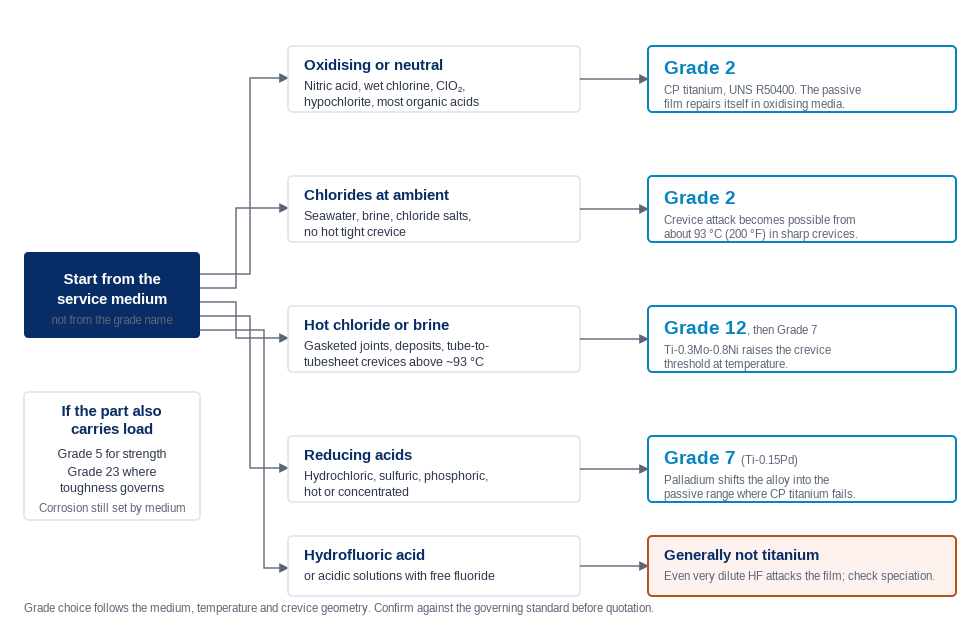
Titanium resists corrosion because it forms a thin, stable, self-healing oxide film. That film is excellent in seawater, chlorides and oxidising media, and the main limit is strong reducing acids, where palladium-bearing grades such as Grade 7 are used instead, within concentration and temperature limits checked against the stream. The right grade depends on the service medium, the temperature and whether crevice corrosion is a risk. This guide maps the common environments to the grade that suits them and what to specify.
How titanium resists corrosion
The passive oxide film reforms instantly if it is scratched, as long as oxygen or water is present. This is why commercially pure titanium performs so well in seawater and oxidising acids. In hot, oxygen-starved reducing acids the film is harder to maintain, so the palladium grade (Grade 7) is used to keep the surface passive, within concentration and temperature limits that have to be checked against the stream. Grade 12, with molybdenum and nickel, is chosen for crevice resistance in hot, near-neutral brine, not as a reducing-acid grade.
Grade selection by service medium
| Service environment | Suited grade | Why |
|---|---|---|
| Seawater, brine, coastal and marine | Grade 2 (Grade 12 for hot brine) | Passive and pitting-resistant in chlorides |
| Oxidising acids and wet chlorine | Grade 2 | Stable oxide film in oxidising media |
| Reducing acids (HCl, H2SO4, phosphoric), and crevices that run acidic | Grade 7 | Palladium raises passivity and resists crevice attack; check concentration and temperature limits against the stream |
| Hot chlorides, brine and sour service | Grade 12 | Crevice and hot-brine resistance at intermediate strength |
| Strength plus corrosion (pumps, shafts, valves, fasteners) | Grade 5, Grade 23 | High strength with good general corrosion resistance |
Choosing a grade for this service? Open the matching product page, or send the medium, temperature, grade and form in one RFQ:
Common applications
Grade 2 is the workhorse for chemical process heat exchangers, reactors, columns and piping, for the evaporators and condensers of MSF and MED desalination plants, and for seawater piping and offshore service. Grade 7 is specified where the process runs reducing acids. Where hot brine or chloride conditions would risk crevice corrosion on commercially pure titanium, Grade 12 comes first, with Grade 7 when conditions are at the limit or reducing-acid contamination is possible. Grade 5 and Grade 23 are used where the part must carry load as well as resist corrosion, such as pump and valve components.
| Grade | Where the guide says it is used |
|---|---|
| Grade 2 | Chemical process heat exchangers, reactors, columns and piping; the evaporators and condensers of MSF and MED desalination plants; seawater piping and offshore service |
| Grade 7 | Where the process runs reducing acids; in hot-brine crevice service when conditions are at the limit or reducing-acid contamination is possible |
| Grade 12 | Where hot brine or chloride conditions would risk crevice corrosion on commercially pure titanium; not a reducing-acid grade |
| Grade 5 and Grade 23 | Where the part must carry load as well as resist corrosion, such as pump and valve components |
For tanks, piping, valves and nozzles in a dosing or filling line, see how those grade choices are applied to titanium wetted parts in liquid filling equipment.
Forms and how to specify
| Product form | Standard to cite |
|---|---|
| Sheet and plate | ASTM B265 |
| Tube | ASTM B338 |
| Bar | ASTM B348 |
| Forgings | ASTM B381 |
The same grade is supplied across product forms, so the corrosion choice and the form are specified together. State the grade, the standard (ASTM B265 for sheet and plate, B338 for tube, B348 for bar, B381 for forgings), the form and dimensions, the medium and temperature, and the certificate scope. Material is supplied with mill test certificates and EN 10204 3.1 by order scope.
| Field to state | What to give |
|---|---|
| Grade | The grade the corrosion duty calls for |
| Standard | The product standard for the ordered form |
| Form and dimensions | The form and its dimensions |
| Medium and temperature | The service medium and the operating temperature |
| Certificate scope | Material is supplied with mill test certificates and EN 10204 3.1 by order scope |
See how the grades compare overall in the titanium grades comparison guide, then choose a form: titanium bar, titanium sheet and plate, or titanium tube and pipe. For a broader material comparison, read the titanium vs stainless steel guide. Send the medium and requirements to [email protected] for a grade recommendation and quotation.
Turning a corrosion decision into order lines
A grade chosen on corrosion grounds still has to be bought, and the fields that decide whether the delivered material matches the decision are not corrosion fields. Three of them are where enquiries most often stop short.
| Order field | Why the corrosion decision depends on it |
|---|---|
| Grade with its UNS number | Grade numbers repeat across specifications, and the UNS number is what fixes the composition table |
| Service medium, concentration and temperature | A grade is selected against all three, so quoting one of them is not a selection basis |
| Governing specification | Sets which limits the certificate reports against for the form being bought |
| Product form with dimensions and tolerance | The same grade behaves as a different purchase as bar, plate, tube or wire |
| Delivery condition and surface | Two separate fields, and the surface is what meets the medium |
| Reports required | Decides whether the certificate answers what incoming inspection will ask |
Surface condition, marking, packing, the reports required and the disposition of rejected material are all items an order is expected to carry in the bar and billet specification ASTM B348 (ASTM B348, ordering information). A grade choice made carefully and then written onto an order as a grade number alone leaves every one of them to a default.
Specification detail with sources
For unalloyed titanium in sharp crevices in near-neutral saturated sodium chloride brine, TIMET’s Corrosion Resistance of Titanium reports that attack becomes possible at about 93 °C (200 °F) and above, while it is not likely below 70 °C (158 °F); lower pH or high concentrations of calcium or magnesium ions can lower the onset temperature. That window is why gasket faces and tube to tubesheet joints in hot brine service get the closest review.
Where service falls inside that risk window, the crevice-resistant grades change the picture: Grade 7 (UNS R52400) adds 0.12 to 0.25 wt% palladium per the chemical requirements of ASTM B265, and Grade 12 (UNS R53400) uses 0.2 to 0.4 wt% molybdenum with 0.6 to 0.9 wt% nickel to raise crevice corrosion resistance at lower alloy cost than Grade 7.
Once the grade is chosen, supplier-side comparisons by product family are collected in the titanium supplier lists index.
Reference sources
- TIMET, Corrosion Resistance of Titanium (technical manual)
- ASTM B265 / B338 / B348 / B381, titanium product specifications
- ASTM G48, Standard Test Methods for Pitting and Crevice Corrosion Resistance
- NACE / AMPP corrosion literature on titanium in chloride and reducing acid service
- ASM Handbook, Volume 13B, Corrosion: Materials