
Filling and dosing lines are built in 316L stainless steel because it suits most food, beverage and personal-care products. The material question only becomes interesting at the edges: bleach and hypochlorite, chloride brines, acidic cleaners, and warm process liquids that sit in a machine over a weekend. In those services a handful of wetted components move to titanium while the rest of the machine stays stainless. This page covers which components, which grade, and what the purchase order has to say.
Which parts are actually wetted
The decision is scoped by the wetted circuit, not by the machine. On a typical liquid filler the product touches a supply tank or hopper, product piping and hoses, a pump or piston and its cylinder, valve bodies and seats, the filling nozzles, level or flow sensors, and the seals at every joint. Everything else is frame, drive and guarding, and stays in ordinary construction materials.
| Wetted item | What the guide states |
|---|---|
| Supply tank or hopper | The product touches it |
| Product piping and hoses | The product touches them |
| Pump or piston | The product touches it |
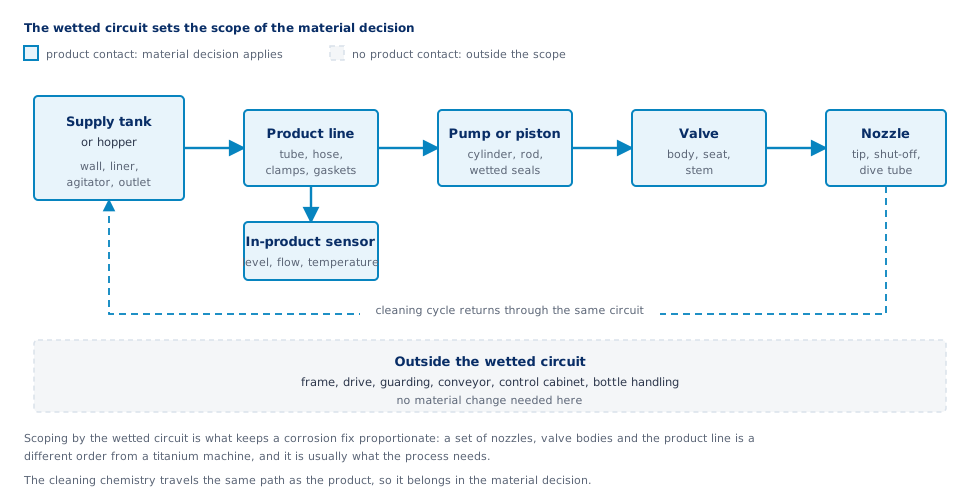
Scoping matters commercially. A tank liner, a set of nozzles and the valve bodies is a very different order from a titanium machine, and the second one is rarely what the process needs.
Where 316L stops
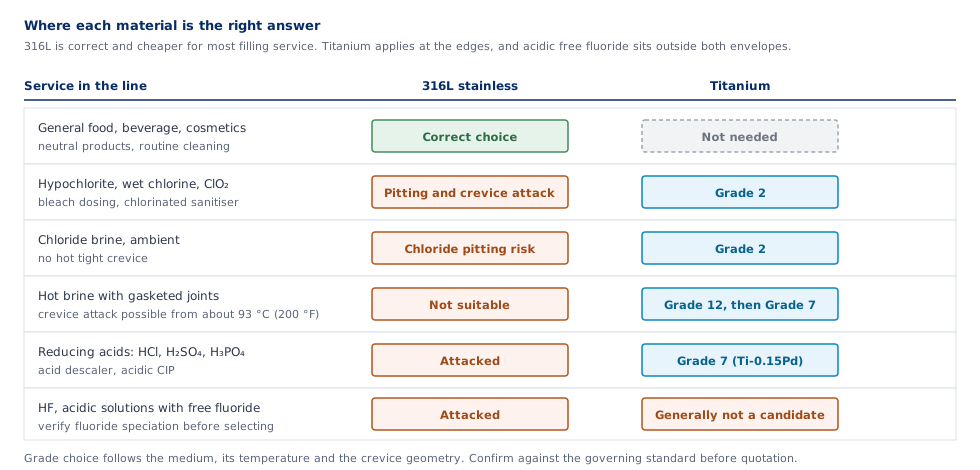
Austenitic stainless steel relies on a chromium oxide film that chloride ions penetrate locally. That is why 316L can look untouched in a strong organic acid and then pit in a mild chloride solution. Three service conditions push a filling line past it.
Hypochlorite and wet chlorine. Bleach, sodium hypochlorite dosing and chlorinated cleaners attack stainless by pitting and crevice attack, and the damage concentrates exactly where a filler is most sensitive: nozzle tips, valve seats and the shadow under a gasket. Titanium behaves the other way round, because its oxide film is stable in oxidising chloride chemistry.
Chloride brines and salted products. Concentration and temperature both matter, and so does geometry. A gasketed joint or a deposit under a clamp creates the oxygen-starved crevice where attack starts.
Acidic cleaning chemistry. Many lines see a cleaning cycle more aggressive than the product. Descalers and acid CIP cycles can decide the material even when the filled product is benign.
Which titanium grade
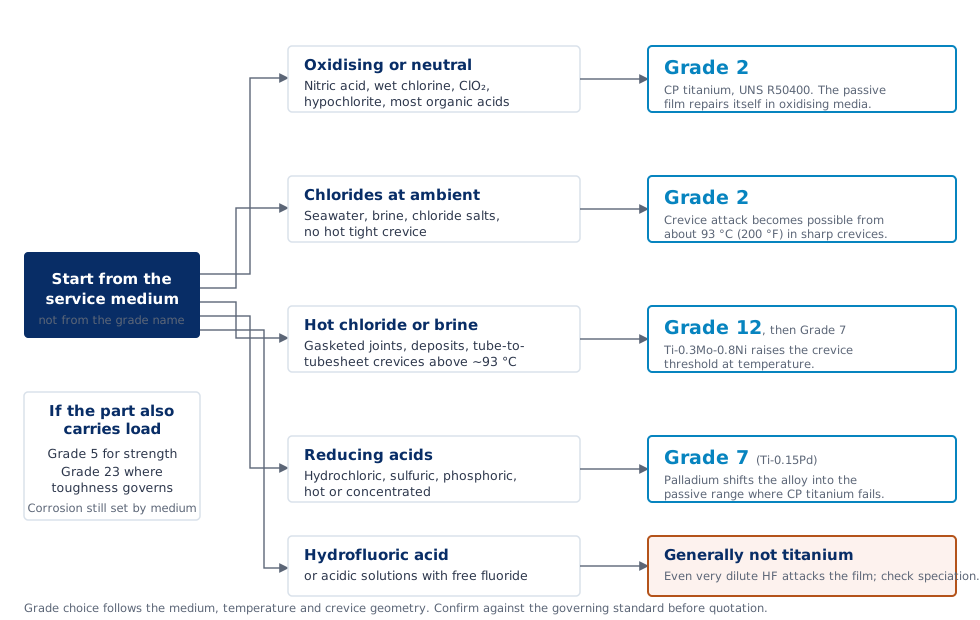
Grade selection follows the medium, its temperature, and whether the geometry creates a tight crevice. It does not follow the grade name.
| Service in the filling line | Starting grade | Why |
|---|---|---|
| Hypochlorite, wet chlorine, chlorine dioxide | Grade 2 (UNS R50400) | The passive film is stable in oxidising chloride chemistry |
| Neutral chloride brine at ambient temperature | Grade 2 | Sufficient where no hot tight crevice exists |
| Hot brine, gasketed joints, deposits under clamps | Grade 12 (UNS R53400), then Grade 7 | Molybdenum and nickel raise the crevice threshold at temperature |
| Reducing acids: hydrochloric, sulfuric, phosphoric | Grade 7 (UNS R52400) | Palladium holds the alloy in the passive range where CP titanium does not |
| Hydrofluoric acid or acidic solutions containing free fluoride | Generally not titanium | Even very dilute HF can rapidly attack the passive film; verify fluoride speciation and any proven inhibitor effect |
Crevice corrosion is the threshold that most often decides between Grade 2 and Grade 12 on a filling line, because a machine is full of gasketed joints. TIMET’s Corrosion Resistance of Titanium reports that, in sharp crevices in near-neutral saturated sodium chloride brine, crevice attack on unalloyed titanium becomes possible at about 93 °C (200 °F) and above, while it is not likely below 70 °C (158 °F); lower pH or high concentrations of calcium or magnesium ions can lower the onset temperature. Our titanium corrosion resistance grade guide works through the media in more detail.
Mixing titanium and stainless in one circuit
Most retrofits leave stainless in the circuit and change only the parts that fail. That creates a galvanic couple, and the direction matters: titanium is the more noble of the two, so in a conductive electrolyte it is the stainless steel that carries the increased attack, not the titanium.
The area ratio decides how bad this gets. A small stainless part connected to a large titanium surface is the worst arrangement, because the whole titanium area drives current onto a small anode. A stainless clamp on a titanium product line is a real example. Where the couple cannot be avoided, isolate at the joint, keep the exposed stainless area generous relative to the titanium, or convert the neighbouring parts as well.
Forms and standards you will order against
Wetted parts on a filling line come from four product forms, each with its own specification.
| Wetted part |
|---|
| Tank walls, liners and cut plate to ASTM B265, stating thickness, width, length, surface condition and flatness. |
| Product piping and dosing lines to ASTM B338 for tube, or ASTM B861 and B862 for seamless and welded pipe, stating outside diameter, wall thickness, length and tolerance. |
| Machined valve bodies, seats and nozzles from bar to ASTM B348, stating diameter, condition, tolerance and machining allowance. |
| Flanges and fittings to the project standard, with the dimensional standard stated separately from the material standard. |
Two documentation points cause most of the disputes. State the certificate type: EN 10204 3.1 with heat-number traceability is the normal requirement for process equipment, and it has to be on the order rather than requested afterwards. And state the grade with its standard rather than the grade alone, because acceptance values differ between specifications for the same grade.
Who builds the machine, and who supplies the metal
These are two different conversations, and running them together is what slows projects down. The equipment builder owns the filling principle, the dosing accuracy, the cleaning design and the acceptance test. A specialist such as a liquid filling machine manufacturer is the right party to define which components sit in the product path, what the cleaning cycle will be, and how a complete liquid filling line is integrated end to end. That specification is the input to the material decision, not the output of it.
Beiyu Titanium works on the material side only. We supply titanium bar, plate, tube and forgings to ASTM specifications with EN 10204 3.1 mill test certificates and heat-number traceability by order scope, and we do not build filling equipment or compete with equipment manufacturers and fabricators.
What to send for a quotation
A material enquiry for filling-line parts can be quoted in one pass when it carries the following.
| Field to state |
|---|
| The product and the cleaning chemistry, with concentration and temperature, not only the product name |
| Whether the part sits in a gasketed joint, under a clamp, or anywhere a deposit can form |
| Product form, grade and the governing standard, for example ASTM B348 Grade 7 bar |
| Dimensions with tolerance, condition and surface requirement |
| Quantity, and the drawing where the part is machined |
| Certificate and inspection scope, for example EN 10204 3.1 with heat-number traceability |
Where the grade is still open, send the medium, the temperature and the geometry and it can be reviewed against the corrosion data before the enquiry is priced. Send requirements to [email protected].
Frequently asked questions
Does a bleach filling line need a titanium machine? No. The usual answer is a stainless machine with titanium in selected wetted parts: nozzles, valve bodies, the product line and, where the exposure is long, the tank surface. Scope it by the wetted circuit.
Is titanium approved for food contact? Food-contact compliance is a regulatory question answered by the equipment builder and the applicable regional rules, not by the material specification. What the mill certificate proves is grade, chemistry, mechanical properties and heat traceability.
Can titanium and 316L be welded together? Not by fusion welding. Titanium and iron form brittle intermetallic compounds at the fusion zone, so such a joint does not survive service. Mixed circuits are joined mechanically with isolation at the connection, or through a transition joint designed and qualified by a specialist fabricator, which is also where the galvanic couple and the area ratio are handled.
Which grade is the default? Grade 2 for oxidising and neutral chloride service, Grade 12 when hot brine and crevices are involved, Grade 7 when the chemistry is a reducing acid. Confirm against the governing standard before quotation.
What a wetted part order has to fix beyond the grade
On filling and process equipment the material contact surface is the product. The grade decides the corrosion behaviour, but the surface condition, the examination and the document scope decide whether the delivered part can be put into service without rework.
| Field | What it controls on a wetted part | Where it belongs |
|---|---|---|
| Surface condition | Cleanability and the starting point for any finishing operation | Stated apart from the delivery condition |
| Delivery condition | The metallurgical state as delivered | Its own line on the order |
| Examination scope | What is inspected, at what coverage, to which acceptance class | Named on the purchase order |
| Certificate scope | What arrives with the metal | Set by the order, so the order should state it |
What is checked, and at what coverage
| Check | Coverage on the precision ground bar route | What it settles |
|---|---|---|
| Ultrasonic flaw detection | 100 percent of the lot | Internal discontinuities against the acceptance class named on the order |
| Eddy current | 100 percent of the lot | Surface and near surface discontinuities |
| Optical surface inspection | 100 percent of the lot | Visible surface condition along the full length |
| Infrared laser diameter measurement | 100 percent of the lot | Diameter through the length, not a spot check at the ends |
| Straightness | 100 percent of the lot | Bow against the published value over a stated gauge length |
These are the checks carried on the quoted precision route, reviewed against as a production capability rather than offered as a stock statement. An enquiry that names the acceptance class alongside the examination can be priced without a clarification round.
Specification detail with sources
Grade selection for titanium wetted parts is anchored in the ASTM chemistry tables rather than in trade names. ASTM B265 and B348 hold Grade 7 at 0.12 to 0.25 percent palladium and Grade 12 at 0.2 to 0.4 percent molybdenum with 0.6 to 0.9 percent nickel, the fraction-of-a-percent additions behind the crevice and reducing-acid positions in the table above. For the bar that becomes machined nozzles and valve seats, ASTM B348 sets Grade 2 minimums at 345 MPa tensile and 275 MPa yield strength, values reported per heat on the mill certificate a fabricator files with the weld records.
| Grade | Addition per ASTM B265 and B348 |
|---|---|
| Grade 7 | 0.12 to 0.25 percent palladium |
Beiyu Titanium supplies the wetted-part forms this page scopes from one enquiry: bar for machined components from 1 to 500 mm diameter against ASTM B348, and seamless tube for product and dosing lines from 5 to 325 mm outside diameter with 0.5 to 12 mm walls against ASTM B338, each available in Grade 2, Grade 7 and Grade 12. In Beiyu’s supply practice the material lines of a filling-line enquiry are reviewed by grade, standard, dimensions, tolerance, surface condition and inspection scope before quotation, so the metal conversation stays separate from the machine conversation, as this page recommends.