
In chemical processing, the grade is decided by whether the medium is oxidizing or reducing. Grade 2 (UNS R50400) handles oxidizing acids, wet chlorine, chlorides and most organic acids very well. For reducing acids such as hydrochloric and dilute sulfuric, especially hot, move to Grade 7 (UNS R52400), whose palladium keeps titanium passive where Grade 2 corrodes. For hot concentrated chloride and brine with crevices, Grade 12 (UNS R53400) is the cost-balanced choice. One hard rule: titanium is not used with hydrofluoric acid, which attacks it even when dilute.
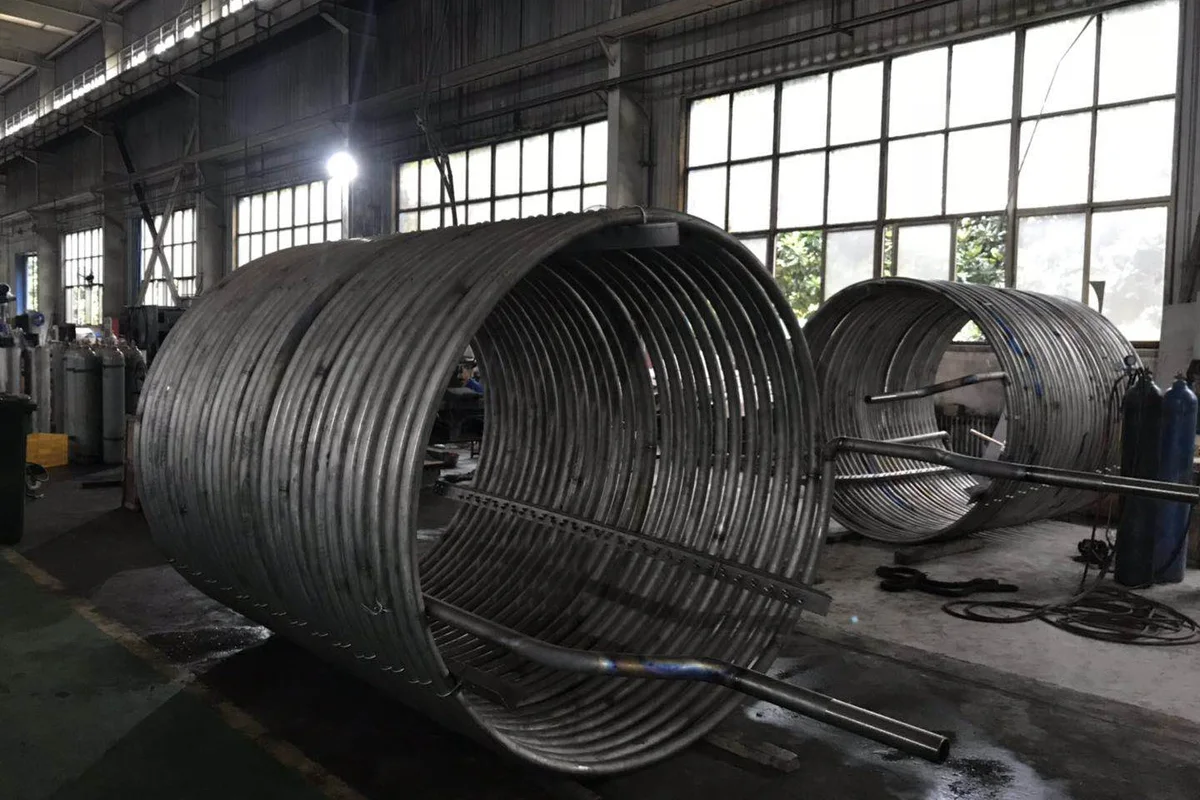
Beiyu Titanium supplies Grade 2, Grade 7 and Grade 12 to ASTM B265, B338 and B348 according to the ordered product form. State any required EN 10204 3.1 document and reporting scope in the RFQ.
Getting this choice wrong costs you in both directions. Under-specify, and the equipment corrodes through in service, where the cost of the failure and the downtime dwarf the cost of the metal. Over-specify, and you pay for palladium-bearing Grade 7 on a duty that plain Grade 2 would have handled for far less. The aim of this guide is to put you on the right grade for your actual stream, so you neither fail in service nor overpay at purchase.
The single idea that controls the whole decision: oxidizing versus reducing
Titanium protects itself with a passive titanium-dioxide film. That film is built and maintained by oxygen or other oxidizing species in the environment. This leads to the rule that governs every chemical-service grade choice:
- In oxidizing or neutral media (nitric acid, wet chlorine, chlorine dioxide, hypochlorite, chloride salts, seawater, most organic acids), the film stays intact and commercially pure titanium performs extremely well.
- In reducing media (hydrochloric acid, hot or concentrated sulfuric acid, phosphoric acid, oxygen-starved crevices), the film is not reliably maintained, and commercially pure titanium can corrode.
So the first question for any chemical duty is not “how strong is the acid” but “is the environment oxidizing or reducing.” That answer points you to a grade.
What Grade 2 handles, and where it stops
Grade 2 commercially pure titanium is the default for chemical equipment because of how much it handles:
| Service |
|---|
| Nitric acid across most concentrations and temperatures (titanium is a classic material for nitric service). |
| Wet chlorine, chlorine dioxide and hypochlorite, which is why titanium dominates chlor-alkali and bleaching equipment. |
| Chloride salts, brines and seawater at ambient and moderate temperature. |
| Most organic acids (acetic, formic, citric and similar) under typical conditions. |
Grade 2 reaches its limit in:
| What the guide states |
|---|
| Hydrochloric acid above dilute and cool conditions. |
| Sulfuric acid once it is hot or concentrated. |
| Phosphoric acid when hot. |
| Hot, tight, oxygen-starved crevices in chloride service, where crevice corrosion can start as metal temperature climbs above roughly 70 to 80 C. |
ASTM minimums for Grade 2 are 345 MPa tensile and 275 MPa yield, confirmed on the EN 10204 3.1 mill test certificate per heat.
Grade 7: the reducing-acid grade
Grade 7 is commercially pure titanium with a small palladium addition (about 0.12 to 0.25 percent). Mechanically it is identical to Grade 2 (345 MPa tensile, 275 MPa yield minimum), so it is specified purely for corrosion. The palladium provides a cathodic effect that keeps titanium in its passive region under reducing conditions, which is exactly where Grade 2 fails.
In practice this extends usable titanium into:
| What the guide states |
|---|
| Dilute to moderate hydrochloric acid at temperatures where Grade 2 would corrode. |
| Reducing or contaminated sulfuric and phosphoric acid service. |
| Hot brine and concentrated chloride with crevices, where Grade 7 raises the crevice-corrosion onset temperature well above Grade 2. |
Grade 7 is the most expensive of the corrosion grades because of the palladium, so it is reserved for the duties that genuinely need it rather than used everywhere.
Grade 12: hot chloride at a lower cost
Grade 12 is a lean titanium alloy with about 0.3 percent molybdenum and 0.8 percent nickel. ASTM minimums are 483 MPa tensile and 345 MPa yield, so it is both stronger than Grade 2 and more resistant to crevice corrosion in hot chloride and brine. It does not match Grade 7 in strongly reducing acids, but for hot chloride process streams, brine handling and desalination duty it gives much of the crevice resistance at a lower cost than the palladium grade. For many hot-chloride heat exchangers and evaporators, Grade 12 is the practical middle choice between Grade 2 and Grade 7.
When strength also matters: Grade 5 and Grade 23
When a chemical-service part must carry mechanical load, such as pump and valve internals, shafts, fasteners and agitator components, the alloy grades come in. Grade 5 (Ti-6Al-4V, UNS R56400) gives 895 MPa tensile and 828 MPa yield minimum with good general corrosion resistance, though it is not as crevice-tolerant in hot chloride as Grade 7 or Grade 12. Grade 23 (Ti-6Al-4V ELI, UNS R56407 under the ASTM B series; R56401 under ASTM F136) is the high-toughness, low-interstitial version used where fracture toughness or fatigue matters. Both are chosen for strength first, with corrosion handled by the design rather than by the grade alone.
Iso-corrosion data: how far each grade carries you in HCl
Selection is not just “reducing acid means Grade 7.” Published iso-corrosion data, the concentration at which the corrosion rate stays below about 0.13 mm per year (5 mils per year) at room temperature, shows how far each grade goes in hydrochloric acid:
| Point | What the guide states |
|---|---|
| Grade 2 (commercially pure) | resistant to roughly 7 percent HCl at room temperature. |
| Grade 12 | roughly 9 percent HCl at room temperature. |
| Grade 7 (palladium) | roughly 27 percent HCl at room temperature. |
Corrosion rates climb steeply with both temperature and concentration, so these room-temperature limits fall as the acid heats up. Treat the figures as a starting reference, then confirm against an iso-corrosion chart for your actual temperature and concentration, and against your own corrosion coupon testing for critical service.
The palladium family: Grade 7, 11, 16 and 17
Grade 7 is not the only palladium grade, and knowing the family lets you balance cost against strength instead of defaulting to the most expensive option:
| Point | What the guide states |
|---|---|
| Grade 7 (UNS R52400) | Grade 2 base plus 0.12 to 0.25 percent palladium. |
| Grade 11 (UNS R52250) | Grade 1 base plus the same palladium range, for duties where formability matters more than strength. |
| Grade 16 (UNS R52402) | Grade 2 base with a leaner 0.04 to 0.08 percent palladium, which keeps most of the reducing-acid resistance at a lower palladium cost. |
| Grade 17 (UNS R52252) | the Grade 1 base version of the lean-palladium approach. |
For many reducing-acid duties, lean-palladium Grade 16 delivers most of Grade 7’s benefit at lower cost, so it is worth quoting against full Grade 7 rather than assuming Grade 7 is the only option.
The hard limit: hydrofluoric acid
Titanium is attacked by hydrofluoric acid, and by fluoride ions in acidic solution, even at low concentration. No titanium grade solves this. If a process stream contains HF or acidic fluorides, titanium is the wrong material and a different alloy must be used. This is the one exception worth stating plainly, because it is the most common way titanium equipment is specified into a service it cannot survive.
Media-to-grade quick reference
| Medium | Character | Starting grade |
|---|---|---|
| Nitric acid | Oxidizing | Grade 2 |
| Wet chlorine, ClO2, hypochlorite | Oxidizing | Grade 2 |
| Chloride salts, brine, seawater (ambient) | Neutral chloride | Grade 2 |
| Hydrochloric acid (dilute, hot) | Reducing | Grade 7 |
| Sulfuric acid (hot or concentrated) | Reducing | Grade 7 |
| Hot concentrated chloride or brine, crevices | Reducing crevice | Grade 12, then Grade 7 |
| Organic acids | Mostly oxidizing or mild | Grade 2 |
| Hydrofluoric acid or acidic fluorides | Attacks titanium | Not titanium |
Use this as a starting point, then confirm against the actual concentration, temperature and contaminant profile of the stream before specifying. Where the grade decision lands on process equipment rather than raw material, the titanium shell and tube heat exchanger is quoted from the same service data.
Comparison table
| Grade | UNS | ASTM min tensile / yield | Best for | Weak in |
|---|---|---|---|---|
| Grade 2 | R50400 | 345 / 275 MPa | Oxidizing acids, wet chlorine, chlorides, organics | Hot reducing acids, hot crevices |
| Grade 7 | R52400 | 345 / 275 MPa | Reducing acids (HCl, H2SO4), hot crevices | Cost; not needed for oxidizing media |
| Grade 12 | R53400 | 483 / 345 MPa | Hot chloride and brine, crevices | Strong reducing acids |
| Grade 5 | R56400 | 895 / 828 MPa | Load-bearing parts | Hot-chloride crevice corrosion |
| Grade 23 | R56401 | 828 / 759 MPa | Load-bearing, high toughness | Hot-chloride crevice corrosion |
Mechanical values are ASTM minimums and are confirmed on the EN 10204 3.1 mill test certificate for each heat. All titanium grades fail in hydrofluoric acid.
Forms and standards for chemical equipment
| Field to state |
|---|
| Sheet and plate to ASTM B265 for reactors, columns, tanks, vessel linings and tubesheets. |
| Tube to ASTM B338 for heat exchangers and condensers, with process piping ordered to ASTM B861 (seamless) or B862 (welded). |
| Bar to ASTM B348 for machined valve, pump and fitting parts. |
| For pressure equipment the project may reference the ASME adoption, for example ASME SB-265 for plate. State it on the RFQ if the drawing calls it out. |
Procurement checklist for chemical-service titanium
When you send a chemical-service titanium RFQ, state:
- The exact medium, concentration and temperature, including any contaminants such as fluorides, oxidizers or reducing agents.
- Whether the environment is oxidizing or reducing, and whether crevices are present.
- Grade and UNS number, and the controlling standard.
- Form and dimensions: thickness for plate, OD and wall for tube, diameter for bar.
- Inspection and document scope: EN 10204 3.1 mill test certificate, plus any UT, eddy-current or hydrostatic test for tube.
Sharing the real stream chemistry lets the grade be confirmed before quotation, which is far cheaper than discovering a wrong-grade selection after a failure.
How Beiyu Titanium supplies chemical-service grades
Beiyu Titanium supplies Grade 2, Grade 7 and Grade 12 titanium for chemical processing as sheet and plate to ASTM B265, tube to ASTM B338, with process piping to ASTM B861 or B862, and bar to ASTM B348. For chemical-service material, state the required EN 10204 3.1 document, chemistry, mechanical results and heat or lot traceability in the RFQ so the available document scope can be confirmed before order release. Send the medium, concentration, temperature and form, and the correct grade can be confirmed before quotation.
Related guides and tools
- Titanium grade for seawater and marine service
- Medical-grade titanium (ASTM F136, Grade 23 ELI)
- Titanium grade selector tool
Specification detail with sources
ASTM B265 and its tube and bar companion standards list a tier of chemical-service grades most selection charts omit: the H variants. Grade 2H and Grade 7H keep the base grade’s chemistry and its 275 MPa minimum yield strength but raise the minimum tensile floor from 345 MPa (50 ksi) to 400 MPa (58 ksi), a designation created so pressure-equipment designers working under the ASME code can take higher allowable stress from the same metal. Where a titanium reactor or column shell is thickness-limited by stress rather than by corrosion, quoting Grade 2H against Grade 2 adds 55 MPa of specified tensile floor with 0 change in palladium content or corrosion behaviour.
Beiyu Titanium quotes all 4 palladium grades on this page’s ladder, Grades 7, 11, 16 and 17, across the three product forms chemical plants buy: plate from 0.5 to 70 mm thick, seamless tube from 5 to 325 mm outside diameter, and bar from 1 to 500 mm diameter. That coverage lets a lean-palladium Grade 16 alternative be priced next to full Grade 7 on the same quotation, in the same form and size, which is how Beiyu presents the cost decision this page describes.
For oxidising acid duty specifically, the published corrosion rates by concentration and temperature are in titanium in nitric acid.