
Ti-6Al-4V machines badly for three physical reasons. Thermal conductivity is about 6.7 W/m·K, roughly one seventh of carbon steel, so cutting heat stays at the edge instead of leaving in the chip. The metal is chemically reactive at those edge temperatures, and the cut surface work hardens.
Ask any shop that has run titanium for the first time and you’ll hear the same three complaints: the tool died fast, the chips welded to the insert, and the part skin got harder the more they cut it. None of that is bad luck. Ti-6Al-4V fails in machining for reasons that are baked into the metal’s physics, and once you see them the fix is mostly about not fighting them.
Three properties cause almost every problem
1. It barely conducts heat
Ti-6Al-4V has a thermal conductivity around 6.7 W/m·K, roughly one-seventh of carbon steel and well below even 304 stainless. In steel, a useful share of the cutting heat leaves in the chip. In titanium it doesn’t; the heat stacks up in a tiny zone right at the cutting edge. Edge temperatures climb fast, and that single fact drives the next two problems.
| Property | What the guide states |
|---|---|
| Thermal conductivity of Ti-6Al-4V | Around 6.7 W/m·K, roughly one seventh of carbon steel and well below even 304 stainless |
2. It chemically welds to your tool
Above roughly 500 °C titanium becomes chemically reactive and has a strong affinity for the elements in most cutting tools. The hot chip effectively micro-welds to the rake face, tears away, and takes tool material with it. That is the galling, built-up edge and cratering you see, not abrasion so much as adhesion and pull-out. It’s why a sharp edge that’s run too hot can disintegrate in minutes.
3. It’s springy, so it work-hardens
The elastic modulus of Ti-6Al-4V is about 114 GPa, a bit over half that of steel. The workpiece deflects away from the tool, then springs back under and behind the edge. If the tool is dull or rubbing instead of cutting, that rub plastically smears the surface and leaves a hardened skin. The next pass meets harder metal, and the spiral begins. Most “titanium is impossible” stories are really a dull-tool, rubbing, work-hardening loop.
What actually works
| Machining control | What the guide states |
|---|---|
| Run low surface speed, healthy feed | Surface speed makes edge heat; feed gets the edge under the previous pass’s hardened layer. The classic titanium combination is conservative SFM with a real chip load, not the other way round. |
| Use sharp coated carbide | AlTiN / TiAlN-coated carbide resists the heat and the adhesion. Keep edges sharp and change them on a schedule, before they start rubbing. |
| Flood it, ideally at high pressure | Coolant here is for heat evacuation and chip clearing as much as lubrication. High-pressure through-tool coolant lifts the chip off the rake face and breaks the adhesion cycle. |
| Never let the tool dwell | A stationary edge in contact is work-hardening the surface and cooking itself. Keep it moving, keep it cutting, retract fully on deep holes (peck drill with full chip clearance). |
| Be rigid | The low modulus punishes long overhangs and weak fixturing with chatter. Shorten tools, support the part, climb mill. |
The part you start with decides how it cuts
Tooling advice is everywhere; the material side gets ignored. Two bars both stamped “Grade 5” can machine very differently, and the certificate tells you why before you load the first one.
| Order field | What the guide states |
|---|---|
| Condition | Order bar in the annealed condition for machining unless you specifically need solution-treated-and-aged strength. Annealed Ti-6Al-4V cuts more predictably; ask for the hardness on the mill cert. |
| Oxygen content | Oxygen is an interstitial strengthener; higher oxygen means higher strength and a harder cut. A normal Grade 5 sits near 0.18% oxygen; that’s part of why ELI (Grade 23), with oxygen held ≤0.13%, often machines a touch kinder. The number is on the test report if you read it. |
| Straightness and surface | Scale, hard alpha case or a bent bar turns a continuous cut into an interrupted one, and interrupted cuts are where titanium edges chip. Specify the surface condition and tolerance you need. |
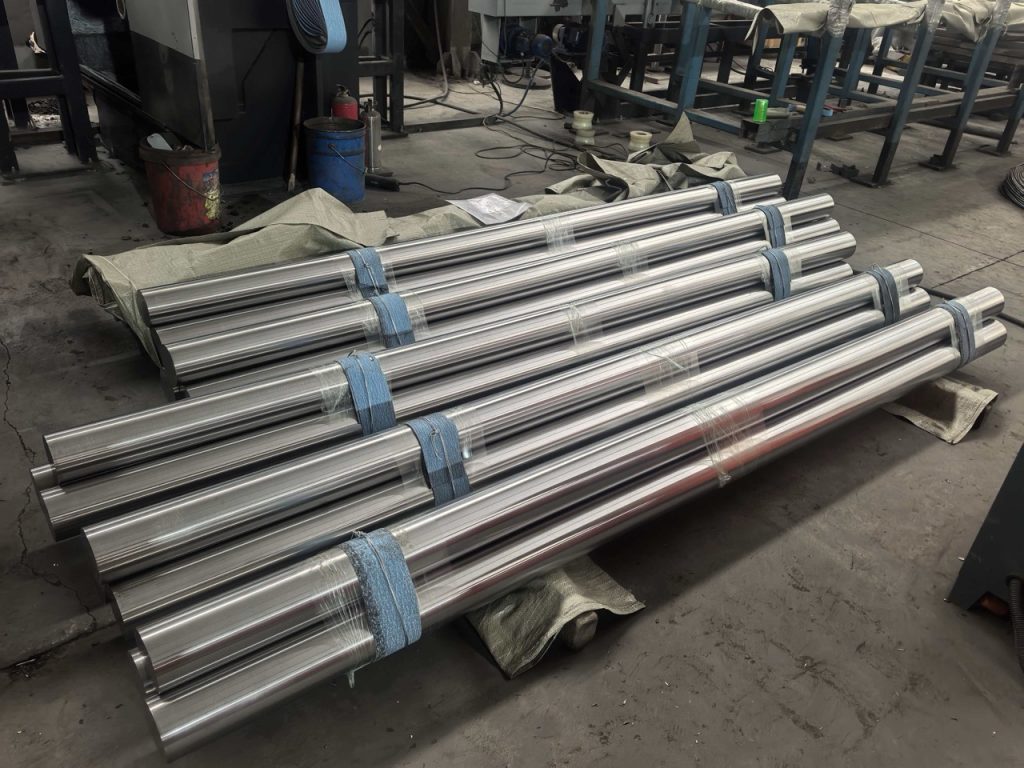
We supply Ti-6Al-4V (Grade 5) bar and AMS 4928 bar in the annealed condition with mill test certificates, so the shop knows the hardness, oxygen and heat number before the first chip, not after a scrapped part. For larger near-net stock, see Grade 5 forging block.
Because these traits make Ti-6Al-4V demanding to machine, buyers who order titanium bar to specification sometimes have it turned and milled into finished parts by a dedicated CNC machining partner such as Daxin CNC.
FAQ
Is titanium harder than steel to machine because it's harder?
No. Ti-6Al-4V isn’t especially hard. It’s difficult because it traps heat at the edge, chemically adheres to tooling, and work-hardens when rubbed. A hardness number alone doesn’t predict it.
Why do my chips catch fire / glow?
Fine titanium chips have a high surface area and the cutting zone runs hot. Keep chips coarse with adequate feed, clear them with coolant, and don’t let fines accumulate. It’s a real housekeeping hazard, not a myth.
Does Grade 2 machine like Grade 5?
No. Commercially pure Grade 2 is softer and gummier and has a different failure mode: it tends to smear and build up rather than chip hard. Grade 5 is stronger and more abrasive on tools. Match speeds and feeds to the grade.
Can you supply bar cut and conditioned for machining?
Yes. Specify grade, condition, tolerance and surface, plus the documents you need. Send an enquiry and we’ll quote against it.
Specification detail with sources
ASM Handbook machining data place the onset of titanium’s chemical adhesion to tool materials above roughly 500 degrees C, the edge-temperature regime this page describes. ASTM B348 caps oxygen for Grade 5 at 0.20 percent by weight against 0.13 percent for Grade 23, and because oxygen is the interstitial that hardens the cut, those two certificate lines predict machining behaviour before the bar is loaded. AMS 4928 fixes the bar it covers in the annealed condition at a 130 ksi minimum tensile strength, the condition this page recommends ordering for machining work.
Beiyu Titanium supplies Ti-6Al-4V machining stock as round bar from 1 to 500 mm diameter in lengths to 6000 mm, released in one of the three mill conditions coded R, M or Y, with the condition and the heat chemistry, oxygen included, stated on the EN 10204 3.1 mill test certificate supplied with the order. For tolerance-critical stock, Beiyu’s published machining capability holds ground medical bar to a ±0.0127 mm diameter tolerance at Ra 0.8 micron, and that straight, scale-free bar condition is Beiyu’s answer to the interrupted-cut and hardened-skin problems described above.
Send a technical RFQ
For Ti-6Al-4V bar machining RFQs, include grade, diameter, condition, surface finish, tolerance, quantity and machining allowance.