
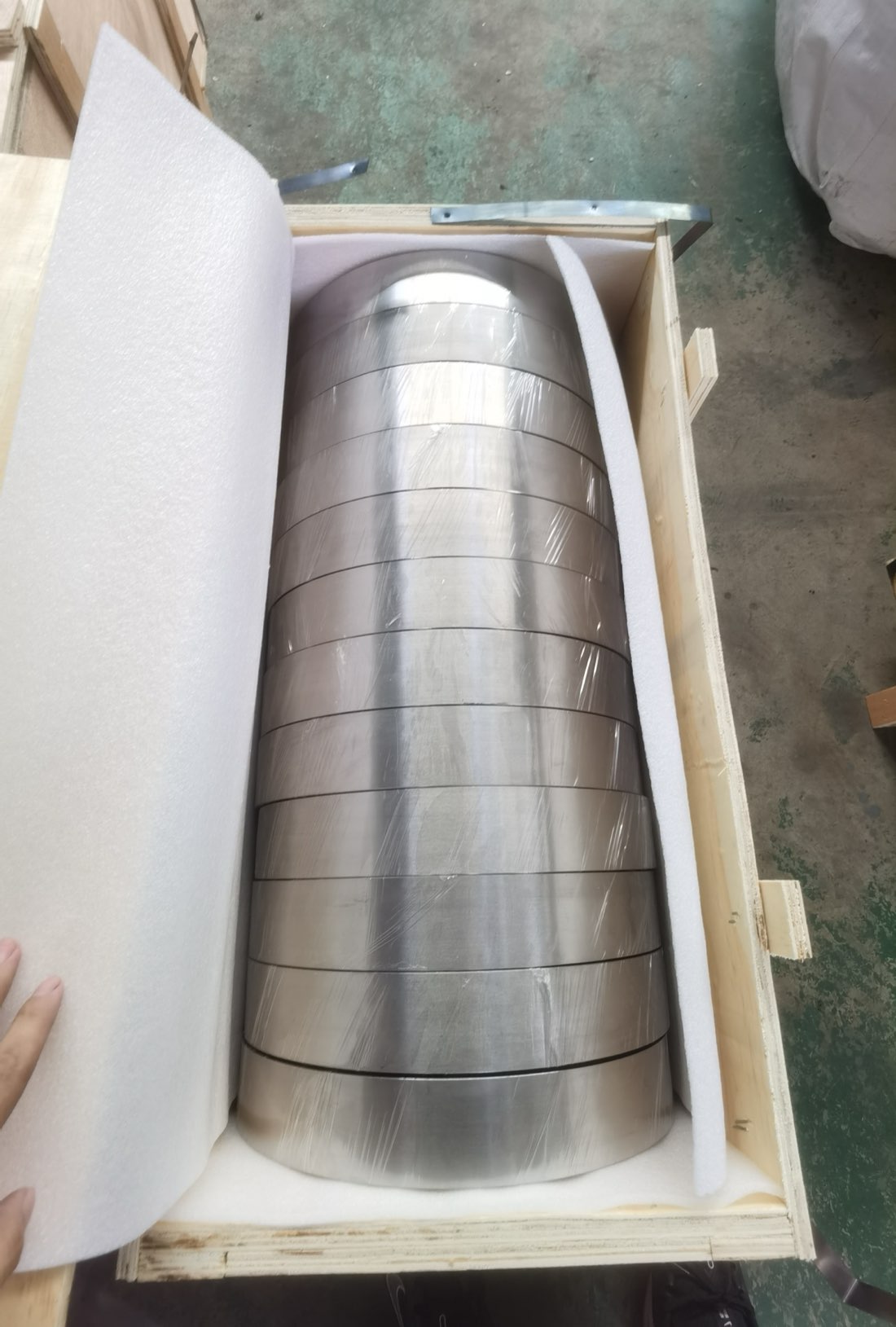
Choose a titanium forging grade by the part’s job. Grade 2 suits flanges, valve bodies and corrosion-equipment forgings; Grade 5 (Ti-6Al-4V) is the high-strength choice for forged discs, rings and blocks; Grade 7 and Grade 12 handle aggressive acids and hot brine; Grade 23 (ELI) is for fracture-critical and medical-related forgings. Forgings are made to a drawing, so the grade decision sits alongside the forged form, the test plan and the certificate package.
The forging-grade decision in one table
| Grade | Character | Best forging use | Product |
|---|---|---|---|
| Grade 2 | Commercially pure, weldable | Flanges, valve bodies, corrosion-equipment forgings | Titanium forgings |
| Grade 5 | Ti-6Al-4V, high strength-to-weight | Forged discs, rings and blocks for aerospace and high-load parts | Grade 5 forging block |
| Grade 7 | Pd-alloyed CP | Forgings for reducing acids and crevice service | Grade 7 forgings |
| Grade 12 | Ti-0.3Mo-0.8Ni | Hot-brine and chloride process forgings, valve bodies | Grade 12 forgings |
| Grade 23 | Ti-6Al-4V ELI | Fracture-critical and medical-related forgings | Grade 23 implant forgings |
Grade 2: corrosion-equipment forgings
Commercially pure Grade 2 is specified for flanges, valve bodies and corrosion-equipment forgings where weldability and seawater or acid resistance matter more than strength. It forges and welds readily and is the default for chemical and marine forged hardware.
| Grade | What the guide states |
|---|---|
| Grade 2 | Specified for flanges, valve bodies and corrosion-equipment forgings where weldability and seawater or acid resistance matter more than strength |
| Grade 5 (Ti-6Al-4V) | The workhorse for forged discs, rings and blocks that carry load, used across aerospace and high-load industrial parts |
| Grade 7 and Grade 12 | Where the forging serves reducing acids, crevice-prone joints or hot chloride brine |
| Grade 23 (ELI) | Grade 5 with extra-low interstitials for higher fracture toughness, specified for fracture-critical and medical-related forgings such as implant blanks |
Grade 5 (Ti-6Al-4V): the high-strength forging
Grade 5 is the workhorse for forged discs, rings and blocks that carry load, used across aerospace and high-load industrial parts. Forging stock is commonly supplied to ASTM B348 or AMS 4928 and then forged and tested to ASTM B381. For aerospace forgings, state AMS 4928 stock and the forged test plan. See the Grade 5 forging block.
Grade 7 and Grade 12: aggressive chemical and hot brine
When the forging serves reducing acids, crevice-prone joints or hot chloride brine, Grade 2 can be outpaced. Grade 7 adds palladium for the best resistance in reducing and crevice conditions; Grade 12 adds molybdenum and nickel for improved crevice resistance in hot brine, and is common for forged valve bodies. See Grade 12 ball-valve forgings.
Grade 23 (ELI): fracture-critical and medical forgings
Grade 23 is Grade 5 with extra-low interstitials for higher fracture toughness, specified for fracture-critical and medical-related forgings such as implant blanks, following ASTM F136. See hip-implant titanium forgings.
Forgings are made to a drawing
Because a forging is produced to a drawing, the RFQ controls more than the grade. State the forged form (disc, ring, block, sleeve, valve body or custom), the drawing with forged and finished dimensions, the machining allowance, the non-destructive testing scope and acceptance class, the location of mechanical test specimens, the heat-treat condition, and the certificate package. Forging stock route (ASTM B348 or AMS 4928) and the finished forging standard (ASTM B381) should both be stated.
| Field to state on a forging RFQ | Detail |
|---|---|
| Forged form | Disc, ring, block, sleeve, valve body or custom |
| Drawing | The drawing with dimensions |
| Grade and standard | The grade and its governing standard |
| Tests and documents | The required tests and document scope |
Frequently asked questions
Which titanium forging grade for aerospace discs and rings?
Grade 5 (Ti-6Al-4V), forged from AMS 4928 or ASTM B348 stock and tested to ASTM B381. Grade 23 (ELI) where fracture toughness is critical.
Which grade for forged flanges and valve bodies?
Grade 2 for corrosion service; Grade 12 for hot-brine and chloride valve bodies; Grade 7 for reducing acids.
What standard covers titanium forgings?
ASTM B381 covers titanium forgings. Forging stock is commonly ASTM B348 (bar and billet) or AMS 4928 (aerospace Ti-6Al-4V), then forged to B381.
What should a forging RFQ include?
Grade, the drawing with forged and finished dimensions, machining allowance, NDT scope, test specimen location, quantity and the certificate package.
Specification detail with sources
ASTM B381 renames each alloy with an F prefix and keeps its UNS: the Grade 2 forging is Grade F-2 at UNS R50400 and the Grade 5 forging is Grade F-5 at UNS R56400. For ELI material the number follows the chain on the order: Grade F-23 to ASTM B381 carries UNS R56407, while R56401 belongs to the ASTM F136 surgical-implant chain.
| ASTM B381 designation | UNS the guide gives |
|---|---|
| Grade F-2 | R50400 |
| Grade F-5 | R56400 |
Beiyu’s published forging envelope covers 4 shapes: forged round bar from 50 to 500 mm diameter in lengths up to 3000 mm, rings from 50 to 2000 mm outside diameter with bores of 10 to 900 mm and heights of 20 to 400 mm, discs from 50 to 2000 mm diameter at 20 to 500 mm thickness, and blocks from 50 to 600 mm. Beiyu quotes hot-forged, machine-finished product against ASTM B381 and 6 SAE AMS documents from its factory sheet, AMS 4928, AMS-T-9047, AMS 4981, AMS 4967, AMS 4965 and AMS 6931.
Request titanium forgings by grade
Send the grade, the drawing with forged and finished dimensions, machining allowance, NDT and inspection scope, and the certificate package. Beiyu confirms the forging route and test plan before quotation. Contact [email protected].
Related titanium guides
- ASTM B381 Titanium Forgings Guide
- Titanium Grades Compared: Grade 2 to 23
- Which Titanium Bar Grade to Order
- Which Titanium Plate Grade to Order
Standards and sources
Forgings follow ASTM B381 (titanium and titanium alloy forgings); forging stock follows ASTM B348 (bar and billet) or SAE AMS 4928 (aerospace Ti-6Al-4V); medical forgings follow ASTM F136 (Ti-6Al-4V ELI). Grade designations follow ASTM B381 / B348. Corrosion behaviour for the palladium and molybdenum-nickel grades reflects published titanium corrosion data. Confirm the current revision, NDT class and certificate package on the order, and the heat against its mill test certificate.
| Scope | Standard the guide names |
|---|---|
| Forgings | ASTM B381 |
| Forging stock | ASTM B348 (bar and billet) or SAE AMS 4928 (aerospace Ti-6Al-4V) |