
Nickel 200 (UNS N02200, W.Nr. 2.4060 and 2.4066) and Nickel 201 (UNS N02201, W.Nr. 2.4061 and 2.4068) are commercially pure wrought nickel, with at least 99.0 % nickel (plus cobalt, in Special Metals’ wording) in the Special Metals and ATI limits and 99.2 % in VDM’s. ATI states that the two grades differ only in the maximum carbon allowed: 0.15 % for Nickel 200 and 0.02 % for Nickel 201. That difference is what sets the producers’ service-temperature advice for each grade. Special Metals says Nickel 200 is normally limited to service below 315 °C (600 °F), because at higher temperatures it can suffer graphitization that severely compromises its properties, and prefers Nickel 201 above that temperature. Both are ferromagnetic. Special Metals cites their resistance to reducing chemicals and caustic alkalies, and their use where product purity matters, in handling foods, synthetic fibres and caustic alkalies.
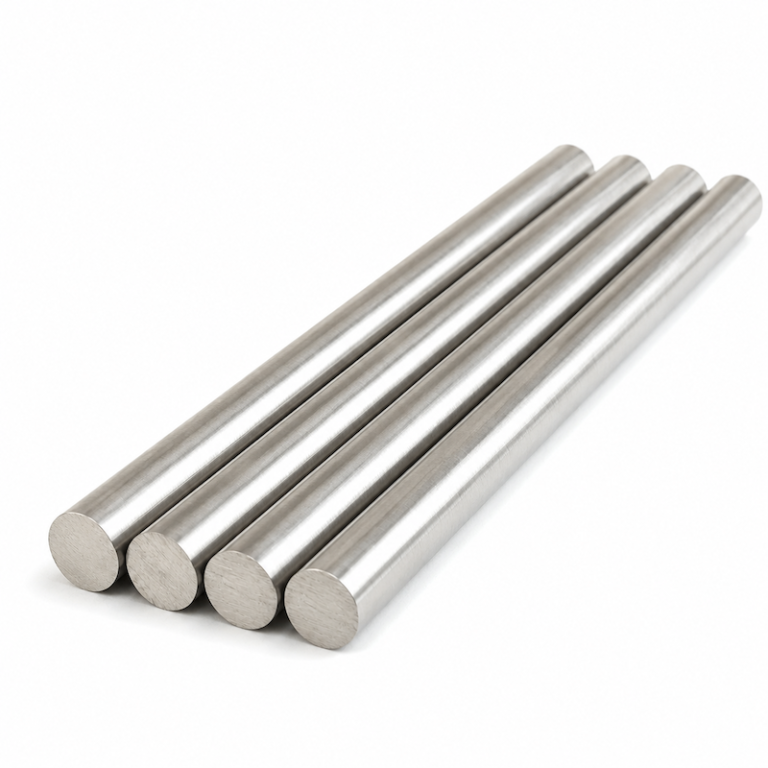
Nickel 200 and Nickel 201 side by side
| Point of comparison | Nickel 200 | Nickel 201 |
|---|---|---|
| UNS and Werkstoff numbers | N02200; 2.4060 and 2.4066 | N02201; 2.4061 and 2.4068 |
| Carbon, maximum | 0.15 % | 0.02 % |
| Recommended service temperature | Below 315 °C (600 °F), Special Metals; not recommended above 316 °C, ATI; VDM’s threshold is 300 °C | Preferred above 315 °C (Special Metals); may be considered above 316 °C (ATI); preferable above 300 °C (VDM) |
| ASME Section VIII, Division 1 limit | 600 °F (315 °C), per Special Metals | 1250 °F (677 °C), per Special Metals and Corrosion Materials |
| Thermal conductivity at 20 °C | 70.3 to 71 W/m·K | 79 to 79.3 W/m·K |
| Electrical resistivity at 20 °C (Special Metals) | 0.096 µΩ·m | 0.085 µΩ·m |
| ASTM B162 annealed minimums as transcribed by ATI and distributors (tensile, yield, elongation) | 55 ksi (380 MPa), 15 ksi (100 MPa), 40 % | 50 ksi (345 MPa), 12 ksi (80 MPa), 40 % |
| SAE AMS 5553 sheet and strip | Not covered (the title sets carbon at 0.02 % max) | Covered |
| ASTM B564 forgings | Listed in the scope | Not listed in the scope |
Composition limits
The limits below are the ones Special Metals publishes for each grade; ATI prints the same figures on the cards that list ASTM B162 and ASME SB-162. The current ASTM editions (B160-24, B161-25, B162-26) set the governing limits, but their tables are not public, so the ordered specification and revision decide acceptance.
| Element, weight % | Nickel 200 | Nickel 201 |
|---|---|---|
| Nickel (Special Metals: plus cobalt) | 99.0 min | 99.0 min |
| Carbon | 0.15 max | 0.02 max |
| Iron | 0.40 max | 0.40 max |
| Manganese | 0.35 max | 0.35 max |
| Silicon | 0.35 max | 0.35 max |
| Copper | 0.25 max | 0.25 max |
| Sulfur | 0.01 max | 0.01 max |
VDM works to a different, DIN-based set: nickel at least 99.2 %, carbon 0.1 % max for Nickel 200 and 0.02 % max for Nickel 201, sulfur 0.005 %, silicon 0.15 %, and additional limits of 0.1 % titanium and 0.15 % magnesium. The 99.6 % that Special Metals quotes for Nickel 200 is a nominal figure, not a limit. One distributor sells material dual-certified to both grades by combining the two sets of restrictions, which in practice means the 0.02 % carbon ceiling.
Physical properties
Typical values. Special Metals, VDM and ATI publish independent data; where they split the two grades, both values are shown.
| Property | Typical value, by source |
|---|---|
| Density | 8.89 g/cm³ (0.321 lb/in³), Special Metals and ATI’s product pages, both grades; ATI’s data sheet gives 8.90 and VDM 8.9 g/cm³ |
| Melting range | 1435 to 1446 °C (2615 to 2635 °F) for Nickel 200 (Special Metals); 1435 to 1445 °C for both grades (VDM) |
| Curie temperature | 360 °C (680 °F), Special Metals; 360 °C, VDM; 357 °C (670 °F), ATI |
| Specific heat at room temperature | 456 J/kg·K, all three producers |
| Thermal conductivity at 20 °C | Nickel 200: 70.3 (Special Metals), 71 W/m·K (VDM); Nickel 201: 79.3 (Special Metals), 79 W/m·K (VDM) |
| Electrical resistivity near room temperature | Special Metals: 0.096 µΩ·m (Nickel 200) and 0.085 µΩ·m (Nickel 201); VDM: 9 µΩ·cm; ATI: 8.5 µΩ·cm at 27 °C, neither splitting the grades |
| Mean expansion to about 100 °C | 13.3 µm/m·°C for Nickel 200 and 13.2 for Nickel 201 (Special Metals); 13.3 (VDM, ATI) |
| Young’s modulus at room temperature | 205 GPa for Nickel 200 (Special Metals, VDM); 207 GPa for Nickel 201 (Special Metals) and for both (ATI) |
| Saturation flux density | 0.61 T (VDM); about 6400 gauss saturation magnetisation (ATI) |
Carbon and the service-temperature limit
The producers’ service-temperature advice for the two grades, source by source:
| Source | What it states |
|---|---|
| Special Metals, Nickel 200 | Normally limited to service below 315 °C (600 °F); at higher temperatures it can suffer graphitization with severely compromised properties. Prolonged exposure between 425 and 650 °C precipitates graphite, so it is not recommended between 315 and 650 °C |
| ATI, Nickel 200 | Long exposure between 427 and 649 °C precipitates a carbon-containing phase with loss of ductility, so it is not recommended above 316 °C; the low-carbon grade may be considered, and creep should be treated as a design criterion as service temperatures approach 427 °C |
| Special Metals, Nickel 201 | Not subject to embrittlement by intergranular carbon or graphite when held at 315 to 760 °C for extended times, provided carbonaceous materials are not in contact with it |
| VDM | Prefers Nickel 201 above 300 °C (572 °F) |
Lower carbon also changes how the metal behaves in the shop. Special Metals finds Nickel 201 particularly suited to spinning and cold forming because of its low base hardness and lower work-hardening rate, and VDM notes that the reduced carbon lowers strength and work hardening and raises ductility. ATI adds that welds in Nickel 201 should use low-carbon, stabilised filler metal so that no free carbon is introduced.
Mechanical properties
The ASTM mechanical tables are not public. The minimums below are transcriptions by producers and distributors, none of which names the edition they copied, so they should be checked against the edition the order names.
| Specification, form, condition | Nickel 200: tensile / yield / elongation | Nickel 201: tensile / yield / elongation | Basis |
|---|---|---|---|
| ASTM B162 plate, sheet and strip, annealed | 55 ksi (380 MPa) / 15 ksi (100 MPa) / 40 % | 50 ksi (345 MPa) / 12 ksi (80 MPa) / 40 % | ATI cards and a distributor; Nickel 200 also a second distributor |
| ASTM B160 rod and bar, annealed | 55 ksi / 15 ksi / 40 % | 50 ksi (345 MPa) / 10 ksi (70 MPa) / 40 % | Two distributors for Nickel 200; for Nickel 201 one distributor, matching the superseded 2005 edition, which also sets 25 % elongation for hot-worked flats 7.9 mm thick and under |
| ASTM B160 rod and bar, hot-worked | 60 ksi / 15 ksi / 35 % | 50 ksi / 10 ksi / 40 % | As above |
| ASTM B161 seamless pipe and tube, annealed | 55 ksi / 15 ksi (12 ksi over 5 in OD) / 40 % (35 % at 5 in OD and under) | No reliable public transcription found | One distributor |
ATI states that Nickel 200 is stronger than Nickel 201 in the annealed condition and that specifications generally recognise this with lower minimums for Nickel 201; its typical annealed values are 462 MPa tensile, 148 MPa yield and 47 % elongation for Nickel 200, against 403 MPa, 103 MPa and 50 % for Nickel 201. VDM’s DIN-based values for soft-annealed material are 370 MPa tensile and 100 MPa proof stress for Nickel 200 (DIN 17750) and 340 MPa and 80 MPa for Nickel 201 (VdTÜV 345), both with 40 % elongation; its tables do not say whether these are minimums.
Corrosion behaviour and applications
| Service | What the producers report |
|---|---|
| Caustic alkalies | Special Metals: highly resistant to reducing chemicals and unexcelled in caustic alkalies; Nickel 201 is very widely used to handle caustic soda. ATI reports use where the chlorate level is low, and VDM says chlorate must be kept low |
| Chloride stress-corrosion cracking | ATI: the nickel content makes the alloys virtually immune |
| Halogens and salts | ATI: used in high-temperature halogens and salts other than oxidising halides; VDM lists tanks for fluorine production and hydrogen chloride production |
| Sulfur and oxidising media | Special Metals: Nickel 201 is subject to intergranular embrittlement by sulfur compounds above 315 °C; ATI: sulfurous atmospheres are corrosive, especially above 316 °C, and oxidising mineral acids and oxidising salts are also corrosive |
| Industry | Uses named by the producers |
|---|---|
| Chemical processing | Caustic soda production and handling, caustic evaporators, phenol storage and transport, chlorination of hydrocarbons, vinyl chloride monomer production, synthetic fibres and soaps |
| Food | Food handling for product purity, including cooling brine, fatty acids and fruit juices |
| Electrical and electronic | Electronic components, battery electrode contacts and current conductors, electrodes for hydrogen production by electrolysis, plater bars |
| High-temperature laboratory and furnace parts (Nickel 201) | Laboratory crucibles for oxidising furnace atmospheres up to 1100 °C, combustion boats |
Heat treatment needs clean material: VDM and ATI both name sulfur, phosphorus and lead among the low-melting contaminants to keep away from the metal when it is heated.
Specifications by product form
| Form | ASTM | Grades in the scope or listing |
|---|---|---|
| Rod and bar | B160, hot-worked, cold-worked or annealed | Both (also N02211) |
| Seamless pipe and tube | B161, cold-worked; hot-worked material by agreement (general requirements B829) | Both |
| Condenser and heat-exchanger tube, seamless | B163, outside diameter up to 76.2 mm with minimum wall up to 3.76 mm and average wall up to 4.19 mm (general requirements B829) | Listed for both by Special Metals and ATI; the public scope page does not show its alloy table |
| Welded pipe | B725, welded and annealed or stress relieved, schedules 5S, 10S and 40S up to 30 in nominal size (general requirements B775) | Both |
| Welded tube | B730, welded and annealed or stress relieved (general requirements B751) | Both |
| Plate, sheet and strip | B162 | Both |
| Forgings | B564 | Nickel 200 only |
| Wrought welding fittings | B366 | Listed for both by Special Metals and ATI; the public scope page names no alloy |
For sheet and strip, SAE AMS 5553 covers low-carbon (0.02 % max) nickel, which is Nickel 201. No ASTM or ASME wire specification for these grades turned up in the sources used here; Special Metals lists DIN 17753 and ISO 9724 for wire.
Common questions
Nickel 200 or Nickel 201: what actually differs? In the ASTM-type limits, only the carbon: 0.15 % against 0.02 %. In practice that means Nickel 201 for service above about 315 °C, slightly higher thermal conductivity and lower resistivity for Nickel 201 in Special Metals’ data, and lower strength minimums for Nickel 201 in the specifications.
Can Nickel 201 replace Nickel 200? Not automatically. Nickel 201 meets the Nickel 200 composition limits, but its specified strength minimums are lower, so an order that calls for Nickel 200’s minimums needs to be checked; material dual-certified to both grades is one route one distributor offers. The reverse substitution is the one the producers warn against: Nickel 200 is not recommended above about 315 °C. In either direction, the mill test certificate for the heat, tested against the ordered specification, decides acceptance.
Is Nickel 200 magnetic? Yes. Both grades are ferromagnetic, with a Curie temperature of about 360 °C.
Is Nickel 200 pure nickel? It is commercially pure: Special Metals and ATI require at least 99.0 % nickel (Special Metals counting cobalt with it), VDM 99.2 %, and Special Metals gives a nominal 99.6 %.
The nickel alloys covered by the other grade pages are Inconel 600, Inconel 625, Inconel 718 and Alloy 825.
Specification detail with sources
Special Metals’ bulletin Nickel 200 and 201 (Publication SMC-061, 2006) supplies the UNS and W.Nr. designations, the composition limits of both grades and the nominal 99.6 %, the 8.89 g/cm³ density, the Nickel 200 melting range, the 360 °C Curie temperature, the 456 J/kg·°C specific heat, the conductivity, resistivity and expansion of each grade, the 205 and 207 GPa moduli, the graphitization limits for Nickel 200, the extended-exposure statement for Nickel 201, the ASME Section VIII limits, the sulfur caution, the spinning and cold-forming note, the specification lists and the caustic, food, fibre, electronic, crucible and combustion-boat uses. VDM Metals’ data sheet No. 1101 (Revision 02, 2022) gives the DIN-based composition, the 8.9 g/cm³ density, the melting range for both grades, the conductivity values, the 9 µΩ·cm resistivity, the 205 GPa modulus, the saturation flux density, the 300 °C preference for Nickel 201, the chlorate and heat-treatment cautions, the DIN 17750 and VdTÜV 345 values and the food, fluorine, phenol, hydrogen chloride, vinyl chloride, battery and electrolysis uses. ATI’s product pages and its Nickel 200 and 201 data sheet (2014) give the carbon-only difference, ferromagnetism, the B162 cards with their composition and minimums, the 8.90 g/cm³ density, the 357 °C Curie temperature, the 8.5 µΩ·cm resistivity, the expansion, the 207 GPa modulus, the saturation magnetisation, the 316 °C limit and 427 °C creep note, the comparison of strengths and typical values, the chloride, halogen, sulfur and oxidising-media statements, the welding-filler and contamination cautions. Corrosion Materials’ Nickel 200/201 data sheet gives the B160 and B161 transcriptions, the second source for the B162 and 1250 °F figures, and the dual-certification practice; a second distributor’s transcriptions give the B160 and B162 rows for both grades, and the superseded ASTM B160-05e1 catalogue card shows the same Nickel 201 bar values. The forms and grades of ASTM B160, B161, B162, B725, B730 and B564, the B163 size limits, the B366 scope and the B751, B775 and B829 listings come from ASTM’s published scope pages, and AMS 5553’s scope from SAE’s title. All of these are public alloy references; none of them names the producer of material supplied on a Beiyu order.
Ordering Nickel 200 and Nickel 201
The grade is the first line of the order: name UNS N02201 when the part will run above about 315 °C, and N02200 where its higher strength minimums are wanted at lower temperatures, then the specification and revision, the form, size and condition. Beiyu Titanium quotes Nickel 200 and 201 tube as seamless tube (OD 5 to 325 mm, wall 0.5 to 12 mm) and welded tube (OD 6.35 to 1219 mm, wall 0.5 to 25 mm), both up to 12000 mm long, and as capillary tube (OD 1 to 5 mm, wall 0.1 to 2 mm) up to 6000 mm long, against ASTM B161 or B163 where those apply, otherwise the buyer’s ASTM, ASME or project standard; Nickel 200 seamless pipe against ASTM B161; nickel round bar from 5.0 to 300 mm diameter up to 6000 mm long against ASTM B160; and nickel plate from 3.0 to 70 mm thick, up to 2500 mm wide and 6000 mm long, with sheet from 0.8 to 3.0 mm thick up to 1200 mm wide, against ASTM B162. Mill test certificates with heat number traceability are supplied, and EN 10204 3.1 documentation, PMI or third-party inspection when the order requires them.
For standard grades and sizes the typical lead time is 15 to 30 days from order confirmation or deposit to ex-works dispatch, sea transit time not included; special chemistry or mechanical requirements call for an adjusted melt recipe, so their lead time depends on the requirements and is confirmed with the quotation.