
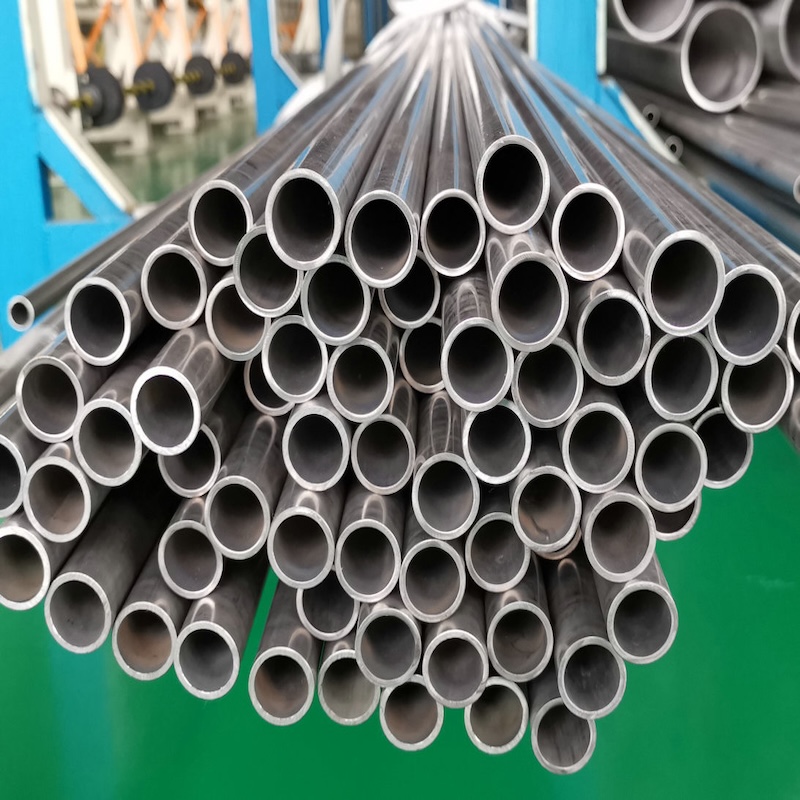
Choose a titanium tube or pipe grade by service first, then by strength and form. Grade 2 seamless tube is the default for heat exchangers, condensers and seawater; Grade 7 and Grade 12 handle reducing acids and hot brine; Grade 9 (Ti-3Al-2.5V) is the high-strength choice for hydraulic lines, aerospace tube and bicycle frames. Decide seamless versus welded, then state the ASTM standard, diameter, wall and length.
The tube-grade decision in one table
| Grade | Character | Typical service environment | Form | Product |
|---|---|---|---|---|
| Grade 2 | Commercially pure, weldable | Heat exchangers, condensers, seawater, chemical | Seamless or welded | Grade 2 seamless tube |
| Grade 7 | Pd-alloyed CP | Reducing acids and crevice conditions | Seamless or welded | Grade 7 pipe |
| Grade 12 | Ti-0.3Mo-0.8Ni | Hot chloride brine and process service | Seamless or welded | Grade 12 tube |
| Grade 9 | Ti-3Al-2.5V | Hydraulic lines, aerospace tube, bicycle frames | Seamless | Grade 9 tube |
Grade 2: the heat-exchanger and corrosion default
Commercially pure Grade 2 is the most specified titanium tube for heat exchangers, condensers, seawater systems and chemical service. It resists seawater pitting, crevice and stress-corrosion failure that limit stainless steel, welds readily and is widely stocked. Most titanium condenser and heat-exchanger tube is Grade 2 to ASTM B338. For tube sheets and assemblies see the Grade 2 tube sheet and shell-and-tube heat exchanger.
| Grade | What the guide states |
|---|---|
| Grade 2 | The most specified titanium tube for heat exchangers, condensers, seawater systems and chemical service |
| Grade 7 and Grade 12 | Where the tube sees reducing acids, crevice-prone joints or hot chloride brine |
| Grade 9 (Ti-3Al-2.5V) | Higher strength than commercially pure grades while staying weldable and formable, which makes it the choice for hydraulic lines, aerospace tube and bicycle frames |
For condenser, cooler and offshore tube orders, compare that default against the seawater and marine grade-selection guide when the medium is chloride water rather than general process service.
Grade 7 and Grade 12: aggressive chemical and hot brine
When the tube sees reducing acids, crevice-prone joints or hot chloride brine, Grade 2 can be outpaced. Grade 7 adds palladium for the best resistance in reducing and crevice conditions; Grade 12 adds molybdenum and nickel for improved crevice resistance in hot brine at a lower cost than Grade 7. Both are chosen on the corrosion case.
At equipment level, Grade 2 titanium for chemical and heat-exchanger service shows where the same tube choice stays with Grade 2 and where the duty steps up to Grade 7 or Grade 12.
Grade 9 (Ti-3Al-2.5V): the high-strength tube
Grade 9 carries higher strength than commercially pure grades while staying weldable and formable, which makes it the choice for hydraulic lines, aerospace tube and bicycle frames. It is supplied seamless. For frame tube see titanium bicycle tubing and for hydraulic service see hydraulic titanium pipe.
What mechanical minimums apply to each titanium tube grade?
Tube is accepted against the minimums of ASTM B338 for the ordered grade and condition, shown on the mill test certificate of the delivered heat. Annealed Grade 2 tube requires at least 345 MPa tensile and 275 MPa yield. Grade 9 roughly doubles that in the cold-worked stress-relieved condition, which is why it is the hydraulic-line choice.
| Grade and condition | Tensile strength, min | Yield strength (0.2%), min |
|---|---|---|
| Grade 2, annealed | 345 MPa | 275 MPa |
| Grade 7, annealed | 345 MPa | 275 MPa |
| Grade 12, annealed | 483 MPa | 345 MPa |
| Grade 9, annealed | 620 MPa | 483 MPa |
| Grade 9, cold worked stress relieved | 862 MPa | 724 MPa |
Minimums per ASTM B338. Grade 2 yield has an upper limit of 450 MPa in the standard. Confirm the revision on the purchase order; the MTC of the heat governs acceptance. A standing size ordered often enough to keep its own page is 1.5 inch titanium tubing.
Seamless vs welded, and pipe vs tube
Seamless tube has no weld seam and is preferred for higher-pressure and critical service; welded tube is made from strip and is economical for larger diameters and lower-pressure runs. On the standards side, condenser and heat-exchanger tube is ASTM B338, titanium pipe is ASTM B861 (seamless) and B862 (welded), and pipe fittings are ASTM B363. State seamless or welded, the diameter, the wall thickness and the length on the RFQ.
| Route | What the guide states |
|---|---|
| Seamless | No weld seam; preferred for higher-pressure and critical service |
| Welded | Made from strip; economical for larger diameters and lower-pressure runs |
What size range is typical for heat-exchanger titanium tube?
Most shell-and-tube and condenser projects order titanium tube between 12.7 and 38.1 mm outside diameter (1/2 to 1 1/2 in) with wall thickness from 0.56 to 2.11 mm (24 to 14 BWG), cut to the tube-sheet drawing length. This is a typical planning range for scoping an RFQ, not a mill limit; sizes outside it are quoted against the drawing. State OD, wall, length, seamless or welded, and the tolerance system (average or minimum wall) on the inquiry.
| Dimension | Typical range the guide gives |
|---|---|
| Outside diameter | 12.7 to 38.1 mm (1/2 to 1 1/2 in) |
| Wall thickness | 0.56 to 2.11 mm (24 to 14 BWG) |
How to order tube once the grade is set
State the standard and grade (for example Grade 2 to ASTM B338), seamless or welded, outside diameter, wall thickness, length, and the certificate package. See the ASTM B338 tube & pipe guide for the specification detail, and the grades comparison for the property reference table.
Frequently asked questions
Which titanium tube grade for a heat exchanger?
Grade 2 seamless tube to ASTM B338 is the default for heat exchangers and condensers. Move to Grade 7 or 12 only if the process fluid is a reducing acid or hot brine that Grade 2 cannot handle.
Grade 2 vs Grade 9 titanium tube?
Grade 2 for corrosion and heat-transfer service; Grade 9 (Ti-3Al-2.5V) when the tube needs higher strength, such as hydraulic lines or bicycle frames.
Seamless or welded titanium tube?
Seamless for higher-pressure and critical service; welded is economical for larger diameters and lower-pressure runs. State which on the RFQ.
What is the standard for titanium pipe?
ASTM B861 for seamless titanium pipe and ASTM B862 for welded; heat-exchanger tube is ASTM B338 and fittings are ASTM B363.
What the selected tube grade still leaves for the order to fix
Grade selection settles the corrosion behaviour. It does not settle the fields that decide whether the tube can be installed as delivered, and those fields are where tube enquiries most often stall.
| Field | What it controls | Where it belongs |
|---|---|---|
| Outside diameter and wall, together | Whether the item is supplyable at all | Both stated, not one of the two |
| Manufacturing route | Seamless or welded changes the governing specification | Named alongside the standard |
| Examination scope | What is inspected and to which acceptance class | The purchase order text |
| Certificate scope | What arrives with the metal | Set by the order, so the order should state it |
The reported figures on a tube certificate have a named basis
| What is reported | Method the specification references |
|---|---|
| Oxygen and nitrogen | ASTM E1409 |
| Hydrogen | ASTM E1447 |
| Carbon | ASTM E1941 |
| Tensile properties | ASTM E8 |
Naming a method settles how a value was produced. It does not add an examination the order did not request, and it does not make a heat analysis and a later product analysis interchangeable.
Specification detail with sources
ASTM B338 ties each tube grade to one UNS number: Grade 2 is R50400, Grade 7 R52400, Grade 12 R53400 and Grade 9 R56320. Grade 9 earns its strength from a lean alloy window of 2.5 to 3.5% aluminum and 2.0 to 3.0% vanadium, roughly half the alloy content of Ti-6Al-4V, which is why it stays weldable and formable while the minima climb.
| Grade under ASTM B338 | UNS |
|---|---|
| Grade 2 | R50400 |
| Grade 7 | R52400 |
| Grade 12 | R53400 |
| Grade 9 | R56320 |
Beiyu’s published tube envelope runs in 3 routes: capillary tube from 1 to 5 mm outside diameter with 0.1 to 2 mm walls, seamless tube from 5 to 325 mm outside diameter with 0.5 to 12 mm walls in lengths up to 12000 mm, and welded tube from 6.35 to 1219 mm outside diameter with 0.5 to 25.4 mm walls in lengths up to 22000 mm. Beiyu quotes tube in 10 grades from its factory sheet, Grades 1, 2, 5, 7, 9, 11, 12, 16, 17 and 23, so a duty that sits between Grade 2 and Grade 7 can also be priced against the lower-palladium Grade 16 and Grade 17.
Request titanium tube by grade
Tell Beiyu the service (process fluid, temperature, pressure), seamless or welded, diameter, wall and length, and the right grade and form will be confirmed before quotation. Contact [email protected].
Related titanium guides
- ASTM B338 Titanium Tube & Pipe Guide
- Titanium Grades Compared: Grade 2 to 23
- Which Titanium Bar Grade to Order
- Which Titanium Plate Grade to Order
Standards and sources
Standards referenced are ASTM B338 (titanium tube for surface condensers and heat exchangers), ASTM B861 (seamless titanium pipe), ASTM B862 (welded titanium pipe) and ASTM B363 (welding fittings). Grade designations follow ASTM B338 and B348. Corrosion behaviour for the palladium and molybdenum-nickel grades reflects published titanium corrosion data. Confirm the current revision and certificate package on the order, and the heat against its mill test certificate.