
Beyond grade and dimensions, two metallurgical criteria decide whether medical titanium bar passes incoming inspection: grain size and hydrogen content. Both are set at the mill, provable by certificate and lab reports, and impossible to fix at goods-in. A drawing that states them explicitly gets quoted and accepted cleanly; one that leaves them to assumption invites rejections. This guide covers how to specify each on an RFQ and how compliance is verified.
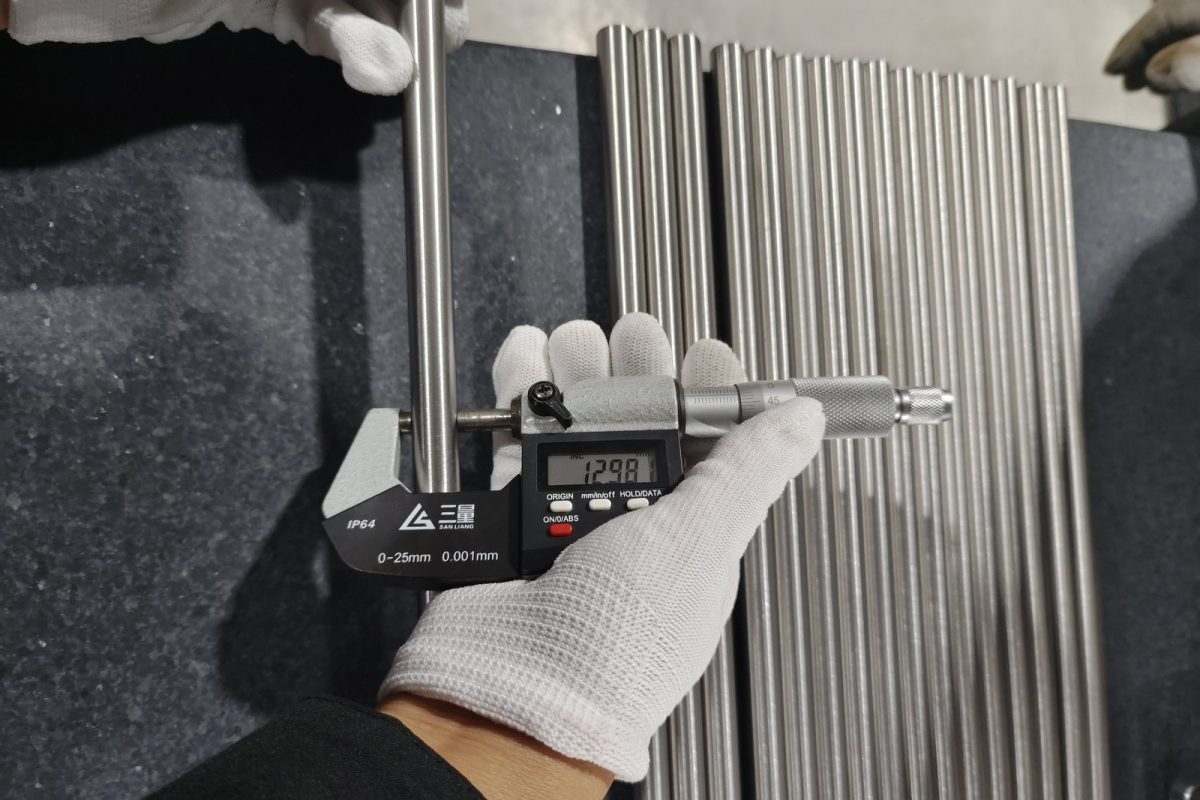
Beiyu Titanium supplies medical CP bar to ASTM F67 and ELI bar to ASTM F136. When EN 10204 3.1 documentation is required, state the chemistry, mechanical, grain-size, hydrogen and heat-traceability reporting scope in the RFQ.
For the grade and standard context around these acceptance criteria, use Beiyu’s titanium for medical implants hub before setting the detailed grain-size and hydrogen call-outs.
Why do grain size and hydrogen sit at the top of a medical bar spec?
Both control fatigue performance in the body, which is what an implant or a device component ultimately has to survive:
- Grain size governs strength uniformity and fatigue-crack initiation. Finer, uniform grain resists crack starts; coarse or mixed grain creates weak points.
- Hydrogen drives hydrogen embrittlement. Titanium absorbs hydrogen readily, and once above the interstitial limit it forms brittle hydrides that cut ductility and fatigue life.
Neither shows up in a dimensional check or a tensile pull, which is why medical drawings call them out separately and why the mill test certificate has to report them.
How is grain size specified? ASTM E112 and the grain-size number
Grain size on titanium bar is specified by the ASTM E112 grain-size number, a standardized scale where a higher number means finer grain. Medical drawings state a minimum grain-size number that the microstructure must meet and that the certificate must record.
| ASTM E112 grain-size no. | Relative grain | Where it appears |
|---|---|---|
| ≥ 5.0 | Moderately fine | Common minimum on general medical CP bar |
| ≥ 8.0 | Fine | Tighter call-out on precision implant bar |
| Higher | Very fine | Set by specific device drawings |
State the minimum grain-size number and require it to be reported on the certificate, not just met. Grain size is measured on a polished, etched cross-section under the E112 method, so it needs a metallographic check at the mill.
Why cap hydrogen so tightly, and how low is realistic?
Hydrogen is the interstitial element medical buyers watch most, because embrittlement is progressive and irreversible. The specification limits are the ceiling; many device drawings sit below them:
| Material / source | Hydrogen max | Notes |
|---|---|---|
| CP titanium bar, ASTM F67 | 0.015% (150 ppm) | Standard ceiling for Grades 1-4 |
| Ti-6Al-4V ELI bar, ASTM F136 | 0.012% (120 ppm) for most mill products; thin wire may differ by standard revision/product form | ELI ceiling; confirm against the current revision and ordered form |
| Tighter drawing call-outs | down to 0.0034% (34 ppm) | Seen on precision implant stock |
Confirm exact limits against the current revision of each standard. If a drawing caps hydrogen below the standard, state the tighter limit explicitly on the RFQ, because it changes what the mill must verify and cannot be caught at incoming inspection. Beiyu reviews any tighter-than-standard hydrogen limit on a per-order basis against mill capability.
What microstructure should the bar have?
Chemistry and grain-size number describe the metal, but medical drawings often add a microstructure requirement, because uniformity is what prevents fatigue failures:
- CP titanium (F67): a uniform, equiaxed alpha structure.
- Ti-6Al-4V ELI (F136): a uniform alpha-beta structure, free from continuous grain-boundary alpha and free from inclusions or defects that could start a fatigue crack.
This is verified metallographically and belongs in the certificate package when the drawing requires it. Metallographic reports for grain size and microstructure can be provided, including third-party reports where a drawing calls for them.
How do you put grain size and hydrogen on the RFQ?
A complete metallurgical section on a medical bar RFQ states, alongside grade and dimensions:
| RFQ line | What to state | Certificate / report expectation |
|---|---|---|
| Grain size | Minimum ASTM E112 number | Grain-size number reported by heat/lot |
| Hydrogen | Maximum content in % or ppm; flag any tighter-than-standard limit | Hydrogen result against the stated limit |
| Microstructure | Required alpha or alpha-beta condition; no continuous grain-boundary alpha for ELI | Metallographic report when required by drawing |
| Reporting | EN 10204 3.1 + heat number | All results traceable to the heat number |
These pair with the dimensional and finish items covered in our guides to specifying F67 CP bar and F136 ELI bar. If the drawing also cites general bar requirements, review the order line against the relevant ASTM B348 titanium bar and billet scope. Stated together, they let the mill quote once and produce to acceptance.
How is compliance verified and documented?
Grain size and hydrogen are provable through the certificate package, so the paper trail is the acceptance record:
| Control point |
|---|
| Hydrogen is measured by the mill’s chemistry, commonly by inert gas fusion, and reported against the limit. |
| Grain size and microstructure are measured metallographically per ASTM E112 and reported as the grain-size number. |
| Both are tied to the heat number, so a buyer can trace results to the melt. |
For medical scope, material can be sourced from mills operating certified ISO 13485 systems, and the producing mill’s quality certificates accompany the material per order, so the certificate entity matches the mill on the MTC. For broader implant and device requirements, see Beiyu’s medical titanium materials page.
For upstream metallurgy context, compare the certificate fields with the guide to reading a titanium ingot test report, the role of oxygen, nitrogen, hydrogen and carbon in titanium, and the separate surface risk from oxygen-rich alpha case.
Frequently asked questions
What grain size is required for medical titanium bar?
Medical drawings specify a minimum ASTM E112 grain-size number, where higher means finer. Common minimums are ≥5.0 for general medical bar and ≥8.0 for precision implant bar; the exact value is set by the drawing and must be reported on the certificate.
What is the hydrogen limit for medical titanium?
The standard ceiling is 0.015% (150 ppm) for CP titanium under ASTM F67. For Ti-6Al-4V ELI under ASTM F136, check the current revision and ordered form; the commonly cited bar limit is 0.012% (120 ppm), while some thin-wire or drawing call-outs may differ. Any tighter drawing limit must be stated on the RFQ.
Why does hydrogen matter in titanium implants?
Excess hydrogen forms brittle hydrides that reduce ductility and fatigue life, a progressive and irreversible effect. Keeping hydrogen low preserves the fracture toughness implants depend on.
How is grain size measured?
On a polished, etched cross-section under ASTM E112, reported as a grain-size number. It cannot be checked dimensionally, so it must be verified at the mill and recorded on the certificate.
Specification detail with sources
Chemistry limits for medical titanium bar tighten in ways the industrial tables do not show. ASTM F136 narrows the aluminum window of Ti-6Al-4V ELI to 5.5 to 6.5 percent, against the 5.5 to 6.75 percent of industrial Grade 5 under ASTM B348, and caps oxygen at 0.13 percent and iron at 0.25 percent. The test methods behind those certificate values are themselves numbered standards: ASTM E1447 covers hydrogen determination in titanium by inert gas fusion, and the ASTM E112 grain-size rating is made against reference charts at 100X magnification.
| Element | ASTM F136 limit for Ti-6Al-4V ELI |
|---|---|
| Aluminium | 5.5 to 6.5 percent |
Beiyu Titanium finishes medical bar to the precision side of these limits: centerless ground bar holds ±0.0127 mm (±0.0005 in) on diameter with a surface finish of Ra 0.8 µm or better, supplied annealed. The F67 and F136 bar program described above also quotes against ISO 5832-2 and ISO 5832-3 for drawings written to the international system, and Beiyu’s bar grade list carries the implant alloys Ti-6Al-7Nb and Ti-13Nb-13Zr for device families specified outside Ti-6Al-4V.
Request a quote for medical titanium bar
Use the titanium bar RFQ checklist to keep the metallurgical requirements attached to the correct grade, dimensions, tolerance and quantity.
To quote medical bar with metallurgical requirements, state the grade and standard (F67 CP or F136 ELI), diameter and tolerance, minimum ASTM E112 grain-size number, maximum hydrogen limit, required microstructure, surface finish and inspection-document scope. For commercially pure medical bar, review ASTM F67 titanium bar; for Ti-6Al-4V ELI, review Grade 23 ASTM F136 bar. Beiyu reviews each metallurgical line against mill capability before quotation and confirms the available test-result and heat-traceability reporting in the quotation and purchase order. Contact Beiyu Titanium for an RFQ.