
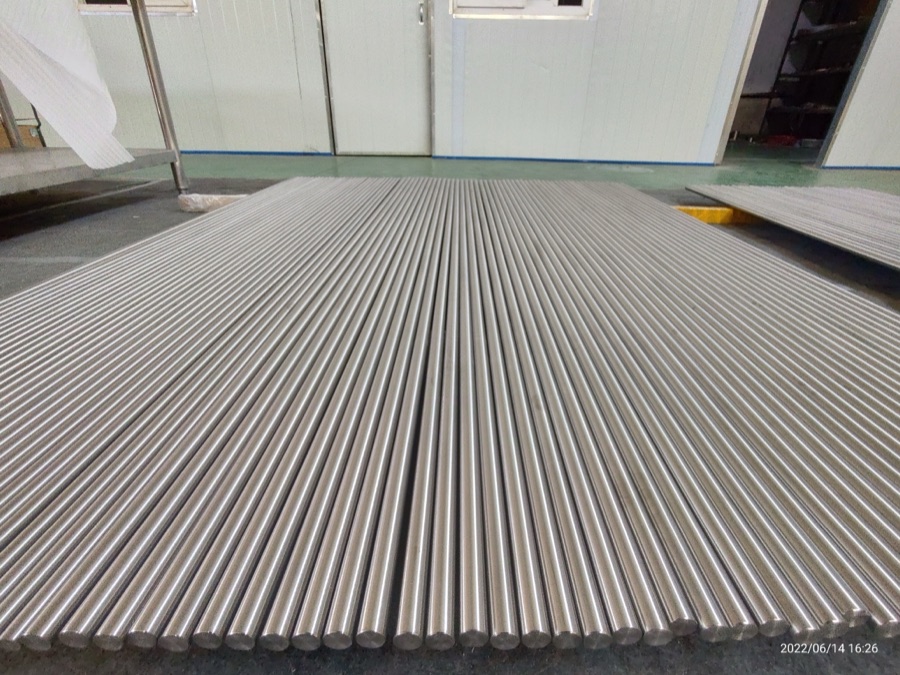
ASTM numbers titanium grades from Grade 1 upward and leaves 8, 10 and 22 unassigned, so the count depends on which standard and edition you read. About a dozen account for nearly all commercial ordering. They split into two families: commercially pure titanium, where oxygen and iron content sets the strength, and titanium alloys carrying aluminum, vanadium, palladium, molybdenum or nickel. Buyers choose on service condition first, then strength.
Titanium grades at a glance
The table below covers the twelve grades that account for most commercial titanium ordering. Tensile values are the annealed minimums required by ASTM B265 (strip, sheet and plate) and ASTM B348 (bar and billet), which specify identical figures for these grades. Elongation is measured in 2 in. or 50 mm under B265 and in 4D under B348.
| Grade | UNS | Werkstoffnummer | Nominal composition | Min UTS | Min yield (0.2%) | Min elong. | Density | Primary reason to specify |
|---|---|---|---|---|---|---|---|---|
| Grade 1 | R50250 | 3.7025 / T35 | Unalloyed Ti, O 0.18 max, Fe 0.20 max | 240 MPa (35 ksi) | 138 MPa (20 ksi) | 24% | 4.51 g/cm3 | Deepest forming and drawing; anode substrate and lining stock |
| Grade 2 | R50400 | 3.7035 / T40 | Unalloyed Ti, O 0.25 max, Fe 0.30 max | 345 MPa (50 ksi) | 275 MPa (40 ksi) | 20% | 4.51 g/cm3 | Seawater and general corrosion service; the default weldable grade |
| Grade 3 | R50550 | 3.7055 | Unalloyed Ti, O 0.35 max, Fe 0.30 max | 450 MPa (65 ksi) | 380 MPa (55 ksi) | 18% | 4.51 g/cm3 | Pressure parts needing more strength than Grade 2 without alloying |
| Grade 4 | R50700 | 3.7065 / T60 | Unalloyed Ti, O 0.40 max, Fe 0.50 max | 550 MPa (80 ksi) | 483 MPa (70 ksi) | 15% | 4.51 g/cm3 | Strongest unalloyed grade; dental and surgical instrument work |
| Grade 5 | R56400 | 3.7165 | Ti-6Al-4V (Al 5.5-6.75, V 3.5-4.5) | 895 MPa (130 ksi) | 828 MPa (120 ksi) | 10% | 4.43 g/cm3 | Load-bearing machined parts, shafts and fasteners |
| Grade 7 | R52400 | 3.7235 | Grade 2 chemistry plus Pd 0.12-0.25 | 345 MPa (50 ksi) | 275 MPa (40 ksi) | 20% | 4.51 g/cm3 | Reducing acids and crevice corrosion |
| Grade 9 | R56320 | 3.7195 | Ti-3Al-2.5V (Al 2.5-3.5, V 2.0-3.0) | 620 MPa (90 ksi) | 483 MPa (70 ksi) | 15% | 4.48 g/cm3 | Tube that still cold-forms at about 1.8 times Grade 2 tensile |
| Grade 11 | R52250 | 3.7225 | Grade 1 chemistry plus Pd 0.12-0.25 | 240 MPa (35 ksi) | 138 MPa (20 ksi) | 24% | 4.51 g/cm3 | Grade 7 corrosion behaviour where deep forming is needed |
| Grade 12 | R53400 | 3.7105 | Ti-0.3Mo-0.8Ni (Mo 0.2-0.4, Ni 0.6-0.9) | 483 MPa (70 ksi) | 345 MPa (50 ksi) | 18% | 4.51 g/cm3 | Hot chloride brine and high-temperature crevice service |
| Grade 16 | R52402 | None in common use | Grade 2 chemistry plus Pd 0.04-0.08 | 345 MPa (50 ksi) | 275 MPa (40 ksi) | 20% | 4.51 g/cm3 | Grade 7 duty at roughly a third of the palladium |
| Grade 17 | R52252 | None in common use | Grade 1 chemistry plus Pd 0.04-0.08 | 240 MPa (35 ksi) | 138 MPa (20 ksi) | 24% | 4.51 g/cm3 | Grade 11 duty at roughly a third of the palladium |
| Grade 23 | R56407 under ASTM B265, B348, B381 and B863; R56401 under ASTM F136 only | 3.7165 (shared with Grade 5; ELI has no separate DIN number) | Ti-6Al-4V ELI (Al 5.5-6.5, V 3.5-4.5, O 0.13 max) | 828 MPa (120 ksi) | 759 MPa (110 ksi) | 10% | 4.43 g/cm3 | Fracture-critical parts and surgical implant material |
The Werkstoffnummer column also carries the French designation after the slash: T35 for Grade 1, T40 for Grade 2 and T60 for Grade 4.
Two notes before this table reaches a purchase order. Density is a nominal physical property, not an ASTM requirement, so it never appears on a mill certificate as a tested value. And the Grade 23 UNS number depends on the standard: for the B-series mill product specifications ASTM B265, B348, B381 and B863 the cross-reference is R56407, while ASTM F136 for surgical implants calls it R56401, and writing the wrong one is a common cause of rejected material. European drawings often use the DIN material number instead, which our Werkstoffnummer-to-ASTM cross-reference maps both ways.
Commercially pure titanium grades 1 to 4
All four commercially pure grades are unalloyed titanium with no intentional alloy additions. What separates them is not purity in any loose sense. It is the permitted level of interstitial oxygen and nitrogen plus substitutional iron, which the standard allows on purpose because they raise strength. ASTM B861 says so in its own scope wording: Grade 1 is unalloyed titanium with low oxygen, Grade 2 standard oxygen, Grade 3 medium oxygen.
| Element (wt%, max) | Grade 1 | Grade 2 | Grade 3 | Grade 4 |
|---|---|---|---|---|
| Oxygen | 0.18 | 0.25 | 0.35 | 0.40 |
| Iron | 0.20 | 0.30 | 0.30 | 0.50 |
| Nitrogen | 0.03 | 0.03 | 0.05 | 0.05 |
| Carbon | 0.08 | 0.08 | 0.08 | 0.08 |
| Hydrogen | 0.015 | 0.015 | 0.015 | 0.015 |
| Residuals, each / total | 0.1 / 0.4 | 0.1 / 0.4 | 0.1 / 0.4 | 0.1 / 0.4 |
| Min tensile | 240 MPa | 345 MPa | 450 MPa | 550 MPa |
| Min yield | 138 MPa | 275 MPa | 380 MPa | 483 MPa |
| Max yield (B265) | 310 MPa | 450 MPa | 550 MPa | 655 MPa |
| Min elongation | 24% | 20% | 18% | 15% |
Read down the oxygen row and up the elongation row and the family makes sense. Oxygen goes from 0.18 to 0.40 percent, minimum tensile more than doubles, elongation falls from 24 to 15 percent. Grade 4 is not lower quality than Grade 1; it carries more oxygen and iron on purpose to buy strength, and pays in formability and weld ductility. Carbon and hydrogen limits do not move across the four, and hydrogen at 0.015 percent maximum is the one to watch on the certificate, since hydride platelets embrittle the material without shifting the tensile numbers. Yield also carries a maximum in ASTM B265, because sheet that overshoots the band will not form to the shapes these grades are bought for.
One point published grade charts get wrong: ASTM specifies no minimum titanium percentage here. Both B265 and B348 state that titanium is determined by difference, so figures like 99.5 percent pure are arithmetic leftovers from the element maxima, not something anyone certifies. In practice Grade 2 is the volume grade, Grade 1 is picked when the part is drawn hard or used as an anode substrate or loose lining, and Grades 3 and 4 appear when a pressure part needs alloy-level strength with unalloyed corrosion behaviour. Product routes are set out in our ASTM B265 sheet and plate guide and ASTM B348 bar and billet guide.
Titanium alloy grades
Grade 5, Ti-6Al-4V
Grade 5 is the most widely ordered titanium alloy. ASTM allows 5.5 to 6.75 percent aluminum and 3.5 to 4.5 percent vanadium, oxygen 0.20 percent max and iron 0.40 percent max. Annealed minimums are 895 MPa tensile and 828 MPa yield at 10 percent elongation, about three times the yield of Grade 2 at 98 percent of the density. It responds to solution treatment and ageing, so condition has to be stated or the mill supplies annealed. It is weldable, but needs tighter control than commercially pure titanium, and it machines slower.
Grade 9, Ti-3Al-2.5V
Grade 9 sits between the CP grades and Grade 5 at 620 MPa tensile and 483 MPa yield minimum, 15 percent elongation. The lean 3 percent aluminum and 2.5 percent vanadium leave enough ductility to cold draw and cold bend, which is why it dominates titanium tubing for hydraulic lines, aerospace ducting and bicycle frames. It is a strength-to-weight upgrade over Grade 2, not a corrosion upgrade: in seawater or acid the corrosion-first grades remain the answer. Tube routes are set out in the ASTM B338 tube and pipe guide.
Grade 23, Ti-6Al-4V ELI
Grade 23 is Grade 5 with the interstitials pulled down: oxygen 0.13 instead of 0.20 percent, iron 0.25 instead of 0.40, nitrogen 0.03 instead of 0.05, hydrogen 0.0125 instead of 0.015, aluminum capped at 6.5 rather than 6.75. ELI stands for extra low interstitial. That raises fracture toughness and damage tolerance and improves cryogenic behaviour, at the cost of strength: minimums drop to 828 MPa tensile and 759 MPa yield. The trade is the whole reason the grade exists, and it is worked through against Grade 5 in our Grade 5 and Grade 23 compared side by side.
Grade 23 is also where UNS numbering trips people up. As bar to ASTM B348, plate to B265, forgings to B381 or wire to B863, it is UNS R56407. As surgical implant material to ASTM F136 it is UNS R56401, and F136 is not simply a tighter version of the same document: it sets higher tensile minimums, allows more nitrogen at 0.05 rather than 0.03 percent, and holds hydrogen tighter at 0.012 rather than 0.0125 percent. Same alloy, different acceptance criteria. Name the standard, not just the grade.
Corrosion-resistant grades: 7, 11, 12, 16, 17
Titanium resists corrosion through a passive titanium dioxide film. In oxidising and neutral chloride conditions that film reforms as fast as it is damaged, which is why Grade 2 handles seawater indefinitely. In reducing acids and inside tight crevices where oxygen is consumed, the film cannot repair itself and unalloyed titanium corrodes actively. Four of these five grades fix that with a small platinum-group addition; the fifth uses a different mechanism.
Palladium acts as a low-hydrogen-overvoltage cathode. A few hundredths of a percent shifts the alloy potential into the passive range, so the oxide film reforms where it otherwise would not. Grades 7 and 11 carry 0.12 to 0.25 percent palladium; Grades 16 and 17 carry 0.04 to 0.08 percent, roughly a third of the palladium and most of the benefit in less aggressive duty. These are palladium grades, not ruthenium grades: the ruthenium equivalents are Grade 26 and Grade 27, both at 0.08 to 0.14 percent ruthenium, developed when palladium pricing made the Grade 7 family expensive. The pairing is systematic, each palladium grade sitting on a commercially pure base, and the mechanical properties come from that base rather than the addition, which is why Grade 7 and Grade 2 share tensile minimums.
| Grade | Base chemistry | Addition | Chosen for |
|---|---|---|---|
| Grade 7 | Grade 2 (O 0.25, Fe 0.30 max) | Pd 0.12-0.25 | Reducing acids such as dilute sulfuric and hydrochloric; crevice attack under gaskets, deposits and tube-to-tubesheet joints |
| Grade 11 | Grade 1 (O 0.18, Fe 0.20 max) | Pd 0.12-0.25 | The same acid and crevice duty on parts that must be deep drawn or used as loose lining |
| Grade 12 | Alloyed, not CP | Mo 0.2-0.4, Ni 0.6-0.9 | Hot chloride brines, geothermal and desalination duty, crevice corrosion at high temperature |
| Grade 16 | Grade 2 (O 0.25, Fe 0.30 max) | Pd 0.04-0.08 | Moderate reducing-acid and crevice duty where full Grade 7 palladium content is not justified |
| Grade 17 | Grade 1 (O 0.18, Fe 0.20 max) | Pd 0.04-0.08 | The Grade 16 case on a Grade 1 base, for formed and lined components |
Grade 12 is the odd one out and the most misread: it carries no platinum-group metal at all. Molybdenum and nickel raise strength to 483 MPa tensile minimum and push the crevice corrosion threshold upward, which is why it is specified for hot brine rather than cold acid. The working rule: reducing acid points to Grade 7 or Grade 16, hot chloride points to Grade 12, and when both apply the choice needs a corrosion engineer rather than a table. Media-by-media selection is covered in our guide to titanium grade selection for chemical processing.
Alpha, alpha-beta and beta titanium alloys

Pure titanium changes crystal structure at about 882 degrees C, from close-packed hexagonal alpha below to body-centred cubic beta above. Alloying elements are classified by which phase they stabilise: aluminum, oxygen, nitrogen and tin stabilise alpha, while vanadium, molybdenum, niobium, iron, chromium and nickel stabilise beta. The balance decides how a grade behaves in heat treatment and forming.
Alpha and near-alpha grades
The commercially pure grades 1 to 4 and the palladium grades 7, 11, 16 and 17 are single-phase alpha with at most traces of beta. Grade 12 is near-alpha, mostly alpha with a little beta from its molybdenum and nickel. None can be strengthened by heat treatment; strength comes from interstitial content and cold work, which is exactly why the CP section above is a chemistry table. They are supplied annealed, weld readily and hold properties at temperature.
Alpha-beta grades
Grades 5 and 23 are the classic alpha-beta alloys, both phases present at room temperature and a real response to solution treatment and ageing. Grade 9 is normally classed near-alpha, with only a few percent beta, which is why it keeps enough ductility to be cold drawn into tube; some references group it with the lean alpha-beta alloys instead. Because one UNS number covers annealed, solution treated and aged material at very different strengths, condition belongs on the purchase order.
Beta grades
Grades 19, 20 and 21 carry enough beta stabiliser to retain beta on cooling. They cold form well when solution treated, then age to the highest strengths in the ASTM system: B348 sets 1138 MPa minimum for Grades 19 and 20 and 1172 MPa for Grade 21 in the high-strength aged condition, against 895 MPa for Grade 5. Cost keeps them outside routine industrial ordering.
The consequence for ordering is direct. For an alpha grade, condition is not a variable and the certificate shows annealed properties. For an alpha-beta or beta grade, leaving condition off the order means the grade name alone does not define the part, and forming temperatures relative to the beta transus shift with the class.
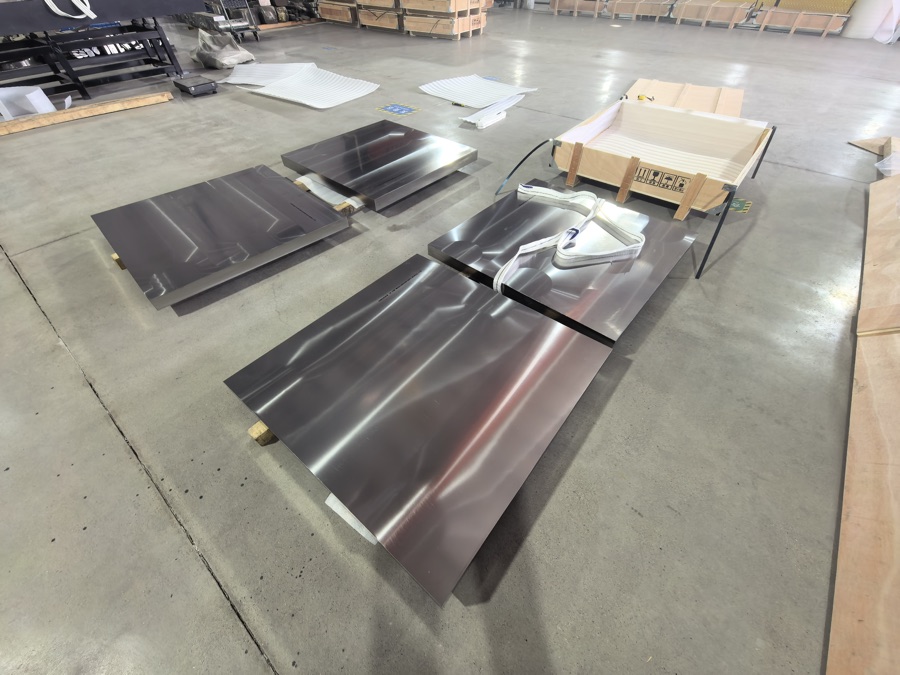
Grade 19 and Grade 29: the two grades this chart does not carry
The comparison table above stops at Grade 23. Two grades outside it come up often enough on drawings to be worth stating: Grade 19, a beta alloy, and Grade 29, which is Grade 23 chemistry with ruthenium added. The alloy identities below are the ones ASTM B348 states in its scope clause 1.1; the chemistry and tensile limits are the ones ASTM B265 tabulates, so they are the sheet, strip and plate figures rather than a general reference. A bar or forging order for either grade runs under its own product standard and its own tables.
| Item | Grade 19 | Grade 29 |
|---|---|---|
| Alloy identity | Titanium alloy, 3 percent aluminium, 8 percent vanadium, 6 percent chromium, 4 percent zirconium, 4 percent molybdenum (ASTM B348 scope clause 1.1, nominal composition) | Titanium alloy, 6 percent aluminium, 4 percent vanadium, extra low interstitial, plus 0.08 to 0.14 percent ruthenium (ASTM B348 scope clause 1.1, nominal composition) |
| Aluminium | 3.0 to 4.0 percent (ASTM B265, chemical requirements) | 5.5 to 6.5 percent (ASTM B265, chemical requirements) |
| Vanadium | 7.5 to 8.5 percent (ASTM B265, chemical requirements) | 3.5 to 4.5 percent (ASTM B265, chemical requirements) |
| Other alloying elements | Chromium 5.5 to 6.5 percent, molybdenum 3.5 to 4.5 percent, zirconium 3.5 to 4.5 percent (ASTM B265, chemical requirements) | Ruthenium 0.08 to 0.14 percent (ASTM B265, chemical requirements) |
| Oxygen, maximum | 0.12 percent (ASTM B265, chemical requirements) | 0.13 percent (ASTM B265, chemical requirements) |
| Hydrogen, maximum | 0.02 percent (ASTM B265, chemical requirements) | 0.0125 percent (ASTM B265, chemical requirements) |
| Iron, maximum | 0.30 percent (ASTM B265, chemical requirements) | 0.25 percent (ASTM B265, chemical requirements) |
| Condition the tabulated properties belong to | Solution treated. In ASTM B265 the whole Grade 19 property row carries table notes G and H, so every figure in the next three rows is a solution treated value; note H states the grade is normally purchased solution treated and that aged properties are agreed between purchaser and supplier | Annealed, the condition ASTM B265 tabulates. The Grade 29 row carries no condition note |
| Minimum tensile strength | 793 MPa (115 ksi), solution treated (ASTM B265, tensile requirements, table notes G and H) | 828 MPa (120 ksi) (ASTM B265, tensile requirements) |
| Minimum yield strength, 0.2 percent offset | 759 MPa (110 ksi), solution treated (ASTM B265, tensile requirements, table notes G and H) | 759 MPa (110 ksi) (ASTM B265, tensile requirements) |
| Minimum elongation | 15 percent, solution treated (ASTM B265, tensile requirements, table notes G and H) | 10 percent (ASTM B265, tensile requirements) |
One column from the main chart is missing here on purpose. The ASTM B series tables state grades by number and do not print a UNS number alongside them, so an order that needs a UNS reference has to name the specification that carries it rather than expecting the product standard to supply one. ASTM B265 table note A adds that the tabulated minima apply to both longitudinal and transverse tests, and that properties for non-annealed material or for plate thicker than 25 mm (1 in.) are agreed between purchaser and supplier.
Which grades exist in which product forms
A grade is orderable in a form only if a standard covers the combination, and the gaps catch people out. ASTM B338, the condenser and heat exchanger tube standard, does not list Grade 4, Grade 5 or Grade 23 among its 28 grades, and the pipe standards B861 and B862 do not list Grade 4.
| Grade | Bar and billet (B348) | Strip, sheet, plate (B265) | Condenser tube (B338) | Pipe (B861 / B862) | Forgings (B381) | Wire (B863) |
|---|---|---|---|---|---|---|
| Grade 1 | Yes | Yes | Yes | Yes | Yes | Yes |
| Grade 2 | Yes | Yes | Yes | Yes | Yes | Yes |
| Grade 3 | Yes | Yes | Yes | Yes | Yes | Yes |
| Grade 4 | Yes | Yes | Not covered | Not covered | Yes | Yes |
| Grade 5 | Yes | Yes | Not covered | Yes | Yes | Yes |
| Grade 7 | Yes | Yes | Yes | Yes | Yes | Yes |
| Grade 9 | Yes | Yes | Yes | Yes | Yes | Yes |
| Grade 11 | Yes | Yes | Yes | Yes | Yes | Yes |
| Grade 12 | Yes | Yes | Yes | Yes | Yes | Yes |
| Grade 16 | Yes | Yes | Yes | Yes | Yes | Yes |
| Grade 17 | Yes | Yes | Yes | Yes | Yes | Yes |
| Grade 23 | Yes | Yes | Not covered | Yes | Yes | Yes |
A gap does not always mean the material cannot be made. Grade 5 tubing exists, but it is bought to an aerospace specification or to the pipe standards rather than to B338, and Grade 23 implant bar and wire are bought to ASTM F136 rather than B348 or B863. What the gaps do mean is that the standard named on the order has to cover the grade in that form, or the mill has no acceptance criteria to certify against.
How to choose a titanium grade

Work from the service condition rather than from the grade name, in this order.
| Service condition | Grade the guide points to |
|---|---|
| Seawater, brackish water, neutral chlorides | Grade 2 is the baseline and handles it indefinitely |
| Reducing acids, or crevices under gaskets and deposits | Grade 7 or Grade 16 on a Grade 2 base, Grade 11 or Grade 17 on a Grade 1 base |
| Hot chloride brine, geothermal, desalination | Grade 12, for its higher crevice corrosion threshold at temperature |
| Load-bearing machined part, shaft or fastener, or a drawing calling for Ti-6Al-4V | Grade 5, with the heat treatment condition stated |
| Fracture-critical part, cryogenic service or a medical implant | Grade 23, ordered to ASTM F136 if it is an implant and to B348 or B265 if it is not |
| Tube that has to bend, hold pressure and beat Grade 2 on strength | Grade 9 |
| Pressure part needing more strength than Grade 2 with unalloyed corrosion behaviour | Grade 3 or Grade 4 |
Two failure patterns are worth naming. Defaulting to Grade 5 because it is the strongest is the first: it does not out-perform Grade 2 in seawater or acid, and costs more to buy, weld and machine. Treating Grade 9 as a corrosion upgrade is the second: it buys strength-to-weight, not corrosion margin. For the direct commercially pure versus Ti-6Al-4V decision across product forms, read the Grade 2 vs Grade 5 titanium comparison.
How to specify a titanium grade on an order
A line item a mill can certify against needs seven things: product form, governing standard and grade, UNS number, dimensions with tolerance class, condition, surface condition, and the test and certificate requirement. For example: titanium bar, ASTM B348 Grade 23, UNS R56407, 40 mm diameter, annealed, centreless ground, EN 10204 3.1 with heat-number traceability. When the product form is bar and the grade is still open, use the titanium bar grade selection guide before fixing the order line.
| Field on the order line | Example from the guide |
|---|---|
| Product form | Titanium bar |
| Governing standard and grade | ASTM B348 Grade 23 |
| UNS number | UNS R56407 |
| Dimensions with tolerance class | 40 mm diameter in the guide’s example line; state the tolerance class alongside the dimension |
| Condition | Annealed |
| Surface condition | Centreless ground |
| Test and certificate requirement | EN 10204 3.1 with heat-number traceability |
Most rejected material traces to one of two omissions. The first is naming a grade without a standard, which bites hardest on Grade 23: to ASTM B348 it is UNS R56407 with an 828 MPa tensile minimum, to ASTM F136 it is UNS R56401 with a higher minimum and different interstitial limits. The second is leaving condition blank on an alpha-beta or beta grade, where one grade number covers annealed and aged material hundreds of megapascals apart.
| Common omission | What the guide states goes wrong |
|---|---|
| Naming a grade without a standard | It bites hardest on Grade 23: to ASTM B348 it is UNS R56407 with an 828 MPa tensile minimum, to ASTM F136 it is UNS R56401 with a higher minimum and different interstitial limits |
| Leaving condition blank on an alpha-beta or beta grade | One grade number covers annealed and aged material hundreds of megapascals apart |
Beiyu Titanium supplies titanium mill products to ASTM and AMS specifications. When EN 10204 3.1 documentation and heat or lot traceability are required, state the requested results and traceability fields in the RFQ. Send the product form, grade, governing standard, dimensions, quantity, condition and service medium, and Beiyu confirms the applicable material and document scope in the quotation.
How many grades of titanium are there?
There is no single number, and any answer given without naming a standard is a guess. ASTM assigns grade numbers inside its mill product specifications, so the count moves with the specification and the edition. ASTM B265 and B348 enumerate 35 numbered grades, Grade 1 to 7, 9, 11 to 21 and 23 to 38, because 8, 10 and 22 are not assigned in the B-series; later editions of both have extended the range further. Narrower standards carry fewer: ASTM B338 covers 28 grades and ASTM B861 covers 34. On top of the numbers sit the 2H, 7H, 16H and 26H variants, which share the chemistry of the base grade but guarantee a higher minimum tensile strength for pressure vessel work.
One correction, because the error circulates widely on supplier sites: Grade 6 does exist. It is Ti-5Al-2.5Sn, UNS R54520, listed in ASTM B265 and B348 at 828 MPa minimum tensile. Grades 8, 10 and 22 are the numbers genuinely absent from the B-series. Commercial ordering concentrates on about twelve grades: 1, 2, 3, 4, 5, 7, 9, 11, 12, 16, 17 and 23.
Which grade of titanium is best?
Titanium grades are matched to a duty rather than ranked, so the question resolves only once the service condition is named. Grade 2 is the default for seawater and general corrosion work and is what most equipment is built from. Grade 5 wins where a part carries load and has to be machined. Grades 7 and 11 give the widest corrosion margin in reducing acids and crevices, Grades 16 and 17 cover the same duty at lower palladium content, and Grade 12 takes over in hot chloride brines. Grade 23 is right only where fracture toughness or implant compliance is the requirement.
What is the strongest grade of titanium?
Among grades ordered in normal industrial volume, Grade 5 is strongest at 895 MPa (130 ksi) minimum tensile annealed. Higher figures exist in the ASTM system: B348 sets 1138 MPa minimum for the beta alloys Grades 19 and 20, and 1172 MPa for Grade 21, in the high-strength aged condition. The strongest commercially pure grade is Grade 4 at 550 MPa. Grade 23, despite being the higher-priced Ti-6Al-4V, has lower minimums than Grade 5 because it trades strength for fracture toughness.
What grade of titanium is used for medical implants?
Grade 23 (Ti-6Al-4V ELI) and the commercially pure grades are the implant materials, but the standard matters more than the grade name. Implant stock is bought to ASTM F136 for Ti-6Al-4V ELI, which carries UNS R56401, or to ASTM F67 for unalloyed titanium. The same alloy bought as general engineering bar to ASTM B348 carries UNS R56407 and a lower tensile minimum, and is not interchangeable with F136 material for implant use.
How the numbers in these tables are measured
A grade table gives limits. It does not say how a value was produced, and two certificates quoting the same figure by different methods are not answering the same question. ASTM B348 settles this by naming the test methods it relies on, so the basis can be checked rather than assumed.
| What is being determined | Method ASTM B348 relies on | What naming it settles |
|---|---|---|
| Oxygen and nitrogen | ASTM E1409 | Inert gas fusion, so the interstitial figures on a certificate have a stated basis |
| Hydrogen | ASTM E1447 | The element with the tightest limit on ELI grades is determined by a named method |
| Carbon | ASTM E1941 | Combustion, rather than an unstated in-house technique |
| Alloy composition | ASTM E539 and ASTM E2371 | X-ray fluorescence and atomic emission plasma spectrometry, the two spectrometric routes named in the referenced documents of ASTM B348 |
| Tensile properties | ASTM E8 | How yield and tensile figures were generated, including the strain rate ASTM B348 itself specifies, 0.003 to 0.007 in./in./min through the specified yield strength |
| Rounding of reported values | ASTM E29 | Whether a borderline figure passes is decided by a stated rounding rule, not by judgement |
These are the methods ASTM B348 names in its referenced documents and test sections. Naming a method settles how a value was produced. It does not add an examination stage that the order did not ask for, and it does not make two different determinations interchangeable.
One further distinction decides how these figures are read on a certificate. The limits above are heat analysis limits taken at the melt, while a product analysis run later on the finished item carries its own tolerance under ASTM B348 and does not widen the grade. That comparison, and the order fields that control what a certificate reports, are set out on the Grade 5 certification guide.
Specification detail with sources
Within the ASTM system, the four unalloyed grades are separated mainly by oxygen and strength: oxygen limits step from 0.18% (Grade 1) to 0.25%, 0.35%, and 0.40% (Grades 2, 3, and 4), per ASTM B265, Table 1, and minimum tensile strength rises correspondingly from 240 to 550 MPa, per Table 2 of the same standard.
The grade numbers are not continuous: ASTM B265, Table 1 runs from Grade 1 through Grade 38, and the numbers 8, 10, and 22 are not assigned to any composition. UNS numbers give the unambiguous cross-reference, for example R50400 for Grade 2 and R56400 for Grade 5, per the same table.
Once the grade is settled, the next question is who supplies it. The titanium supplier lists index groups company-page comparisons by product family and grade.