
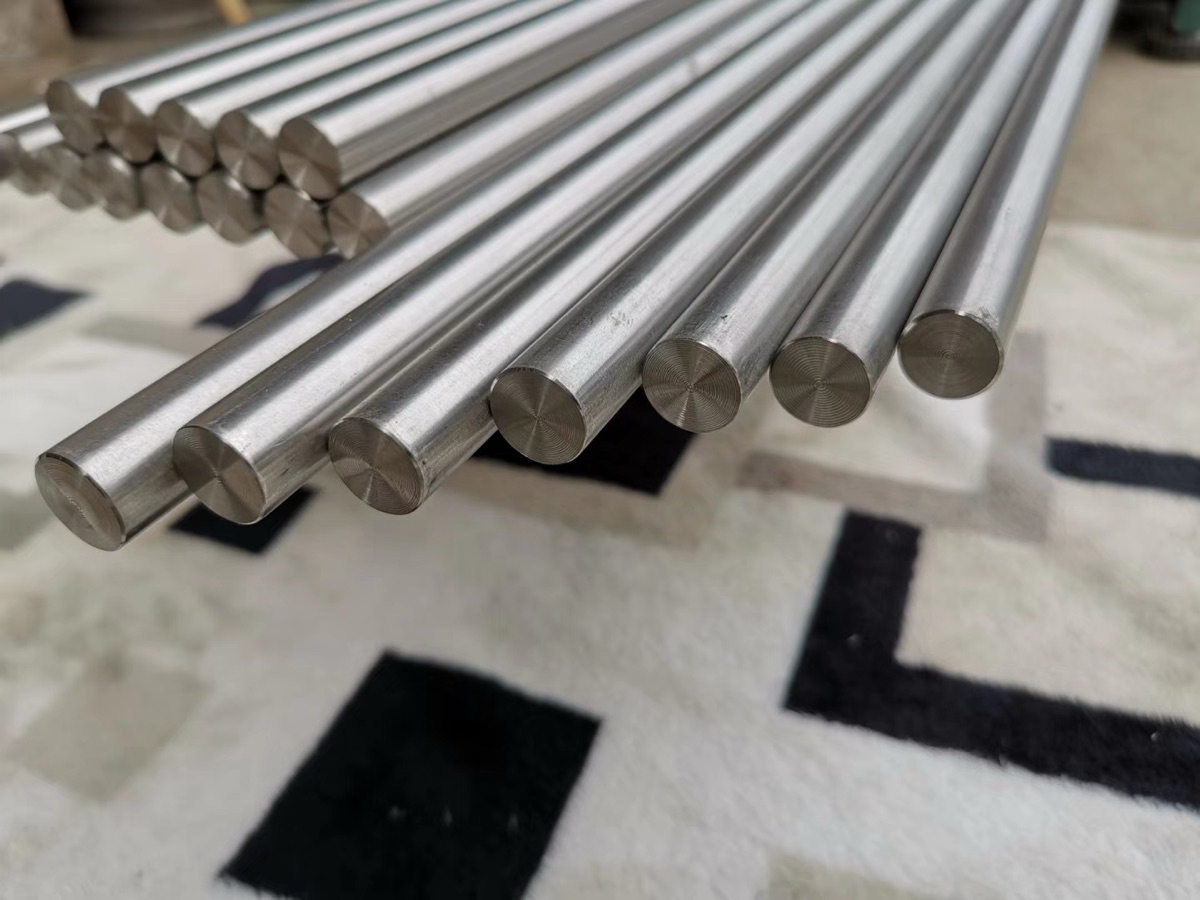
A titanium bar quotation cannot be reviewed from the alloy name alone. State the grade, the ASTM or AMS standard, the size, tolerance, surface condition, supply condition, inspection scope and certificate package in one RFQ. This checklist gives engineering and purchasing teams the exact fields a supplier needs to quote titanium round, flat, square or hollow bar without back-and-forth.
For implant-chain bar, use the separate medical titanium bar RFQ checklist, which adds ASTM F67, F136 and F1472 callouts, interstitial reporting, one-heat lot logic and document-pack requirements that the industrial checklist does not cover.
What a complete titanium bar inquiry should include
Diameter, length, tolerance, surface finish, supply condition, inspection requirement and certificate scope all change the production route and lead time. An RFQ that says only “Grade 5 titanium bar” forces a round of clarification before anyone can quote. The fields below let the supplier confirm at once whether the request is standard bar stock, aerospace specification material, or drawing-based processing.
Minimum RFQ information
| Field to state | Detail |
|---|---|
| Grade and alloy | Grade 2, Grade 5 / Ti-6Al-4V, Grade 7, Grade 12, Grade 23 or another grade. Add the UNS if required, for example UNS R56400 for Ti-6Al-4V. |
| Standard and revision | Common bar standards are ASTM B348 for titanium bar and billet, and AMS 4928 for annealed Ti-6Al-4V bar. State the revision if your drawing fixes one. |
| Form and size | Round, flat, square or hollow bar, with diameter or section and length. |
| Tolerance | Diameter or section tolerance class (for example h9 or h11), and straightness if downstream machining needs it. |
| Surface condition | Peeled, ground, polished or pickled. |
| Supply condition | Annealed or solution treated and aged (STA). |
| Quantity and documents | Quantity, mill test certificate, heat-number traceability and EN 10204 3.1 if required. |
Grade and standard routing
Use specific wording instead of a broad “titanium rod” or “titanium bar” with no grade, size or standard.
| Buyer intent | Recommended RFQ wording | Product |
|---|---|---|
| General corrosion service | Grade 2 titanium round bar to ASTM B348, with diameter, length, surface condition and MTC requirement | Grade 2 bar |
| High-strength machined parts | Grade 5 / Ti-6Al-4V titanium bar, ASTM B348 or AMS 4928, annealed unless another condition is specified | Grade 5 bar |
| Aerospace specification bar | Ti-6Al-4V bar to AMS 4928, condition and test package per the drawing | AMS 4928 bar |
| Aggressive chemical service | Grade 7 or Grade 12 titanium bar to ASTM B348, with the acid and temperature stated | Grade 7 / Grade 12 |
| Toughness-critical or medical-related | Grade 23 (Ti-6Al-4V ELI) titanium bar to ASTM F136 / B348 | Grade 23 ELI bar |
Fields that affect quotation review
These details are often why two titanium bar quotations are not directly comparable.
| Field to state | Detail |
|---|---|
| Size | diameter, width, thickness and length. For long bars, confirm cut-length tolerance and straightness if machining depends on it. |
| Surface | peeled, ground, polished or pickled. Surface condition changes handling, inspection and machining allowance. |
| Condition | annealed or STA. For Ti-6Al-4V, distinguish annealed AMS 4928 from STA requirements. See annealed vs STA. |
| Documents | mill test certificate, heat-number traceability, EN 10204 3.1 and any third-party inspection. |
What diameter tolerance should a titanium bar RFQ state?
State an ISO 286 tolerance class against each diameter instead of writing “standard tolerance”. Machined or ground titanium round bar is commonly ordered to h9 or h11. The band width depends on the diameter: on a 25 mm bar, h9 allows 0 to -0.052 mm and h11 allows 0 to -0.130 mm. Straightness is a separate requirement and should be stated when bars are machined between centers.
| Nominal diameter | h9 band | h11 band |
|---|---|---|
| over 18 to 30 mm | 0 / -0.052 mm | 0 / -0.130 mm |
| over 30 to 50 mm | 0 / -0.062 mm | 0 / -0.160 mm |
| over 50 to 80 mm | 0 / -0.074 mm | 0 / -0.190 mm |
Tolerance bands per ISO 286-2. As-rolled or as-forged bar ordered to ASTM B348 follows the permissible variations of that standard instead of an ISO class, so the RFQ should say which of the two applies.
Which mechanical minimums should the mill test certificate show?
Check the MTC against the minimums of the ordered standard, not against a datasheet. For annealed bar to ASTM B348, Grade 2 requires tensile strength of at least 345 MPa with yield strength between 275 and 450 MPa. Grade 5 (Ti-6Al-4V, UNS R56400) requires at least 895 MPa tensile and 828 MPa yield. The certificate reports the actual results of the delivered heat, and those results must meet the required minimums and any upper limit in the ordered standard.
| Grade | Tensile strength, min | Yield strength (0.2%) |
|---|---|---|
| Grade 2 | 345 MPa | 275 to 450 MPa |
| Grade 5 (Ti-6Al-4V) | 895 MPa | 828 MPa min |
| Grade 7 | 345 MPa | 275 to 450 MPa |
| Grade 12 | 483 MPa | 345 MPa min |
Minimums per ASTM B348, annealed condition. Confirm the revision fixed by your drawing or purchase order; acceptance is by the MTC of the delivered heat.
Inspection and documentation: define the package before the quotation is finalized
For traceable export orders, confirm the certificate type, heat-number marking, inspection scope and packing labels before production or cutting begins.
- Material identity: grade, UNS, standard and heat-number requirements.
- Inspection scope: dimensional report, visual inspection, ultrasonic testing, PMI or hardness if needed.
- Export packing: moisture protection, wooden case or pallet, and shipping marks.
A ready-to-send RFQ line
Specific enough for material review, while leaving room to confirm tolerance, inspection and lead time:
“Grade 5 Ti-6Al-4V titanium round bar, ASTM B348 / AMS 4928, annealed condition, diameter 25 mm, length 3000 mm, ground surface, MTC and EN 10204 3.1 required, export wooden-case packing.”
Specification detail with sources
ASTM B348 fixes the chemistry ceilings a bar MTC is read against: Grade 2 allows at most 0.25% oxygen and 0.30% iron, while Grade 5 (Ti-6Al-4V) allows at most 0.20% oxygen and 0.40% iron. The same standard settles the UNS line for ELI material: Grade 23 ordered to ASTM B348 is UNS R56407, and R56401 applies only when the bar is ordered to the surgical-implant specification ASTM F136.
Beiyu publishes its own size envelope for the form and size fields: round bar from 1 to 500 mm diameter, square bar from 3 × 3 to 500 × 500 mm, flat bar from 3 × 12.7 to 30 × 500 mm and hexagonal bar up to 17 mm across flats, each in lengths up to 6000 mm, produced by hot rolling or forging. An RFQ that lands inside that envelope moves straight to tolerance and document review, and one outside it gets flagged in Beiyu’s first reply rather than after quotation.
Send the checklist with your drawing or size list
Include grade, standard, size, tolerance, quantity, certificate scope and packing requirement. Beiyu confirms the production route and test plan before quotation. Contact [email protected].