
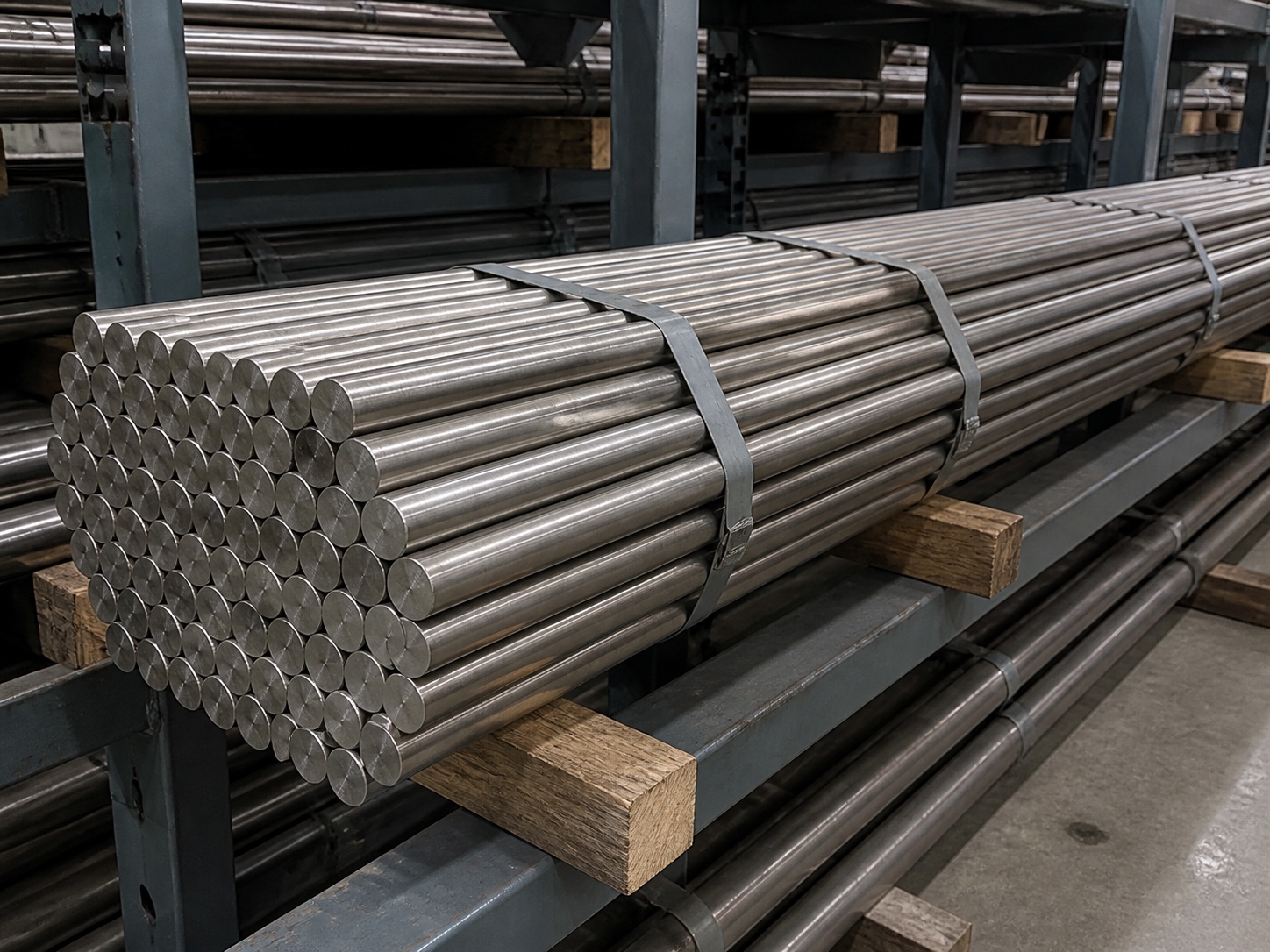
Grade 2 titanium is commercially pure (unalloyed) titanium, UNS R50400, Werkstoffnummer 3.7035. ASTM B265 and B348 set it at 345 MPa (50 ksi) minimum tensile strength with 20 percent minimum elongation. It is the most used of the four commercially pure grades, holding working strength and seawater corrosion resistance while staying formable and weldable.
Grade 2 titanium chemical composition
These limits are identical in ASTM B265 (strip, sheet, plate) and ASTM B348 (bar and billet). Every figure is a maximum, and titanium is never analysed directly: the standards take it by difference. Oxygen separates the commercially pure grades, so 0.25 percent is the defining number.
| Element | Limit, weight percent | Role |
|---|---|---|
| Nitrogen (N) | 0.03 max | Cuts ductility |
| Carbon (C) | 0.08 max | Limits formability |
| Hydrogen (H) | 0.015 max | Embrittlement control |
| Iron (Fe) | 0.30 max | Beta stabiliser |
| Oxygen (O) | 0.25 max | Sets CP grade strength |
| Residuals, each | 0.10 max | Unintentional |
| Residuals, total | 0.40 max | Unintentional |
| Titanium (Ti) | Balance | By difference |
Standard cited: ASTM B348 Table 1 and B265 Table 2, published in ASME SB-348 and SB-265. Hydrogen is reported on the finished product, not the ingot, and a tighter limit than 0.015 percent can be negotiated with the mill.
Grade 2 titanium mechanical properties
Grade 2 carries a specified yield range rather than a floor, and only in flat product. ASTM B265 puts a maximum on every commercially pure grade; ASTM B348 does not. ASTM B265 sets 0.2 percent offset yield at 275 to 450 MPa (40 to 65 ksi), an upper limit the mill certificate must satisfy. ASTM B348 for bar and billet keeps the 275 MPa minimum, publishes no maximum, and adds a 30 percent minimum reduction of area that B265 does not require. Gauge length differs too: 2 in. (50 mm) in B265, 4D in B348.
| Property | ASTM B265 (strip, sheet, plate) | ASTM B348 (bar, billet) |
|---|---|---|
| Tensile strength, min | 345 MPa / 50 ksi | 345 MPa / 50 ksi |
| Yield strength, 0.2% offset | 275 to 450 MPa / 40 to 65 ksi (range) | 275 MPa / 40 ksi min (no maximum) |
| Elongation, min | 20% in 2 in. (50 mm) | 20% in 4D |
| Reduction of area, min | Not specified | 30% |
| Bend test, mandrel radius | 2T under 1.8 mm; 2.5T for 1.8 to 4.75 mm | Not applicable |
| Limit of the table | Non-annealed condition or plate over 25 mm by agreement | Longitudinal sections to 76 mm and 64.5 cm²; larger by agreement |
Grade 2H is the same material certified to a higher guaranteed tensile minimum of 400 MPa (58 ksi) for pressure vessel work. Above the section sizes in the table, properties move to mill and purchaser agreement, so a heavy forged billet is quoted differently from 20 mm bar. Detail sits in the ASTM B348 bar and billet guide and ASTM B265 sheet and plate guide.
Specified minimums are not what a mill ships. Reported room temperature values for annealed Grade 2 run near 483 MPa (70 ksi) tensile, 352 MPa (51 ksi) yield and 28 percent elongation. Strength falls steeply with heat: Rolled Alloys publishes 283 MPa tensile at 200 degrees C and 186 MPa at 400 degrees C.
Grade 2 titanium physical properties
| Property | Metric | Imperial |
|---|---|---|
| Density | 4.51 g/cm³ | 0.163 lb/in³ |
| Melting point | about 1660 C (sources give 1649 to 1671 C) | about 3020 F (3000 to 3040 F) |
| Modulus of elasticity | 105 GPa | 15.2 x 10&sup6; psi |
| Poisson’s ratio | 0.32 | 0.32 |
| Thermal conductivity at 20 C | 20 to 22 W/m·K | 11.6 to 12.7 BTU/hr·ft·F |
| Specific heat capacity | 520 J/kg·K | 0.124 BTU/lb·F |
| Coefficient of thermal expansion | 8.6 x 10⁻&sup6; /K (0 to 100 C) | 4.8 µin/in·F (68 to 212 F) |
| Electrical resistivity | 0.48 to 0.53 µΩ·m | 19 to 21 µΩ·in |
| Hardness | Not a requirement of B265 or B348. Published typical values sit near 150 HB or 160 to 200 HV. | |
Two entries need a caution, not a tidy number. Published thermal conductivity spreads across roughly 16 to 22 W/m·K by source and temperature basis, and electrical resistivity shows the same spread, so sizing should use the figure your design code supports. Hardness is the common trap: neither B265 nor B348 has a hardness column, so a hardness value cannot be rejected against those standards and needs a supplementary test on the order. Figures for every grade are on titanium hardness by grade.
More on this: Is titanium magnetic? sets out the permeability figures by grade and why ASTM B265 and B348 do not verify them.
Corrosion resistance of Grade 2 titanium
Grade 2 owes its behaviour to a titanium dioxide film that re-forms almost instantly wherever a trace of moisture or oxygen is present, giving near total immunity in chlorides and oxidising media and only moderate performance in reducing acids. Figures below come from the TIMET corrosion manual, which lists unalloyed titanium as TIMETAL 50A.
| Medium and condition | Grade 2 behaviour | Comment |
|---|---|---|
| Ambient seawater, shallow | 3.15 x 10⁻⁵ mpy (0.8 x 10⁻⁶ mm/y) | Below any corrosion allowance |
| Deep seawater, 720 to 2070 m | under 0.010 mpy (0.00025 mm/y) | No measurable attack |
| Seawater temperature limit | Resists to 260 C (500 F) | General corrosion basis |
| Seawater velocity | Nil to 7.6 m/s; 0.3 mpy at 36.6 m/s | Condenser and service water duty |
| Boiling 90% nitric acid, metal face 116 C | 1.1 to 6.6 mpy (0.03 to 0.17 mm/y) | Type 304L same test: 150 to 518 mpy |
| Wet chlorine, 10 to 88 C | Nil to 0.02 mpy (0.001 mm/y) | Water content protects the film |
| Dry chlorine, 30 C | Rapid attack and ignition | Hard exclusion |
| Saturated NaCl brine, 21 C to boiling | Nil | General corrosion only |
| Hydrochloric acid, room temperature | Useful to about 7% HCl | Grade 12 about 9%, Grade 7 about 27% |
| Sulfuric acid, room temperature | Useful to about 5% (about 20% at 0 C) | Grade 7 about 45% |
| Boiling sulfuric acid | High rates from as little as 0.5% | Grade 12 about 1%, Grade 7 about 7% |
| Hydrofluoric acid | Attacks the oxide film | Not a candidate |
Those acid limits sit on the 5 mpy (0.127 mm/y) iso-corrosion lines. Dissolved ferric, cupric, nickel and molybdenum ions passivate titanium against hydrochloric acid, so real process streams are often milder than pure acid data suggests.

When to move from Grade 2 to Grade 7 or Grade 12
The switch point is crevice corrosion, not general corrosion. In near neutral brine, crevice attack on unalloyed titanium becomes possible at about 93 degrees C (200 F) and is unlikely below 70 degrees C (158 F); in seawater the threshold is above 82 degrees C (180 F). Lower pH and high calcium or magnesium concentrations pull the onset lower.
- Grade 12 (UNS R53400, 0.3% Mo, 0.8% Ni): no attack in neutral saturated brines above 316 degrees C (600 F) in laboratory tests, crevice resistance to about pH 3. The choice for hot brine and geothermal duty.
- Grade 7 (UNS R52400, Grade 2 plus 0.12 to 0.25% Pd): better than Grade 12 below pH 3, and the reducing-acid answer at about 27% HCl and 45% sulfuric acid at room temperature.
- Stay on Grade 2 for seawater and heat exchanger duty below the crevice thresholds, for oxidising acids such as nitric and chromic, and for wet chlorine and neutral chlorides.
Grade 1 and Grade 2 are essentially immune to stress corrosion cracking in seawater, though unalloyed grades above 0.2 percent oxygen can be susceptible. No case of microbiologically influenced attack on titanium has been reported, removing a failure mode behind many stainless piping choices.
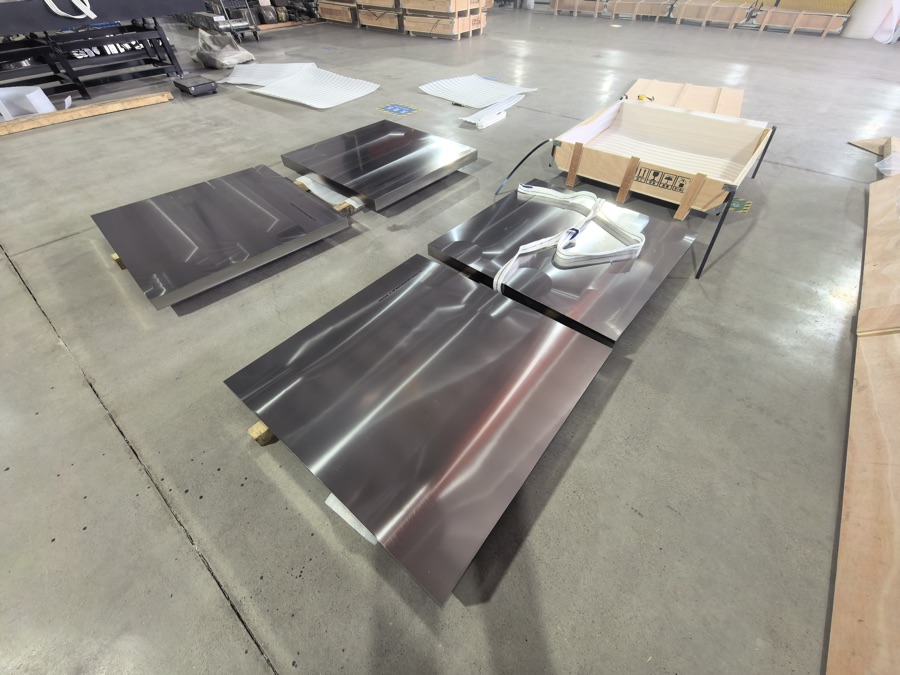
Standards and product forms
Grade 2 is specified per product form, not per material. Naming the wrong ASTM number is a common cause of a rejected mill certificate: acceptance tests differ between plate and bar standards even where chemistry is identical.
| Product form | ASTM | ASME | Other |
|---|---|---|---|
| Strip, sheet, plate | B265 | SB-265 | AMS 4902 |
| Bar and billet | B348 | SB-348 | – |
| Tube, seamless and welded | B338 | SB-338 | AMS 4941 welded, AMS 4942 seamless |
| Seamless pipe | B861 | SB-861 | – |
| Welded pipe | B862 | SB-862 | – |
| Forgings | B381 | SB-381 | – |
| Wire | B863 | – | AMS 4951, AWS A5.16 ERTi-2 welding wire |
| Fittings | B363 | SB-363 | – |
| Castings | B367 | SB-367 | – |
| Surgical implant stock | F67 | – | ISO 5832-2 |
| European designation | Werkstoffnummer 3.7035, written Ti2 or Titan Grade 2 | ||
French designation: A French drawing may mark this grade T40, the French code for the grade written UNS R50400 in ASTM and Werkstoffnummer 3.7035 in EN and DIN.
The ASME SB numbers matter once the part falls under a pressure code: SB-265, SB-338, SB-348, SB-363, SB-367, SB-381, SB-861 and SB-862 are the Section II Part B versions of the matching ASTM specifications, while B863 wire has no SB counterpart, and a code-stamped vessel calls the SB number.
Grade 2 vs Grade 5 and Grade 1
| Property (ASTM B265 basis) | Grade 1 (R50250) | Grade 2 (R50400) | Grade 5 (R56400) |
|---|---|---|---|
| Tensile strength, min | 240 MPa / 35 ksi | 345 MPa / 50 ksi | 895 MPa / 130 ksi |
| Yield 0.2% offset | 138 to 310 MPa | 275 to 450 MPa | 828 MPa min |
| Elongation, min | 24% | 20% | 10% |
| Oxygen, max | 0.18% | 0.25% | 0.20% |
| Iron, max | 0.20% | 0.30% | 0.40% |
| Alloying | None | None | 5.5 to 6.75% Al, 3.5 to 4.5% V |
| Density | 4.51 g/cm³ | 4.51 g/cm³ | 4.43 g/cm³ |
Grade 1 buys ductility with lower oxygen, 24 percent elongation against 20, costing 105 MPa of tensile minimum. It suits deep drawing and explosive cladding, not structural sections. Grade 5 is a different material class: Ti-6Al-4V gives roughly 2.6 times the tensile minimum but drops to 10 percent elongation, is harder to weld, and does not extend corrosion resistance in reducing acids, where TIMET ranks it below unalloyed titanium. See Grade 2 vs Grade 5 titanium and the titanium grades comparison guide. Working rule: loaded parts go to Grade 5, wetted parts stay on Grade 2 and step sideways to Grade 7 or 12.
Applications
Grade 2 is the default where the duty is corrosion rather than load: shell and tube heat exchangers, reactor vessel linings, columns, piping and valve bodies in chemical plant; condenser tubing, service water piping and desalination internals for multi-stage flash and reverse osmosis lines; power station tubesheets, often as clad plate over carbon steel. Further uses run to chlorine dioxide bleaching in pulp and paper, anode baskets and plating racks, offshore hydrocarbon components, and pharmaceutical process surfaces. Grade 2 also serves surgical instruments and non-load-bearing implant parts under ASTM F67 and ISO 5832-2.
For product-contact tanks, piping, valves and nozzles, the titanium wetted-parts guide shows how the liquid, cleaning cycle, crevice geometry and mixed-metal joints narrow the material scope.
How to specify Grade 2 titanium on an order
An enquiry carrying these eight items can be quoted and certified in one pass. A line reading only “titanium grade 2 bar” cannot: the mill does not know which standard the certificate must satisfy.
- Grade and UNS number. Grade 2, UNS R50400. Add 3.7035 on a European drawing, and call Grade 2H if a pressure part needs the 400 MPa guaranteed minimum.
- Standard. The ASTM or ASME number matching the form, for example ASTM B348 for bar or ASME SB-265 for code plate. This decides whether the 450 MPa yield ceiling and 30 percent reduction of area apply.
- Product form. Round bar, forged block, plate, sheet, seamless tube, welded pipe, wire or ring.
- Dimensions. Diameter or thickness, width, cut length. For tube give OD and wall, not nominal pipe size.
- Tolerance. Standard mill tolerance to the ASTM table, or a tighter figure such as h9 or plus-zero.
- Condition. Annealed is the normal supply condition. State it, and add stress relief for parts machined from heavy section.
- Surface. Hot rolled and descaled, pickled, ground, turned, centreless ground or polished.
- Certificate. EN 10204 3.1 with heat number traceability, plus any supplementary requirement the base standard omits: hardness, ultrasonic testing, restricted hydrogen.
Beiyu Titanium supplies Grade 2 to ASTM and AMS specifications. When EN 10204 3.1 documentation and heat or lot traceability are required, state the requested results and traceability fields in the RFQ; Beiyu confirms the available scope in the quotation and purchase order. Sizes and enquiry format are on the Grade 2 titanium bar page.
Does Grade 2 titanium rust?
No. Rust is iron oxide, and Grade 2 holds no more than 0.30 percent iron. What forms instead is a titanium dioxide film that re-establishes itself almost instantly wherever a trace of moisture or oxygen is present, so a scratch does not become a corrosion site. The film has limits: hydrofluoric acid attacks it directly, dry chlorine causes rapid attack and ignition at 30 degrees C, and seawater crevices above roughly 82 degrees C break it down locally.
Is Grade 2 titanium magnetic?
Grade 2 titanium is paramagnetic, with relative magnetic permeability only marginally above 1.0, so engineering practice treats it as non-magnetic. It will not hold a magnet and does not disturb nearby fields in any way that matters for instrumentation, MRI environments or sensor housings. Permeability is not verified by B265 or B348, so a stated limit needs a supplementary test on the order.
Is Grade 2 titanium pure titanium?
It is commercially pure, not chemically pure. The standards never analyse titanium directly: they cap the interstitials and iron, then take titanium by difference, which puts it above 98.9 percent under ASTM B265 limits. Oxygen does most of the work in the grade ladder: Grade 1 is capped at 0.18 percent, Grade 2 at 0.25 percent and Grade 3 at 0.35 percent, which is why tensile minimums step from 240 to 345 to 450 MPa.
How does Grade 2 titanium compare with 316L stainless steel?
Grade 2 is about 44 percent lighter at 4.51 g/cm³ against roughly 7.98 g/cm³, and starts higher on specified yield, 275 MPa minimum against 170 MPa for 316L plate under ASTM A240. The decisive difference is chloride behaviour: Grade 2 shows essentially no measurable corrosion in ambient seawater, while austenitic stainless faces chloride pitting and stress corrosion cracking. In reducing acids the order reverses, since Grade 2 stops at about 7 percent hydrochloric acid and the titanium answer there is Grade 7.
Specification detail with sources
In the annealed condition, Grade 2 (UNS R50400) must meet a minimum tensile strength of 345 MPa (50 ksi), a yield strength between 275 and 450 MPa, and 20% minimum elongation, per ASTM B265, Table 2; ASTM B348 applies the same 345 MPa tensile minimum to bar and billet.
Interstitial limits define the grade: oxygen is capped at 0.25% and iron at 0.30% per ASTM B265, Table 1. Density is 4.51 g/cm³ (ASM Handbook, Vol. 2), and the European designation Werkstoff 3.7035 in DIN 17850 covers the equivalent unalloyed composition.