
Tungsten heavy alloy is mostly tungsten powder consolidated by sintering with a metallic binder such as nickel, iron or copper. The cancelled specification MIL-T-21014D grouped it into four classes with nominal tungsten contents of 90, 92.5, 95 and 97 % and class density ranges from 16.85 to 18.85 g/cm3, against 19.3 g/cm3 for pure tungsten. The binder is the ductile phase; its type sets the magnetic response, and attainable ductility falls as tungsten content rises. ASTM B777 is the current purchase specification for tungsten-base high-density metal, and acceptance values come from the edition named on the order.
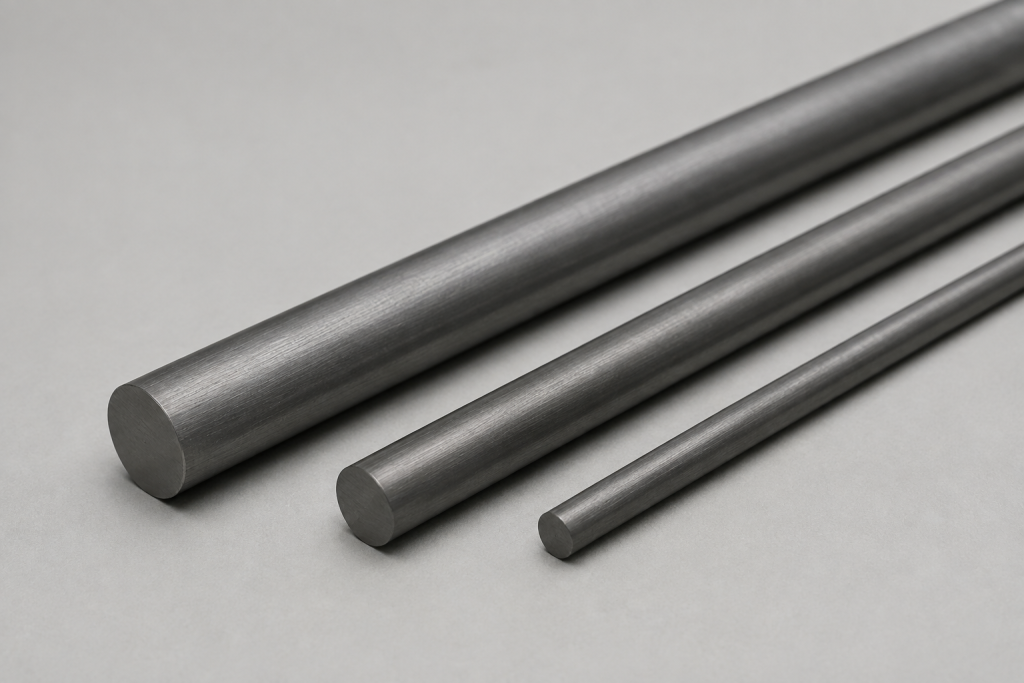
What tungsten heavy alloy is
Heavy alloy combines tungsten particles with a metallic binder matrix through powder consolidation and sintering. Both MIL-T-21014D and ASTM B777 describe machinable high-density tungsten-base metal in their scope.
- The starting mixture consists mainly of tungsten powder plus metallic binder powder.
- Liquid-phase sintering consolidates the tungsten powder with a lower-melting metallic phase.
- The microstructure contains tungsten particles distributed through the binder matrix.
MIL-T-21014D specified a uniform distribution of tungsten particles in the binder matrix when viewed at 200x. An enquiry needs the binder family as well as the tungsten content and class.
The four classes at a glance
The historical MIL-T-21014D tables show how density and mechanical requirements change across the classes. Density is a range, hardness is a maximum, and the tensile properties below are minimum values.
| Class | Nominal W wt % | Density g/cm3 | Hardness HRC max | UTS ksi (MPa, calculated) | 0.2 % yield ksi (MPa, calculated) | Elongation % |
|---|---|---|---|---|---|---|
| 1 | 90 | 16.85 to 17.25 | 32 | 110 (758) | 75 (517) | 5 |
| 2 | 92.5 | 17.15 to 17.85 | 33 | 110 (758) | 75 (517) | 5 |
| 3 | 95 | 17.75 to 18.35 | 34 | 105 (724) | 75 (517) | 3 |
| 4 | 97 | 18.25 to 18.85 | 35 | 100 (689) | 75 (517) | 2 |
These are the figures of MIL-T-21014D (1986), which was cancelled and whose successor was superseded by ASTM B777. MIL-T-21014D Table II note 1 applies the mechanical properties to test bars; bars machined from production parts may deviate. Table I note 2 says that for mechanically worked or aged material the hardness can be as high as Rc 46.
How to choose a class
Choose the class around the required density and ductility. ASTM B777 scope states that increasing tungsten content raises stiffness, radiation attenuation and density while reducing attainable ductility.
| Class | Density g/cm3 (MIL-T-21014D Table I, historical) | Minimum elongation % (MIL Table II, historical) | Successfully tapped holes required by MIL Table III |
|---|---|---|---|
| 1 | 16.85 to 17.25 | 5 | 8 |
| 2 | 17.15 to 17.85 | 5 | 6 |
| 3 | 17.75 to 18.35 | 3 | 4 |
| 4 | 18.25 to 18.85 | 2 | 2 |
In the MIL-T-21014D tapping test, holes 0.1695 inches in diameter were drilled and tapped with a No. 10-32 high-speed steel tap; each counted hole had to be threaded to at least 60 % without destroying the tap. The higher the class, the fewer holes the specification required. These counts describe an acceptance test, not cutting data. Confirm the selected class alongside the drawing and material condition.
Magnetic and non-magnetic grades
Tungsten heavy alloys may be weakly ferromagnetic. Where freedom from magnetic response is required, ASTM B777 says it should be specified in the purchase order. Producers’ data sheets list nickel-iron compositions as slightly magnetic and nickel-copper compositions as non-magnetic; the 1.05 permeability limit on the order, not the binder name, decides acceptance.
| Requirement on the order | What it changes |
|---|---|
| Non-magnetic material | Maximum permeability 1.05; ASTM B777 cites ASTM A342/A342M for testing |
| Non-magnetic class selection | Class 4 is unavailable in a non-magnetic grade |
| Historical non-magnetic tensile requirements | MIL Table II note 3 gives Classes 1 to 3 a minimum UTS of 94 ksi |
| Historical non-magnetic elongation | MIL Table II note 3 gives Classes 1 and 2 a minimum of 2 %, and Class 3 a minimum of 1 % |
The non-magnetic exceptions change the historical mechanical requirements shown above. Put the magnetic limit and test method beside the binder and class in the RFQ so they can be reviewed together. The is tungsten magnetic page explains the binder distinction.
Heavy alloy, pure tungsten, lead and tungsten carbide
Heavy alloy is denser than lead or tungsten carbide and less dense than pure tungsten. Tungsten heavy alloy machines far more easily than pure tungsten, which is why it is used for non-furnace duties.
| Material | Density g/cm3 | Governing document |
|---|---|---|
| Tungsten heavy alloy | 16.85 to 18.85, historical class ranges | ASTM B777 with class when ordered |
| Pure tungsten | 19.30, NIST reference | Bar/rod: buyer’s material specification |
| Lead | 11.35, NIST reference | Buyer’s selected material specification |
| Tungsten carbide | 15.6, IARC reference | Buyer’s selected carbide specification |
The same mass of heavy alloy takes about 0.60 to 0.67 of the volume of lead (calculated). Beiyu uses 19.25 g/cm3 for pure-tungsten estimates; the handbook value is 19.3 g/cm3. State the density basis used for a mass estimate and keep the material specification attached to it. The tungsten density page explains these reference values.
Where it is used
Heavy alloy serves applications that need concentrated mass, radiation attenuation or vibration damping. The specification scope and Beiyu’s product applications identify these uses:
- Weights and counter-balances for static or dynamic balancing.
- High-speed rotating inertia members.
- Radiation shielding, including collimators for medical and industrial use.
- Vibration damping.
- High-density inserts.
Use the application’s density, mechanical and magnetic requirements to define the purchase. The what tungsten is used for page places these applications within the wider tungsten range.
Tests and documents to put on the order
Specify the required test methods and whether acceptance depends on coupons or the actual part. Coupon results may differ from properties at a location within a large part.
| Test | Method and the document that names it | Note |
|---|---|---|
| Hardness | MIL-T-21014D: ASTM E18 | Specify another hardness method if required |
| Density | MIL-T-21014D: ASTM B311 | Water displacement |
| Tension | MIL-T-21014D: ASTM E8 | Identify the test specimen basis |
| Microstructure | MIL-T-21014D: ASTM E3 / E407 | Preparation and etching, examined at 200x |
| Machinability | MIL-T-21014D: tapping test | Applies when specified |
| Permeability | ASTM B777 scope cites A342/A342M | Include when non-magnetic material is required |
MIL-T-21014D called for at least two sintered test bars and one chemical analysis sample from each powder lot unless otherwise specified. ASTM B777 scope warns that sintered properties vary with part size and sampling location. For large sections requiring part property data, specify a part-specific test program or suitable nondestructive testing on the order. Inspection records, MTC or COC, heat/lot marking and export packing are supplied only when they are included in the quotation and purchase order.
Ordering tungsten heavy alloy from Beiyu
Beiyu quotes W-Ni-Fe / W-Ni-Cu heavy alloy by composition and class against ASTM B777 when ordered. Sizes and shapes are quoted to the drawing.
- ASTM B777 and the required class.
- Binder family and any non-magnetic requirement, including maximum permeability 1.05 if needed.
- Drawing with dimensions and tolerances.
- Condition, as sintered or worked after sintering, and surface requirements.
- Hardness method if different from Rockwell C.
- Any part-specific tests and acceptance requirements.
- Required documents, marking and packing.
- Quantity.
The tungsten range lists W1 and W2 plus W-Ni-Fe, W-Mo, W-Cu and W-La compositions, and W-Ni-Cu heavy alloy is quoted by composition and class in the same way. Pressed and sintered material and material worked after sintering differ in density, machining behaviour and the surface they hold, so include condition in the enquiry. Samples are charged and the sample charge is credited against the production order.
Send the RFQ through the contact page. Product context is on the tungsten bar and rod page; the full tungsten range is on the tungsten category page.
Common questions
Is tungsten heavy alloy magnetic?
It depends on the binder. Producers list nickel-iron grades as slightly magnetic and nickel-copper grades as non-magnetic. ASTM B777 treats non-magnetic as a purchase-order requirement with a maximum permeability of 1.05 by ASTM A342/A342M, and Class 4 is not available non-magnetic.
What is its density?
The historical class ranges span 16.85 to 18.85 g/cm3. Take the acceptance range from the purchase specification edition named on the order.
Is it the same as tungsten carbide?
No. Heavy alloy contains tungsten particles in a metallic binder matrix. Tungsten carbide is a different material with a different purchase specification.
Does it melt at tungsten’s melting point?
The binder phase melts far below pure tungsten. Review the material distinction on the tungsten melting point page when assessing temperature requirements.
Specification detail with sources
MIL-T-21014D Table I lists nominal tungsten contents of 90, 92.5, 95 and 97 % and density ranges of 16.85-17.25, 17.15-17.85, 17.75-18.35 and 18.25-18.85 g/cm3 for Classes 1 to 4. The mechanical values above come from MIL-T-21014D Table II; the MPa entries are conversions (calculated). MIL-T-21014D §3.3 and §4.2.3.5 specified microstructure examination at 200x; §4.2.3.1 to §4.2.3.3 named ASTM E18, ASTM B311 and ASTM E8 for hardness, density and tension. ASTM B777 §1.1-1.4 supplies the current scope guidance on machinability, coupon testing, applications and magnetic requirements; no ASTM table values are reproduced here.
NIST X-Ray Mass Attenuation Coefficients, Table 1 gives tungsten at 19.30 and lead at 11.35 g/cm3; IARC Monographs Vol. 86 §1.1.3 gives tungsten carbide at 15.6 g/cm3. The lead-volume comparison is calculated from the NIST lead density and MIL-T-21014D Table I density endpoints. ASTM B777 §1.4 defines the non-magnetic maximum permeability as 1.05 and cites A342/A342M; MIL-T-21014D §6.3 gave the same limit.