
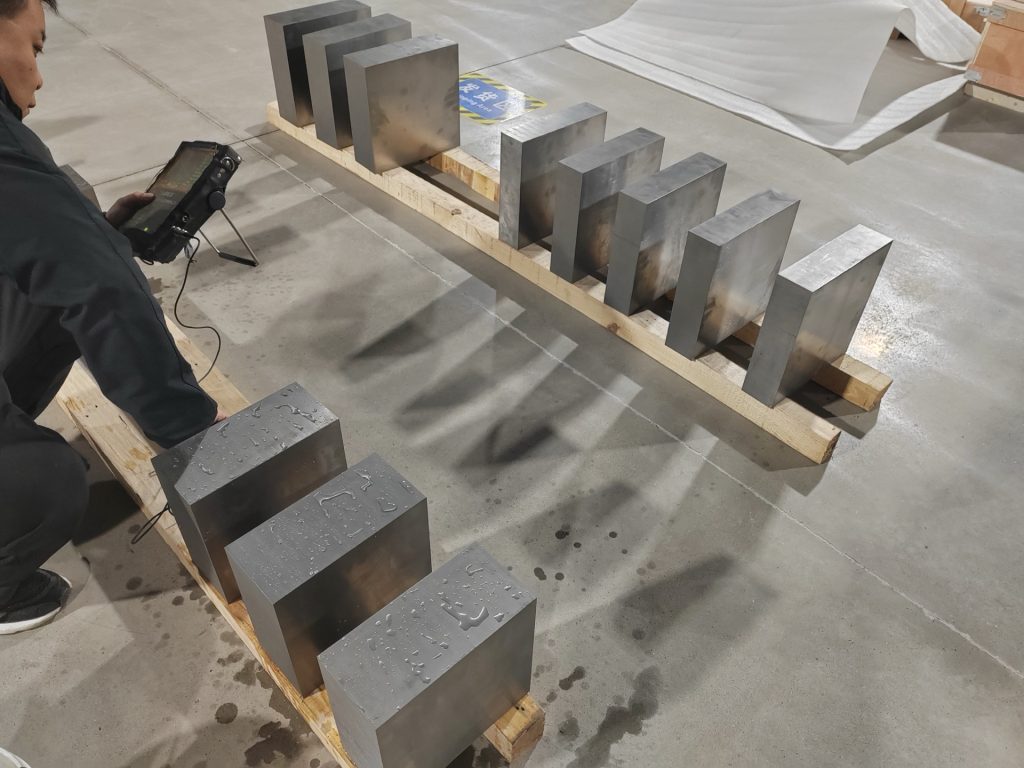
Vet a titanium supplier on documentation and process, not just price. Confirm they provide mill test certificates (EN 10204 3.1) with heat-number traceability, that they can supply to the exact standard you need (ASTM B348, B265, B338, B381, F136 and others), and that they accept third-party inspection or PMI for critical orders.
Seven checks before you order
| Due-diligence item | What the guide states |
|---|---|
| Material certificates | mill test certificate / EN 10204 3.1 stating grade, heat number, chemistry and mechanical properties. |
| Traceability | heat number on the certificate must match the marking on the material. |
| Standards capability | can they supply to the exact ASTM/AMS standard your drawing calls out? |
| Grade match | do they understand which grade fits your application, or do they push one grade for everything? |
| Inspection | willingness to allow PMI/XRF or third-party inspection before shipment. |
| Technical response | do they ask for grade, standard, dimensions, tolerance and certificate needs, or just quote a price? |
| Realistic pricing | a price far below market for the grade is a warning sign, not a bargain. |
Why the certificate alone is not enough
Falsified paperwork exists in the market, so a certificate should always be cross-checked against the heat-number marking and, for critical orders, confirmed by PMI or third-party inspection. See our guide on how to verify titanium mill test certificates for the detailed checklist.
| Cross-check | What the guide states |
|---|---|
| Heat-number marking | A certificate should be cross-checked against it |
| Independent confirmation | For critical orders |
How Beiyu supports buyer due diligence
Beiyu reviews each RFQ for grade, standard, dimensions and inspection scope, supplies titanium fasteners and other products with mill test certificates and EN 10204 3.1 documentation, and supports PMI or third-party inspection when specified. More about the company is on the About Us page.
FAQ
What documents should a titanium supplier provide?
At minimum a mill test certificate / EN 10204 3.1 stating the grade, heat number, chemical composition and mechanical properties, with heat-number traceability to the material.
How do I avoid fake titanium?
Cross-check the heat number, require certificates to the correct standard, be wary of prices far below market, and use PMI/XRF or third-party inspection for critical orders.
Should I order a sample first?
For a new supplier or a critical application, a sample with its certificate lets you confirm grade, documentation and quality before placing a production order.
Pre-Shipment Checks That Reduce Risk
Before shipment, confirm that the material label, heat number and certificate all match the purchase order. For bar, plate, tube, wire or forgings, the buyer should check grade, standard, dimensions, tolerance, quantity and surface condition before releasing payment or arranging third-party inspection.
| Pre-shipment check | What the guide states |
|---|---|
| Label, heat number and certificate | All three match the purchase order |
For critical titanium orders, a practical inspection plan may include PMI/XRF for grade screening, dimensional inspection, visual surface review and certificate review against ASTM or AMS limits. This does not replace a qualified supplier evaluation, but it gives procurement and engineering teams a concrete checklist instead of relying on brochure language.
Specification detail with sources
EN 10204:2004 defines 4 types of inspection document, 2.1, 2.2, 3.1 and 3.2. A type 3.1 certificate is validated by the manufacturer’s authorized inspection representative, who must be independent of the manufacturing department, while a type 3.2 certificate adds validation by the purchaser’s authorized representative or an inspector named by official regulations. Asking a candidate supplier which of the four types they actually issue, and who signs them, separates document capability from marketing copy in a single question.
| Document type | What the guide states |
|---|---|
| 2.1 and 2.2 | Two of the four types EN 10204:2004 defines |
| 3.1 | Validated by the manufacturer’s authorised inspection representative |
| 3.2 | The fourth type EN 10204:2004 defines |
Beiyu can put its own numbers behind those checks: RFQ review at Beiyu is handled by Penn Ma with 15 years in titanium export, chemistry on supplied orders is verified at one of 2 designated laboratories under the factory’s documented quality flow, and ultrasonic or other NDT is added on the product types that call for it. Production runs under an ISO 9001:2015 and EN 9100:2018 quality system, with heat-number traceability maintained through the marking, weighing and packing steps, the three closing stages of that flow.
Send a technical RFQ
For supplier review or quotation, send the required grade, product form, standard, dimensions, quantity, end-use application and document package.
Vetting assumes a shortlist already exists. Where it does not, the dated list of titanium suppliers gives a starting set drawn from one query on one day, with the inclusion rule written on the page so it can be re-run.
To test the answers against a live production floor rather than a document set, the nine-stop walkdown is in the titanium supplier video audit.