
Product Details
Titanium Clad Copper Bar
Review grade, standard, size, surface, inspection and packing details before quotation.
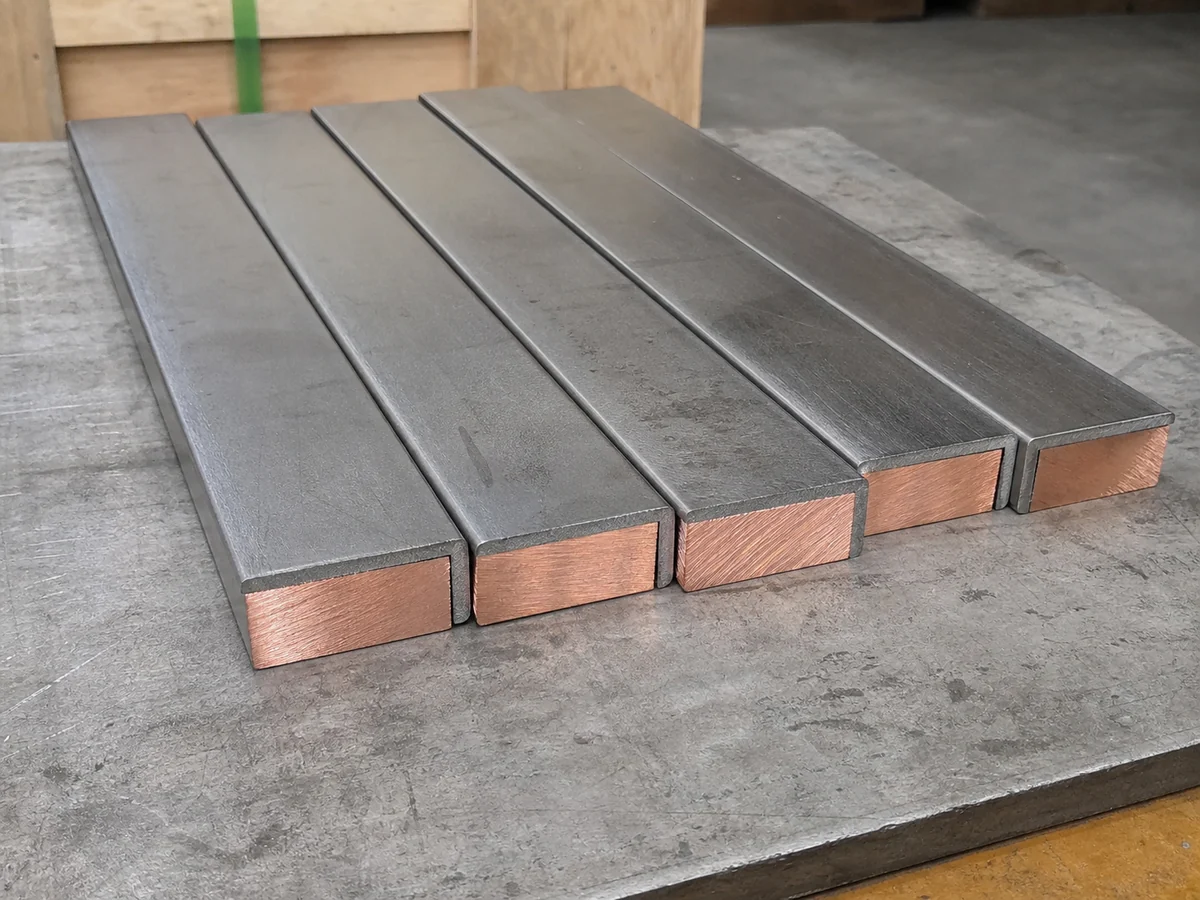
Titanium Clad Copper Bar
Titanium clad copper bar for conductive components that need a titanium corrosion barrier with a copper core. Quote by bar shape, titanium layer thickness, copper grade, diameter or section, length, tolerance, bonding requirement and inspection documents.
- DocumentsMTC and EN 10204 3.1 on request
- TraceabilityHeat number and inspection scope confirmed
- RFQ detailsGrade, standard, size, tolerance, quantity
- PackingExport protection by product form and length
Product Introduction
Titanium clad copper bar / drawing-based conductive compositeApplicable standard or RFQ reference
Titanium grade, copper grade, clad ratio, bar size, length and bonding requirementCore information needed for quotation
Width, thickness, length, titanium layer, copper core and toleranceDimensional review before production
MTC / EN 10204 3.1Traceability documents when required
Acceptance is by the ordered specification. Final grade, chemistry, dimensions, inspection and documentation are confirmed by the purchase specification and mill test certificate.
Titanium Clad Copper Bar for Conductive Components
Titanium clad copper bar is used when a conductive copper core needs a titanium corrosion barrier on the working surface. It is normally quoted from a drawing or project specification because the clad ratio, titanium layer thickness, copper core size, bonding route and final machining details affect both electrical performance and corrosion resistance.
Typical RFQs come from electrochemical equipment, anode and cathode connection systems, conductive busbar assemblies and replacement parts for corrosive service. The buyer should define whether the bar will be used as a current-carrying part, a terminal, a hanger, a transition piece or a machined component.
Specification Items to Confirm
| Material route | Titanium clad copper bar, titanium clad copper rod or drawing-based conductive composite. |
|---|---|
| Titanium layer | Grade 1, Grade 2 or project-specified titanium layer thickness and exposed surface requirement. |
| Copper core | Copper grade, section size, length, straightness and conductivity requirement when specified. |
| Bonding and machining | Bonding method, machining allowance, holes, slots, thread details and final tolerance should be stated on the drawing. |
| Documentation | Material certificate, heat or batch traceability, dimensional report and bonding inspection documents when required. |
Common Applications
- Conductive parts for electrochemical equipment
- Anode and cathode hanger or terminal components
- Titanium-copper busbar assemblies exposed to corrosive media
- Replacement clad copper components made from buyer drawings
Inspection, Packing and RFQ Notes
Inspection should focus on titanium layer thickness, bonding condition, final size, hole position, surface condition and identification marking. For export packing, machined faces and conductive contact areas should be protected from dents, moisture and contamination. RFQs should include drawings, quantity, copper and titanium grades, clad ratio or layer thickness, certificate requirement and destination.
FAQ
What information is needed to quote titanium clad copper bar?
Send the drawing, titanium grade and layer thickness, copper grade, bar section, length, tolerance, bonding requirement, machining details, quantity and document requirement.
Can the bar be supplied as a finished machined part?
Yes, the RFQ can be reviewed as a finished component if the drawing defines holes, slots, threads, contact surfaces and final inspection points.
Common applications
Review export and fabrication support22
Ti
Titanium
47.867 u
4.51 g/cm3
Titanium clad copper bar / drawing-based conductive composite
4.51 g/cm3
Titanium clad copper bar / drawing-based conductive composite
Electrochemical busbar assembliesConfirm grade, size, tolerance, surface, inspection and certificate scope before quotation.Conductive titanium-copper componentsConfirm grade, size, tolerance, surface, inspection and certificate scope before quotation.Anode and cathode connection systemsConfirm grade, size, tolerance, surface, inspection and certificate scope before quotation.Custom clad bar replacementConfirm grade, size, tolerance, surface, inspection and certificate scope before quotation.
Sections the conductor bar is supplied in
A clad conductor solves two problems with one part. Copper carries the current at a cross section the cell can afford, and the titanium skin takes the electrolyte and the splash that would attack bare copper. Which section is used follows from how the bar is clamped and how much current it has to carry, so it belongs on the enquiry with the length.
| Section | Range supplied |
|---|---|
| Round rod | Ø8 mm to 50 mm |
| Rectangular bar | 20 mm to 150 mm wide by 6 mm to 30 mm thick |
| Square bar | 10 mm to 30 mm |
| Wire | Ø2.0 mm to 8.0 mm |
| Layer thickness | 1 mm to 3 mm |
| Length | Under 6000 mm |
The layer thickness is a separate line from the section, and the order has to say which layer that figure belongs to. An enquiry that gives only a section leaves it open. Beiyu Titanium also supplies stainless steel copper and nickel copper bar on the same clad routes where the electrolyte calls for a different skin.
Two fields decide whether the bar can be used as delivered. The joint arrangement at each end has to be stated, since a bar that is bolted, welded or clamped is prepared differently, and the delivery condition is stated separately from the surface. The work is quoted against ASTM B898 with its ASME adoption SB-898, ASME SA-265, ASME SA-263 and SA-264, and GB/T 12769, with the condition given as R or M.
The table gives the Beiyu Titanium production ranges for this product. Sections or lengths outside it are quoted against the drawing.
Compare related titanium products
Clad TitaniumProduct
Reference
RFQ focus
Titanium Clad Plates
Project bonding spec
Corrosion lining plate
>
Titanium Clad Steel Plates
Steel-backed Ti plate
Large equipment plate
>
Titanium Clad Copper Bar
Conductive composite
Busbar and connector work
Titanium Cathode Plate
Grade 1 / 2
Electrochemical plate
>
Related RFQ pages
Clad TitaniumSpecification detail with sources
Clad bar is quoted from a cross section and a layer requirement, not from a diameter. The Beiyu Titanium supply ranges carry titanium copper clad bar, stainless steel copper bar and nickel copper bar, in rectangular, square, round and wire sections, with the section dimensions and the clad layer thickness both confirmed against the order.
Cross section is the first field on such an enquiry because three of those four sections are not round, and a diameter given on its own only speaks to the round and wire forms. After the section come the layer thickness, the length, the conductivity requirement the copper core carries and the corrosion requirement the cladding is there to meet, and the inspection scope, including any bond testing. A quotation therefore starts from the section drawing, not from a single dimension.
For a view of who else publishes this material and what each one states, see Titanium Clad Copper Bar Suppliers: Five Company Pages Compared.
Request a quote for Titanium Clad Copper Bar
Send grade, standard, size, condition, quantity and certificate requirements. Beiyu replies with quotation, lead time and documentation scope.