
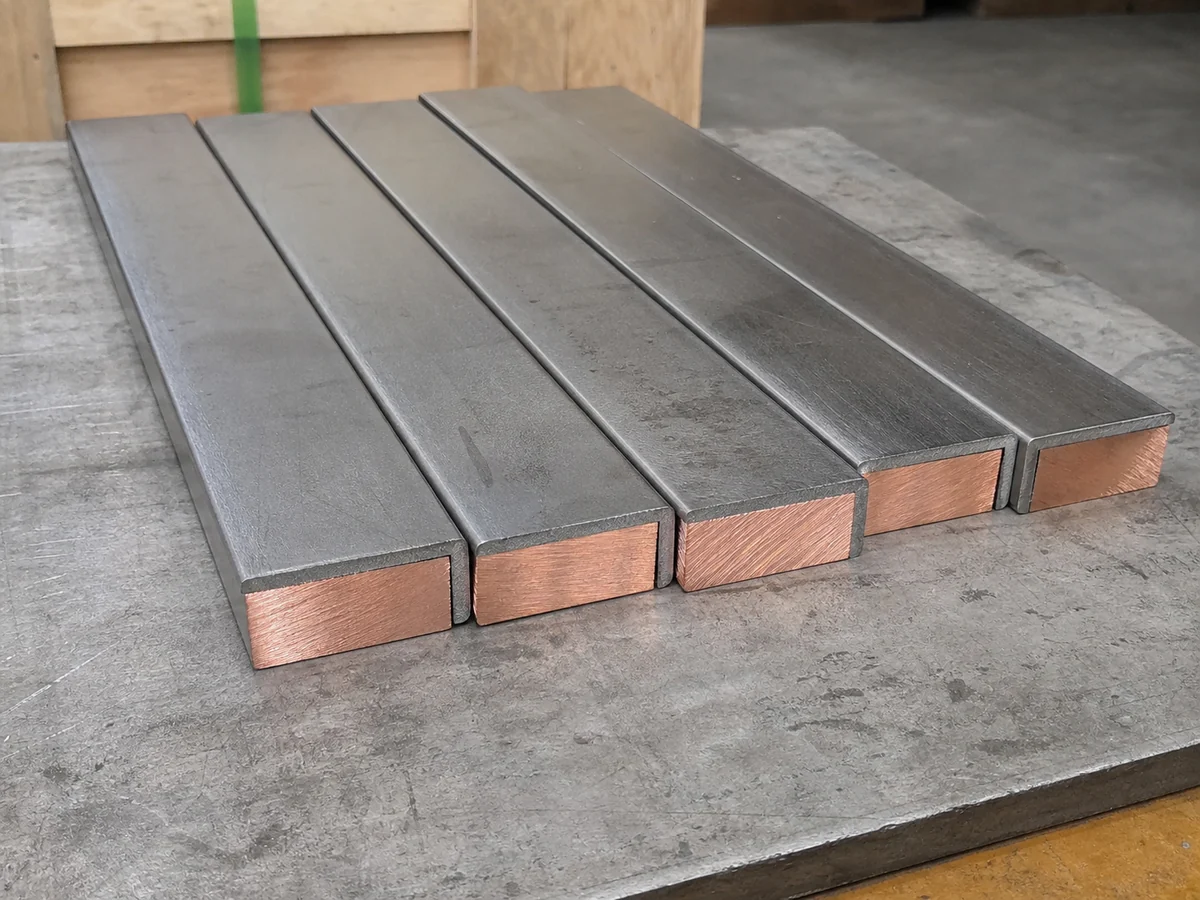
Titanium-clad copper bar combines a conductive core with a corrosion-facing layer, but public pages use bar, rod, wire and busbar for different sections and production routes. Five company-owned pages met the rule. Their visible differences show why a buyer needs to specify both metals, the interface and the finished electrical connection instead of ordering by a generic Ti/Cu label.
How the five company sources were selected
We froze the query titanium clad copper bar busbar manufacturer supplier on 1 September 2026. Eligible pages expressly offered a titanium-clad copper bar, rod or busbar and exposed a material, cross-section, cladding, process or machining field. Beiyu, geographies excluded by site policy, marketplaces, directories, third-party rankings, plate-only cladding pages and finished-anode pages without a bar route were removed. The order below records discovery after exclusions; it is not a quality or delivery ranking.
A public page can identify a likely supply route. It cannot prove the allocated lot, final schedule, inspection result or suitability of material or equipment that has not yet been produced or assigned. Those points remain dated quotation fields.
Company pages that met the rule
| Company source | Page role | Visible fields | RFQ check |
|---|---|---|---|
| Fugo Tech | Multi-material clad-bar page | Ti/Cu and GB 12769 wording; cladding and square, round and wire range fields | Separate bar from wire and return titanium/copper grades, bond route, section and interface test |
| Taicheng Clad Metal | Ti/Cu clad-bar page | Round, square, rectangular and wire ranges; explosion-bonding statement; electrochemical uses | Define electrical/mechanical tests with units, method, specimen and lot acceptance |
| Hallmark Rare Metals | Cladded busbar and wire page | Round/rectangular bars; titanium and copper designations; length built to drawing | Reconfirm the material pair, finished section, current capability and certificate package |
| STRX Metal Material | Supplier bar/rod page | Copper core, titanium cladding, extrusion/hot-rolling labels and round/square/rectangular ranges | Page also uses explosion-clad wording; require the actual offered process and interface qualification |
| Jetvision Titanium | Custom Ti/Cu bar page | Custom dimension, titanium-thickness, copper-grade, machining and packing options | Option language needs a finished range, tolerance, bond test, electrical check and packing return |
The pages do not share one geometry definition or one bonding description. One source groups wire with bar, while another separates core diameter and titanium layer. Treat the interface as a manufactured feature: the quote should show the production route, section drawing, interface inspection and the conductivity or resistance method required for the application.
Specify both metals and the bonded interface
| Decision | Choices visible in the source set | Required written return |
|---|---|---|
| Material pair | Titanium grade/cladding and copper core designation | Exact identities tied to input and finished-product traceability |
| Cross-section | Round rod, square bar, rectangular busbar or wire | Finished width/thickness or diameter, length, straightness and tolerances |
| Cladding | Nominal layer thickness or area coverage | Minimum finished cladding, coverage map and permitted exposed-copper zones |
| Bonding | Extrusion, rolling, explosion or another qualified route | Named process, interface acceptance method, sampling and result |
| Connection finish | Cut, drilled, threaded, machined, capped or welded end | Drawing-controlled conductive and corrosion-facing interfaces |
A Ti/Cu bar can pass a visual check and still be unsuitable if the interface, copper section or connection preparation differs from the current-density and corrosion design. Put resistance or conductivity, bond integrity and dimensional acceptance on the order with a method and units. Do not rely on an unqualified claim such as good conductivity.
A page conflict is a verification prompt, not a finding that a company cannot supply the item. Record the page as observed, ask for a clean technical return and make the purchase order control the final material, geometry, responsibility and acceptance route.
Send one controlled RFQ
| RFQ line | Buyer input | Supplier return |
|---|---|---|
| Material identity | Titanium grade and copper grade | Offered pair, input certificates and finished traceability |
| Geometry | Section, length, straightness, tolerances and end preparation | Signed drawing and dimensional report |
| Interface | Bond route, clad thickness/coverage and exposed zones | Process record and interface-inspection result |
| Electrical | Conductivity/resistance method, path, temperature and acceptance | Measured values with units and specimen/lot identity |
| Fabrication | Holes, threads, machining, welding/capping and connection surfaces | Finished-operation scope and inspection |
| Commercial | Quantity, packing, marking, required date and destination | Current schedule, validity, documents and exceptions |
Remove any source that cannot return the exact material, deliverable, finished geometry and acceptance evidence. Compare commercial terms only after the technical lines, responsibility boundary and document scope are aligned.
Where Beiyu fits
Beiyu is outside the five-company set. Its titanium-clad copper bar route asks for titanium and copper grades, round/square/rectangular section, cladding and core dimensions, length, bonding/process requirement, machining or connection drawing, electrical acceptance, interface inspection and documents. Final availability and acceptance remain quotation and purchase-order fields.
The fields in this section describe only Beiyu’s published enquiry route. They do not score the companies above and do not transfer to another company’s catalogue.
Related Beiyu pages
- Titanium-clad copper bar
- Titanium in pressure-vessel cladding
- Titanium anode manufacturer pages compared
- How to compare titanium quotations
Published by Beiyu Titanium. Beiyu is outside the five-company set. The sequence is a dated discovery snapshot after the stated exclusions, not a rating or endorsement.
Related supplier lists and supply ranges
- titanium bar supply range
- Grade 12 Titanium Bar Suppliers
- Grade 2 Titanium Bar Suppliers
- Grade 23 Titanium Bar Suppliers
- Grade 5 Titanium Bar Suppliers
- Grade 7 Titanium Bar Suppliers
- Inconel 718 Bar Suppliers
- all supplier lists by product family
Specification detail with sources
Beiyu Titanium publishes this list and is not part of the comparison above. For readers who want the publisher’s own figures on the same basis they would ask of any supplier on this page, the material is specified to ASTM B348, and each order carries an EN 10204 type 3.1 certificate with heat and pour numbers by order scope.
Round bar runs 1 to 500 mm diameter, square 3 x 3 to 500 x 500 mm, flat 3 x 12.7 to 30 x 500 mm and hexagon up to 17 mm across flats, in lengths to 6000 mm. The precision ground route covers 3.175 to 25.4 mm diameter at +/-0.0127 mm, tightened to +/-0.0076 mm against a drawing, with straightness held to 0.5 mm per metre and 0.3 mm per metre at 25 mm and under.
Bar from the precision ground line runs five inspections at 100 percent coverage rather than by sampling: ultrasonic, eddy current, surface optical, infrared laser diameter and straightness. The ultrasonic parameters are immersion method, focused longitudinal wave, 100 percent of the circumference, a 1.2 mm flat-bottom hole reference at 80 percent screen height, 10 MHz, Class A1, to AMS-STD-2154 or GB/T 5193. These are Beiyu published supply figures and inspection parameters, not limits taken from the standard; limit values belong to ASTM B348 and are confirmed against the exact edition named on the purchase order. Certification is stated as a production capability, and no stock position, delivery time or price is implied by any figure on this page.