
When you buy industrial titanium, what decides the order is not the word titanium but whether the grade, form, dimensions and corrosion duty match. This page covers titanium electrodes (including platinum-coated), titanium tube and titanium plate in the common grades (Grade 2, 5, 7), metric RFQ fields, the UNS/ASTM cross-reference and the EN 10204 3.1 material certificate. It is written for engineering and purchasing, not consumer goods.
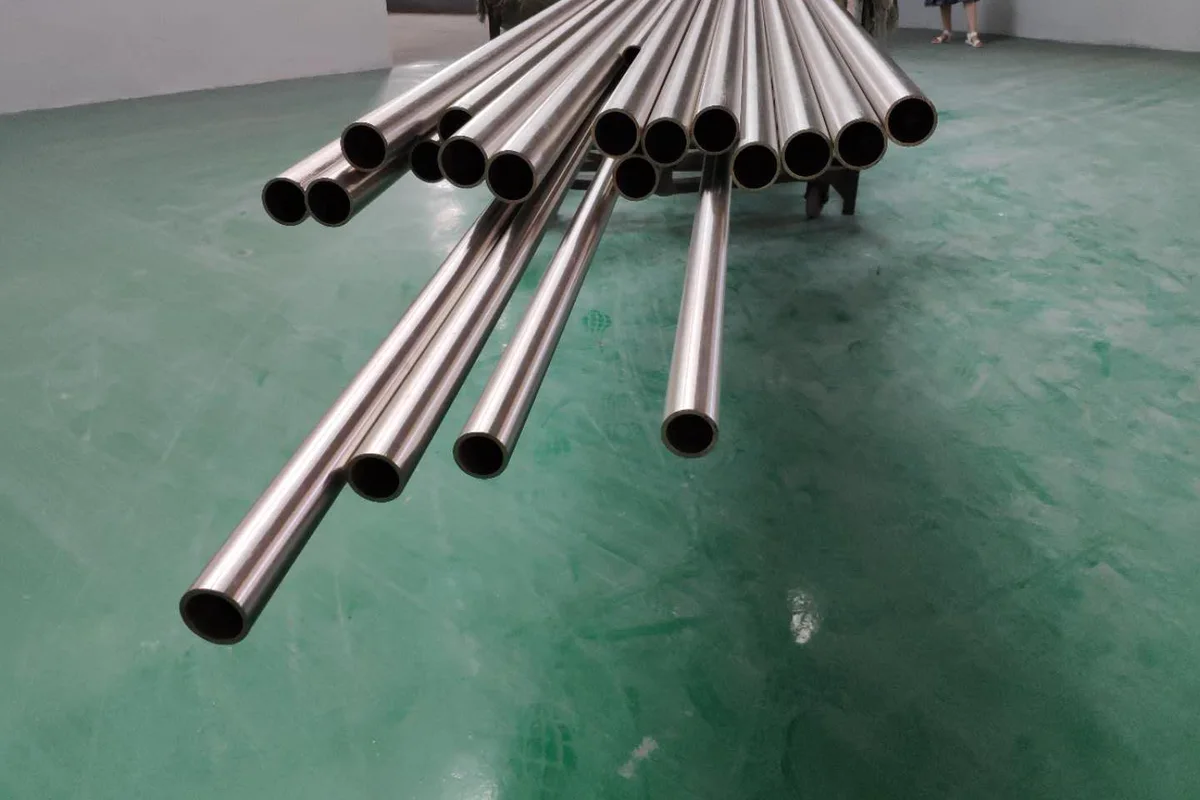
Titanium electrodes and platinum-coated titanium anodes
Titanium is a common substrate for electrodes in electrochemical processing, electroplating and cathodic protection, because it can hold a protective oxide film in many chloride-bearing environments. The coating decides the function: a platinum-coated titanium anode is used for plating and electrolysis, while an MMO (mixed metal oxide, for example Ru-Ir) anode is used for chlor-alkali production and cathodic protection.
| Form | Standard the guide names |
|---|---|
| Plate | ASTM B265 |
| Tube | ASTM B338 |
| Bar | ASTM B348 |
- Platinum-coated titanium anode for electroplating and electrolysis, see platinum-plated titanium anode.
- MMO Ru-Ir anode for chlor-alkali and cathodic protection, see Ru-Ir titanium anode.
The electrode substrate is usually titanium plate or bar in Grade 1 or Grade 2; the coating is specified separately for the electrochemical environment.
Common grades for tube and plate
Industrial titanium is mostly commercially pure titanium and a few alloys, chosen by corrosion and strength need, not by picking the highest grade.
| Grade | UNS | Characteristics and use |
|---|---|---|
| Grade 2 (CP) | R50400 | Workhorse for chemical, seawater and heat exchangers; good corrosion resistance, easy to weld and form |
| Grade 5 (Ti-6Al-4V) | R56400 | High strength for structural parts; corrosion resistance lower than CP |
| Grade 7 (Ti-Pd) | R52400 | CP titanium plus palladium; reviewed when better corrosion resistance than Grade 2 is needed in reducing acids such as HCl or H2SO4 |
Standards by form: plate ASTM B265, tube ASTM B338, bar ASTM B348; the EN 10204 3.1 certificate is used across international markets. For exchanger work the two items usually quoted together are the Grade 2 titanium tube sheet and the titanium shell and tube heat exchanger assembly.
How to write metric RFQ dimensions
Vietnamese buyers mostly search and quote by metric size (diameter, thickness). To let a supplier check the standard, tolerance and manufacturing route, write the following fields instead of only "titanium tube" or "titanium plate":
| Form | RFQ fields to provide | Standard |
|---|---|---|
| Titanium tube | outside diameter (OD/phi), wall thickness, length, seamless or welded, tolerance | ASTM B338 |
| Titanium plate | thickness, width x length, tolerance, surface condition and quantity | ASTM B265 |
| Titanium bar | diameter, length, material condition, tolerance and surface condition | ASTM B348 |
For seawater and chemical duty, the grade-selection logic is in our seawater corrosion resistance guide.
Material certificate: what to check on import
For titanium electrode, tube and plate deliveries, read the inspection document against the purchase order, the ordered product standard and the document type that was actually specified. An EN 10204 3.1 certificate reports specific-inspection results for the supplied material and is validated by the manufacturer’s authorised inspection representative independent of the manufacturing department. The traceability identifier must connect the document to the supplied material. If 3.2 or other independent inspection is required, define the responsible parties, witness points, reports and schedule in the RFQ. The full field list for RFQs is in our titanium bar RFQ checklist.
Frequently asked questions
What is a platinum-coated titanium anode used for?
The titanium substrate stays stable in a chloride-bearing electrochemical environment, while the platinum coating provides the anode surface for electroplating and electrolysis. For chlor-alkali production and cathodic protection, an MMO Ru-Ir anode is usually used instead of platinum.
What is the difference between titanium Grade 2 and Grade 5?
Grade 2 is commercially pure titanium, with good corrosion resistance and moderate strength, and is the workhorse for seawater and chemical service; Grade 5 (Ti-6Al-4V) adds aluminium and vanadium for high strength but lower corrosion resistance. Choose Grade 2 for corrosion duty, Grade 5 for structural strength.
What is the EN 10204 3.1 material certificate?
EN 10204 sets out inspection-document types; it does not state product requirements. A type 3.1 certificate supplies the specific-inspection results for the delivered products under the manufacturer’s independent inspection representative, and it sits alongside the governing product specification rather than replacing it. Name the document type in the RFQ and purchase order, then check that the issued certificate carries the results and traceability the ordered material, form and size require.
Substrate and coating are two separate lines on the order
A coated titanium anode carries two acceptance questions that are settled by different documents. The titanium underneath is a mill product with a grade, a product specification and a certificate. The coating on top is a process with its own description, and no titanium product specification covers it. An order that names only the coating leaves the substrate to a default, and an order that names only the grade leaves the working surface undefined.
| Line on the order | Which layer it belongs to | What it settles |
|---|---|---|
| Grade with its UNS number | Substrate | The composition limits the certificate reports against |
| Product specification and form | Substrate | Whether tube, plate or bar requirements apply |
| Dimensions with tolerance | Substrate | The dimensional acceptance at receiving |
| Surface condition before coating | Substrate | The state the coating is applied to, stated apart from the metallurgical condition |
| Coating description | Coating | What is applied, and to which faces |
| Reports required | Both | Whether the substrate certificate and the coating record both arrive |
The bar and billet specification ASTM B348 lists the reports required and the disposition of rejected material among the items an order is expected to carry (ASTM B348, ordering information). It governs bar and billet rather than coated assemblies, but the point survives the change of form: on a two layer item those two lines have to be answered twice, once for the metal and once for the working surface.
Specification detail with sources
ASTM’s form standards carry the numbers a metric RFQ should restate: plate to B265, tube to B338 and bar to B348, with the grades tabled above resolving to UNS R50400 for Grade 2, R56400 for Grade 5 and R52400 for Grade 7, whose 0.12 to 0.25 percent palladium addition is what buys the reducing-acid margin. EN 10204 itself defines the 3.1 document this page describes, a certificate whose specific-inspection results are validated by the manufacturer’s authorised inspection representative independent of the manufacturing department.
Beiyu Titanium quotes the three forms on this page from a single mill envelope: welded titanium tube from 6.35 to 1219 mm OD in walls of 0.5 to 25.4 mm and lengths to 22000 mm, seamless tube from 5 to 325 mm OD, and plate from 0.5 to 70 mm thick. For electrode work Beiyu supplies the Grade 1 or Grade 2 substrate from that same range, with the platinum or MMO coating specified separately for the electrochemical duty as this page notes, and every Beiyu delivery releases against an EN 10204 3.1 certificate with heat traceability.
Request a quote for titanium electrodes, tube or plate
To quote industrial titanium, Beiyu needs: grade (Grade 2/5/7, or the UNS/ASTM code), form and standard, metric dimensions (tube OD x wall / plate thickness / bar diameter), quantity, service or medium, the coating type if an electrode, and the required inspection-document type. State any EN 10204 3.1 or 3.2 document, test, validation and heat-traceability scope in the RFQ so Beiyu can confirm it before order release. Contact Beiyu Titanium for an RFQ.
| Field to state | Detail |
|---|---|
| Grade | Grade 2, 5 or 7, or the UNS or ASTM code |
| Form and standard | Both |
| Metric dimensions | Tube outside diameter x wall, or plate thickness |