
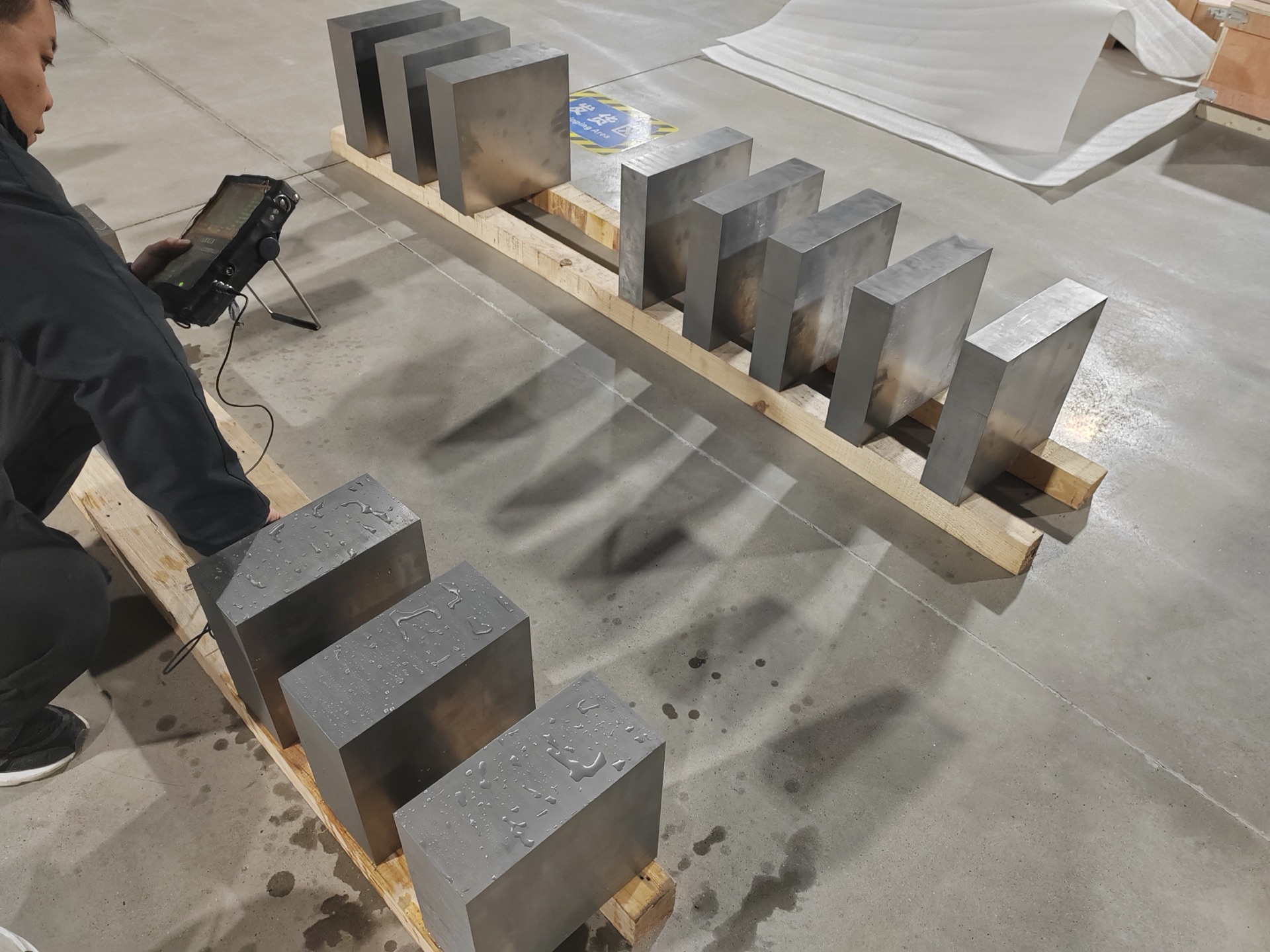
When a drawing calls out an ASTM standard, order it to the commercial specification for that form: standard, grade, form, size, condition and EN 10204 3.1 certificate belong on the same line of your RFQ. When a drawing calls out AMS, the part is aerospace-grade: it needs a defined heat-treat condition, tighter inspection, and traceability to a declared heat. Beiyu Titanium confirms the full specification before quotation so grade, condition and inspection are locked before production starts.
What a standard controls on a titanium order
A titanium standard is not just a label. It fixes the chemical composition, the minimum mechanical properties, the product form, the heat-treat condition (for example annealed or solution treated and aged), the sampling and test methods, and the certificate package. Two pieces of the same grade can still be wrong for an order if they are supplied to the wrong standard or condition. State the standard, grade, form, size, condition and inspection level together on the RFQ.
ASTM B348 vs AMS 4928: what is the difference?
ASTM B348 is the commercial specification for titanium bar and billet. AMS 4928 is the aerospace specification for Ti-6Al-4V (Grade 5, UNS R56400) bar and forging stock: it requires a defined annealed condition and tighter inspection than B348. A Ti-6Al-4V bar can be ordered to either standard alone or dual-certified to both where the drawing permits. The choice drives certificate scope, inspection level and, for aerospace buyers, qualification traceability.
Which to specify
If your drawing or purchase order references MIL or MMPDS data allowables, specify AMS 4928 and state the condition (annealed is the default). If your drawing references ASTM mechanical minimums only, B348 Grade 5 is correct. When in doubt, send the drawing to [email protected]: Beiyu confirms the applicable standard before quoting.
How to read a titanium mill test certificate against your standard
An EN 10204 3.1 mill test certificate (MTC) is issued by the manufacturer and carries declared test results traceable to a specific heat. Check these four fields against the standard you ordered:
| Certificate field | What to confirm |
|---|---|
| Grade and UNS designation | Confirm the grade matches your order: Grade 2 is UNS R50400, Grade 5 is R56400, Grade 7 is R52400, Grade 23 is R56407 in ASTM B265, B348, B863 and B381, and R56401 only in ASTM F136 for surgical implants, so read the UNS number against the standard on the order. |
| Heat number | Each coil, bar or plate must be traceable to the applicable heat number declared on its MTC. |
| Chemical composition | Values must fall within the limits stated in the ordered standard (ASTM B348, AMS 4928, or equivalent). The MTC lists actual heat analysis, not nominal values. |
| Mechanical properties | Compare UTS and yield against ASTM minimums: Grade 2 requires 345 MPa UTS and 275 MPa YS; Grade 5 requires 895 MPa UTS and 828 MPa YS. These are ASTM minimums, confirmed on the EN 10204 3.1 MTC per heat. |
If any field is missing or does not match the ordered standard, request a corrected MTC before accepting the shipment. When EN 10204 3.1 and heat or lot traceability are required, state them in the RFQ and purchase order; Beiyu confirms the document scope before order release.
ASTM standards
ASTM specifications cover commercial, industrial and corrosion-service titanium. These are the standards most buyers search for by product form.
| Standard | Scope | Guide |
|---|---|---|
| ASTM B348 | Titanium and titanium alloy bars and billets | B348 bar & billet guide |
| ASTM B265 | Titanium and titanium alloy strip, sheet and plate | B265 sheet & plate guide |
| ASTM B338 | Seamless and welded titanium tube for condensers and heat exchangers | B338 tube & pipe guide |
| ASTM B381 | Titanium and titanium alloy forgings | B381 forgings guide |
| ASTM F67 / F136 | Unalloyed titanium (F67) and Ti-6Al-4V ELI (F136) for surgical implants | Medical titanium grades guide |
| ASTM F467 / F468 | Nonferrous nuts (F467) and bolts, screws and studs (F468), including titanium | Titanium fasteners |
AMS aerospace standards
AMS (Aerospace Material Specifications) define titanium for flight and high-load parts, including the heat-treat condition and tighter inspection. Beiyu works to the following AMS specifications. Scopes are taken from the specification cover sheets.
| Standard | Form and condition |
|---|---|
| AMS 4928 | Ti-6Al-4V bars, wire, forgings, rings and drawn shapes, annealed |
| AMS 4965 | Ti-6Al-4V bars, wire, forgings and rings, solution heat treated and aged (high strength) |
| AMS 4911 | Ti-6Al-4V sheet, strip and plate, annealed |
| AMS 4930 | Ti-6Al-4V ELI (extra low interstitial) bars, wire, forgings and rings, annealed |
| AMS 4973 | Titanium alloy forgings, solution heat treated and stabilized |
| AMS 4985 | Ti-6Al-4V titanium alloy investment castings |
| AMS 4991 | Ti-6Al-4V titanium alloy investment castings |
| AMS 6926 | Titanium alloy bars, forgings and forging stock, solution heat treated and aged |
| AMS 6931 | Titanium alloy bars, forgings and forging stock, annealed |
For aerospace bar to AMS 4928, see the dedicated Ti-6Al-4V bar to AMS 4928 page. For annealed Grade 5 bar, see the Ti-6Al-4V (Grade 5) titanium bar.
ASME standards
ASME specifications apply to pressure equipment and piping. ASME SB-265 mirrors ASTM B265 for titanium plate and is used for code work, so plate can be supplied dual-certified. ASME B16.5 governs pipe flanges, which Beiyu supplies in titanium against a drawing and the matching flange grade.
- ASME SB-265: titanium strip, sheet and plate for ASME code use (dual-certified with ASTM B265 on request).
- ASME B16.5: pipe flanges and flanged fittings, applied to titanium flanges by class and rating.
EN and certification standards
- BS EN 4267: aerospace series round bars in titanium and titanium alloys.
- EN 10204 3.1: inspection certificate issued by the manufacturer with declared test results, available on request for traceable orders.
Chinese national and aviation standards
Beiyu also manufactures to Chinese national (GB / GB/T) and aviation (GJB) standards, which is useful for buyers sourcing against Chinese drawings or dual-standard supply.
| Chinese standard | Scope |
|---|---|
| GB/T 3620.1 | titanium and titanium alloy grades and chemical composition. |
| GB/T 2965 | titanium and titanium alloy bars. |
| GB/T 3621 | titanium and titanium alloy sheet and plate. |
| GB/T 16598 | titanium and titanium alloy discs and rings. |
| GJB 2218A | titanium and titanium alloy bars and forging billets for aviation. |
| GJB 2744A | titanium and titanium alloy material for aviation use. |
| HG/T 20592 | steel pipe flanges, gaskets and fasteners for the chemical industry (used as the dimensional basis for flange supply). |
Tolerance and inspection standards
These process standards control dimensions and testing rather than a product grade. They are quoted alongside the product standard when required.
| Tolerance / inspection standard | Scope |
|---|---|
| AMS 2241 | manufacturing tolerances for titanium and titanium alloy bars and wire. |
| AMS 2242 | manufacturing tolerances for titanium and titanium alloy sheet, strip and plate. |
| AMS 2380 | approval and control of titanium alloy materials. |
| AMS 2631 | ultrasonic inspection of titanium and titanium alloy bar, billet and plate. |
| GB/T 1184 and GB/T 1804 | general geometric and linear tolerances for machined and finished parts. |
How to specify a standard on your RFQ
To get a quotable, inspection-ready specification, state these together:
| Field to state on the RFQ |
|---|
| Product standard and grade, for example ASTM B348 Grade 5 or AMS 4928. |
| Form and size, for example round bar, plate thickness, tube outside diameter and wall. |
| Condition, for example annealed or solution treated and aged. |
| Tolerance standard if tighter than the product standard default. |
| Inspection and documents, for example ultrasonic testing class, mill test certificate and EN 10204 3.1. |
| Quantity, drawing where applicable, and any third-party inspection. |
Frequently asked questions
Which titanium standards does Beiyu manufacture to?
ASTM (B348, B265, B338, B381, F67/F136, F467/F468), AMS aerospace (4928, 4965, 4911, 4930, 4973, 4985, 4991, 6926, 6931), ASME (SB-265, B16.5), EN (BS EN 4267, EN 10204 3.1) and Chinese GB/T and GJB standards.
What is the difference between ASTM and AMS for the same grade?
ASTM covers commercial and corrosion-service titanium. AMS is the aerospace specification for the same alloy with a defined heat-treat condition and tighter inspection. For example, annealed Ti-6Al-4V bar can be ordered to ASTM B348 Grade 5 or to AMS 4928.
Can plate be supplied to both ASTM B265 and ASME SB-265?
Yes. ASME SB-265 mirrors ASTM B265, so titanium plate can be dual-certified for code work on request.
Do you supply to Chinese GB and GJB standards?
Yes. Beiyu manufactures to GB/T national standards and GJB aviation standards, which suits buyers sourcing against Chinese drawings or needing dual-standard supply.
About these standard scopes
The scope of each standard above is summarized from the published specification documents (ASTM, SAE AMS, ASME, EN and Chinese GB/GJB). Standards are revised periodically, so confirm the current revision and its exact requirements before ordering, and confirm supplied material against its mill test certificate. This page is a sourcing reference, not a substitute for the full specification text.
Three AMS numbers this guide did not name: 4921, 4943 and AMS-T-9047
The AMS table above lists the specifications Beiyu quotes most often. Three numbers that appear on drawings are not in it. What follows gives, for each one, the SAE designation title and how the number is handled on a Beiyu order line. It does not restate the requirements inside those documents.
| Specification | SAE designation title | How Beiyu handles it on an order line |
|---|---|---|
| AMS 4921 | Titanium Bars, Wire, Forgings, and Rings, Commercially Pure, 70 ksi (483 MPa) Yield Strength (SAE designation title, current revisions). The 1952 original carried the title Titanium, 99Ti, Annealed, 70,000 psi Yield, so an old drawing may quote either wording for the same number | An unalloyed titanium route. Beiyu quotes unalloyed titanium bar against ASTM B348, and a drawing that cites AMS 4921 is handled by agreeing the product form, the dimensions and the inspection scope on the order line before the quotation is issued. |
| AMS 4943 | Titanium Alloy, Hydraulic, Seamless Tubing, 3.0Al-2.5V, Annealed (SAE designation title) | The 3.0Al-2.5V chemistry in that title is the Grade 9 chemistry, and the title names hydraulic tubing as the duty. Beiyu quotes Grade 9 seamless tube against ASTM B338 and ASTM B861, and states AMS 4943 alongside them where the drawing names it rather than substituting one for the other. |
| AMS-T-9047 | Titanium and Titanium Alloy, Bars (Rolled or Forged) and Reforging Stock, Aircraft Quality (SAE designation title for revision AMS-T-9047A). SAE records that revision as canceled in May 2006 | Named on the Beiyu factory sheet for bar and for forgings, alongside AMS 4928. Because that revision is canceled, an older drawing citing it is handled as a legacy callout: the cited revision, the alloy callout and the customer-approved current acceptance basis are confirmed before quotation. Cancellation does not establish an automatic superseding equivalence. |
Beiyu states the ASTM or ASME product standard alongside the AMS number on a quotation, because the product standard is the document that carries the dimensional tables and the inspection clauses an order is measured against. Where a drawing names only an AMS number, the product form, the dimensions and the inspection scope are agreed on the order line before the quotation is issued.
Specification detail with sources
Elongation is the acceptance line the summary tables above leave out. ASTM B348 requires 20 percent minimum elongation in 4D for Grade 2 bar and 10 percent for Grade 5, alongside the tensile and yield minimums already listed, and the same standard caps hydrogen at 0.015 percent for both grades. Those lines are read together at receipt: a bar certificate is complete only when chemistry, tensile, yield and elongation all appear against the ordered standard, with the heat number tying the results to the marked material.
One designation rule decides certificate acceptance for the ELI alloy. The industrial specifications ASTM B265, B348, B381 and B863 designate Grade 23 as UNS R56407 in their published scopes, while R56401 belongs only to ASTM F136, the surgical implant specification, so the UNS number on a certificate follows the standard on the order, not the grade name alone. For implant files the ISO parallels are ISO 5832-2 for unalloyed titanium and ISO 5832-3 for wrought Ti-6Al-4V, cited alongside or instead of ASTM F67 and F136 as the device documentation requires.
Request titanium to your standard
Send the standard, grade, form, size, condition and the certificate package you need. Beiyu confirms the specification and test plan before quotation, so the grade, condition and inspection are agreed before production. Contact [email protected] for a specification review.
Company-page comparisons organised by standard and product family are collected in the titanium supplier lists index.
Related titanium guides
- Titanium Grades Compared: Grade 2 to 23
- How to Verify Titanium Quality: Mill Test Certificates and EN 10204 3.1
- Medical-Grade Titanium: ASTM F136, F67 and Grade 23 ELI
- ASTM B348 Titanium Bar & Billet Guide
- ASTM B265 Titanium Sheet & Plate Guide
- ASTM B338 Titanium Tube & Pipe Guide
- ASTM B381 Titanium Forgings Guide